This article focuses on the declaration of crypto assets CARF, analyzes the Reporting Nexus rules, and clarifies the determination path of reporting jurisdictions for global platforms.
Written by: FinTax
Previously, we conducted an analysis of reporting subjects under CARF in the article "Recognition Criteria for Reporting Entities under CARF and Applicability Analysis of Eight Types of Businesses", which covered CARF's functional identification standards for reporting entities. Any person or entity that provides services facilitating crypto asset exchange transactions on behalf of clients, through counterparties, intermediaries, or trading platforms, may constitute an RCASP. We defined common crypto-related platforms such as exchanges, brokers, over-the-counter dealers, payment institutions, custodians, etc.
Once the identity recognition of RCASP is completed, compliance assessment needs to extend further to the fulfillment of reporting obligations. For crypto platforms registered, managed, or operating in multiple jurisdictions, the same entity may simultaneously establish connections with various jurisdictions; therefore, it is necessary to determine in which jurisdiction they should fulfill their due diligence and reporting obligations under CARF. CARF does not simply determine reporting jurisdictions based on the place of registration or the location of the group's headquarters. Entities RCASP generally address this issue through Reporting Nexus rules, determining relevant reporting obligations based on connections such as tax residency, place of establishment, management location, fixed business premises, and branches.
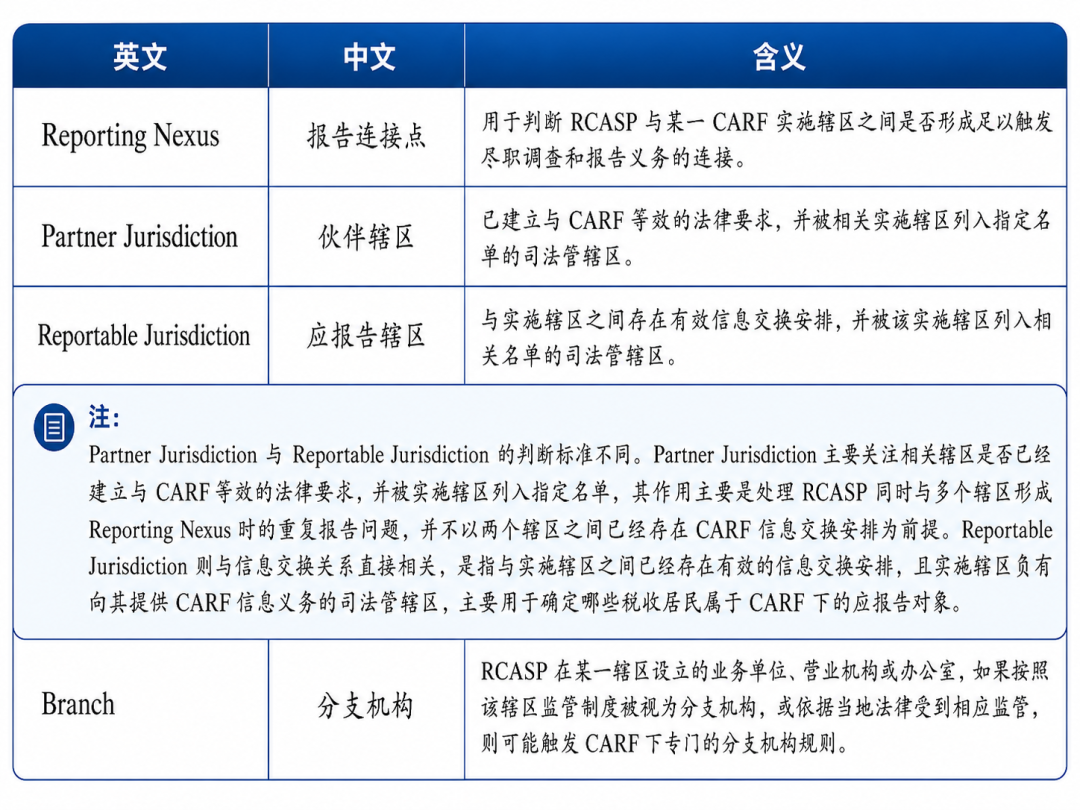
For the sake of analysis, this article lists several key terms related to the Reporting Nexus rules and their meanings as follows:
OECD's Official Guidelines
1. Hierarchical Rules
In 2022, the OECD released the Crypto-Asset Reporting Framework and Amendments to the Common Reporting Standard, in which Section I—Obligations of Reporting Crypto-Asset Service Providers of CARF Rules specifically stipulates the circumstances under which RCASP forms reporting connections with the implementation jurisdictions of CARF. Sections A to H further address the issues of duplicate due diligence and reporting when the same RCASP connects with multiple jurisdictions. In 2023, the OECD formally integrated the above rules into Part I CARF in the International Standards for Automatic Exchange of Information in Tax Matters, and provided further explanations on each connection criterion and their applicable order in Commentary on Section I.
In summary, Section I(A) establishes four types of general connection points for entity RCASP and establishes a hierarchical relationship through Sections I(C) to (F). The logic behind this is that jurisdictions with closer ties to the RCASP and greater capacity to perform reporting obligations should take on primary regulatory and reporting functions.
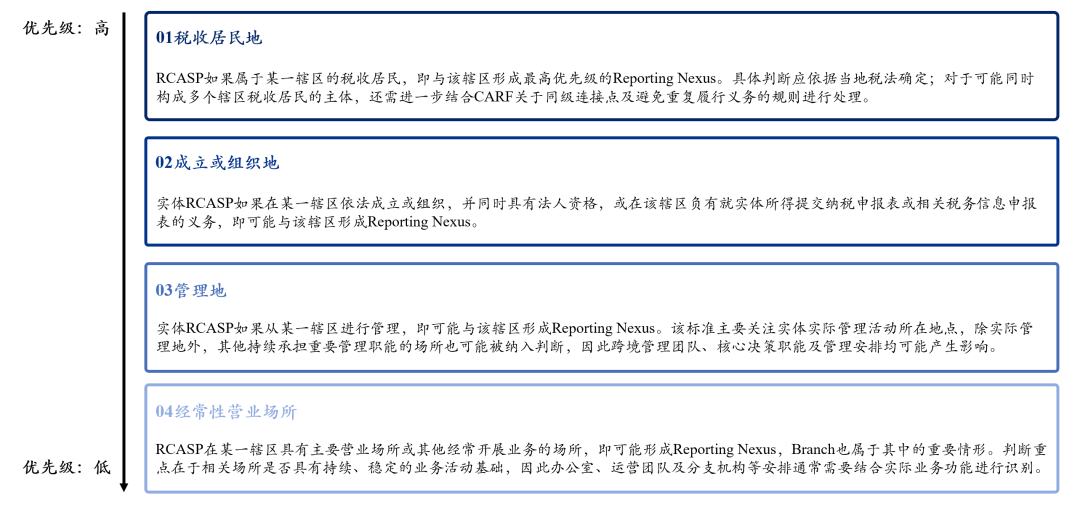
The hierarchical rules clearly present the judgment method for connection points, but the CARF obligations of low-priority jurisdictions still need to be further confirmed in accordance with local specific rules. The OECD's duplicate reporting exemption is predicated on the condition of partner jurisdictions: the relevant jurisdictions must establish equivalent CARF legal requirements and be included in the corresponding partner jurisdiction list of the implementing jurisdiction, while RCASP must also meet corresponding due diligence, reporting, and other conditions. If the jurisdiction of the high-priority connection has not implemented CARF, or if a applicable partnership has not been established between the two parties, the low-priority jurisdiction may still continue to require reporting.
2. Notification Procedures for Same-level Connection Points
When the same RCASP forms substantively identical connection points in two or more partner jurisdictions, such as being tax residents in two jurisdictions simultaneously, Section I(H) allows it to complete due diligence and reporting in one jurisdiction and submit a notification to the other jurisdiction to reduce the redundancy of information reporting. This rule only applies to connection points of the same level; if a jurisdiction has a higher-level connection point, it cannot substitute by choosing a lower-level connection point.
This mechanism has been further refined in local implementation. The UK requires RCASP meeting the same-level conditions to make jurisdiction selections to HMRC under Section I(H); Singapore requires Reporting SGCASP relying on substantively identical connection point exemptions to submit a notification to IRAS annually. For businesses, the duplicate reporting exemption itself also needs to form an operable compliance process, including confirming the status of partner jurisdictions, retaining evidence of due diligence and reporting completed in another jurisdiction, and completing notifications in due course.
3. Relevant Rules for Branches
Branches are a confusing part within Reporting Nexus. Firstly, Section I(A)(4) treats branches as permanent establishments; hence, a branch can itself create a general connection point between the RCASP and a jurisdiction. Secondly, Section I(B) stipulates that if a relevant transaction is facilitated by a branch in a jurisdiction, the RCASP should undertake due diligence and reporting obligations regarding that branch's relevant transactions locally. However, the triggering basis and reporting scope of the two rules are not completely the same.
The OECD's updated FAQs in 2025 clarified the first case: if an RCASP constitutes a permanent establishment due to its branch and forms its highest-level CARF connection point in a certain implementing jurisdiction, there is no higher connection point in other jurisdictions that have implemented CARF, then it should complete due diligence and reporting for all transactions facilitated by the entire entity in that jurisdiction, not just those covering the branch's transactions. The guidance from HMRC in the UK updated in 2026 directly adopts this interpretation.
Simultaneously, the OECD preserved transitional space for staggered implementation in the initial years: in the absence of otherwise stated regulations in the implementing jurisdiction, if RCASP cannot temporarily rely on the usual partner jurisdiction mechanisms due to different jurisdictions implementing CARF in batches, it may fulfill requirements solely for transactions facilitated by the relevant branch in specific circumstances. The transitional guidelines further clarify that the reporting scope for branches needs to be confirmed according to the specific reporting year and local implementation rules, and cannot be treated as a fixed conclusion for overall entity transactions across all years and jurisdictions.
A smaller local branch, under specific structures and implementation years, may also become the highest effective CARF connection point for the entire offshore RCASP, thereby affecting entity-level reporting scope. When assessing branches, businesses need to evaluate their regulatory attributes, actual transaction execution functions, whether there are higher connection points in other jurisdictions, and whether a reliable partner jurisdiction relationship has been established in the relevant jurisdiction.
Analysis of Reporting Nexus for Global Business Platforms
In a global operating scenario, the overlapping connection points increase the complexity of the Reporting Nexus rules.
1. Legal Establishment, Management, and Business Functions May Be Distributed Across Different Jurisdictions
A common global structure for crypto platforms involves splitting legal establishment, licensing, product development, customer operations, and transaction execution across different jurisdictions. For example, an entity may be established in an offshore center, set up a core management team in Singapore, establish a regulated branch in the UK, and serve multiple European markets remotely. According to CARF-related rules, places of establishment, management, and permanent establishments may all form connection points. Whether a certain connection point can attain priority needs to be compared individually with other implementing jurisdictions, and cannot be directly concluded based on the group headquarters or main license.
Remote customer acquisition needs to be distinguished from actual operational connections. The OECD's 2025 FAQs clearly state that simply having a customer base in a particular implementing jurisdiction does not, by itself, constitute a permanent establishment under Section I(A)(4). Therefore, the location of users can impact the scope of reportable users or trigger regional systems such as DAC8, but in the general connection point analysis under OECD CARF, it is still necessary to find actual connection facts like genuine taxpayer identity, organization, management, business premises, or branches.
The OECD Global Forum emphasized in the 2025 CARF monitoring report that reporting connection rules need to achieve effective coverage of RCASP, avoiding important service providers falling outside the reporting network due to decisions about registration locations or cross-border operating methods. Each RCASP needs to list all possible jurisdictions that may form connections and then apply priority and exemption rules in layers.
2. Reporting Connections Need to Be Reassessed Annually
CARF is being implemented in phases, with some jurisdictions entering the data collection period as of 2026, while others will begin implementation in 2027 or later. The OECD's duplicate reporting exemptions rely on partner jurisdictions and the actual fulfillment of reporting obligations; businesses cannot directly regard jurisdictions that have committed to implement CARF in the future as reliable reporting locations for the current year. Even if the connection structure remains unchanged, as another jurisdiction begins implementation, joins the partner jurisdiction list, or activates exchange relationships, reporting responsibilities may still shift across different years.
Therefore, Reporting Nexus needs to be continuously reviewed on an annual basis. At least during the initial global implementation phase of CARF, businesses need to confirm each jurisdiction's effective dates, partner jurisdiction lists, exchange relationships, and local notification requirements annually. For global platforms covering the data collection periods of 2026, 2027, and 2028, this annual update mechanism is particularly important.
Local Differences Arising from Related Rules
While the OECD's four-tier order is indeed clear, differences have emerged during local implementation and need to be assessed in light of specific situations.
1. The United Kingdom
The UK will implement CARF starting January 1, 2026. HMRC has established operational guidelines regarding connection point rules, duplicate reporting rules, same-level connections, dual connections, and branch rules. Generally, the UK assesses primary reporting locations based on OECD's hierarchical rules; in cases where same-level connection points exist simultaneously, a partner jurisdiction may be selected to complete the primary due diligence and reporting through Section I(H) election.
The UK has also included domestic reporting dimensions. HMRC clarifies that even if an RCASP constitutes a same-level tax resident connection in both the UK and France and chooses to complete CARF due diligence and reporting in France, its local reporting obligations regarding UK tax resident crypto asset users may still remain. The international-level duplicate reporting exemption mainly addresses the exchange of duplicate CARF information across borders, and it does not automatically eliminate domestic reporting requirements set by implementing jurisdictions.
2. Singapore
Singapore officially issued the CARF Regulations 2026 and the first edition of the e-Tax Guide on August 11, 2026, with these rules taking effect from January 1, 2027. IRAS adopts the triggering methods outlined by the OECD, including tax residents, place of establishment/organization, management, permanent establishments, and transactions facilitated through Singapore branches, and clarifies that general connection points are processed according to OECD's priority order.
Singapore has set clearer administrative requirements for same-level connection exemptions. Reporting SGCASP, if they have already completed reports and due diligence under Sections II and III based on substantively identical connection points in partner jurisdictions, can be exempted from fulfilling the same obligations again in Singapore, but must submit an annual notification to IRAS before May 31 of the following year. IRAS also clarifies that the entity is still classified as Reporting SGCASP, hence must complete CARF registration in Singapore.
3. European Union
The EU incorporates CARF rules into the tax administrative cooperation system of member states through DAC8, applying from January 1, 2026. The European Commission clarifies that relevant service providers operating in the EU but not authorized under MiCA must complete separate registration in one member state per DAC8 and manage the internal information reporting and exchange within the EU according to relevant rules.
The Irish Revenue will prioritize tax residency over the services authorized or permitted by the Central Bank of Ireland under MiCA; for RCASP not authorized under MiCA, the order of applicability will be tax residency, place of establishment, management location, and permanent establishments. Therefore, if a global platform has both EU licensed entities and non-EU CARF entities, separate mappings of CARF and DAC8 reporting entities and connection points are required.
Case Analysis of Global Trading Platforms
Assume that Example Company provides crypto asset trading services to global users under a unified brand, with the following group structure: Example SG Pte. Ltd. is responsible for major trading matchmaking and account systems in Asia, as a tax resident of Singapore; this entity has a regulated branch in the UK and facilitates some transactions through this branch; Example HK Ltd. provides exchange services to clients in Hong Kong as an independent legal entity; Example EU Ltd. has obtained MiCA authorization in Ireland and serves EU clients. All three legal entities constitute RCASP based on their business functions. The relevant entity circumstances are as follows:
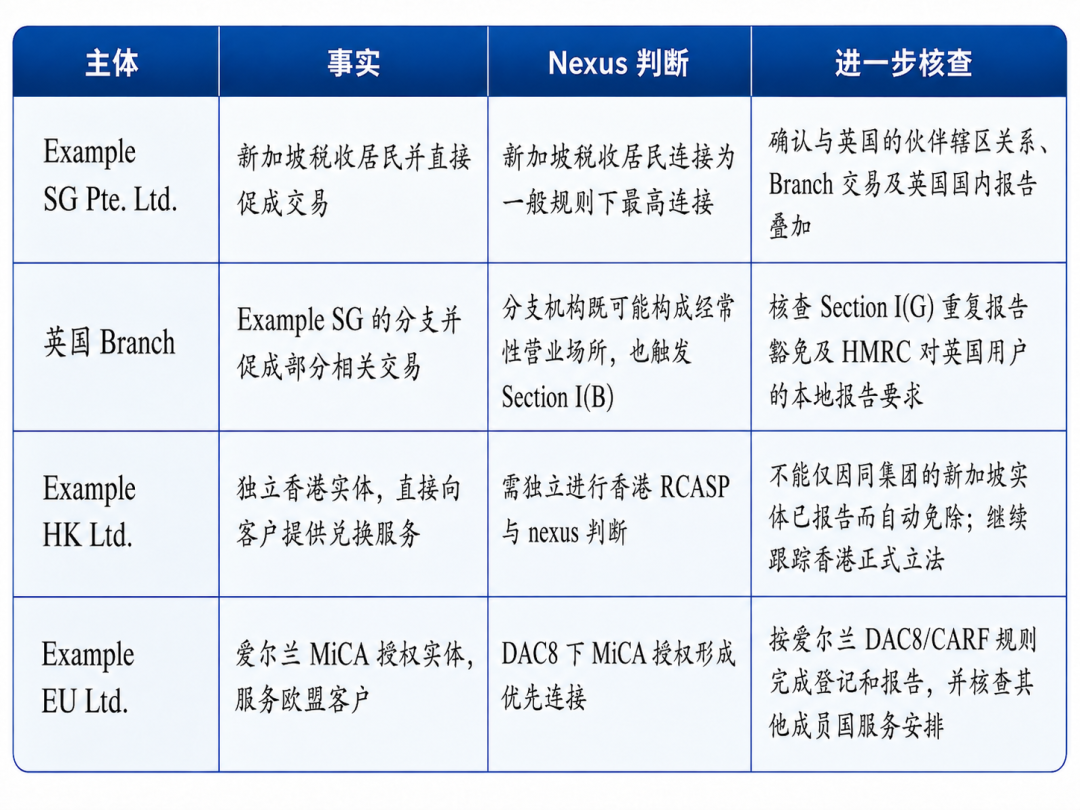
A global platform cannot resolve all obligations by choosing one group headquarters as the global CARF reporting location. They first need to identify who actually facilitated the relevant transactions according to legal entities, establish connection point hierarchies for each RCASP, and then apply partner jurisdictions, branches, and same-level connection rules to handle duplicate reporting. If multiple entities independently each constitute an RCASP, the duplicate reporting rules primarily address the multi-connection issue for the same RCASP and do not automatically merge independent reporting responsibilities of related entities.
Businesses Should Establish a Reporting Nexus Map
For trading platforms operating globally, a more prudent approach is to incorporate reporting connection points into the annual review of CARF applicability, forming documentation traceable to business facts. Specifically, this can be advanced in the following order:
1. Establish a list of legal entities and branches. Clearly state the place of establishment, tax residency, licenses, management teams, office locations, branches, and actual operational areas.
2. Complete business function mapping. Match functions such as matchmaking, brokerage, market-making, OTC, payment, custody, exchange, transfer, etc., to the actual responsible entities, and first identify which entities constitute RCASP.
3. Create a connection point matrix for each RCASP. Evaluate tax residency, place of establishment/organization, management, permanent establishments, and branch structures, and retain supporting facts and legal basis.
4. Apply priority and duplicate reporting rules. Verify whether the jurisdiction of higher connection points belongs to partner jurisdictions, whether it has entered the corresponding reporting year, and whether it meets the exemption conditions of Section I(C) to (H).
5. Overlay local rules. Record requirements for registration, zero reporting, annual notifications, domestic reporting, separate DAC8 registration, MiCA authorization, and other local requirements separately.
6. Implement conclusions into data systems. Ensure that each user and relevant transaction can map to the correct RCASP, reporting jurisdiction, and reporting year, and that it can trace back from the final CARF declaration to customer contracts, transaction records, and underlying data.
This set of documentation needs to be continuously updated along with changes in business structures and systems. New entities, license migrations, management team adjustments, branch openings or closures, changes in transaction execution entities, and updates to partner jurisdiction lists can change reporting connection point conclusions. The necessity for annual review is high for global platforms still in the phased implementation stage of CARF.
免责声明:本文章仅代表作者个人观点,不代表本平台的立场和观点。本文章仅供信息分享,不构成对任何人的任何投资建议。用户与作者之间的任何争议,与本平台无关。如网页中刊载的文章或图片涉及侵权,请提供相关的权利证明和身份证明发送邮件到support@aicoin.com,本平台相关工作人员将会进行核查。


