Author: Claude, Deep Tide TechFlow
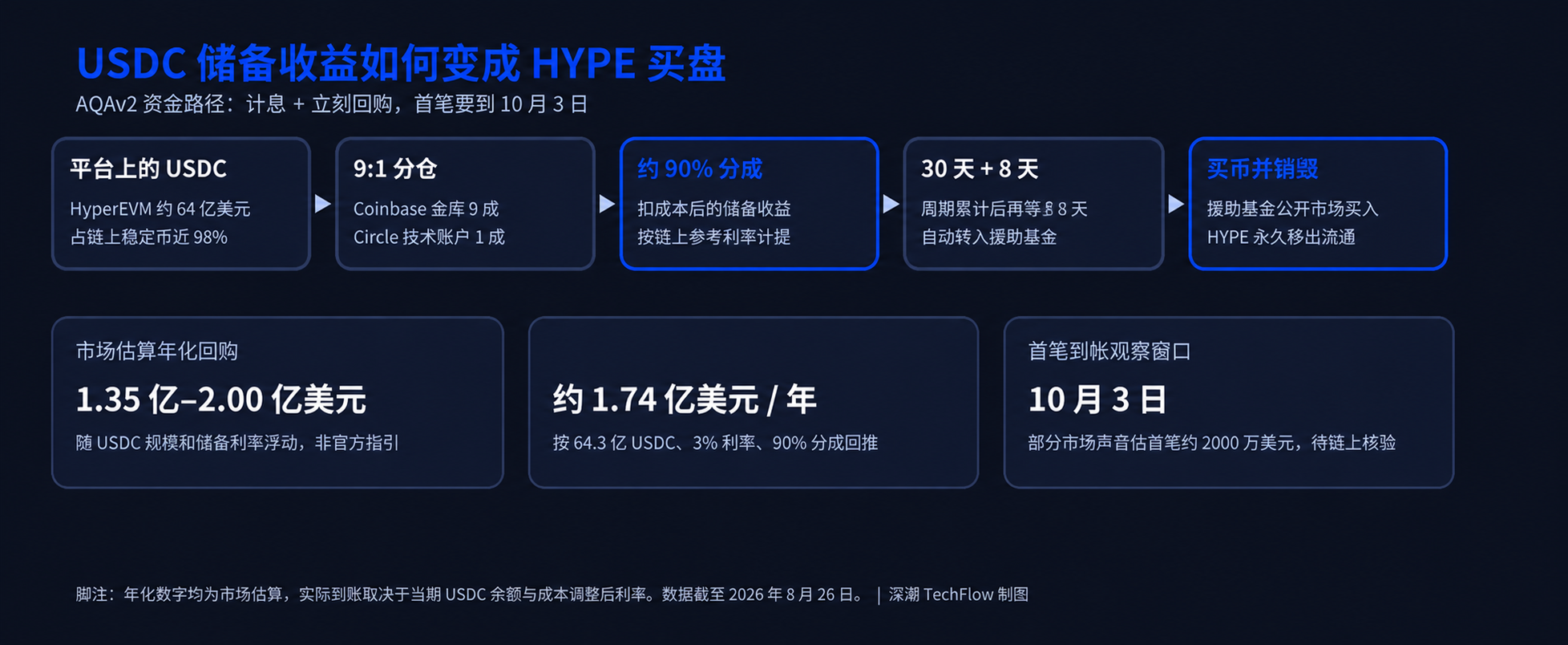
Deep Tide Reading Guide: Starting August 26, Hyperliquid officially accrues reserve earnings on USDC on the platform according to the AQAv2 framework. Approximately 90% of the interest after cost adjustments will go into the assistance fund for purchasing and permanently destroying HYPE in the open market. Real money will arrive on October 3 for the first time. Dune data shows that as of August 25, there was approximately $6.44 billion in USDC on HyperEVM; the market estimates that this new pipeline could contribute $135 million to $200 million in purchases annually, depending on balances and interest rates.

On August 26, Hyperliquid's second repurchase engine began its countdown.
A countdown does not equal an immediate selloff. The official documentation states: The reserve earnings under AQAv2 (Aligned Quote Asset v2) accumulate over a 30-day period and are automatically transferred to the assistance fund on the 8th day after the end of the period. A built-in grace period sets the date for the first payment as October 3.
Accounting starts today; the first purchase will not be seen until October 3
AQAv2 is not a newly invented trading fee. It targets another pot of money: stablecoin issuers take the USDC that users hold on Hyperliquid to buy short-term U.S. Treasury bonds or repurchase agreements, generating reserve interest.
The original sentence from Hyperliquid's official documentation states: Under AQAv2, stablecoin deploying parties will share "approximately 90% of the cost-adjusted reserve earnings" from their provision on Hyperliquid with the protocol. The designated address by the treasury deploying party will share with the protocol at 100% of the on-chain reference rate (AQA rate), which is double the sharing rate of the old version AQA. The earnings accumulate block by block by UTC date and are settled every 30 days, with payments made to the assistance fund on the 8th day thereafter.
@HyperliquidNews wrote a more straightforward version during the voting period in June: "AQAv2 is a revenue sharing mechanism where 90% of the earnings generated by stablecoins on Hyperliquid are distributed, and this 100% share will be used for repurchases and destruction of HYPE." On the day the vote passed, the same account announced: starting from October 3, the assistance fund will begin to use USDC earnings on the platform to purchase HYPE.
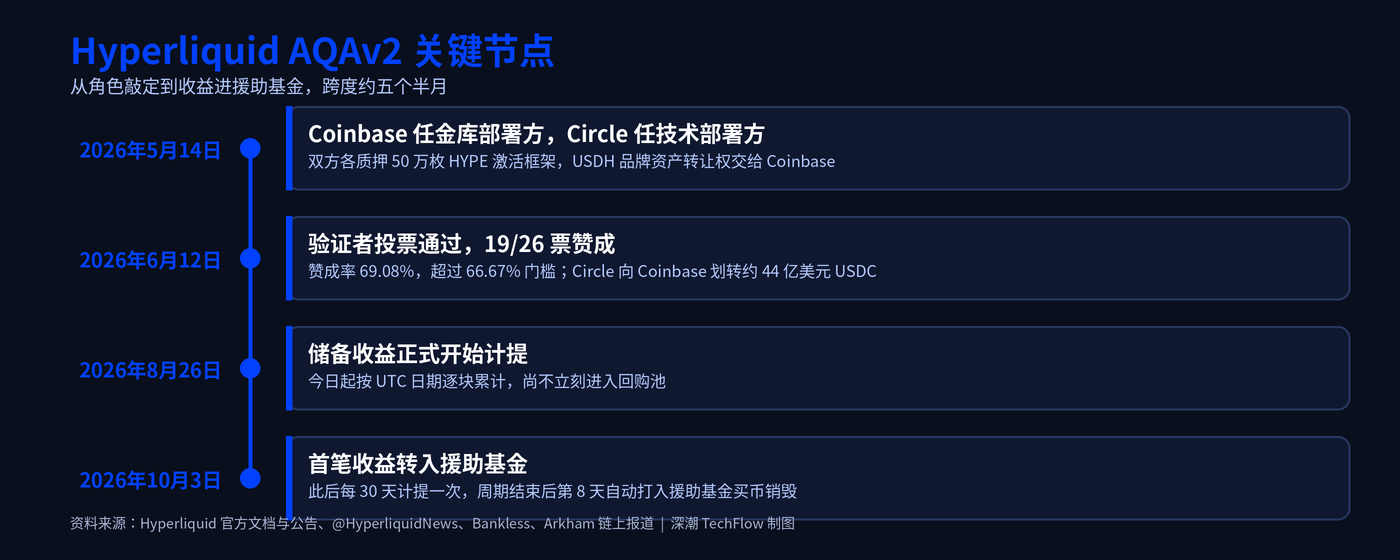
This means that August 26 is more like a day for reservoir opening and accumulating water. The faucet will not be turned on until October 3.
Another pipeline besides trading fees, scale follows USDC
The assistance fund originally relied on trading fees. According to DefiLlama, approximately 99% of qualified perpetual and spot transaction fees enter this fund, being automatically converted on the chain into HYPE and removed from circulation. Azuma, a columnist for Odaily, provided a recent update on August 26: Hyperliquid accumulated about $50.27 million in revenue in the 26 days before August, averaging about $1.93 million per day. This reflects the operational speed of the first engine.
AQAv2 is the second pipeline. It is weakly correlated with transaction volume and strongly correlated with the USDC lying on the platform. The more USDC there is, the larger the accrual base; the higher the reserve interest rate, the more interest can be generated from the same balance. The official has not provided annualized guidance. The commonly circulated range in the market focuses on two brackets: most English reports mention $135 million to $160 million; Odaily and some on-chain accounts place the upper limit at $150 million to $200 million.
Azuma calculated based on $6.43 billion USDC, 3% reserve interest rate, and 90% sharing ratio, resulting in an average of about $476,000 per day, annualizing to about $174 million, which is equivalent to 24.6% of the protocol's average daily revenue at that time. Market estimates cited by Lookonchain suggest that the first funds entering the assistance fund on October 3 could be around the $20 million level. Neither of these figures are official numbers; any change in interest rates or balances will rewrite the results.
Circle manages the channel, Coinbase manages the treasury, both sides pledge 500,000 HYPE
The division of roles was established on May 14. The official account of Hyperliquid wrote that day: Coinbase plans to activate AQAv2 for USDC as the treasury deploying party, while Circle acts as the technical deploying party responsible for CCTP and native cross-chain infrastructure; both parties commit to pledging HYPE to launch the framework. The official evaluation is that after Coinbase shares "the vast majority of reserve earnings" with the protocol, "USDC will become the most aligned stablecoin on Hyperliquid."
The documentation specifies alignment very clearly. The technical deploying party and the treasury deploying party must each pledge 500,000 HYPE. If the treasury address does not have enough balance to deduct earnings, the treasury party's pledge can be confiscated at a daily rate of 2%; the technical party must ensure reliable minting, redemption, and cross-chain channels. If either party stops operating, they must provide a six-month notice, during which the pledge can still be penalized. The balance corresponding to minted tokens on HyperEVM and HyperCore is stored in a 9:1 ratio between the treasury address and the technical party's associated contract, with the system transactions automatically rebalancing every block. A script narrated by Wu described the same ratio as "between the associated contract and the treasury address 1:9," referring to the same group of splits.
On June 12, the validators' vote passed. Results cited by Coinsprobe, Bitget, and others show that 19 out of 26 validators voted in favor, with a support rate of 69.08%, exceeding the 66.67% threshold. On the same day, Arkham data showed that Circle transferred about $4.4 billion in USDC to Coinbase via the AQAv2 path, referred to by several media as the largest single USDC transfer on HyperEVM. The platform's stablecoin USDH, previously issued by Native Markets, exits the market, and Coinbase gains the right to purchase its brand assets. Fragmented quoted assets are consolidated into USDC as the main path.
The stablecoin pool approaches $7 billion, its scale itself adds to the purchasing depth
On the eve of interest accrual starting, the pool is already considerable. @HyperliquidNews reported on August 25 that the market value of Hyperliquid's stablecoins reached $6.888 billion, nearing the historical high of about $7 billion. Dune query "HyperEVM Stablecoin Supply" shows that as of August 25, there was approximately $6.444 billion in USDC on HyperEVM, accounting for 97.89% of that layer of stablecoins; a snapshot from RWA.xyz on August 26 showed about $6.395 billion in USDC on HyperEVM. Both metrics point to the same fact: USDC has become the overwhelming quoted asset on this chain.
The inflow during the third week of August was also strong. @HyperliquidNews noted on August 23 that the net inflow of stablecoins that week exceeded $668 million, marking the third highest single week in history, with USDC accounting for about 97.98%. On the 21st, the same account recorded a total increase of about $399 million in USDC over two days. For AQAv2, this inflow is not just an atmosphere booster; it is the denominator for next year’s repurchase budget.
The price of HYPE has already pre-traded part of this expectation. OKX market data shows that on August 26, it opened at about $81.56, reaching a high of about $83.24; Investing.com quoted around $82.56 during the same period. Over the past week, it rose from about $58 to $62 on August 19 to over $80, with AQAv2 being one of the frequently mentioned near-term factors, but not the only variable.
Trader Pentosh1 said to the media before the launch of AQAv2 that HYPE is "the best-performing asset in a bear market," specifically noting that this mechanism will add a new layer of purchasing power in addition to existing fee destruction.
October 3 is the acceptance day, not the launch show
The mechanism design separates expectations from fulfillment. What can be confirmed on August 26 is the start of accrual, the location of split addresses, and that the pledges from Circle and Coinbase and the six-month exit constraints have been written into the rules. What can be confirmed on October 3 is how much USDC actually went into the assistance fund account and how much HYPE was subsequently bought on the order book.
Three variables still need to be observed. First, whether the USDC balance on the platform will continue to expand or retract in the next 30 days; second, where the actual reserve interest rate (the cost-adjusted on-chain reference rate in the documentation) lands; 3% is just a column author's assumption; third, how the existing fee-based purchasing in the assistance fund overlaps with the new pipeline, whether they will compete for liquidity on the same order book.
免责声明:本文章仅代表作者个人观点,不代表本平台的立场和观点。本文章仅供信息分享,不构成对任何人的任何投资建议。用户与作者之间的任何争议,与本平台无关。如网页中刊载的文章或图片涉及侵权,请提供相关的权利证明和身份证明发送邮件到support@aicoin.com,本平台相关工作人员将会进行核查。


