Author: Claude, Deep Tide TechFlow
Deep Tide Brief: On August 24, the U.S. Department of the Treasury launched "Operation Economic Outcast," with OFAC including digital assets in the scope of sanctions against Iran's economy under Executive Order 13902, stating that Iran is increasingly using cryptocurrencies as a preferred tool for evading sanctions. The Treasury accused UAE national Ukrainian broker Ivan Obukhov of handling over $100 million in cryptocurrency payments since 2023, assisting the Islamic Revolutionary Guard Corps Quds Force in oil sales, and sanctioned him and his company Foscom FZE. At the same time, nearly 60 entities, individuals, and vessels have been added to the sanctions list.
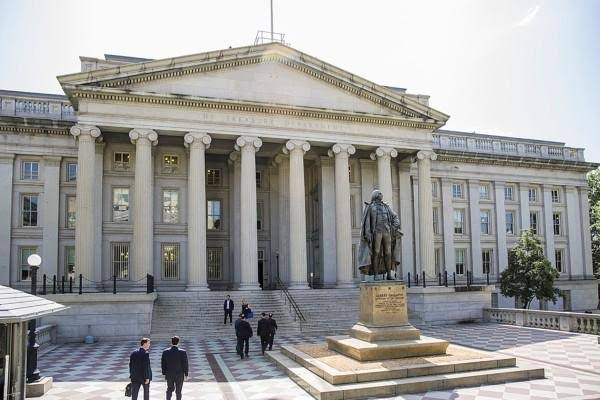
On August 24, the U.S. Department of the Treasury announced the launch of "Operation Economic Outcast," describing it as a whole-of-government economic campaign against the Iranian regime and its supporters. As part of the operation, the Office of Foreign Assets Control (OFAC) issued sectoral sanctions decisions against five key sectors: digital assets, technology, gold, aviation, and shipping, based on Executive Order 13902.
This decision "significantly expands" OFAC's ability to sanction foreign individuals and companies: any entity deemed to operate in or provide support services to Iran's digital asset sector can be sanctioned, regardless of its location. Relevant assets of the designated entities in the U.S. will be frozen, and foreign banks assisting them in significant transactions may face restrictions on U.S. accounts.
The Treasury clearly stated in its announcement: "The Iranian regime is increasingly using cryptocurrencies as a preferred tool for evading sanctions, supporting transactions related to the Islamic Revolutionary Guard Corps (IRGC) and insiders within the Iranian regime."
Over $100 million in cryptocurrency payments accused of aiding IRGC oil sales
In this action, OFAC specifically sanctioned UAE national Ukrainian broker Ivan Obukhov and his company Foscom FZE.
According to the Treasury's statement, Obukhov has acted as a broker for Iranian shadow fleet vessels for years, assisting the Iranian military and its proxies in oil transportation. Since 2023, he has facilitated over $100 million in cryptocurrency payments to promote oil sales on behalf of the IRGC Quds Force. He also coordinated the procurement of vessels used for sanction-evasion activities. Foscom FZE is a UAE company he acquired in 2022 and serves as its owner and general manager.
Obukhov was designated under the amended Executive Order 13224 for providing substantial assistance, sponsorship, or financial, material, or technological support to the IRGC QF; Foscom FZE was designated due to its direct or indirect ownership, control, or direction by Obukhov.
At the same time, the Treasury sanctioned nearly 60 entities, individuals, and vessels, covering nuclear and missile procurement, cyber operations, and oil revenue networks.
Sectoral sanctions significantly advance the risk of secondary sanctions
Unlike previous targeted actions against specific exchanges or wallets, this digital asset sector decision established a broader sanctions basis. Any foreign entity deemed to operate in or provide support services to Iran's digital asset sector could be added to the sanctions list.
Secretary of the Treasury Scott Bessent stated in a related announcement: "Today, at the direction of President Trump, the U.S. Treasury initiated 'Operation Economic Outcast'... Our goal is to cut off every economic lifeline that supports this authoritarian regime until Tehran is entirely isolated." He likened the action to "Economic D-Day," emphasizing that the U.S. is no longer just "managing" the Iranian threat, but aims to "end" it.
Bessent also warned that any entity engaging economically with the regime will face full reach of U.S. power.
Prior series of enforcement actions against Iranian cryptocurrency channels
This sector-level action is the latest escalation in the U.S.'s ongoing efforts to tighten constraints on Iranian cryptocurrency channels.
In January 2026, OFAC first listed cryptocurrency exchanges related to Iran for sanctions, targeting the UK-registered Zedcex and Zedxion. In June, the Treasury sanctioned four Iranian cryptocurrency exchanges, including the largest platform in Iran, Nobitex. On August 7, OFAC also sanctioned Shelbit and Aban Tether, stating that the two jointly facilitated about $5 million in digital asset flows related to Iran.
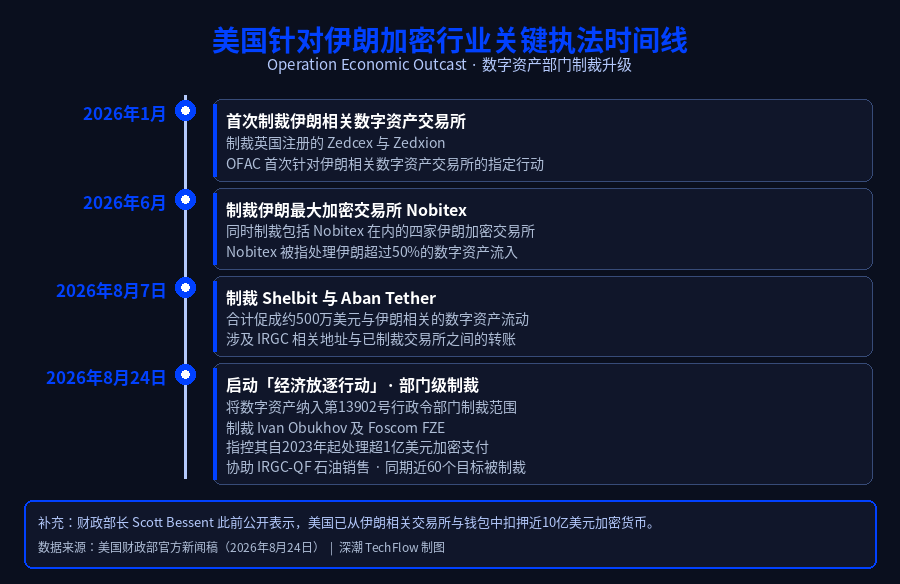
Treasury Secretary Bessent previously stated that the U.S. has seized nearly $1 billion in cryptocurrencies from Iranian-related exchanges and wallets. Prior enforcement actions also included freezing specific wallets.
The Treasury identified digital assets along with technology, gold, aviation, and shipping as key sectors Iran attempts to support its economy and stated it has mapped the nodes of Iran used for smuggling oil, evading sanctions, and funding related activities.
The role of cryptocurrency payments in oil and sanction evasion has been further established
U.S. officials have characterized cryptocurrencies as an important alternative path for Iran after restrictions on traditional financial channels. The Treasury noted that digital assets are used to support transactions related to the IRGC and insiders within the regime and are linked to activities such as the repatriation of oil sales revenue.
Including the entire digital asset sector under Executive Order 13902 means that future sanctions against foreign intermediaries, exchange service providers, payment channels, and even related technology supporters have a lower threshold. Designated entities not only face the risk of asset freezing but their trading partners may also trigger secondary sanctions considerations.
As of the time of publication, OFAC has taken designated actions against the relevant entities based on the aforementioned decision and continues to update the sanctions list.
免责声明:本文章仅代表作者个人观点,不代表本平台的立场和观点。本文章仅供信息分享,不构成对任何人的任何投资建议。用户与作者之间的任何争议,与本平台无关。如网页中刊载的文章或图片涉及侵权,请提供相关的权利证明和身份证明发送邮件到support@aicoin.com,本平台相关工作人员将会进行核查。


