Original author: Li Dan
Original source: Wall Street Journal
US Treasury Secretary Besant stated on Monday local time that the US Treasury will implement the next bond repurchase operation on September 9, and hinted that relevant operations will continue to be promoted thereafter.
Besant mentioned that the next bond repurchase operation will be implemented on September 9, and we shall wait and see. He also stated that the Treasury will continue to execute its regular treasury bond auction program, “so you will hear from us again at the beginning of the next quarter.”
As Besant made these statements, the market was paying attention to whether the US Treasury would further expand its support for the long-term US Treasury bond market.
Earlier on Monday, US media cited news from senior Treasury officials saying that the Treasury is considering using nearly $1 trillion from the Treasury General Account (TGA) to fund the recently expanded US bond repurchase plan. However, officials did not disclose how much money the Treasury would ultimately use or when it would start using it. Related reports indicated that the TGA currently stands at about $950 billion.
September 9 Repurchase Increase Takes Effect, Besant Says Single Operation Scale May Exceed $4 Billion
The September 9 mentioned by Besant is not a new repurchase plan that the Treasury suddenly announced on Monday, but the date when the increased long-term US Treasury bond repurchase measures officially take effect, which was announced last Wednesday.
The US Treasury announced on August 19, last Wednesday, that it would at least double the liquidity support repurchase operation scale for nominal Treasury bonds with maturities of 10 to 20 years and 20 to 30 years, raising the upper limit of the single operation scale from the previous $2 billion to at least $4 billion. The Treasury explicitly stated that this adjustment will take effect from September 9 and will continue until the end of this quarter’s refinancing period on November 4.
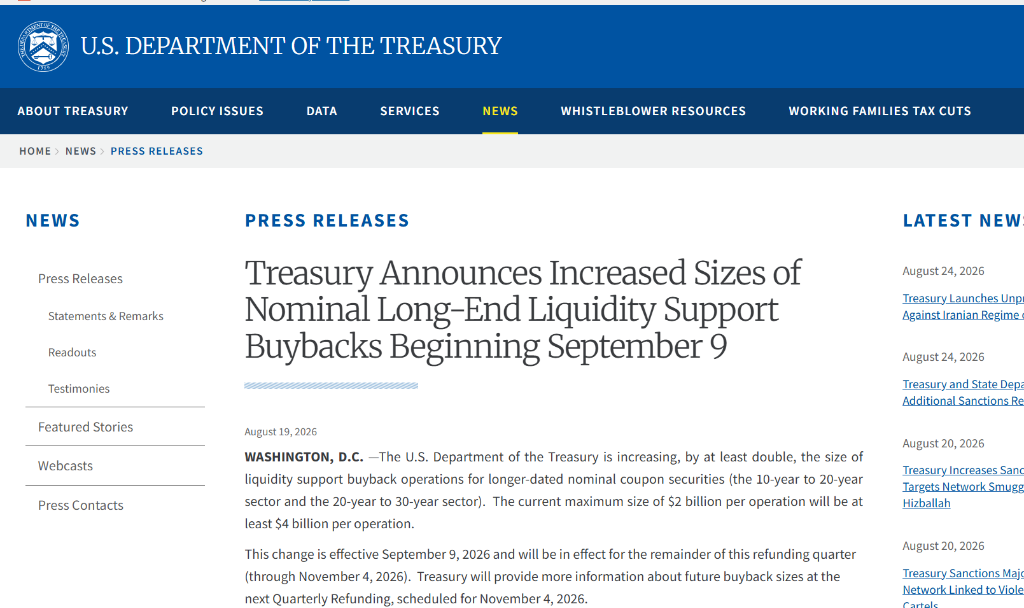
At that time, the Treasury explained that increasing the repurchase scale was to provide more liquidity support to the long-term nominal Treasury bond market, as the Treasury continuously received a large number of high-quality bids during the longer-term repurchase operations, indicating strong participation from market participants in the relevant operations.
On the day after the Treasury announced the plan, Besant further indicated room for expanding the repurchase scale last Thursday. He stated that the single operation scale for long bond repurchases by the Treasury may exceed $4 billion, and remarked that “this is a lightly traded market sector,” asserting that the Treasury has a “sufficient toolbox” in the US Treasury market.
Besant believes that the market has not sufficiently focused on the fundamental factors of the US economy, and that US Treasury yields do not reflect the fundamentals, especially that the liquidity of 30-year Treasury bonds is "particularly scarce".
As for how large the repurchase scale could reach, Besant stated at that time that “it will depend on conditions”, claiming that “any fluctuations within 24 hours are just noise”, and that the Treasury is “trying to bring the weak market back into balance”.
Therefore, September 9 primarily signifies that the previously announced increase in repurchases officially enters the execution phase; while Besant's earlier statement about "possibly exceeding $4 billion" leaves room for an actual operation scale exceeding the previously announced minimum level.
Nearly $1 Trillion TGA May Become Source of Repurchase Funds, Market Reassesses "Toolbox"
Earlier Monday, a CNBC report stated that the Treasury is considering using nearly $950 billion from the TGA to fund the recently expanded bond repurchase plan. Two senior Treasury officials indicated that the TGA is seen as a potential source of funds for purchasing some non-benchmark Treasury bonds, but no specific amounts or timing have been determined yet.
This news is particularly noteworthy because the mainstream speculation in the market regarding the Treasury's funding sources for repurchases was to issue more short-term Treasury bills to fund repurchases of long-term Treasury bonds.
If the Treasury adopts this approach, it would mean increasing the supply of short-term debt while simultaneously reducing the supply of long-term bonds, creating an effect similar to the fiscal version of "quantitative tightening" (QT) in the debt maturity structure. The market previously discussed the similarities between Treasury operations and the Federal Reserve's historical "QT" operations.
If the Treasury directly uses TGA cash for repurchases, it means that it does not have to rely entirely on the issuance of new short-term Treasury bonds to raise repurchase funds.
However, the nearly $1 trillion TGA does not mean that the Treasury plans to use nearly $1 trillion to purchase Treasury bonds. Current reports only indicate that TGA is viewed as a potential source of funds, and the Treasury has not disclosed the actual amount it will utilize.
More importantly, the TGA itself is the main operational account of the US Treasury at the Federal Reserve, used for the government's daily revenue and expenditure. The actual funds available for repurchase by the Treasury will also be constrained by government expenditures, debt issuance arrangements, and cash balance management objectives.
Thus, for the market, what is truly worth paying attention to is not the absolute balance of the TGA, but whether the Treasury will use this money, how much will be used, and at what pace long-term Treasury bond repurchases will be conducted.
Repurchase Benefits Only Support One Day, Long-End Yields Rise Again
The direct background for the Treasury suddenly expanding long bond repurchases is that US long-term Treasury yields have previously remained high.
After the announcement on August 19, US Treasury yields briefly fell significantly, with the market viewing it as an important policy signal that the Treasury was attempting to alleviate long-end financing pressure.
However, this positive effect did not last long.
Last Thursday and Friday, US mid-to-long-term Treasury prices fell for two consecutive days, meaning that the lift from the Treasury's expanded repurchase lasted only a day. The market refocused on the massive fiscal deficit, long-term debt supply, and inflationary pressures in the United States.
Last week, media reports mentioned that as Treasury bond prices fell, investors felt that the new measures from the Treasury might only briefly curb rising borrowing costs, reflecting doubts among investors about the effectiveness of the new measures. TD Securities strategist Howard Du in New York stated that the market does not completely believe that Besant can truly suppress long-end yields.
This also means that after the repurchase officially increases on September 9, the market's focus will shift from “Will the Treasury take action” to “Will the actions taken truly change the supply and demand for long-term US Treasury bonds.”
From the current plan announced by the Treasury, starting September 9, the upper limit for each repurchase operation for 10 to 20-year and 20 to 30-year Treasury bonds will be raised to at least $4 billion. The Treasury has also indicated that it will provide more information regarding future repurchase scales at the next quarterly refinancing meeting on November 4.
Therefore, September 9 will become an important time node for the market to test the actual effect of the Treasury’s expanded repurchase plan, while Monday's news regarding the TGA further expanded the market's imagination space regarding the future “ammunition” scale of the Treasury.
However, whether through TGA cash or issuing short-term Treasury bills to provide funds for repurchases, this operation cannot be simply equated with the Federal Reserve’s quantitative easing. What the Treasury can change is the debt maturity structure and the marginal demand for specific Treasury bonds, while the overall fiscal deficit, debt scale, and future financing needs of the United States will not disappear as a result.
For long-term US Treasury bonds, the true determinants of the yield center will still be the fiscal situation of the United States, inflation, economic growth, and investors’ judgments on future Treasury supply.
免责声明:本文章仅代表作者个人观点,不代表本平台的立场和观点。本文章仅供信息分享,不构成对任何人的任何投资建议。用户与作者之间的任何争议,与本平台无关。如网页中刊载的文章或图片涉及侵权,请提供相关的权利证明和身份证明发送邮件到support@aicoin.com,本平台相关工作人员将会进行核查。