If you are a high-consuming user of Tokens, over the past year, you should have felt the most core evolution of AI Agents:
Besides the intellectual leap of the underlying large model itself, it has started to resemble a true "worker" more and more.
From the earliest chatbots to the gradually maturing infrastructures like MCP, Skills, and Harness, Agents have begun to gain more and more "limbs"; they can open web pages, read real-time data, operate software, and even connect wallets and trading accounts.
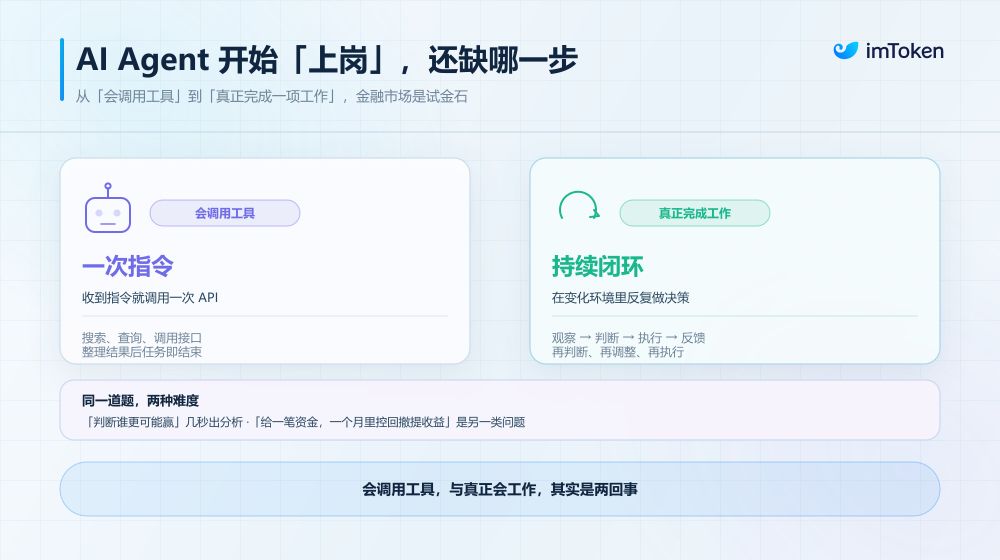
However, reaching this point has also brought forth new real-world problems: Knowing how to use tools and being able to complete a work task are actually two different things.
An Agent that can truly undertake tasks should not just call an API once after receiving instructions but needs to continuously adjust its next actions based on results in a constantly changing environment.
The financial market exemplifies this difference particularly clearly.
You can tell an Agent, "Help me determine who is more likely to win a certain match," and it can give you a seemingly good analysis in a few seconds, but if the request changes to "Give you some funds to participate in the prediction market continuously over the next month, improving returns while controlling the maximum drawdown," it becomes a completely different type of problem.
It must continuously read real-time news, odds, and order books, judge whether the market has priced sufficiently, decide when to establish positions, increase positions, or exit, and promptly adjust strategies after making mistakes in its judgments.
A recent series of innovations in infrastructure seems to be gradually completing this relatively missing piece of the puzzle.
1. Does AI Agent need a "simulated training ground"?
In mid-August, SKALE launched an interesting new product, AgentPit.
In simple terms, it is a "simulated trading sandbox" specially built for prediction market AI Agents, synchronously providing real market information from Polymarket and compatible with its API, while using a CLOB order book, CTF Token, and settlement mechanism that approximates a production environment, with real funds replaced by simulated USDC.
Developers can allow the Agent to read market data in real-time, place orders, manage positions, and test strategies without any risk of financial loss. They can also observe the collective behavior generated when multiple Agents compete in the same order book.
This resembles traditional quantitative trading backtesting and simulations, but its significance for AI Agents is much deeper.
Because a long-term problem faced by Agents is, how do you know if an Agent "really trades"?
It is well-known that in the past, assessing the capabilities of large models has heavily relied on static benchmark tests - solving a few math problems, fixing a piece of code, or summarizing a long text.
However, complex decisions in the real world do not have preset standard answers, especially in financial markets. For instance, suppose an Agent determines that the fair value of a "YES" prediction for a certain event should be $0.70, while the current market price is $0.55. After it buys, the price may drop further to $0.45 or spike due to breaking news, and the instantaneous liquidity of the order book can directly affect the actual execution average price.
This means that the Agent cannot finish its task after providing one prediction; it must continually face the real consequences of its previous decisions, which is precisely the core value of Agent Pit. It provides a dynamic feedback loop that approximates a real production environment for the agent:
Observe → Judge → Execute → Receive Feedback → Adjust → Re-execute.
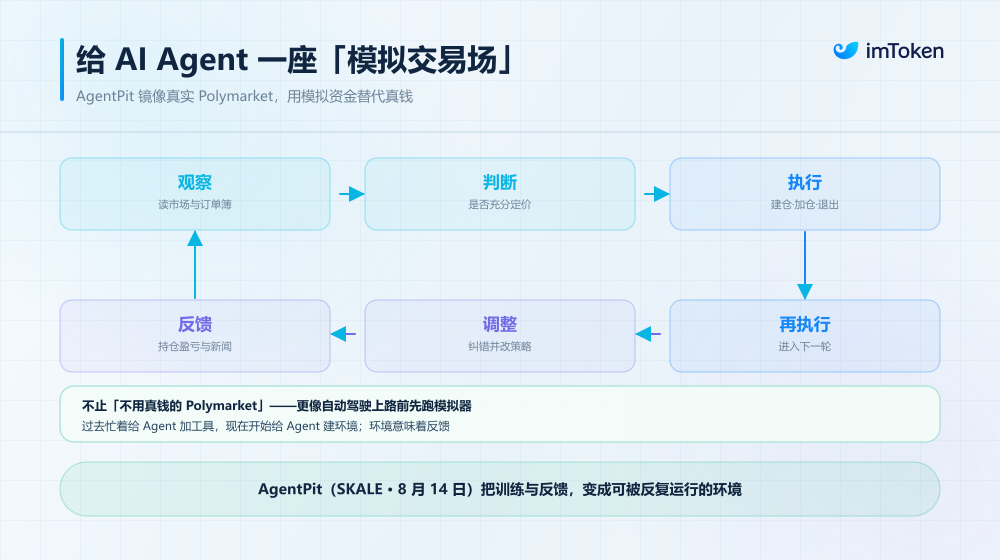
Of course, "training" here does not necessarily mean that the Agent will automatically modify the underlying model parameters every time it completes a trade; it provides an environment where strategies can be run repeatedly, results can be evaluated, and workflows can be iterated.
Just as an autonomous driving system needs to experience a large number of extreme scenarios in a simulator before going on the road, a financial Agent that may manage real funds also finds it difficult to gain asset control solely based on a few Prompt tests; it needs to first prove how it performs in a continuous decision-making environment.
But problems arise as well.
Performing well in a simulated environment does not mean you can immediately hand over real money to AI; a more critical layer is still required in between.
2. Aligning infrastructure: When payments and trading become native components of the Agent
If you observe the actions of mainstream cloud giants and leading trading platforms over the past few months, it is not hard to see that the operational track of Agents is completing standardization at an astonishing speed.
First is the deployment of machine-native payment protocols.
On August 18, Amazon Bedrock AgentCore Payments officially went GA. This service allows Agents running on AgentCore to autonomously discover and pay for third-party APIs, MCP services, or professional data sources, and integrates Coinbase with Stripe / Privy’s wallet infrastructure, natively supporting stablecoins and machine payment protocols like x402.
This solves a highly relevant breakpoint issue - if an Agent discovers high-quality real-time data needs to be paid for while analyzing the market, the workflow in the past had to interrupt, waiting for humans to manually swipe a card to purchase and configure the API Key before continuing.
Under the framework of AgentCore Payments, payment is directly encapsulated as an automated node within the workflow; users only need to preset budgets and strategies, and the Agent can autonomously initiate micro-payments to complete calls when encountering payment barriers, with the entire process requiring no human intervention, and wallet private keys and credentials kept isolated from the model itself.
Then, two days later, on August 20, Binance launched Agent OS and opened the native interface for Agents.
Unlike simply providing a single AI function, Agent OS is more like a financial infrastructure interface specifically for Agents, integrating components like the Binance API, Wallet Agentic Hub, x402, Skills Hub, and MCP together.
It allows compatible AI applications to obtain market data, view account information through MCP, and execute supported trading operations after user authorization. More critically, it emphasizes permission boundaries and isolation at the mechanism level:
Users can assign specific sub-accounts to Agents, isolating funds and trading activities from the main account and configuring specific permissions for the Agent; related access permissions can also be revoked at any time.
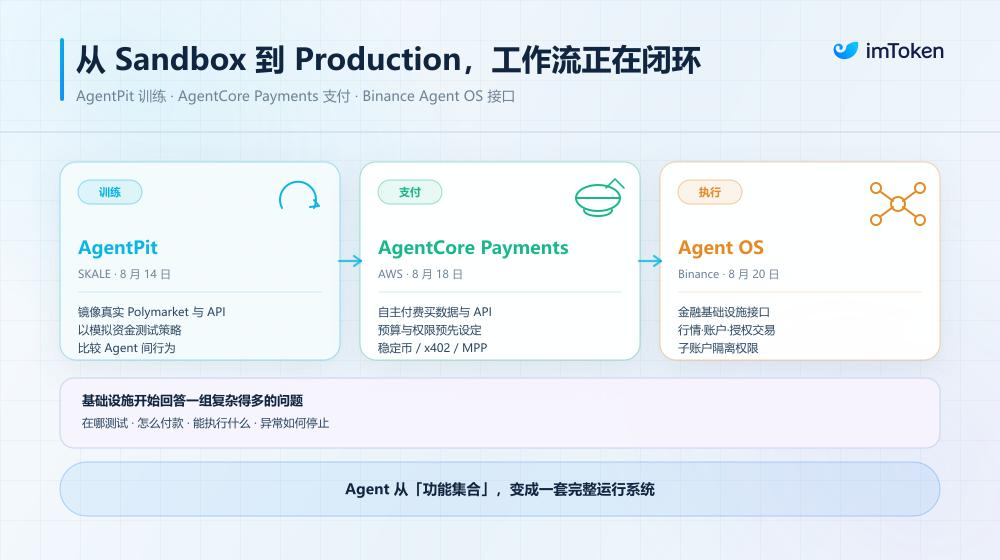
When putting AgentPit, AWS AgentCore Payments, and Binance Agent OS together, a clearer change emerges:
AgentPit provides an environment for strategy testing and continuous feedback, x402 and AWS AgentCore Payments begin to enable machine-native payments, while Binance Agent OS further opens market data, account information, trading, and on-chain capabilities to the Agent, gradually stringing together previously disparate abilities into a complete workflow.
However, one particularly unique aspect of financial scenarios is that, if the code is wrong, you can simply rerun it, but once an Agent executes an erroneous transaction, the assets may have genuinely left the wallet.
This means there is a role that cannot be bypassed when moving from a simulated environment to the real world.
That is the wallet.
3. What is the true value of the Agent Wallet?
If we outline the complete workflow of future AI Agents, it would present a clear chain:
- First, train and test strategies in a simulated environment like AgentPit;
- Then obtain information and tools through MCP, Skills, and various APIs;
- Purchase data and computing resources through protocols like x402 (see further reading “When AI Agents Start to Own 'Wallets': After Economic Autonomy, Who Will Hold Control?”);
- Subsequently enter the real market to execute trades;
- Then continue to optimize strategies based on actual results;
At the execution stage, the role of the wallet will be completely different from today.
After all, the interaction logic of traditional Web3 wallets is designed for human-machine interaction - each signature relies on humans to verify visually on the screen and manually click to confirm; however, if a high-frequency Agent needs to read multiple sets of market data and continuously adjust positions every second and still requires human signatures for each transaction, the significance of automation would be completely lost.
However, if private keys are given to AI for safekeeping, it is tantamount to abandoning all security bottom lines.
Therefore, what the Agent Wallet truly aims to solve is not "how to let AI access private keys," but "how to provide safe and controllable execution rights for Agents without relinquishing ultimate asset control."
This is also the core solution proposed by imToken in the design framework of the Agent Wallet:
- Account Isolation and Session Keys: In the design concept of imToken's Agent Wallet, each Agent with execution rights corresponds to an independent Agent Account, with its Session Key generated and isolated in a Trusted Execution Environment (TEE) and never leaving this secure environment.
- Hard Constraints of Policy Rules: Each Agent Account must bind to a clear Policy, including a whitelist of allowed protocols, limits on single transactions, daily quotas, operating frequency, and authorization validity periods. In other words, the Agent does not receive an unconstrained wallet, but an execution account surrounded by rules.
- User Retains Ultimate Control: The Agent can only autonomously execute within the range of the Policy pre-authorized by the user; operations exceeding the boundary must be reconfirmed by the user, who can always adjust the Policy, pause or resume the Agent, revoke permissions, and withdraw funds; for transactions identified as abnormal or exceeding preset strategies, automated execution will also be paused and request re-authentication from the user.
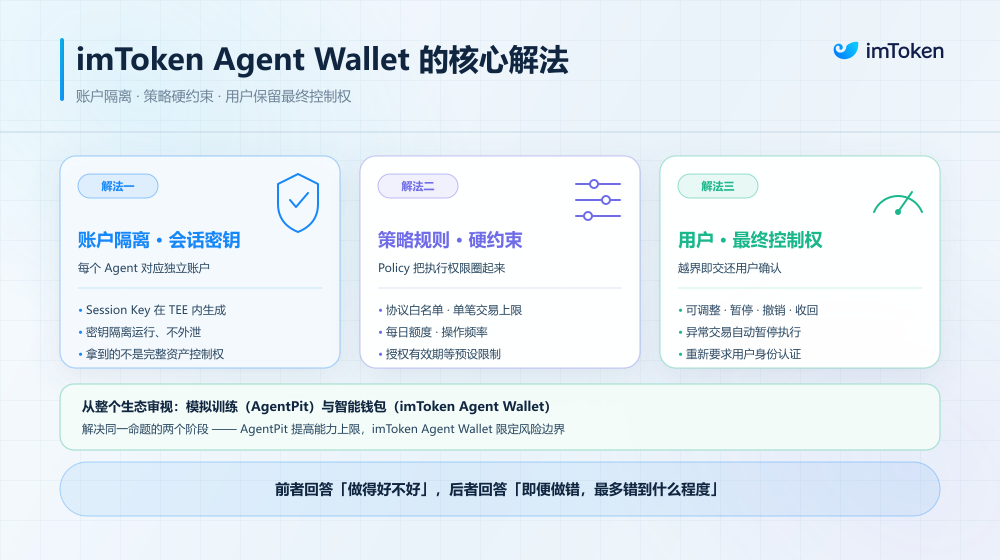
Re-examining the entire ecosystem from this dimension reveals that simulated training (like AgentPit) and smart wallets (like imToken Agent Wallet) are, in fact, two stages solving the same problem.
The former is responsible for enhancing the decision-making capabilities of Agents, while the latter is responsible for solidifying the safety bottom line of Agent actions.
Both are indispensable.
This might be the most significant change of the Agent Wallet compared to traditional wallets.
Final Thoughts
In this sense, the emergence of AgentPit marks the arrival of a new stage worth paying attention to.
AI Agents are moving from "learning to use tools" to "learning how to work."
And when it finally steps out of the simulated training ground and enters the unpredictable real trading world, whether this step can be stable and far-reaching often depends not only on how clever the underlying large model is but also on how solid the account and authorization boundaries we build for it are.
After all, in the real complex economic system, what we truly need is not an Agent that never makes mistakes, but one whose risks remain within controllable boundaries even if errors may occur.
免责声明:本文章仅代表作者个人观点,不代表本平台的立场和观点。本文章仅供信息分享,不构成对任何人的任何投资建议。用户与作者之间的任何争议,与本平台无关。如网页中刊载的文章或图片涉及侵权,请提供相关的权利证明和身份证明发送邮件到support@aicoin.com,本平台相关工作人员将会进行核查。