Temu is contracting, the main e-commerce site is seizing essential consumption, and Duoduo Maicai is growing rapidly.
Article丨Shen Fangwei
Image丨Huang Zhenxin
Editor丨Huang Junjie
LatePost reported that Pinduoduo's GMV growth rate in the second quarter of this year fell below 10% year-on-year, marking the first time since its establishment. Other major platforms also saw a significant decline in growth, with only Douyin e-commerce exceeding Pinduoduo, but its growth rate in several months has also dropped to nearly 10%.
Due to tightening global regulations, Pinduoduo's overseas e-commerce platform, Temu, will no longer pursue growth this year but will focus on resolving compliance issues, with GMV in several European and American markets declining by over 30%.

In the new consumer environment, Pinduoduo is shifting towards essential goods for growth, with several Temu senior executives returning to domestic operations to support Duoduo Maicai. Its core management has also started to directly pay attention to this old business. Duoduo Maicai's revenue this year is expected to exceed 400 billion yuan, generating profits of over 10 billion yuan.
According to the financial report released on the evening of August 24, Pinduoduo's revenue grew by 8% year-on-year to 112.4 billion yuan, with growth rate half of market expectations from investors, yet it still significantly surpassed Alibaba and JD. Additionally, Pinduoduo also reported a "other losses" of 7.4 billion yuan in the quarter, which was not explained in the report.
Over the past decade, Pinduoduo has never lost a business competition, breaking through from low-price e-commerce to community group buying and cross-border e-commerce. Each time, it could find gaps faster than its competitors, seizing a large market share with efficiency and lower prices. However, when the competitors transformed from other internet companies into a new consumer landscape, Pinduoduo could not achieve a 20% domestic e-commerce growth target and shifted to more fundamental consumption.
The perfect storm of consumption cannot be resisted even by the lowest-priced platforms
Last year, e-commerce platforms saw both performance and profit increase, largely relying on 300 billion yuan in state subsidies; this year, the state subsidies have been reduced to 250 billion yuan, with more being shifted to offline. The AI competition and wars have driven up the prices of various raw materials, leading to rising product costs. The decline in housing prices has not reversed, and sales in industries such as furniture have significantly dropped.
The impacts have been reflected in the financial reports of listed companies across various industries. Xiaomi's revenue from mobile phones and hardware business fell by 11.3% year-on-year in the second quarter; Hisense and Haier saw a revenue decline of 5%-10%, with net profits dropping even more; leading home furnishing companies like Oppein and Sophia forecasted profits to drop by 50%-80% year-on-year.
Price increases are continuing. Thousand-yuan phones have basically disappeared, and Chinese mobile phone manufacturers have cut more than 100 million units from their production plans this year. Even Apple, which is strongest in the supply chain, could not contain prices—new Mac mini prices rose from around 3,000 yuan after subsidies to about 6,000 yuan. Price increases have directly led to a decline in sales.
The important categories of e-commerce platforms—consumer electronics, appliances, home decoration—are all declining. The rebound in clothing, beauty, and daily necessities compared to last year cannot offset the overall impact.
Growth rates have significantly declined for major Chinese e-commerce platforms this year. One platform announced that its GMV growth in the first half of the year was about 7%, but the actual figure was only 3.5%—orders stimulated by discount vouchers, many of which were returned. Another platform's representative stated that their actual GMV growth rate was also only in the low single digits. Douyin e-commerce's GMV growth rate was more than 30% last year but has approached 10% in several months this year.
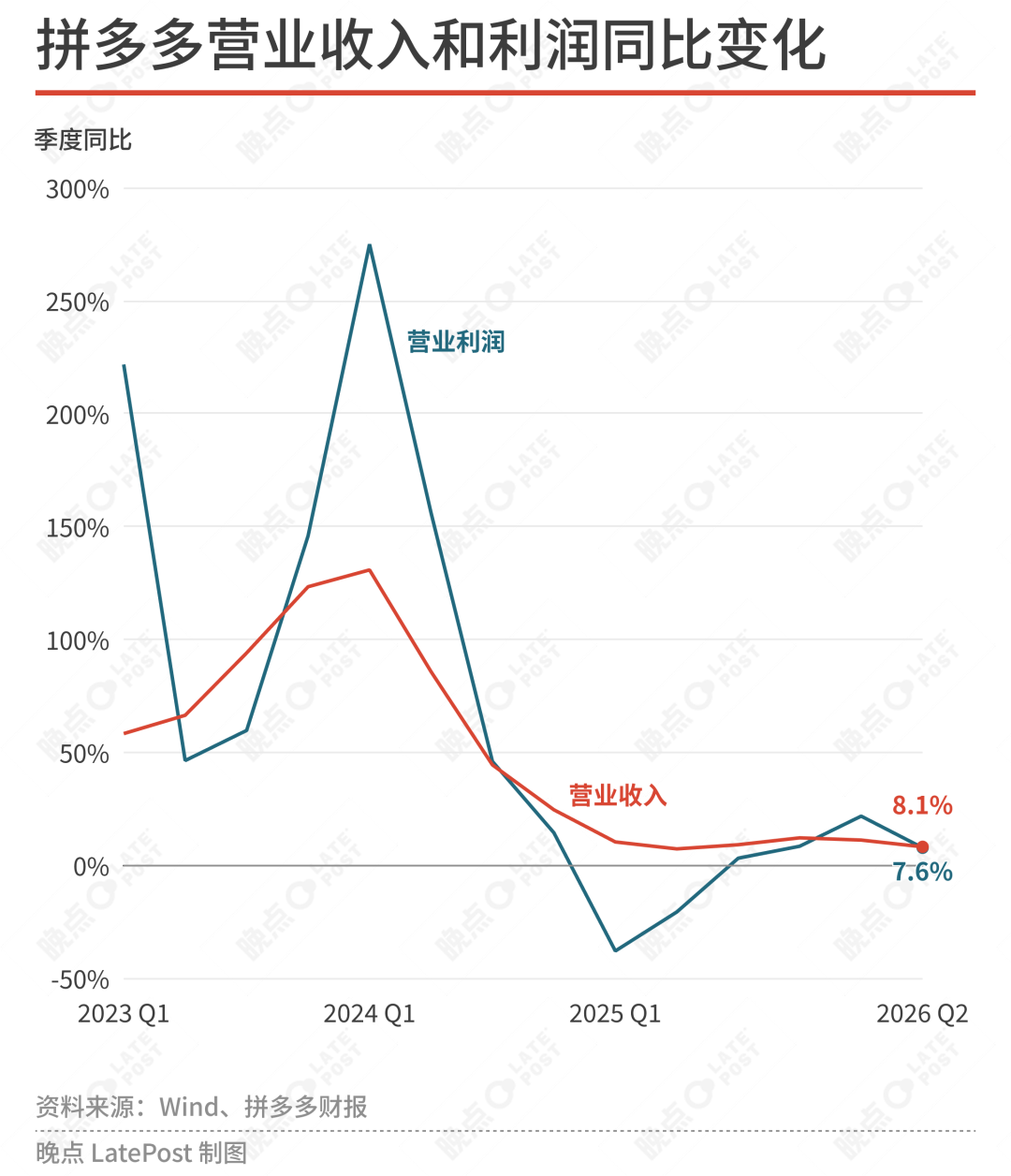
The decline in growth rates does not shake Pinduoduo's fundamentals. By not participating in the delivery war and not building an AI computing center, Pinduoduo remains the healthiest cash-flow internet company, with cash inflow from operations reaching 25.7 billion yuan in the second quarter. As of the end of June, Pinduoduo had over 450 billion yuan in cash and cash equivalents, bringing 13.5 billion yuan in interest and investment returns in the second quarter.
In the past few years, Pinduoduo has always found ways to maintain high growth: sourcing leftover inventory from dealers, creating competition through rules to expedite merchant shipments, and encouraging lower prices. Now they have not found new ways.
In the second quarter of this year, consumer electronics, which accounted for over 1/5 of Pinduoduo's main site revenue, fell by over 10% year-on-year. People close to Pinduoduo told us that even with subsidies and prices lower than other platforms by dozens or hundreds of yuan, digital appliances are still not selling well. As a result, in the second quarter, the GMV growth rate of Pinduoduo's domestic e-commerce business fell below 10% for the first time, far below the previously set goal of 20% growth for the year.
In the past, e-commerce could only reach towns, whereas Pinduoduo started promoting delivery to villages from the fourth quarter of last year—collecting packages at county-level logistics centers that are delivered to every village the next day. For this, the platform subsidizes more than 1 yuan per package.
County-level distributors in places like Shaanxi and Sichuan said they deliver three to four thousand parcels each day, averaging about 60-100 packages per administrative village. An individual familiar with the courier companies estimated that Jitu, Postal Service, Zhongtong, and others have partnered with Pinduoduo, expecting to deliver millions of packages for it.
In developed cities, Pinduoduo has launched next-day delivery. Various courier companies have built warehouses in recent years specifically for e-commerce, offering storage and shipping services but have faced stagnant growth, experiencing a lack of customers. Pinduoduo encourages merchants to stock goods in cloud warehouses to speed up deliveries, labeling items as “next-day delivery” to attract consumer orders. If merchants can ensure next-day delivery themselves, they can also apply for the “next-day delivery” label.
Pinduoduo's main site is also offering international shipping to Southeast Asian countries like Malaysia, Vietnam, and Singapore. Most items, from brooms and buckets to refrigerators and televisions, are shipped free of charge. The Pinduoduo distribution warehouse in Guangdong sends out dozens of standard containers each week, shipped by sea to their destination and then delivered by couriers like Jitu. Its small goods are 20%-30% cheaper than local e-commerce platforms but require a wait of 1-2 weeks.
A Shopee representative observed that this year, the volume of goods sent by Pinduoduo to Southeast Asia has continued to increase. This business mainly serves the local Chinese community, and the application does not support multiple languages, therefore, there is limited impact on other platforms, but competition with Temu has already emerged.
The richness of goods on Pinduoduo's main site is now second only to Taobao in China and is no longer just a place to sell cheap items. In recent years, it has improved its delivery system through subsidies and scale. Next-day delivery, delivery to villages, home delivery in the Hong Kong region, and free shipping to Southeast Asia…everything possible has been done. However, this has not been able to maintain its GMV at a 20% growth target, which is now at single digits.
Overseas growth faces regulatory constraints, entering a waiting phase
After the outbreak of COVID-19, Chinese cross-border e-commerce platforms like Temu and Shein rapidly swept the globe with tax exemption for small packages, setting growth records. However, such rapid expansion has triggered a backlash from overseas regulators.
Last year, the U.S. imposed taxes on cross-border small packages, ending the full custody model initiated by Temu. In May of this year, the European Commission fined Temu 200 million euros for failing to effectively stop the sale of illegal goods—this is just the first penalty among four investigations, with the other three still ongoing. Various European countries have also initiated investigations into Temu, Shein, and AliExpress.
Since last year, Pinduoduo's management has spent considerable time studying how to respond to overseas regulations, hiring relevant talent and consulting professional lawyers familiar with European and American laws but still have not found good breakthroughs. This year, Temu has shifted to a defensive strategy: focusing on compliance first, then expansion, to avoid triggering more regulations.
Multiple merchants operating in the European and American markets have told us that their order volume on the Temu platform has declined by 30%-50% year-on-year. Analysts estimate that starting in the second quarter of this year, Temu's GMV in Europe has declined by about 30%, with package volume decreasing by 40%-50%, directly impacting its profitability and growth objectives.
In March of this year, Pinduoduo announced the "New Pinduoduo" plan to create a higher quality and more compliant private label. We previously reported that New Pinduoduo collaborates with brands like Bosideng, providing vendors with consignment, prepayment, and inventory buyout, exchanging certainty for vendor participation.
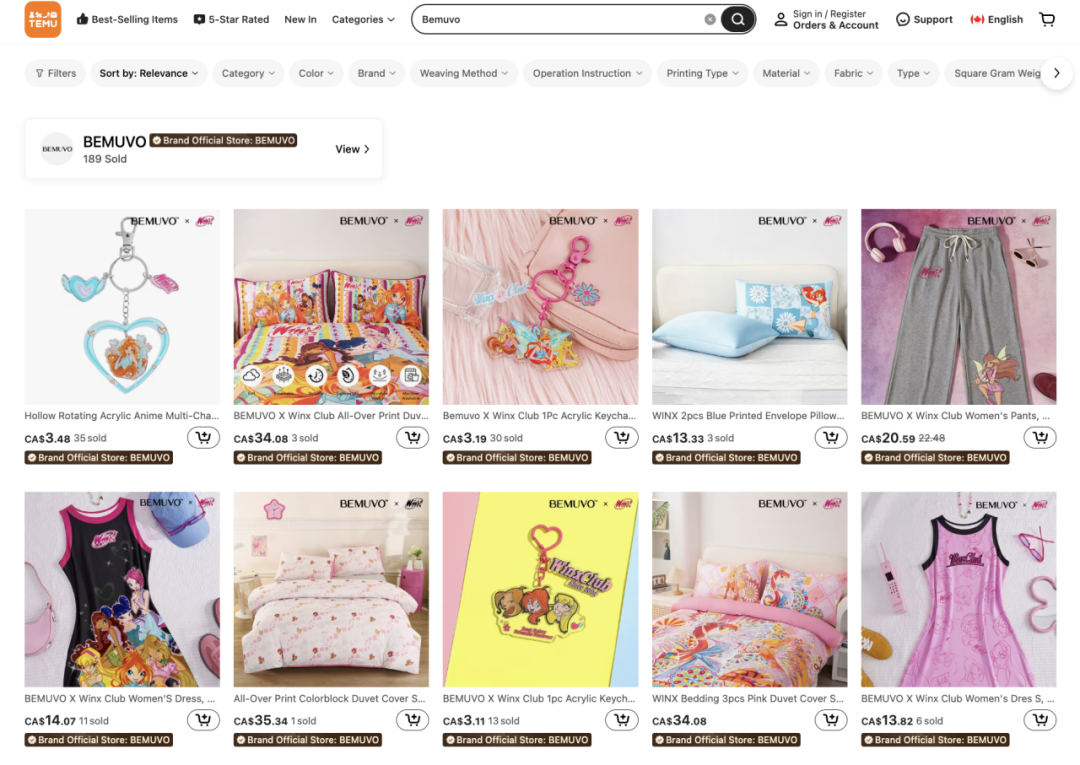
Products sold by New Pinduoduo overseas.
New Pinduoduo has gradually taken away the first batch of clothing from brands like Bosideng, which do not bear the Bosideng brand name, and it is currently unclear what brand it will sell under. In June of this year, New Pinduoduo registered a new brand "Bemuvo" and launched a store of the same name, with relatively low product price points, currently targeting only the Japanese and Canadian markets.
Pinduoduo claims it aims to rely on New Pinduoduo to recreate another Pinduoduo in three years. However, in the second quarter of this year, some senior executives from Temu have returned domestically to support Duoduo Maicai. Pinduoduo's core managers have also started to pay attention to Duoduo Maicai.
Fresh and daily necessities replicate "billion-dollar subsidies," starting from selling Sam's Club products
Optional consumption is becoming increasingly difficult, and Pinduoduo is shifting towards essential goods.
In June 2025, after Meituan's withdrawal, Pinduoduo became the final winner in community group buying. Acquiring group points from Meituan Youxuan, plus the new openings, it added about 1 million group points in the past year, totaling approximately 3 million, covering from first and second-tier cities to thousands of county towns and tens of thousands of townships and villages, building an infrastructure that others do not have.
With no national competitors left, Duoduo Maicai's revenue has increased, and commissions have decreased. The grid warehouse partners responsible for delivery to group points earned 0.5-0.6 yuan per order last year; this year it is generally below 0.4 yuan; group leader commissions have dropped from 2%-3% to 1%-2%.
Duoduo Maicai offers same-day orders with next-day pickup, priced low but not as convenient as convenience stores or deliveries by couriers. Participants previously believed it was more suitable for low-consumption markets. However, this year, several cities in East China have also seen a 30%-50% growth. Many Duoduo Maicai employees are surprised, stating that since the Spring Festival, business has become so busy that they cannot keep up every day.
A portion of the growth comes from expanding product categories. Duoduo Maicai now sells 3,000-4,000 SKU's, covering almost all essential goods. In central and western county towns and even townships, users can also purchase refrigerated milk and fresh meats on this platform.
It is also no longer competing only on price: significantly reducing white-label products, eliminating non-standard small and medium-sized businesses, and selling more branded goods while requiring suppliers to ensure quality comparable to Yonghui, RT-Mart, and Meituan Xiaoxiang supermarket when delivering their goods.
Duoduo Maicai does not organize couriers themselves but delivers items through group leaders. Last year in main cities in East China, it required a minimum order of 29 yuan or 39 yuan for delivery; this year the threshold has been lowered to a minimum of 9 yuan or 19 yuan, enabling delivery for purchasing just one or two items.
We previously learned that Duoduo Maicai's revenue is expected to reach 400 billion yuan this year, bringing in over 10 billion yuan in profits. This business was previously managed by Dongzao. In April of this year, another core manager took over, shifting the assessment focus from market share to three indicators: gross margin, low prices, and the proportion of sales in the local social retail total.
She divided Duoduo Maicai into 12 major regions, with each regional leader managing 2-3 provinces. Regions are not divided geographically; Beijing, Tianjin, and Sichuan are included in one. A person managing several vastly different markets allows for experience to circulate, and headquarters can better control product allocation.
Pinduoduo's main site is also increasing sales of essential goods. Pinduoduo once used billion-yuan subsidies to sell iPhones, Moutai, Lamer, and Dyson, instilling consumer trust in the authenticity of products available here. Essential goods are more difficult—items consumed and used by consumers require additional trust. Pinduoduo's solution is the same: introducing brands, this time selling Sam's Club products.
Since this year, Sam's private label Member's Mark has appeared extensively in Pinduoduo's billion-yuan subsidies. This series is customized by Sam's, priced 10%-20% lower than the supplier's products. Users can purchase on Pinduoduo without needing a Sam's membership, and additional subsidies of 5%-10% or more are applied.
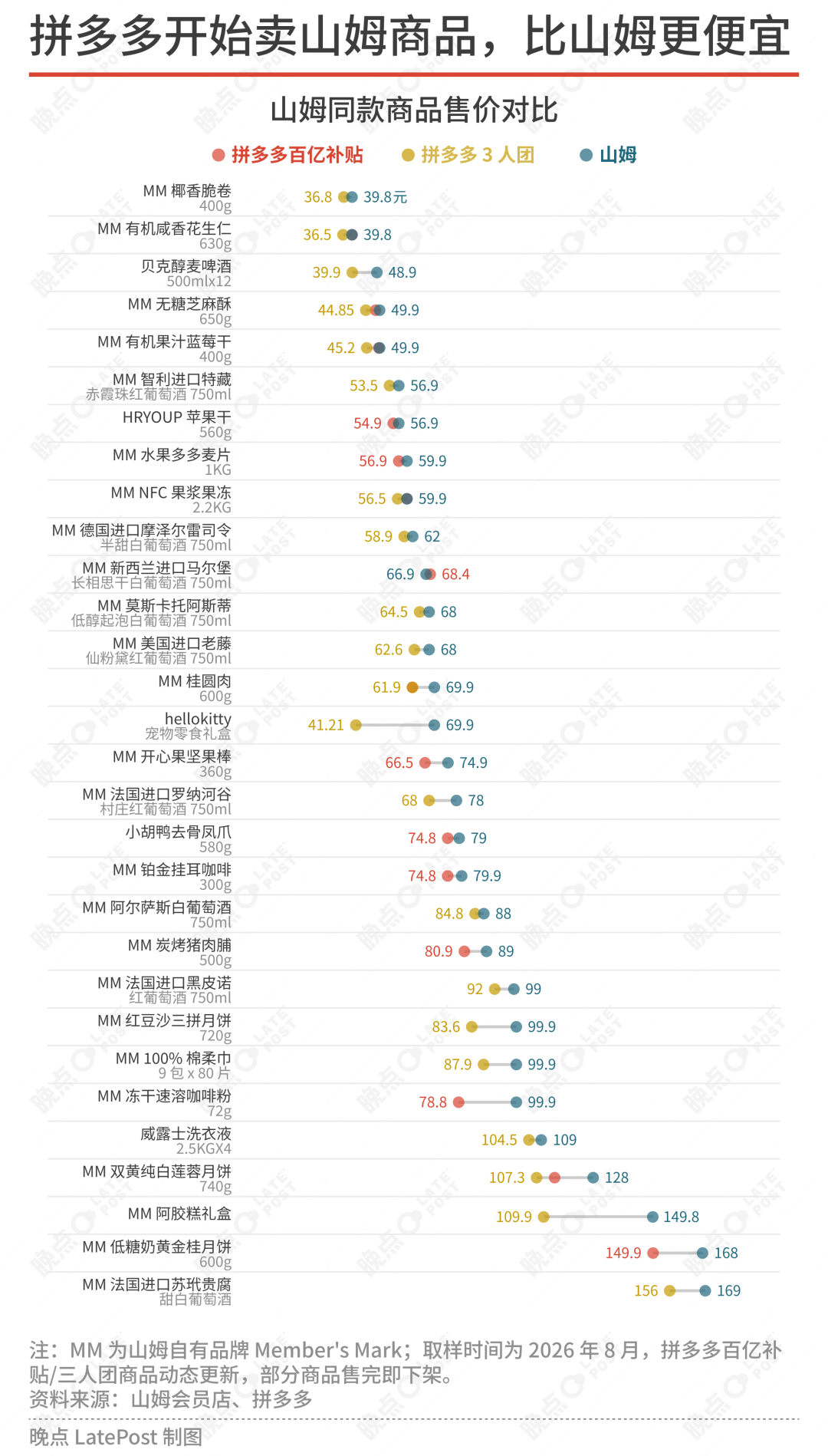
Just like selling iPhones without obtaining authorization from Apple back in the day, these products are also not authorized for distribution by Sam's Club China. About 10%-15% of Sam’s annual supplies flow into personal purchasing and business procurement channels, slightly marked up for resale. Pinduoduo sources goods from purchasing agents, adds a 5%-10% subsidy, and sets the price to the lowest online.
Pinduoduo’s domestic e-commerce does not copy Temu's "New Pinduoduo" to create a private label but instead spends money and traffic on Sam's products that consumers generally trust.
After ten years, Pinduoduo has temporarily shifted from comprehensive expansion and aggressive growth to pursuing safety and focusing on the essential consumer base.
The "phantom delivery" incident last December and subsequent events led to Pinduoduo being fined 1.522 billion yuan. Since then, multiple employees in different businesses have told us that management has focused much more on compliance this year than on business growth.
Pinduoduo has required sellers with annual sales of over 100,000 yuan to upload their business licenses and no longer allows "one license for multiple stores"; encourages merchants to file taxes and provides cash subsidies; and requires merchants to present authorization or trademarks for the brands sold. As a result, the number of active merchants has decreased by 200,000 to 300,000. Duoduo Maicai had previously sold adult products and live animals (chickens, ducks, rabbits, bullfrogs, etc.), which have been gradually removed over the past year.
Caution and pursuit of safety are also reflected in other areas. In the second quarter of this year, Pinduoduo purchased two buildings in Xiong'an, Hebei, and Shanghai—marking its first significant fixed asset purchase since its establishment ten years ago; previously, it would only rent property. The Xiong'an subsidiary was established at the same time, announcing the recruitment of 5,000 customer service, auditing, and operations personnel. Previously, its customer service staff were mostly outsourced and rotation fresh graduates, with only about 100 permanent team members.
Header Image Source: "Mountains and Rivers"
- FIN -
免责声明:本文章仅代表作者个人观点,不代表本平台的立场和观点。本文章仅供信息分享,不构成对任何人的任何投资建议。用户与作者之间的任何争议,与本平台无关。如网页中刊载的文章或图片涉及侵权,请提供相关的权利证明和身份证明发送邮件到support@aicoin.com,本平台相关工作人员将会进行核查。