Investment Thesis
I reaffirm my "Strong Buy" rating on Applied Materials (AMAT). However, particularly following the company's release of its Q3 FY2026 results, I would like to lower the target price from the previous $802 to $680. Yet, I want to make an important distinction here. The reason for lowering the target price is not that my original investment logic has been broken. No, that is not the case. In fact, I believe quite the opposite. The Q3 FY2026 results provide me with stronger evidence that the AI-driven logic chips, DRAM, HBM, advanced packaging, and service business opportunities I previously discussed are developing faster than my original model assumptions. The reason for the target price decrease is that after the valuation multiples of AMAT experienced significant compression, I adopted a more conservative forward-looking valuation multiple, while at the same time, I actually increased my earnings forecast for 2027.
My original investment logic was based on the view that AI is driving semiconductor equipment demand from an ordinary capacity cycle to a more structural growth cycle. The Q3 FY2026 results further reinforced this view as AMAT is now seeing both aspects of AI infrastructure development simultaneously. On the one hand, chip manufacturers are racing to enhance the performance and energy efficiency of advanced devices; on the other hand, due to ongoing tight supply of advanced semiconductors, they are also striving to expand manufacturing capacity. The company stated that advanced process wafer foundry logic chips, DRAM, and advanced packaging are expected to contribute approximately 80% of WFE (wafer fabrication equipment) market growth in 2026 and 2027, respectively. More importantly, AMAT is in a strong position in all three markets. I believe this means that the investment logic I initially expected to occur in the future is now increasingly reflected in customer capital expenditures and product demand.
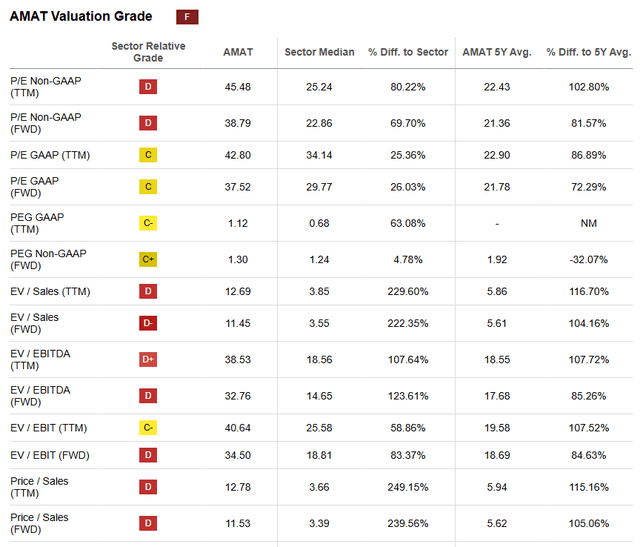
I am not worried about the stock price reaction following the earnings report, and there is a reason for that. Before the Q3 FY2026 earnings report was released, AMAT's stock price had already risen more than double in 2026, creating an exceptionally high expectation threshold for investors. Reuters also reported that some investors were looking for clearer evidence that AMAT's growth rate could exceed that of Lam Research and other semiconductor equipment peers. I understand this concern. However, I believe this round of selling actually improved the risk-reward ratio because the fundamental assumptions supporting my investment logic have become stronger, while the valuation has compressed. AMAT's current forward non-GAAP P/E ratio is 38.79 times, compared to 50.44 times when I initially built the valuation model. On the other hand, the latest growth data shows that the firm's forward revenue growth rate is 19.07%, the forward EBITDA growth rate is 26.56%, the forward EPS growth rate is 28.47%, and the long-term EPS growth rate is 29.76%. In my view, the current investment environment is much healthier than when I previously paid over 50 times earnings valuations before the operating data fully caught up.
[Original Image Position: AMAT Valuation Rating (Seeking Alpha)]
Updated Growth Drivers
The first growth driver remains advanced process wafer foundry logic chips and Gate-All-Around (GAA), but I am increasing the revenue contribution I allocate to this business. Previously, my model was based on the guidance of $6.9 billion in revenue from the Semiconductor Systems business for Q3 FY2026, corresponding to an annualized revenue run rate of $27.6 billion. Now, AMAT's guidance for Q4 Semiconductor Systems revenue is approximately $7.9 billion, increasing its annualized revenue run rate to $31.6 billion. If I continue to adopt the relatively conservative assumption that about 50% of this revenue is exposed to the more valuable advanced process wafer foundry logic chip opportunities, then a revenue base of $15.8 billion can be derived. Applying my previous growth assumption of 18%, this results in about $2.84 billion in new revenue, exceeding the $2.5 billion in my original model. I believe maintaining an 18% growth assumption is quite conservative, as AMAT has indicated that the Gate-All-Around and FinFET capacity expansions drove record revenue for the company's wafer foundry logic business in Q3, and management expects significant growth in advanced process wafer foundry logic chip revenue in the second half of the calendar year.
The operational economics of this growth driver have also improved. My previous model used a profit margin assumption of 35%, while Semiconductor Systems achieved a 38% non-GAAP operating margin in Q3 FY2026. Applying a 38% profit margin to my estimated new revenue of $2.84 billion yields approximately $1.08 billion in additional operating profit. Then, to remain conservative, I applied a 90% profit conversion factor, the latest management-provided assumption of a 13% tax rate for 2027, and divided by approximately 800 million diluted average shares outstanding. This gives a potential contribution of about $1.06 EPS from the advanced process logic chip business. I do not believe all of this $1.06 will be incrementally added to the Q4 FY2026 earnings, as the Q4 guidance already includes some growth releases. However, this calculation tells me that the profitability behind this growth driver is stronger than I assumed in my previous article.
My second growth driver is DRAM and HBM, and the Q3 FY2026 results significantly increased my confidence in this area. AMAT revealed that DRAM revenue, including HBM packaging, surged 52% year-over-year, reaching an all-time high. Management subsequently indicated that as customers expand cleanroom capacity, they expect DRAM revenue to experience very significant growth. This is stronger than the evidence I had when I applied a 25% growth assumption for DRAM and HBM opportunities. However, I still maintain the 25% growth assumption, as I do not want to simply extrapolate the 52% quarterly growth rate indefinitely. Based on a $31.6 billion annualized revenue run rate for Semiconductor Systems and a 26% share of DRAM in Q3, this results in a revenue base of approximately $8.2 billion for DRAM and HBM. At a 25% growth rate, this corresponds to about $2.05 billion in new revenue, exceeding the approximately $1.73 billion in my previous model.
Applying a 38% operating margin to this $2.05 billion in new revenue yields about $780 million in operating profit. After applying my profit conversion factor, tax rate, and share count assumptions, I arrive at about $0.76 in potential additional EPS. Likewise, I will not mechanically add all of this to the Q4 FY2026 EPS run rate, as some of the strong DRAM performance is already included in the guidance. For me, the more important point is that the underlying revenue pool has expanded, while my 25% growth assumption has not increased. This means the model has greater upside potential without requiring me to assume that the current 52% growth rate can be maintained indefinitely. I prefer this modeling approach because the semiconductor industry has a characteristic: anyone who assumes growth will continue along a straight line indefinitely often ends up being punished.
My third growth driver is advanced packaging, and the Q3 FY2026 results significantly strengthened this part of the investment thesis. In my previous article, management projected revenue growth for advanced packaging in 2026 to exceed 50%. The latest outlook has been revised up to a growth rate of over 70%, which is a significant upward revision. AMAT is also strengthening its product portfolio in areas such as plating, CMP (Chemical Mechanical Polishing), eBeam, deposition, etching, and emerging panel-level packaging, with management describing advanced packaging as one of the most critical areas in AI computing innovation. In my updated model, I still apply only a 50% growth assumption. If we assume advanced packaging accounts for about 10% of my $31.6 billion annualized revenue run rate for Semiconductor Systems, then its revenue base would be $3.16 billion, with 50% growth implying an increase of $1.58 billion, higher than the previous $1.4 billion.

[Original Image Position: Advanced Packaging (Q3 2026 AMAT Earnings Call)]
At a 38% profit margin, this growth driver could generate about $600 million in additional operating profit. Applying the same profit conversion factor, tax rate, and 800 million share count yields approximately $0.59 in potential EPS contribution. It is important to note that there is a significant modeling issue here, as AMAT includes some HBM packaging revenue in its DRAM data. This means that simply adding the total contributions from DRAM and advanced packaging could introduce some degree of double-counting. This is also one of the reasons why I will not add every theoretical new dollar of EPS to the Q4 FY2026 guidance.
The fourth growth driver is Applied Global Services (AGS), and management has again exceeded my previous assumptions. I initially modeled AGS based on a $6.66 billion annualized revenue base and used a 15% growth rate. The Q4 FY2026 guidance is now approximately $1.84 billion, meaning an annualized run rate of $7.36 billion. Management has also raised the AGS growth outlook for the calendar year 2026 to over 20% while maintaining the expectation for long-term sustainable mid-double-digit growth. Currently, over 37,000 chambers are connected to AMAT's AIx software, up from over 35,000 when I wrote my previous article, and these systems help customers improve yield and fab utilization. I continue to use a 15% growth assumption, which corresponds to about $1.1 billion in new revenue.
At a 30% profit margin, AGS can provide $330 million in additional operating profit. After applying my profit conversion, tax rate, and share count assumptions, it yields about $0.32 in potential additional EPS. The significance of AGS is not just in this number, as it allows AMAT's revenue structure to become less reliant on new equipment shipments. AI fabs are becoming increasingly complex, and customers increasingly need ongoing monitoring, predictive analytics, parts, maintenance, and yield optimization after equipment installation. This creates a sustained economic relationship between AMAT and its customers rather than a one-time equipment sale. In my view, this aspect deserves more attention as it enhances overall earnings quality.
Additionally, there are two other development factors that can strengthen the above four growth drivers without me needing to establish separate revenue items for them. First, AMAT currently expects that due to advanced logic chips and DRAM requiring more eBeam and inspection steps, the revenue from process diagnostics and control will grow by over 50% in 2026. Second, the company plans to double its quarterly system manufacturing capacity from the current level by 2028 and is already preparing for further expansion to support demand extending into 2030. In the Q3 FY2026 alone, customers announced over 10 new wafer fab projects, and some demand discussions have already extended to 2030. I did not model these factors as independent growth drivers, as that would lead to overlapping revenue contributions already included in the wafer foundry logic, DRAM, and packaging businesses. But they make me more confident that there are real capacity builds and customer demand behind my growth assumptions and not just theoretical extrapolations.
Valuation
The biggest change I made is adjusting the valuation framework. In my previous article, I used a forward non-GAAP P/E of 50.44 times and an EPS forecast of $15.90 for 2027, resulting in a target price of $802. The latest operating data suggests that the $15.90 EPS assumption is overly conservative, but the latest valuation data also leads me to believe that continuing to use 50.44 times as a cautious target valuation multiple is increasingly difficult to justify. AMAT's current forward non-GAAP P/E is 38.79 times, while the industry median is 22.86 times, as shown in the previous Figure 1. The truly important change is that the forward non-GAAP PEG has compressed to 1.3 times, only about 5% higher than the industry median of 1.24 times, and approximately 32% lower than AMAT's average over the past five years of 1.92 times. In other words, looking solely at the forward non-GAAP P/E ratio, the company still enjoys a premium, but its valuation has significantly improved relative to the expected growth rate.
Based on this, I adopted a forward non-GAAP P/E of 40 times in my updated target price. This is only about 3% above AMAT's current 38.79 times valuation, so my investment logic does not need to rely on a significant valuation re-rating to be valid. From a peer comparison perspective, I also believe 40 times is reasonable, as AMAT's current forward non-GAAP P/E is 38.79 times, while Lam Research (LRCX) is 32.83 times, KLA (KLAC) is 34.11 times, and ASML (ASML) is 39.92 times.
In terms of earnings assumptions, I take the midpoint of the Q4 FY2026 non-GAAP EPS guidance of $4.02 as the starting point. Annualized, this corresponds to an earnings run rate of about $16.08 per share. Based on my updated growth drivers, the combined contribution from wafer foundry logic, DRAM/HBM, advanced packaging, and AGS could yield up to about $2.7 billion in additional EPS capacity. However, I will not add all of this to $16.08, as the Q4 FY2026 guidance already includes some growth, and there is some overlap between HBM and advanced packaging. Therefore, when constructing the 2027 forecast, I will only confirm about one-third of this theoretical additional contribution. This results in a projected non-GAAP EPS of about $17 for 2027, up from my previous forecast of $15.90 but still retains a buffer for execution risks, the higher 13% tax rate, and the normal cyclicality of semiconductors.
Item | Value |
|---|---|
2027 Non-GAAP EPS Forecast | $17 |
Forward Non-GAAP P/E Multiple | 40x |
Implied Target Price | $680 |
Current Price | $492 |
Upside Potential | 38% |
Key Risks
The biggest risk I currently see is that the strength of current wafer manufacturing equipment spending may be more cyclical than I have assumed. I say this because my updated model relies on continued investment in advanced process wafer foundry logic, DRAM, HBM, and advanced packaging. But ultimately, if capacity utilization declines, memory chip prices weaken, or AI infrastructure capital spending slows, semiconductor customers could very quickly postpone equipment deliveries. This point is particularly important as I used an annualized revenue run rate of $31.6 billion for Semiconductor Systems in my updated model as the starting point for multiple growth assumptions, which is a significant increase compared to the baseline I initially used. Therefore, if customers delay new wafer fab projects or cleanroom expansions, the $2.84 billion in expected new revenue from wafer foundry logic and $2.05 billion in new revenue from DRAM/HBM may take longer to materialize. This means that the risk is not the long-term disappearance of AI opportunities, but rather that the realization timing of these revenues and EPS contributions may be later than I assumed in my 2027 valuation. In my view, I would become more cautious if management starts to see a shortening visibility of demand for 2027, if Semiconductor Systems growth significantly slows, or if planned capacity expansions begin to outpace actual customer demand.
My second risk is that AMAT still has a high valuation, which means the company has less room for execution missteps. Even after recent valuation compression, the stock's forward non-GAAP P/E still stands at 38.79 times, while the industry median is only 22.86 times. My new model assumes that under the new target price of $680, AMAT can maintain a 40 times valuation based on a $17 EPS for 2027. This is clearly easier to justify than over 50 times forward non-GAAP P/E before, but it still relies on AMAT converting higher wafer foundry logic, DRAM, packaging, and AGS revenues into the profit margin expansions assumed in my model. Therefore, export restrictions, changes in trade policies, or slower customer capacity ramp-ups could deal a double blow to the stock price: reducing forward earnings forecasts while compressing the valuation multiples investors are willing to pay. This is particularly important because AMAT is making substantial investments in manufacturing capacity, R&D, and customer support systems to meet demand extending to 2030, which also increases the costs the company bears if it misjudges demand. However, I currently believe this risk remains manageable as the forward non-GAAP PEG has declined to about 1.3 times, and management's visibility into demand has also improved.
Final Thoughts
Ultimately, my initial investment thesis on AMAT remains very valid, and although I have lowered the target price from $802 to $680, the Q3 results have actually further strengthened this logic. The truly important change is that the company's operational fundamentals have improved, and the valuation framework I have adopted has become more conservative. The growth rates of advanced process wafer foundry logic, DRAM/HBM, advanced packaging, and AGS have all exceeded my initial expectations, while management's current visibility into customer and capacity demand has extended to nearly 2030. My updated model raises the 2027 non-GAAP EPS from $15.90 to about $17, but I am now using a 40 times forward non-GAAP P/E instead of the previous 50.44 times, as I believe this provides a more reasonable and better-justified valuation following the recent valuation compression. With the current stock price of about $492, my $680 target price still implies a 38% upside. In my view, the combination of stronger profitability, a lower entry price, and a more cautious valuation multiple creates a better risk-reward structure than before. This is why I continue to reiterate my "Strong Buy" rating on AMAT.
免责声明:本文章仅代表作者个人观点,不代表本平台的立场和观点。本文章仅供信息分享,不构成对任何人的任何投资建议。用户与作者之间的任何争议,与本平台无关。如网页中刊载的文章或图片涉及侵权,请提供相关的权利证明和身份证明发送邮件到support@aicoin.com,本平台相关工作人员将会进行核查。