In a hot market, Vitalik has finally taken action again after 2 years.
Last month, Vitalik invested 16 ETH (approximately $28,000) in the first round of CCA public auction for The Interfold on Uniswap. The last time Vitalik made a significant public investment in new project tokens or related assets was back in November 2024, when he invested 32 ETH (approximately $107,000) in the NFT public sale for the prediction market Truemarkets.
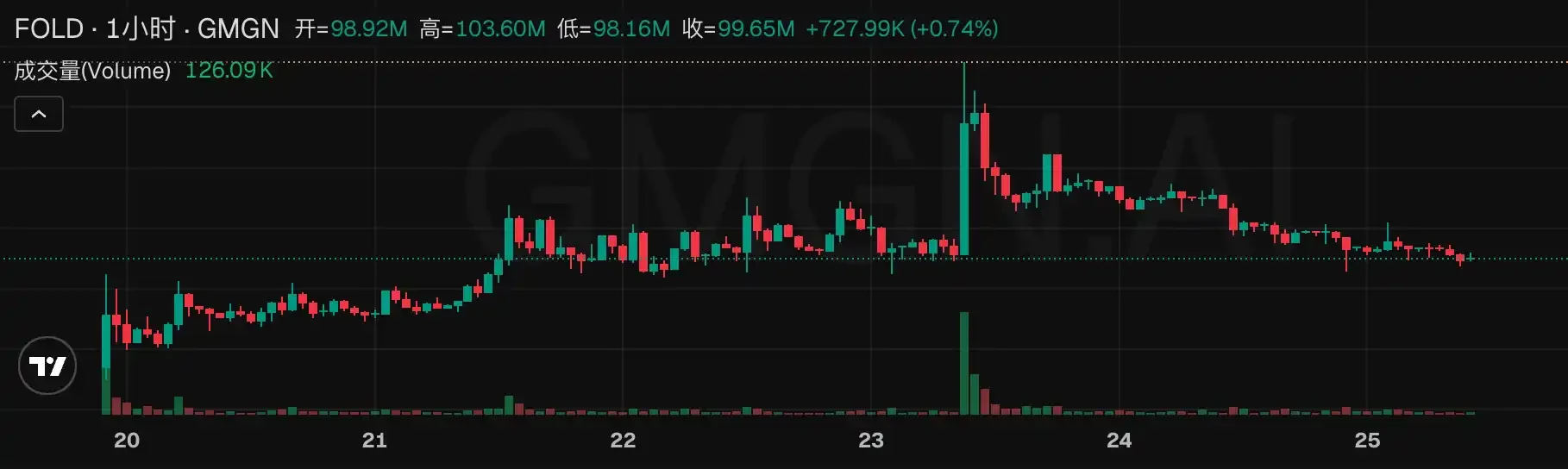
On August 19, the $FOLD token underwent its TGE, and then skyrocketed more than 7 times. We need to analyze this increase in two parts. On August 23, $FOLD was listed on Upbit, instantly doubling the coin price and reaching a market cap of about $230 million at one point. Prior to this, the narrative “Vitalik bought” was the primary catalyst, with on-chain players forming a consensus around this narrative, boosting the coin’s market cap from about $28 million to a peak of around $140 million.
After the unexpected good news from Upbit's launch, $FOLD did not further follow the market trend but instead fell back to the position it was in before the good news emerged. So we can roughly say that the coin has returned to the value range of the narrative “Vitalik bought”:
In fact, the narrative “Vitalik bought” surrounding $FOLD is more significant than one might think. This is a privacy-focused project, developed by Gnosis Guild, featuring an open-source privacy protocol that allows multiple untrusted independent parties to carry out verifiable computations and yield shared results without exposing their private inputs, relying on a single operating entity, or using trusted hardware.
Specific use cases include a DAO where anyone can vote privately, with no one able to see any individual voting record, yet everyone can verify the authenticity of the final voting results.
Encrypted data inputs will be submitted to the protocol’s encrypted execution environment, E3; every computation involving encrypted data will create an independent E3. After the computation ends, the E3 will close, leaving no data traces.
Nodes performing encrypted computations and decrypting need to stake $FOLD to obtain their qualifications.
Compared to ZEC, which is itself a privacy-focused asset, The Interfold is a multi-party privacy computing protocol that lets each party involved in a task collaborate without sharing their individual data. This concept feels quite hardcore when imagining practical use cases, particularly regarding the need for privacy protection.
In terms of the ease of acceptance of the narrative, ZEC is quite straightforward, being “the privacy version of Bitcoin; no one sees where my money goes.” However, The Interfold is more complex to understand. Vitalik directly promoted this project on X at the end of May this year; just looking at the reasons he recommended it clarifies its complexity...
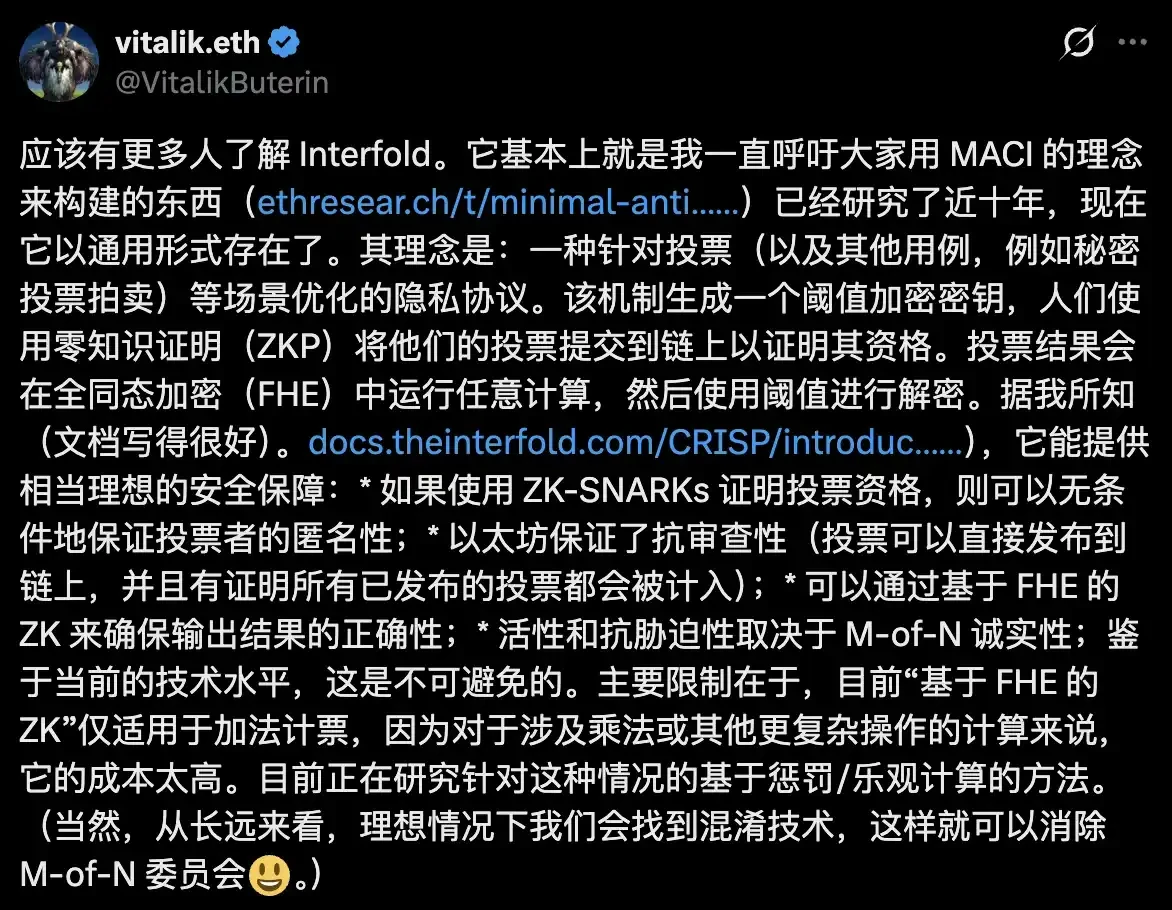
In July at dappcon, Vitalik mentioned this project again in person:

Additionally, Vitalik invested 16 ETH in the public auction, but he has yet to claim the tokens obtained from the sale, let alone selling them. Based on the above appearances, one could say that players are not concerned about what the Interfold can specifically be used for. It suffices for them to know that this is a project that Vitalik is optimistic about, has repeatedly mentioned, and personally invested in.
As for how the coin will perform moving forward, I am personally optimistic. Firstly, it is challenging to compare it to the last prediction market Truemarkets that Vitalik participated in, as the market environment during the $TRUE TGE last year was incomparable to now; moreover, $TRUE was not listed on any exchange, big or small.
The peak market cap for the fully circulated $TRUE did not exceed $20 million, while $FOLD is currently about 27% circulated, with a circulating market cap of approximately $27 million and a FDV of about $100 million. From the perspective of a token that was listed on Upbit merely days after its TGE, $FOLD seems to have some room for growth.
Projects that Vitalik personally invests in can be considered unlikely to sell in the short to medium term; at least on Truemarkets, regardless of whether it is at the low price point now or the peak last October, he has remained unmoved. The narrative “Vitalik bought” for $FOLD will likely continue, especially since he keeps mentioning it, making the probability of an overnight shift to “Vitalik sold” quite low.
Secondly, although this project is a bona fide privacy protocol, from a speculative perspective, applying meme coin strategies is not inherently problematic. The positive factors we can list include the strong performance of ETH, the overall good market environment, its listing on Upbit, and Vitalik’s repeated references, which are essentially attention-based logic, betting that under good overall liquidity, ETH will also be chased by everyone to become a hot target.
Its technology and use cases are rather difficult to comprehend, which inevitably means that for most on-chain players, the points attracting attention will not be the technology and use cases themselves but rather the various attention-driven factors we previously mentioned.
However, it is difficult to judge whether speculating on a target with a circulating market cap close to $30 million, especially on the ETH mainnet, which is currently not very hot, is an advance move or too niche. At this current position, although $FOLD has Vitalik backing it, the odds may not be very enticing.
免责声明:本文章仅代表作者个人观点,不代表本平台的立场和观点。本文章仅供信息分享,不构成对任何人的任何投资建议。用户与作者之间的任何争议,与本平台无关。如网页中刊载的文章或图片涉及侵权,请提供相关的权利证明和身份证明发送邮件到support@aicoin.com,本平台相关工作人员将会进行核查。