Why does Coinbase's tokenized stock have more pages of "risk warnings" compared to other SPVs and synthetic assets?
Written by: Sanqing, Foresight News
On August 25, Coinbase's tokenized stock officially launched on the Base network, with initial targets including Apple, NVIDIA, Meta, and Alphabet. The issuing entity is the newly established Coinbase Onchain SPV Ltd, with the underlying shares custodied by the licensed broker Alpaca, placed in a trust structure supervised by the Abu Dhabi Global Market (ADGM) Financial Regulatory Authority. The tokens held by users are a type of "Certificate," representing a proportional beneficial interest in the trust assets. These securities do not constitute a direct investment in the underlying stocks. Currently, this product is not available to U.S. users, and the initial day's liquidity is mainly provided by the decentralized exchange Aerodrome on Base, with the tokens also accepted as collateral by lending protocols like Aave.
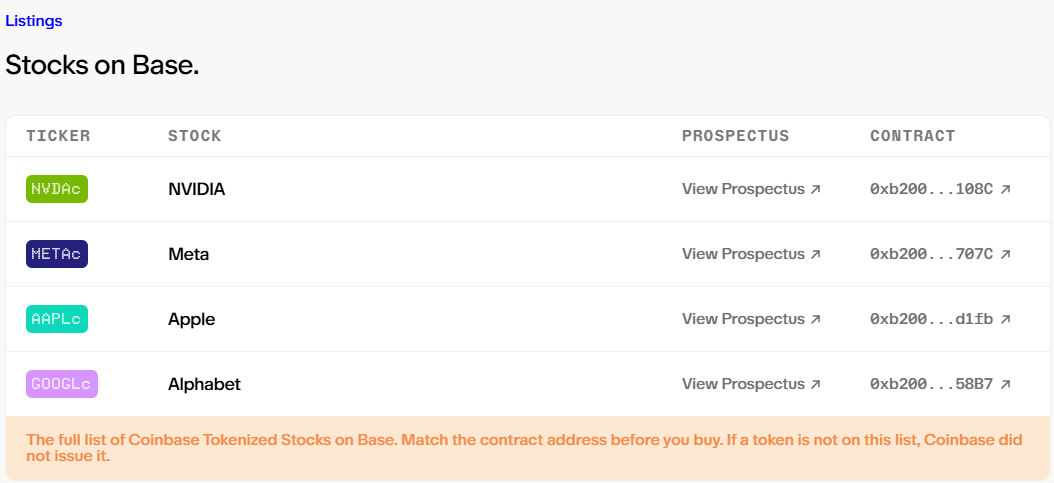
Not Stocks, but Coinbase's "Certificates" are Closer to Stocks
Coinbase entered the field of tokenized stocks relatively late.
xStocks was the first, launched on June 30, 2025, by Backed Finance in collaboration with Kraken; Ondo Stocks followed two months later, launching on September 3, 2025, with a product model where U.S. licensed brokers hold real underlying shares from the beginning. On October 7 of the same year, Ondo completed the acquisition of SEC-registered broker Oasis Pro, further completing the compliant licenses domestically; Binance's bStocks launched on June 11, 2026.
xStocks, Ondo, bStocks, and Coinbase all have special purpose vehicles (SPVs) as the issuing entities.
xStocks is issued by Backed Assets (JE) Limited registered in Jersey; Ondo is issued by Ondo Global Markets (BVI) Limited registered in the British Virgin Islands; bStocks is issued by BTECH Holdings Ltd registered in ADGM; the issuer of Coinbase is Coinbase Onchain SPV Ltd, incorporated in June of this year, also in ADGM.
All four official documents state that holders do not receive a direct investment in the underlying company, but rather some form of beneficial interest or debt claim on the assets held by the SPV.
The real difference lies in the specific terms set for holders by each company.
xStocks defines holder rights as "tracker certificates," with a legal nature as a debt claim against Backed Assets, where holders have no shareholder voting rights and no direct rights to the underlying company's assets.
Ondo adopts a structured note approach, where holders have redemption rights and a priority collateral interest guaranteed by Ankura Trust Company. Holders will not appear on the shareholder registry and have no shareholder voting or information rights. bStocks also indicates that holding bStocks does not represent direct ownership of the shares of the listed company.
However, it excels in its simple structure, where the token itself is the certificate, with a direct settlement process.
Coinbase's structure adds a threshold on top of these three, called Vesting Conditions. Holders are divided into Vested and Unvested: Vested Holders, who have completed KYC and other vesting conditions and are registered in the Legal Register, enjoy complete proportional beneficial rights in the trust assets, exercising redemption rights and voting preferences.
Unvested Holders, who have not completed the vesting conditions, even with tokens in hand, can only claim limited rights. The prospectus specifically lists a risk warning: failing to meet vesting conditions might result in loss of part or all of the investment.
B20 Standard Aids in Constructing DeFi "Building Blocks" for Tokenized Stocks
Coinbase's initial integration list showcased 52 agreements/entities, covering multiple segments including trading, lending, wallets, curation, compliance, and research.
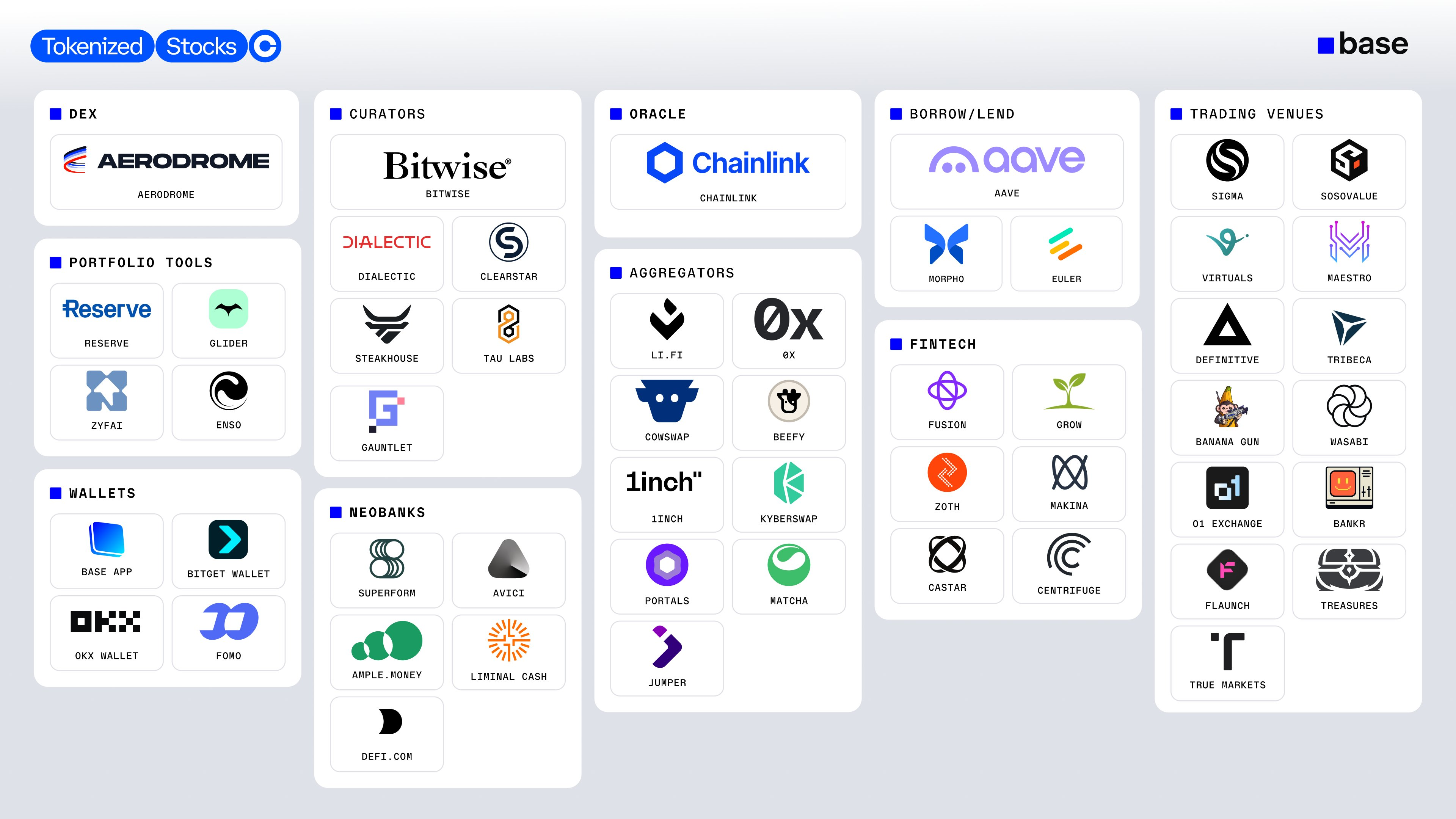
Among these, trading liquidity is provided solely by Aerodrome; the lending market has connected Aave, Morpho, and Eule at one time; the exchange aggregation layer covers 0x, 1inch, KyberSwap, CoW Swap, Matcha; price data is supported by Chainlink oracles; cross-chain transfers are handled by LI.FI and Jumper; wallets have integrated Base App, Bitget Wallet, OKX Wallet, Fomo; professional institutions like Steakhouse, Gauntlet, and Dialectic are responsible for providing position monitoring and risk control modeling for the protocols.
This chain of links can come together as long as the B20 standard addresses one technical issue: if dividends and stock splits are implemented by changing token balances, any positions collateralized in Aave would be disrupted on the company's dividend day.
The B20 approach compresses company actions into a "multiplier," such that the number of tokens remains unchanged. Cash dividends are not deposited into wallets but are converted into proportional shares based on the stock price at that time, reflected as a multiplier adjustment—e.g., the multiplier changes from 1.00 to 1.02 after dividends, indicating that one token can now be exchanged for 1.02 shares.
Stock splits work similarly, with the multiplier and stock price changing in reverse sync, ensuring continuous value when multiplied, without any gaps. Most routine operations undergo "scheduled" updates; only extreme cases activate "instant" updates. The price terminals work with Chainlink oracles, providing "total return price" (stock price × multiplier).
On the day of the corporate action, the pricing feed will be momentarily frozen, and only after both the stock price and multiplier are confirmed and updated will the quotes resume. This prevents the protocol from executing liquidations when the data is only half updated.
Stock lending is one of the oldest and largest yield businesses in traditional finance, with trillions of dollars in stocks lent to short sellers or hedge funds at any given moment, but this business has historically belonged only to brokers and institutions.
Now, with the help of the B20 standard and lending protocols like Aave, a retail wallet holding a single tokenized Apple stock can also participate in earning borrow interest that was previously only available to institutions.
Additionally, the initial list includes two somewhat different names: Virtuals and Treasures, both of which have integrated tokenized stocks into automated trading systems.
Base refers to this direction as the "agentic economy" in its announcement. AI agents can operate continuously, but traditional stock accounts only accept trades during Monday to Friday within a 6.5-hour opening period. The market supply fails to keep pace with the operational capacity of agents. The 24/7 trading and programmable settlement of tokenized stocks fill this gap perfectly.
The inclusion of so many lending, exchange, and treasury management entities on the initial list indicates that Coinbase is not only focused on trade volume, but also wants to turn stocks into DeFi building blocks that can be directly read, pledged, and combined by other protocols.
Learning from Stablecoins, the $2.8 Billion Tokenized Stock Market is Not in a Hurry to Conquer
According to data from RWA.xyz on August 25, the distributed scale of tokenized stocks is approximately $2.48 billion, with 2.12 million holders and monthly active addresses surpassing 1 million.
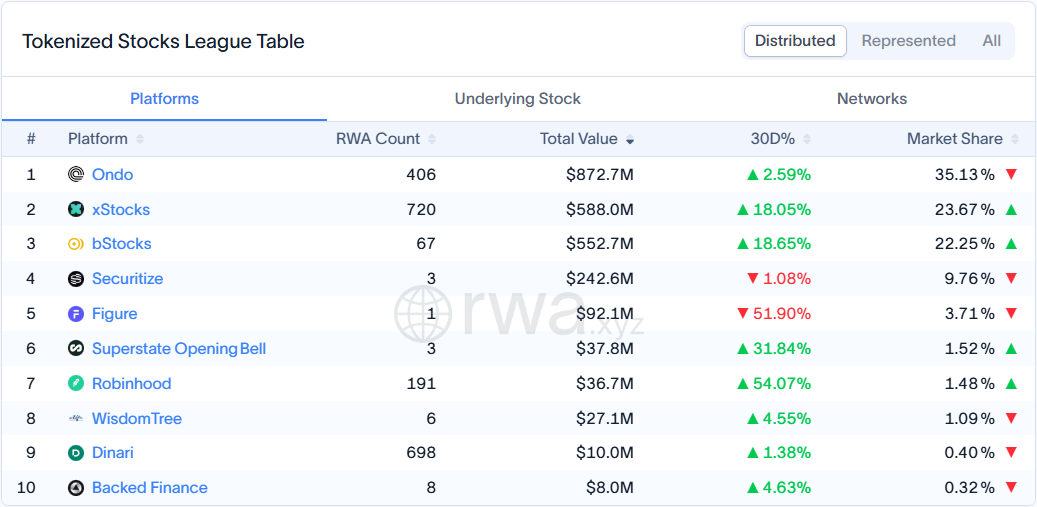
Among these, Ondo Finance, Kraken's xStocks, and Binance's bStocks collectively secured over 80% of the market share, with scales of approximately $873 million (35.1%), $588 million (23.7%), and $553 million (22.3%), respectively. Despite only operating for just over two months, bStocks has caught up to xStocks, which has been in operation longer, as the three share a significant portion of the market's liquidity and users.
The variable that Coinbase can bring is more about its brand trust as a publicly traded exchange and the nearly 50 partners that were ready on the first day.
Additionally, there are the "issuer-sponsored" models from Securitize and Superstate, where listed companies themselves authorize the process, recording tokenized shares directly into the official shareholder registry, with tokens corresponding to real CUSIP codes. Holders receive the same legal rights as traditional shareholders without the need for the SPV layer.
However, its limitations are not only slow. These tokens are legally recognized as restricted securities and must contain a transfer whitelist, allowing only KYC-verified addresses to hold and trade them. Coupled with the price protection rules for tradable prices in U.S. securities transactions, the on-chain automated market maker model is currently unviable. This means it cannot seamlessly integrate with lending protocols like Aave or liquidity pools in Uniswap like the synthetic tokens issued by xStocks, Ondo, bStocks, or Coinbase.
Whichever route taken, the current total scale of $2.8 billion in tokenized stocks is still a small number, roughly comparable to the early stage of stablecoins.
When Coinbase and Circle jointly launched USDC in 2018, the circulation scale of USDT was only a little over $1.8 billion, and no one could foresee that stablecoins would grow into a market worth hundreds of billions of dollars, transferring trillions annually in just a few years.
免责声明:本文章仅代表作者个人观点,不代表本平台的立场和观点。本文章仅供信息分享,不构成对任何人的任何投资建议。用户与作者之间的任何争议,与本平台无关。如网页中刊载的文章或图片涉及侵权,请提供相关的权利证明和身份证明发送邮件到support@aicoin.com,本平台相关工作人员将会进行核查。


