When robot traffic surpasses human traffic, who pays for the content?
Written by: Thejaswini M A
Translated by: Chopper, Foresight News
From Stamps to the Internet: The Core of Payment is "Simplicity"
Before 1840, in Britain, the recipient had to pay the postage for letters. The postage depended on the delivery distance and the number of pages of the letter. Postal workers had to calculate the cost for each letter, and then someone was sent to collect the postage.
In 1837, Roland Hill found this system very absurd. The cost of calculating how much to charge for a letter, then sending someone to collect the payment, exceeded the cost of delivering the letter itself.
The public also figured out ways to exploit the system. The sender and recipient would agree on a secret code in advance, marking the envelope's exterior. When the recipient received the letter at the door, they could refuse to pay after understanding the message encoded on the envelope. The letter would be returned, but the information had already been transmitted for free. Hill proposed a solution: a unified 1 penny charge to be paid in advance by the sender, using a sticker as proof of payment. The sender would affix this small sticker to the envelope, proving that the postage had been paid. This is the origin of the world's first postage stamp.
This prepaid mechanism was simple to operate, and within just a year, the volume of letters delivered more than doubled. The world thus learned a business principle: for a charging model to be viable, the process of collecting payment must be simple and cost-efficient.
This is also the reason why, in 1991, the designers of internet protocols reserved error code 402 (payment required) but never actually implemented it. At that time, the designers envisioned a scenario where web pages would charge per page. However, this idea did not materialize; if a website charged you 2 cents to access, just the credit card processing fees would deduct 30 cents. The cost of microtransactions was too high, and hence the 402 status code has been idle for thirty years.
x402: The Micro-Payment Breakthrough of the AI Era
Now the x402 protocol has emerged. It can handle micropayments at the level of 0.2 cents, with very low transaction fees. This protocol was developed by Coinbase and was transferred to the Linux Foundation in April this year, filling the long-vacant position of 402. When the server returns a 402 response indicating the access price, the client can complete the payment using stablecoins.
This is a renaissance moment for the 402 protocol. Cloud service provider Cloudflare carries a large portion of internet traffic, and they state that bot traffic has now surpassed human user traffic. The CEO of Cloudflare mentioned that an AI agent can generate web requests equivalent to thousands of typical human visits. Currently, Cloudflare's edge nodes return over 1 billion 402 payment responses to AI crawlers every day.
Currently, websites primarily rely on advertising or monthly subscriptions for revenue. But bots neither see advertisements nor subscribe monthly. The traditional two business models have become ineffective. The only viable new idea is to charge a minuscule fee for each web request made by these bots.
Major players like Visa, MasterCard, Google, Amazon, and Stripe are all positioning themselves in this field. Amazon integrated the x402 protocol into CloudFront in June, allowing websites deployed on this service to charge AI agents per access by simply modifying configurations. Cloudflare opened a call for applications for similar functionality on July 1, aiming to implement this capability across the network.
Before writing this article, I tested a transaction of about $5 in such payment wallets, and some observations in this article came from this practical experience; indeed, most relevant information can be publicly accessed online.
The current daily settlement scale for this protocol lies between $20,000 to $30,000, a 93% drop from this year's peak.
At the end of 2025, the daily transaction amount for this protocol almost approached or occasionally exceeded $1 million. A significant portion of the transaction volume came from the token PING, which directly used this payment process as a minting mechanism: users access the interface, receive a 402 payment prompt, pay $1, and then receive tokens. The gas fees on the Base chain are almost zero, thus many users repeatedly executed this operation hundreds or thousands of times. Chainalysis reported that over 150,000 transactions were made in the first month after PING was launched, with a weekly transaction volume increase of over 10,000%.
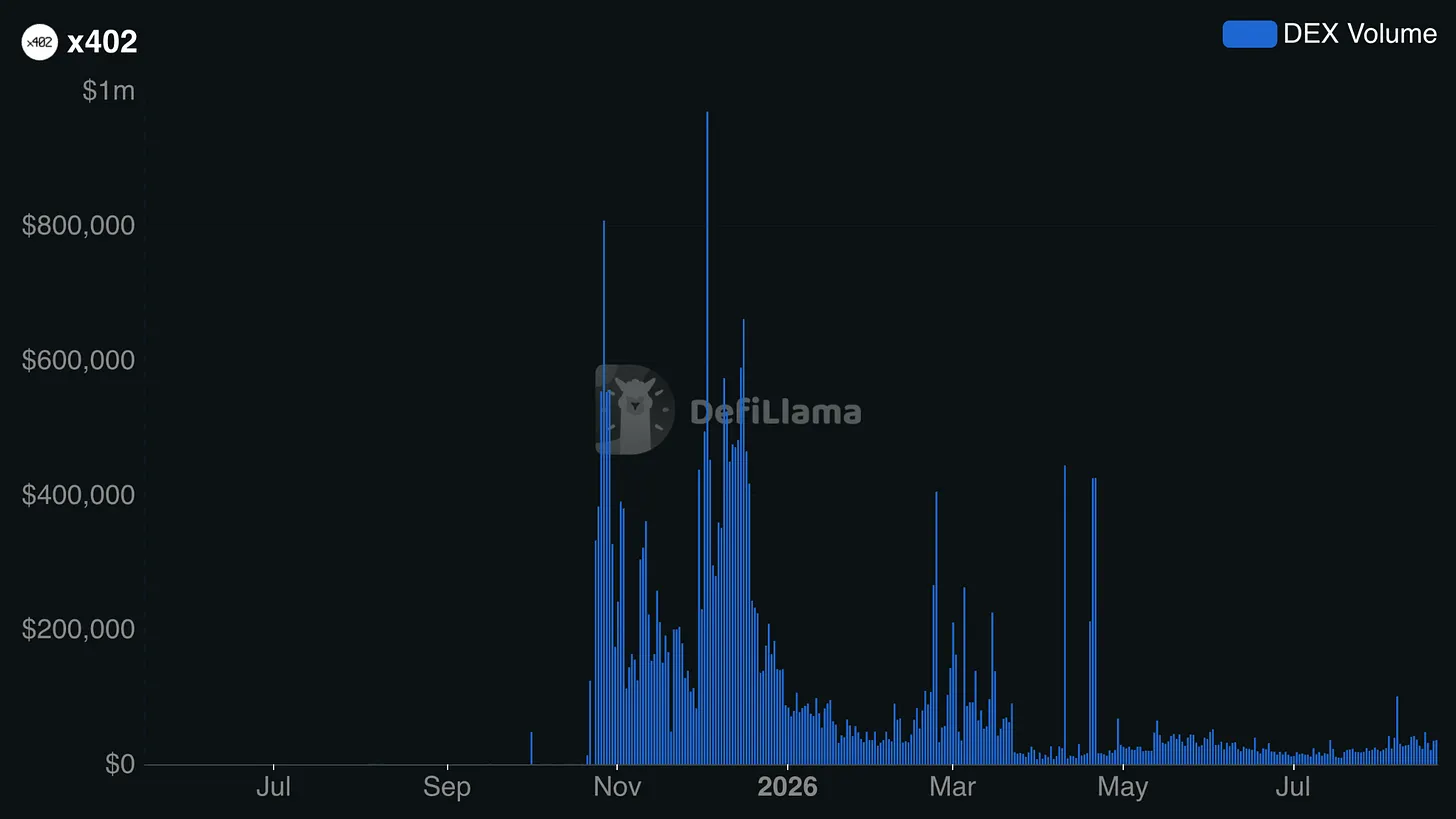
Therefore, the 93% decline in scale is partly a cleansing of fake transaction volumes, which is actually a positive change. The price of the MEME coin PING has also plummeted by 96% from its peak last October. But data shows that even with the loss of speculative fervor, there are still wallets regularly using the protocol, indicating that it indeed possesses genuine business value.
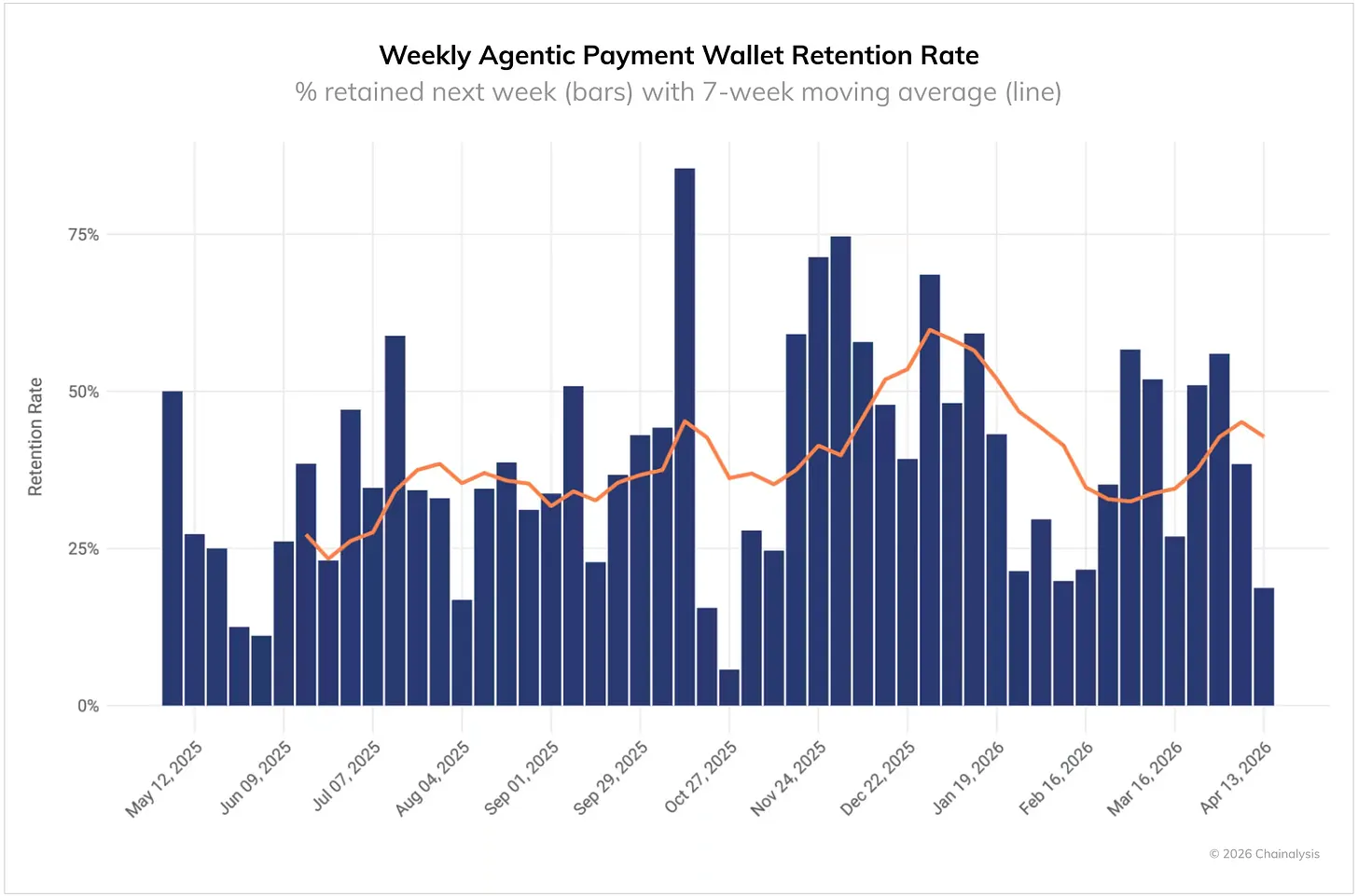
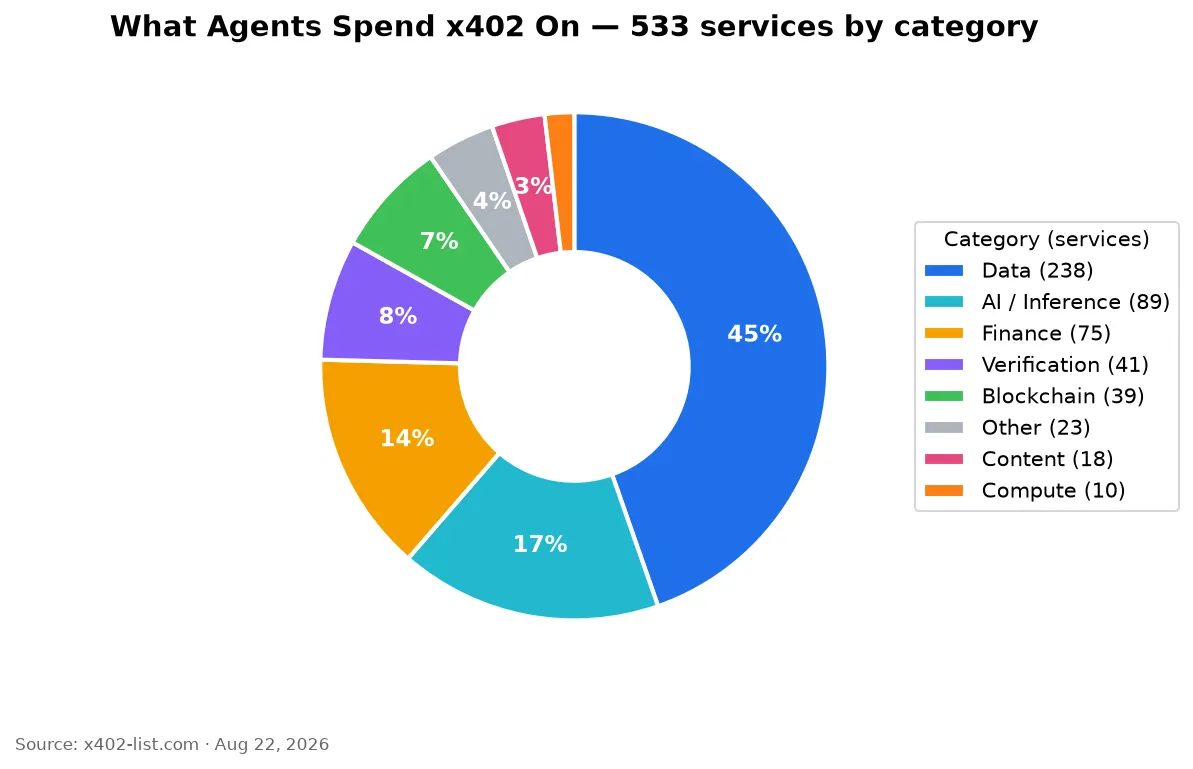
I then looked into what AI agents are spending money on. x402-list showed a total of 12.6 million purchases, amounting to $1.2 million, with over 22,000 buyers and 33,000 sellers. However, just one seller named BlockRun accounted for 64% of the total payment flow. BlockRun earned $199,000 by selling routing access to AI programs.
Bots also purchase second-hand data such as network searching from intermediaries. This market is difficult to comprehensively quantify; x402scan, which includes a large list of 533 sellers, admits to only capturing 17% of the actual transaction volume. This means that the current AI agent economy largely consists of programs purchasing cheap reasoning capabilities from routing service providers and second-hand web data from intermediaries. This is not inherently problematic, but it is still a long way from machines autonomously ordering physical goods.
So, is x402 considered a success? In the specific scenarios it targets, I believe it is. It isn't used for typical consumer purchases like buying shoes with a credit card, but it has become the preferred solution for robots to buy data.
It does not compete with the commercial agreement jointly launched by OpenAI and Stripe for ordering physical goods within ChatGPT. Nor does it compete with Google’s AP2 payment protocol, which actually calls on x402 in the background. These two tools are aimed at typical retail consumption, requiring human confirmation of the purchase and then passing the transaction to the card network for processing; AP2 can also opt to interface with x402.
If you purchase a data subscription within ChatGPT, what happens behind the scenes is still conventional credit card charging. OpenAI's protocol handles permission validation, while Stripe manages the flow of funds.
x402, however, is completely different; its counterpart is merely a server, with no account, no subscription, and a unit price of even less than one cent. Traditional credit card networks would not handle such micropayments, so a completely new payment channel is needed.
Thus, x402 does not compete with traditional checkout protocols. Developers have already built projects allowing AI agents to use encrypted wallets for purchasing physical goods online. But at this stage, the core use of x402 is to enable robots to purchase non-physical digital resources. In this rapidly growing field, it stands out almost alone.
The Difficult Situation of Sellers
I reviewed publicly available blockchain data to see how much these third-party agent service providers have cumulatively earned. JarvisClaw is among the better-performing providers, with a total of 20,920 transactions yielding just $559, averaging about 2.7 cents per request. EmblemAI earned only $1.39 from 65 sales; VIBE AI made merely 46 cents from 1,264 transactions; provider Kite has only 19 cents in total historical income, a contribution from my test payment.
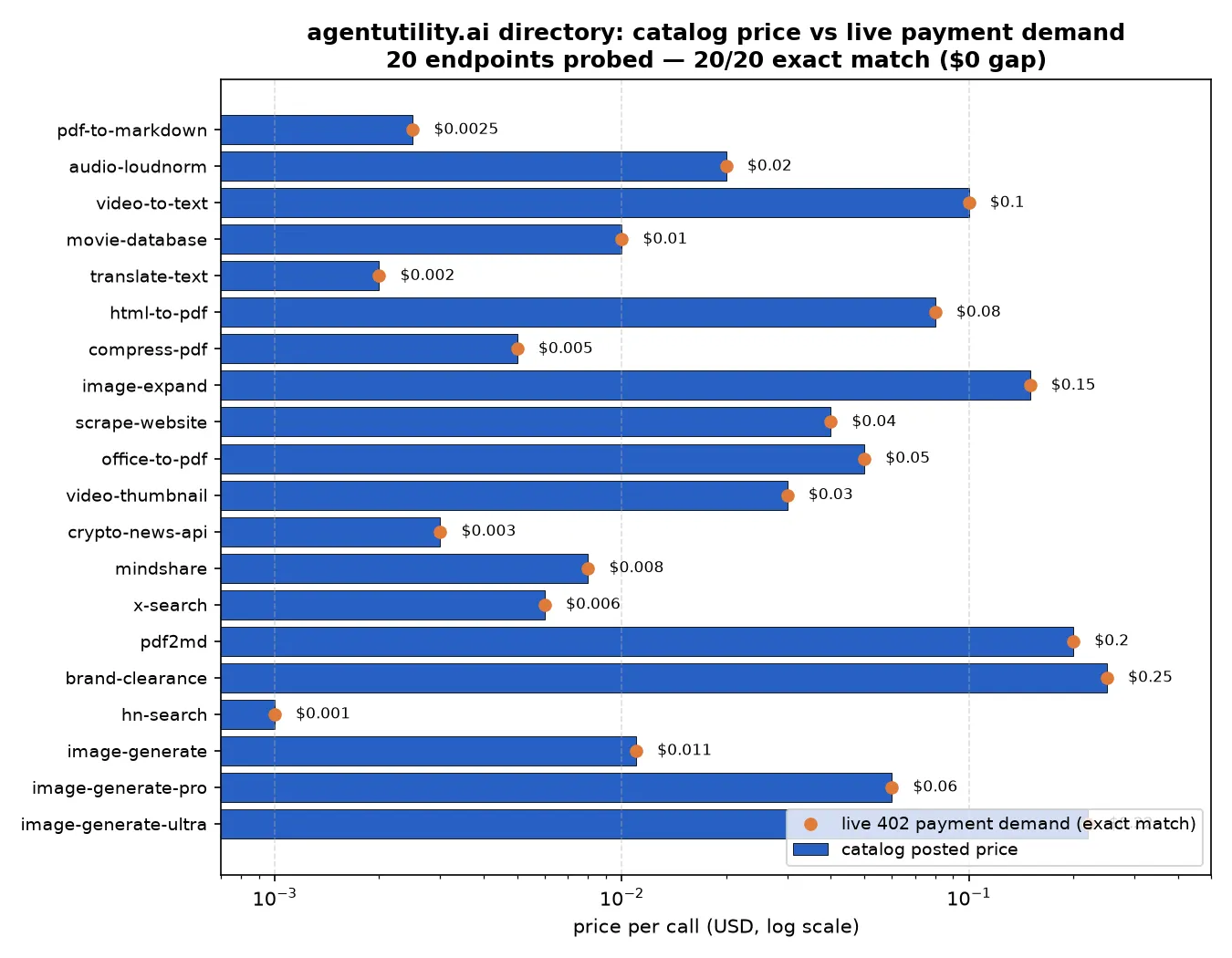
Then I had an AI agent verify the pricing of 22 public APIs. The good news is that the charges for properly functioning APIs matched the listed prices, with unit prices ranging from 0.1 cents to 25 cents.
The bad news is that out of the 22 APIs, 6 had already failed or crashed. About a quarter of the service catalog was completely unusable. These two phenomena point to the same conclusion: sellers can hardly earn any money, leading them to abandon their projects. When servers crash, subsequent users access dead links, causing the entire ecosystem to falter.
I once spent 4 cents to purchase financial data for a crypto project, but the system forwarded the request to a stock database. I received an empty file, yet still got charged; the transaction was marked as successful. There was no customer service available for a refund. Human consumption relies on brands, reviews, and refund mechanisms to avoid scams, but AI agents currently have no such protections.
Circle requires a verification code sent to a human email to activate; Stripe demands users to manually confirm in the mobile app; Nevermined.ai can connect to x402 to serve as a payment assistant, but still requires a human to log into the website to obtain the initial access key. Even free testing coin websites can identify bots and block access. After a human completes an initialization setup, these three can only operate automatically under the spending limits you set. Essentially, a human must unlock permissions before the machine can take over operations. This model is secure enough, but it contradicts the notion that "machines can complete everything autonomously."
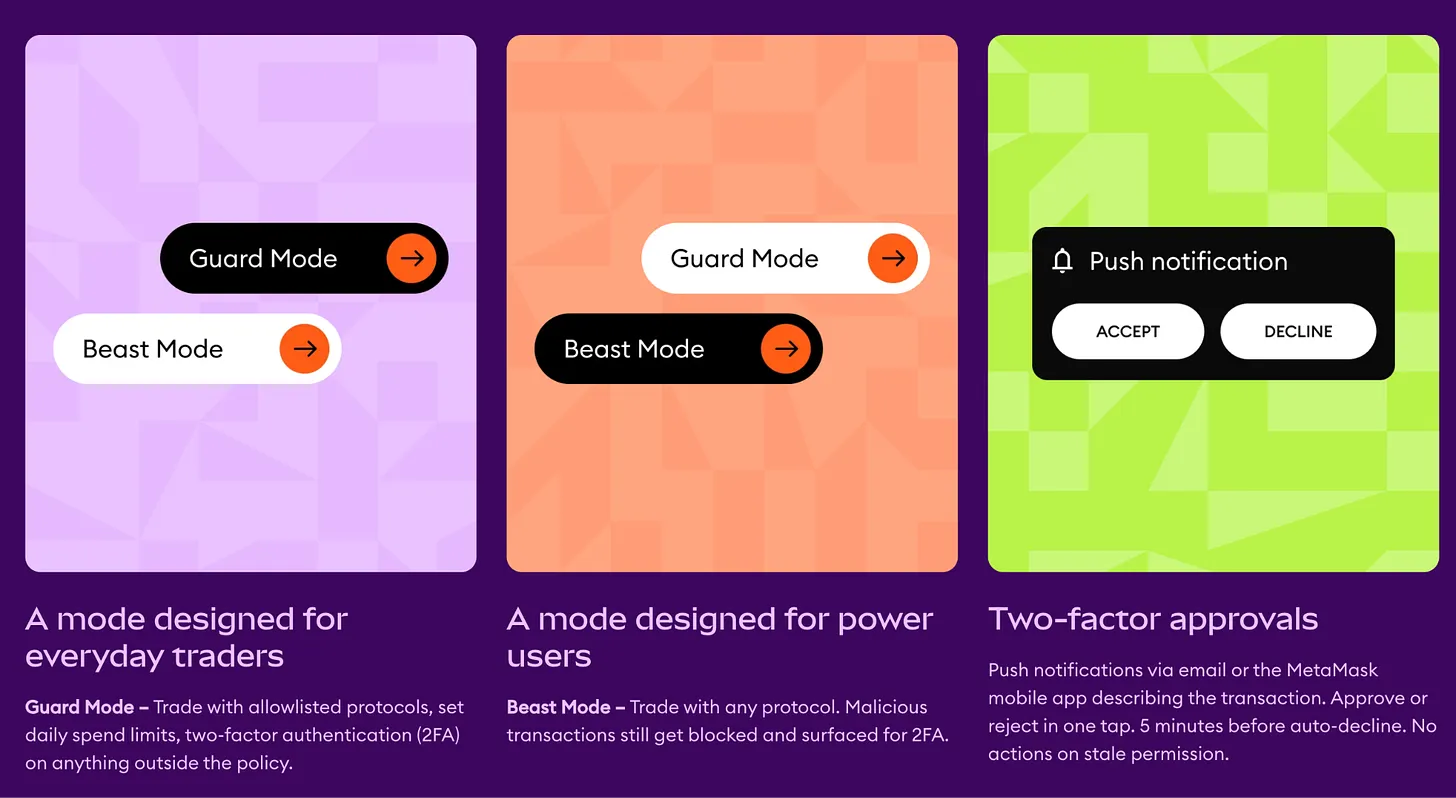
MetaMask's agent wallet has a completely different positioning. It is aimed at cryptocurrency trading, handling large token swaps, gambling, and decentralized applications. Any high-risk action requires human confirmation. This tool is suitable for high-value large transactions, but it is not adapted for bots making thousands of high-frequency small purchases of a few tenths of a cent.
It can indeed facilitate micropayments, but for the scenario where bots are repeatedly accessing cheap data files, excessive security verifications become redundant burdens.
Every payment made by your AI agent is completely public, permanently binding to the blockchain address. I conducted a test: I instructed another AI agent to investigate my test wallet solely through blockchain records. It accurately reconstructed all my operations: observing frequent small payments to the same API, automated tasks executed every 15 minutes during the night, and several large one-off transactions. It correctly identified that this was a developer automating the payment interface testing.
If businesses use this system, all of your partners, research preferences, and work hours will be permanently exposed to competitors. Traditional credit cards would safeguard such information properly.
The x402 protocol does not natively include chargeback or dispute resolution mechanisms. The design logic is that automated programs lack the human appeal and refund support system. MasterCard and OpenAI have integrated dispute resolution capabilities within their own payment tools. However, in an open crypto payment network, refunds entirely depend on the seller's willingness. The official x402 documentation suggests that sellers actively refund buyers. Because there is no native refund capability, another team has developed the x402r extension protocol, introducing escrow accounts to provide real refund channels for buyers.
The entire ecosystem severely lacks accountability mechanisms. When automated scripts exceed budget limits, which party bears legal responsibility is not clearly defined; there is also no native identity layer to trace which AI agent initiated the purchase. Researchers from the Swiss Federal Institute of Technology Lausanne and Zhejiang University recently investigated 15 core intermediary service providers carrying 99% of the traffic, serving over 60,000 sellers and 360,000 buyers. All service providers violated basic security norms, and researchers uncovered 31 previously undisclosed vulnerabilities that could facilitate free service exploitation and fund theft.
Conclusion
My conclusion is that the micropayment mechanism operates exceptionally well, but almost all supporting elements necessary for building a complete market are missing.
We need a tamper-proof reputation evaluation system and proof that the content obtained matches what was paid for, ensuring that the proof represents the completion of delivery, rather than blind transfers.
Client software should default to verifying blockchain data, rather than simply believing the seller's unilaterally issued invoices. Most importantly, we must find a business model that enables independent sellers to earn enough money to maintain continuous server operations.
Every website that you read for free today earns income from ads shown to humans. But human readers are rapidly being replaced by automated programs: robots leave the webpage without paying a dime, reminiscent of the old story in 1837 where coded marks on envelopes cheated postage payments.
In the history of the internet, robot traffic has surpassed human traffic for the first time. If micropayments can take off, it is the only hope for saving small websites and independent creators. If it fails, these content creators will be drained by crawlers and vanish, with all traffic devoured by large centralized AI answer engines. Setting aside the cryptocurrency narrative, this is the true stakes of this technology.
免责声明:本文章仅代表作者个人观点,不代表本平台的立场和观点。本文章仅供信息分享,不构成对任何人的任何投资建议。用户与作者之间的任何争议,与本平台无关。如网页中刊载的文章或图片涉及侵权,请提供相关的权利证明和身份证明发送邮件到support@aicoin.com,本平台相关工作人员将会进行核查。


