Using ETH net flow to adjust token issuance, NFTs become "bank licenses," how does The Standard Reserve actually work?
Written by: KarenZ, Foresight News
Most token projects first consider how to issue coins, to whom, and how to attract more buyers.
The Standard Reserve, however, approaches the problem from a different angle: if funds are fleeing, can the protocol actively reduce issuance, repurchase tokens, and compensate those who remain?
It tries to codify these actions into smart contracts, building an automatically adjusting on-chain monetary system. When funds flow in, the system gradually increases issuance and accumulates reserves; when funds flow out, the system reduces issuance, repurchases, and destroys tokens. NFTs are not just collectibles here but serve as "bank licenses" within the protocol: holders can become bankers and receive corresponding token issuance shares based on the number of branches they own.
The project refers to itself as a "sovereign on-chain central bank." But here, "central bank" and "bank" are just concepts within the protocol. The white paper clearly states that STANDARD is an experimental on-chain protocol, not a regulated financial institution, does not offer bank accounts, and does not hold customer funds.
Regarding the team, @0xbeans presented its mechanisms in the voice of a project participant and mentioned that the exit design continues some ideas from its 2023 Bear Bonds project. Bear Bonds is a system that transfers value from sellers to holders. The project won the ETHGlobal hackathon championship at that time. However, as of now, The Standard Reserve's website and white paper have not disclosed the founding team members or operational entities.
A monetary policy that only looks at ETH flows
The Standard Reserve plans to establish an ETH—STANDARD trading pool based on Uniswap v4. The system records fund flows through the trading pool's Hook:
When users buy STANDARD, it means ETH is flowing in; when users sell STANDARD, it means ETH is flowing out. The difference gives the net ETH flow over a period.
Based on this, the system breaks down into two states:
- When net ETH flow is positive, the system enters an expansion state. The speed of token issuance can gradually increase when funds continuously flow in; the protocol's ETH income during each epoch, including transaction fees and Charter auction revenue, is allocated 70% to the expansion treasury, which is used to accumulate ETH and purchase hard reserve assets (tokenized gold and similar assets).
- When net ETH flow is negative or zero, the system enters a contraction state. The speed of token issuance decreases immediately; 70% of the aforementioned ETH income obtained by the protocol in each epoch is transferred to the contraction treasury, used to buy back and destroy STANDARD from the open market. This treasury purchases STANDARD from the open market hourly, within limits, and all acquired tokens are destroyed. This throttling mechanism controls the daily buyback scale to about 5% of the trading pool depth, aimed at avoiding a single large purchase creating excessive market impact and preventing buyback funds from being concentrated for arbitrage within a single block.
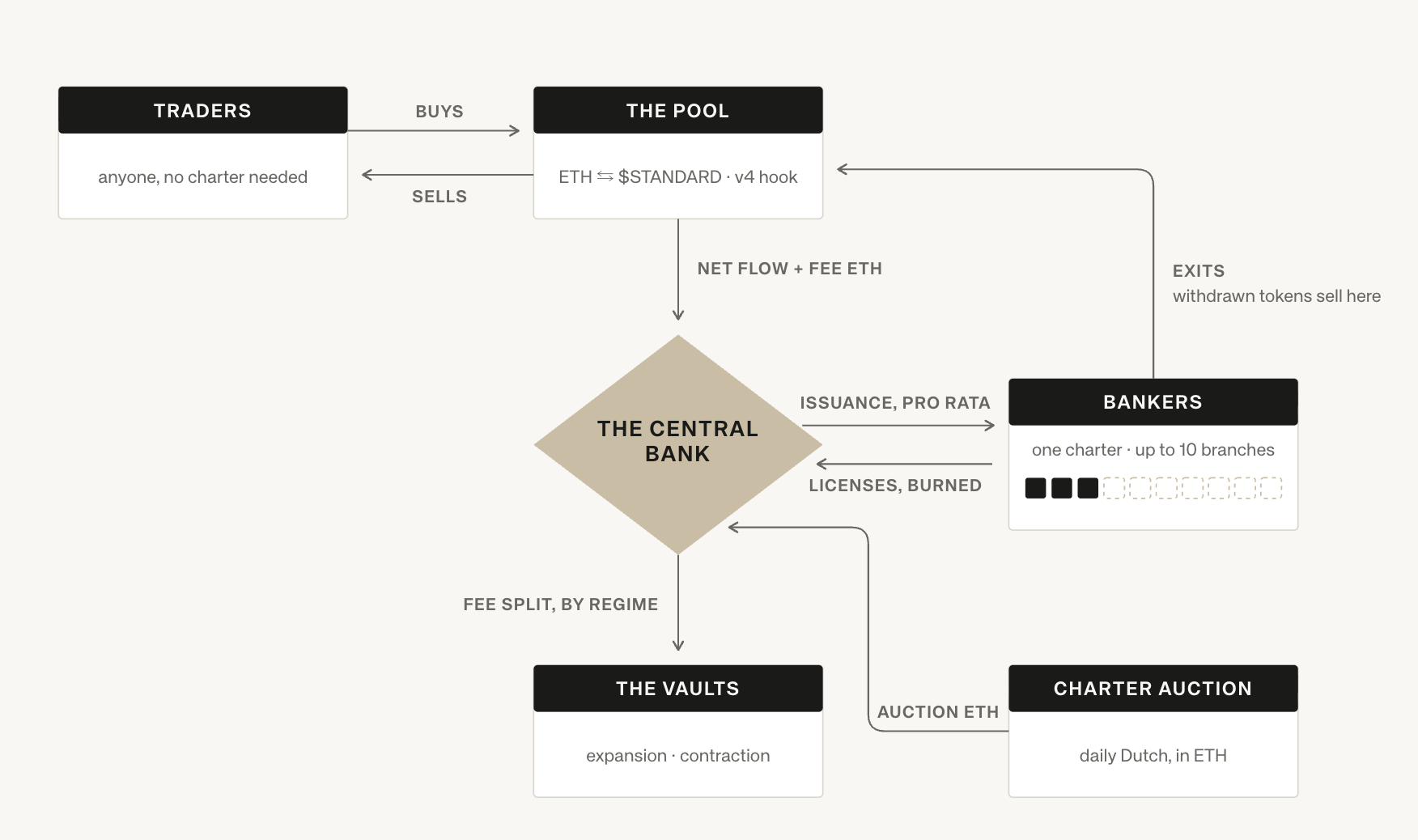
From the remaining ETH income, 15% is used to increase the protocol's own liquidity, and 15% is allocated to the team.
The issuance policy references the net flow from the last two completed epochs, while deciding whether funds go into the reserve treasury or repurchase based on the current epoch's fund direction. In other words, the system will not suddenly issue a large number of new coins due to a single large buy within a short time frame, but it can enter a defensive state faster when funds begin to flow out.
The Hook in Uniswap v4 is a smart contract module that allows custom logic to be executed before or after trading or liquidity operations. Therefore, using Hook to track fund flows, adjust fees, or trigger other operations is technically feasible.
NFTs became "bank licenses"?
Ordinary users do not need NFTs and can trade STANDARD freely. However, to receive newly issued tokens from the protocol, one must hold an NFT called "Charter."
Charter serves as a participation license within the protocol, akin to a "bank license." Holders are called Bankers, and each Charter initially has one branch, which can expand up to ten branches.
Branches can proportionally obtain issuance shares. The STANDARD generated within an epoch is distributed among all branches in the system proportionally based on their numbers.
The Standard Reserve plans to offer the free minting of 1,000 founding charters (Founding Charters), partially allocated to a whitelist and partly opened to the public, with a maximum of one mint per wallet.
After the genesis phase, new "bank licenses" (Charter) will be produced through a daily Dutch auction paid in ETH. The auction price starts at a high level and continuously drops over a day until someone is willing to buy at the current price. The ETH obtained from the auction will enter the protocol fee system.
When launching, Charter will be a non-transferable Soulbound NFT. The white paper reserves a one-way switch for the future to enable transfers. If the transfer function is activated, the Charter will transfer along with its branches and unclaimed balance.
How does STANDARD issue and destroy?
According to the white paper, STANDARD is an ERC-20 token with a hard supply cap of 1 billion pieces, but it will not all enter circulation at the project's launch.
The planned supply structure of the project is:
- 100 million for genesis liquidity, this portion of tokens constitutes the protocol's own full price range liquidity with ETH. The white paper states that this liquidity position is held by the protocol and cannot be withdrawn;
- The remaining 900 million is the future issuance budget;
- Once cumulative issuance reaches 900 million, base issuance will stop permanently.
STANDARD also has a special design: the earnings obtained by Bankers are initially just balances recorded internally within the protocol and will not be immediately minted into tokens in their wallets. Only when a Banker closes a branch and withdraws earnings will the corresponding amount of STANDARD truly be minted.
Tokens are primarily destroyed in three ways: all STANDARD paid when a Banker purchases an expansion license is destroyed; all STANDARD repurchased by the protocol from the market is destroyed; and half of the fees paid when a Banker exits is also destroyed.
Expansion requires burning tokens, exiting requires closing a branch
If bankers want to expand their share in subsequent token issuances, they need to increase branches for their licenses (Charter). However, new branches cannot be obtained for free; they must first purchase an expansion license.
Expansion licenses are auctioned daily in a Dutch auction format, initially offering 100 licenses per round. The auction price starts high and continuously drops over 24 hours until someone purchases at the current price. Each license can buy a maximum of three licenses a day; the round ends when all 100 licenses are sold, or the auction runs for a full 24 hours, with unsold licenses not carrying over to the next round. The result of the last transaction will determine the opening price for the next day.
Purchasing expansion licenses must use STANDARD, and the paid tokens will be fully destroyed. This means that as bankers increase the number of branches, a portion of STANDARD will be permanently removed from market circulation. However, increasing branches does not guarantee a profit: the amount of tokens each branch can distribute still depends on the system's issuance speed and the total number of branches in the system.
When bankers withdraw earnings, they need to permanently close corresponding branches. Assuming a license has ten branches, closing one can only withdraw one-tenth of the accumulated balance inside that license; only by closing all branches can they withdraw the entire balance, and once the last branch is closed, the license will also be destroyed.
The withdrawn internal balance will be minted into STANDARD at that time and transferred to the bankers' wallets, but first, an exit fee (Resolution Fee) will be deducted. Therefore, bankers cannot retain the original complete branch count and subsequent issuance share after withdrawing all earnings.
The exit fee is determined based on the recent seven days of exit pressure across the entire system: the more tokens applied for withdrawal relative to the remaining internal balance, the higher the fee rate. Half of the fee is destroyed, while the other half is allocated to bankers who do not exit. The specific lower limit, upper limit, and triggering interval for the fee rate have yet to be disclosed.
The white paper states that even if exit pressure reaches a high level, withdrawals will not be suspended or placed in a waiting queue. The protocol responds to concentrated exits by increasing exit costs rather than shutting down withdrawal channels.
Summary
As of August 24, The Standard Reserve has publicly launched its website, application page, and white paper v0.1; however, STANDARD and Charter NFTs have not officially gone live. The official statement emphasizes that there will be no sudden issuance of tokens or NFTs, and the current minting page remains in an "upcoming" state.
From the designs already disclosed, The Standard Reserve constitutes an on-chain monetary experiment: the license NFT decides who can be a banker, and the number of branches determines the relative share of new STANDARD issuance they receive; expansion licenses and new charter licenses are generated through Dutch auctions, and the protocol utilizes mechanisms such as reserve accumulation, repurchase and destruction, exit fees, and branch cancellations to regulate token supply and fund outflow.
However, it remains uncertain whether this mechanism can operate as described in the white paper over the long term. The Standard Reserve has not disclosed formal protocol contract addresses or complete audit reports, and key parameters such as base issuance speed, policy cycles, transaction fee rates, and exit fee upper and lower limits have not been fully revealed. Participants may also face risks and mechanisms such as smart contract vulnerabilities, insufficient market liquidity, increasing exit fees, and permanently losing corresponding branches and subsequent issuance shares after withdrawing earnings. DYOR.
免责声明:本文章仅代表作者个人观点,不代表本平台的立场和观点。本文章仅供信息分享,不构成对任何人的任何投资建议。用户与作者之间的任何争议,与本平台无关。如网页中刊载的文章或图片涉及侵权,请提供相关的权利证明和身份证明发送邮件到support@aicoin.com,本平台相关工作人员将会进行核查。


