Written by: Rita
The “quantity” of China's semiconductor industry has caught up, but the gap in “quality” remains enormous.
On August 24, Goldman Sachs released the fourth annual report of the “Chip Act” series, indicating that by June 2026, China's self-sufficiency rate for semiconductor ICs has reached 70%, nearly doubling from 38% in January 2010. The gap in value self-sufficiency remains significant, with the core bottleneck being the lack of photolithography equipment. Goldman Sachs raised its forecast for China's semiconductor capital expenditure in 2030 to $82 billion, a 79% increase from its previous forecast, to capture demand growth driven by the increase in self-sufficiency, generative AI, and customers' “localization” strategies. The report first covers the Chinese DRAM leader Changxin Storage, giving it a buy rating and a target price of 129 yuan.
Significant Capital Expenditure Revisions, Advanced Process Gap Narrowing Rapidly
Goldman Sachs expects China's semiconductor capital expenditure to maintain an annual growth rate of 10% to 15% from 2026 to 2030, reaching $82 billion in 2030. Front-end wafer equipment spending is expected to grow by 13%, 20%, and 15% from 2026 to 2028, mainly driven by investments in storage and advanced processes.
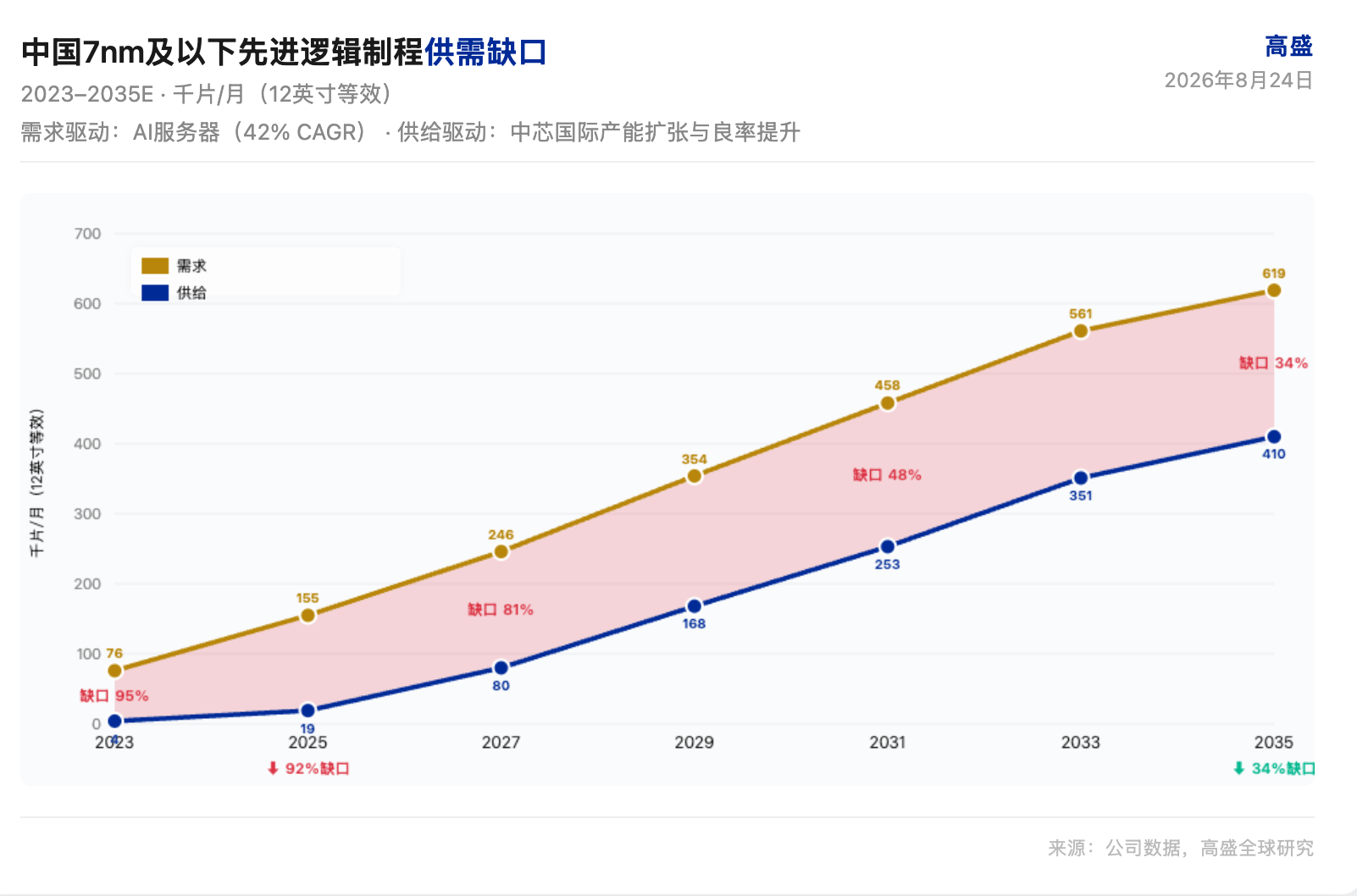
The supply and demand gap for advanced logic processes is narrowing rapidly. Goldman Sachs' model shows that the demand for 7nm and below wafers in China will have a compound annual growth rate of 17% from 2025 to 2035, reaching 619,000 wafers/month by 2035, primarily driven by AI server demand. During the same period, the compound annual growth rate for AI server wafer demand reaches as high as 42%. Supply growth is even faster, with a compound annual growth rate for 7nm and below wafers expected to be 46% from 2025 to 2035, reaching 410,000 wafers/month by 2035, largely benefiting from SMIC's annual capacity expansion of 30,000 to 50,000 wafers/month and yield improvements from 23% in 2026 to 75% in 2035. The supply and demand gap is expected to narrow from 92% in 2025 to 34% in 2035.
AI Chips and DRAM Market Growth Strong, $678 Billion and $257 Billion Expected
Goldman Sachs has released their first estimates for China's total addressable market for AI chips and DRAM. In a baseline scenario, China’s AI chip market is expected to reach $678 billion by 2030, with a compound annual growth rate of 69% from 2025 to 2030. This scale corresponds to a shipment volume equivalent to 27 million H800 AI chips and an IT power demand of 32GW. In a more optimistic scenario, the AI chip market could reach $4.1 trillion, corresponding to 238 million chips and a power demand of 196GW.
The Chinese DRAM market is also expanding rapidly. Goldman Sachs expects the compound annual growth rate of the Chinese DRAM market to be 50% from 2026 to 2028, reaching $257 billion in 2028. Among these, the compound annual growth rate for HBM is expected to be 188%, reaching $32 billion in 2028, reflecting strong demand for high-bandwidth memory driven by AI inference and training.
Changxin Storage is becoming a core supplier in China's DRAM market. Goldman Sachs predicts its capacity will grow from 270,000 wafers/month in 2026 to 447,000 wafers/month in 2028, and will more than double to 665,000 wafers/month by 2030 compared to 2026. Average annual capital expenditure from 2026 to 2030 is expected to increase from 60 billion yuan in 2024 to 84 billion yuan (approximately $12 billion) in 2025. Changxin Storage's conventional DRAM supply is expected to reach 41% and 50% of Samsung and SK Hynix by 2028, up from 28% and 35% in 2025 respectively. In terms of HBM, Goldman Sachs estimates that Changxin Storage's HBM revenue will have a compound annual growth rate of 166% from 2026 to 2030.
Accelerated Domestic Replacement of Equipment, Global Suppliers Remain Key
The domesticization rate of China's semiconductor equipment is steadily increasing. Goldman Sachs expects the share of local equipment manufacturers in the domestic WFE market to increase from 31% to 38% from 2026 to 2028. Deposition, etching, and photolithography are the three largest categories in the WFE market, which is expected to reach $53 billion by 2027.
Japanese equipment suppliers continue to benefit from the expansion of the Chinese market. Combined revenues from Tokyo Electron, SCREEN, International Equipment, and Ebara's front-end equipment companies in China are expected to reach 1.21 trillion yen in fiscal year 2025, accounting for 35% of their semiconductor equipment revenue. This ratio has decreased from 41% in fiscal year 2024, but all four companies expect their revenues from China to continue to grow in absolute terms. As Chinese wafer fabs move towards more advanced nodes, they increasingly rely on non-Chinese equipment suppliers to ensure yield.
U.S. equipment suppliers face export control pressures, and Goldman Sachs believes their shipments to China will remain around 25% of their revenues. Goldman Sachs maintains a bullish view on global equipment stocks, expecting WFE to grow by 36% and 45% in 2026 and 2027 respectively. Etching and deposition equipment will benefit from the expansion of surrounding gate transistors, 3D NAND, and advanced packaging. In the U.S. coverage, there is a priority recommendation for Applied Materials, Lam Research, and Onto Innovation.
Changxin Storage Benefits from Scarcity and AI Demand Dual Drivers
Changxin Storage is the only DRAM IDM company in China to achieve large-scale mass production, covering the design and manufacturing of DRAM chips, serving major domestic cloud service providers and consumer electronics brands. Goldman Sachs expects its net profit to grow at a compound annual rate of 47% from 2026 to 2030.
The growth momentum comes from two aspects: the expansion of China’s AI infrastructure driving demand for server DRAM and HBM; and consumer electronics customers diversifying their supplier networks to ensure supply security. Goldman Sachs expects Changxin Storage's conventional DRAM to have a compound annual growth rate of 34% from 2026 to 2030.
The target price of 129 yuan is based on the discounted earnings per share method for 2030, with a target price-to-earnings ratio of 16.6 times, discounted back to 2027. This valuation implies a 2027 price-to-earnings ratio of 24 times, corresponding to an average earnings per share growth of 77% from 2027 to 2028, with a PEG of 0.31 times, significantly lower than Cambricon, SigmaIntell, and Zhongwei's ratios of 1.12 times, 1.46 times, and 2.21 times. Goldman Sachs believes that the scarcity of Changxin Storage, product mix upgrades, and AI demand make its valuation attractive.
Downside risks include intensifying market competition, terminal demand failing to meet expectations, and geopolitical uncertainties.
The Chinese semiconductor industry is at a critical stage of transitioning from “quantity expansion” to “quality breakthroughs.” Significant capital expenditure revisions, the continuous narrowing of the supply and demand gap for advanced processes, and the explosive demand for AI chips and HBM are interwoven, collectively driving the revaluation of the industry's value chain. Domestic replacement of equipment, the rise of storage leaders, and the infrastructure for AI computing power constitute three major directions with strong certainty.
Disclaimer
This article is a summary and interpretation of a third-party brokerage research report (Goldman Sachs, August 24, 2026) by Chao Xiang Research, combined with public market information. The ratings, target prices, profit forecasts, and related judgments quoted in the text are the views of the brokerage analysts, representing only the position of their respective institutions and do not represent the views of Chao Xiang Research, nor do they constitute any investment advice.
The market carries risks, and decisions should be made independently. This article should not be used as a basis for buying or selling any securities.
免责声明:本文章仅代表作者个人观点,不代表本平台的立场和观点。本文章仅供信息分享,不构成对任何人的任何投资建议。用户与作者之间的任何争议,与本平台无关。如网页中刊载的文章或图片涉及侵权,请提供相关的权利证明和身份证明发送邮件到support@aicoin.com,本平台相关工作人员将会进行核查。


