Author: Matt Cole, Strive CEO
Translated by: Jia Huan, ChainCatcher
The trend of Bitcoin priced in gold further strengthens my judgment: The next Bitcoin cycle is likely to be the strongest one to date.
The dollar logic I previously mentioned, along with the AI-driven increasing scarcity demand in an "abundant era," is providing strong structural support for scarce assets. Moreover, the BTC/gold ratio has released another important signal: as more capital flows toward scarce assets, Bitcoin may be re-establishing its leading position relative to gold, once again becoming that "fastest horse."
Dollar and AI
This judgment is primarily based on two structural forces driving capital towards scarce assets.
The first force comes from the dollar.
As I wrote earlier this week, I believe the dollar might be entering a long-term down cycle, and the long-term trend of the dollar index (DXY) supports this judgment.
Bitcoin has never experienced such a macro environment before. If the dollar truly enters a long-term weak cycle, it will provide Bitcoin with a tailwind that has never been seen in its history.
The second force comes from the renewed pursuit of scarcity in the AI era.
As intelligence becomes cheaper and more abundant, many things that were previously valuable due to scarcity, such as knowledge, software capabilities, and many traditional business competitive barriers, are beginning to become easier to replicate.
This means that capital will increasingly value those scarce assets that cannot be replicated in large quantities due to technological advancements.
Bitcoin, gold, and silver may all significantly benefit from this change. And this is also a structural force that Bitcoin has never truly possessed before.
The combination of these two forces will drive more capital towards monetary assets with scarcity attributes. Gold will benefit, and Bitcoin will benefit.
For a long time, I have firmly believed that as the global purchasing power of currencies continues to be diluted and capital returns to chase scarce assets, Bitcoin will ultimately become that "fastest horse."
The BTC/gold ratio is an important indicator to observe when Bitcoin re-establishes such a leading position.
If the funds flowing into gold and Bitcoin are both increasing, and Bitcoin starts outperforming gold, then the opportunities brought by the combination of these two forces will be stronger than any single factor.
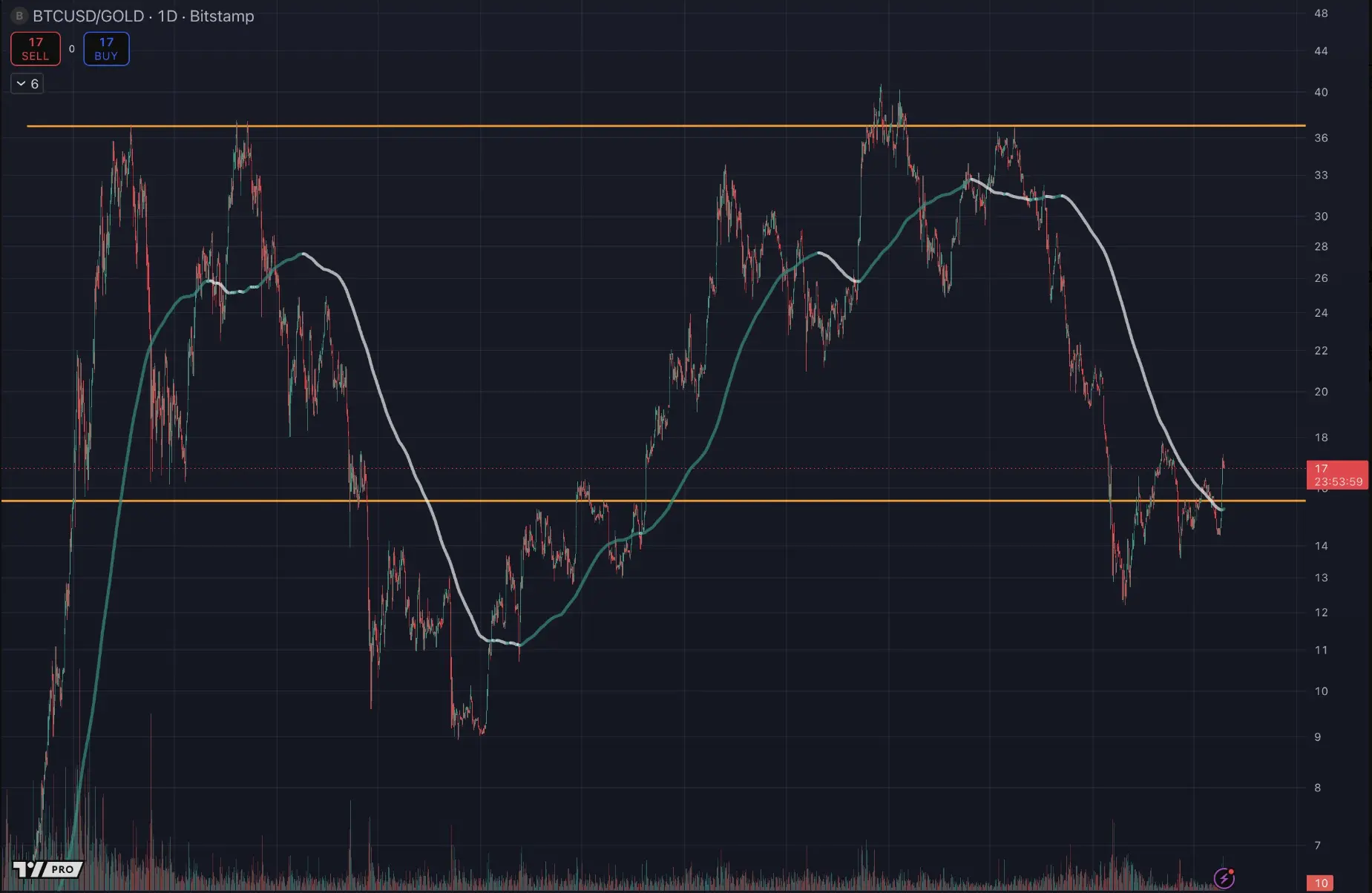
Over the past two years, the BTC/gold ratio has actually been a very effective leading indicator for observing Bitcoin's movements.
In December 2024, Bitcoin peaked relative to gold; however, Bitcoin priced in dollars did not peak until October 2025, with nearly a year difference between the two.
During this period, the dollar price of Bitcoin still continually set new highs, but it was no longer able to set new highs relative to gold.
This is very important for an emerging monetary asset like Bitcoin, which is still in a growth phase.
The sustainability of a bull market largely relies on new funds and liquidity, along with the resulting positive feedback: more and more investors want to hold an asset, driving it to strengthen further, and a stronger performance will attract more funds.
Looking back, BTC/USD was still sending strong signals at that time, but BTC/gold had already shown that the foundation of this bull market was gradually weakening.
Ultimately, this fragility also reflected in the dollar price.
This may also explain why market sentiment is so pessimistic in this bear market, even though the pullback priced in dollars isn't particularly severe by Bitcoin's historical standards.
Because during that previous bull market, Bitcoin never truly displayed the relative leading advantages that the market expected.
Although Bitcoin set a new high priced in dollars, it consistently underperformed gold, and then entered a bear market with a diminished relative strength.
If a bull market never validates the logic that "Bitcoin is the fastest horse," then even if the subsequent price pullback isn't as severe as in prior cycles, the investor's experience will still be very painful.
BTC / Gold
In the bottom phase, we can see similar signals, but the direction is entirely opposite.
Bitcoin bottomed out relative to gold in February 2026, but Bitcoin priced in dollars didn't truly bottom until July 2026, with a difference of about five months between the two.
This is why I have repeatedly discussed the BTC/gold ratio in different contexts in the first half of this year. Previously, the BTC/gold ratio indicated a market weakening earlier than BTC/USD; and while Bitcoin's dollar price remained weak, this ratio began to show signs of bottoming.
Thus, it was also one of the important signals I used to assess whether Bitcoin's bear market was possibly closer to the end than what the dollar price showed.
This bear market also has a significantly different aspect from the past: the financing environment hasn't tightened as dramatically as in previous bear markets, and the broader stock market still performs strongly, continuously setting historical highs.
In the past, a Bitcoin bear market often accompanied a clear weakening of the entire risk asset market. But this time, the weakness is more concentrated in Bitcoin and its related ecosystem. This makes the improvement of the BTC/gold ratio even more noteworthy.
What is truly interesting this week is: Now, Bitcoin has simultaneously broken through against both the dollar and gold, and this breakthrough is very forceful.
It wouldn't surprise me to see a notable pullback next, but it's also entirely possible that it won't happen.
If a significant pullback does occur, I expect the market to buy actively.
At the same time, I am now very confident: The Bitcoin bear market has ended.
If the BTC/gold ratio is once again the earlier signaling indicator, then seeing BTC/USD and BTC/gold both moving upwards gives me more confidence about the future 12 to 18 months, and makes me more optimistic about the larger opportunities that may arise in the next few years.
A weak dollar in combination with a continuously diluted purchasing power, along with the AI-driven pursuit of persistent scarcity, will create an extremely favorable environment for scarce assets.
And the relative performance between different scarce assets will ultimately determine where new capital and liquidity flow to.
When Bitcoin becomes that "fastest horse," it will have the chance to capture a larger proportion of new funds.
Stronger relative performance will bring deeper liquidity, and better liquidity will create greater space for trading, financing, and other capital operations, further attracting capital in.
If these structural forces continuously expand the entire scarce asset market, while Bitcoin re-establishes its leading position relative to gold, then Bitcoin is, in fact, occupying an increasingly larger share of a continually expanding pool of funds.
It is this situation that makes me more bullish on Bitcoin than at any other time.
Gold has thousands of years of monetary history behind it.
Meanwhile, Bitcoin possesses not only absolute scarcity but also global liquidity, portability, and a monetary network capable of transmitting and settling value anywhere in the world, 24/7.
If the dollar enters a long-term weak cycle, and AI drives the capital to re-chase persistent scarcity, while Bitcoin re-establishes its leading position relative to gold, it will constitute an environment that Bitcoin has never truly had before.
Our Bitcoin Strategy
This framework also profoundly influences the way we build Strive.
When we consider risk, we don't just think about how to survive a severe Bitcoin downturn.
For Bitcoin, which we believe still has tremendous upside potential, we think the bigger risk might actually be being too conservative.
Whether it's being not bullish enough on Bitcoin, or being bullish but structuring the company's capital in a way that doesn't allow common shareholders to fully participate when a real upswing occurs.
This is why we have consistently opposed the view that acquisitions, heavy investments, or placing primary focus on operating cash-generating businesses is the best way to maximize total return compared to Bitcoin itself.
If your fundamental judgment is that Bitcoin will appreciate significantly in the future, then waiting for the future business to generate cash flow before buying Bitcoin means you will end up buying fewer Bitcoins at higher prices.
Having businesses that can generate cash flow may seem more robust.
But if you believe converting this portion of economic value into more Bitcoin now can bring a higher expected total return in the most likely scenarios, then what is termed a more conservative cash flow strategy could ultimately lag in total return.
Considering all possible outcomes, we believe to maximize the expected total return of $ASST (Strive's stock symbol), we should increase our participation in Bitcoin's rise as much as possible, within the scope the company can responsibly endure, while maintaining strict capital discipline.
This includes: not using debt, not setting margin requirements, and not adopting any financing structure that could trigger forced liquidation.
On the surface, this structure looks very simple, and that is precisely what we intend it to be.
But the real difficulty lies in considering both the downside and the upside clearly:
Downside, how much of a drop can this structure actually withstand?
And:
Upside, if Bitcoin ultimately rises as you judge, how much return will be missed due to being too conservative with the structure?
If our macro judgment ultimately comes to fruition, then this structure will become very powerful.
First, the opportunities in the entire scarce asset space are expanding.
Second, Bitcoin may take a higher share from this increasingly large pool of funds.
Finally, $ASST's structure further amplifies the company's participation in Bitcoin's rise.
Thus, three layers of mutually reinforcing upward logic will actually form:
Opportunity pool expansion, Bitcoin capturing a larger share within it, ASST common stock further amplifying this return elasticity.
This is also why we care so deeply about accurately designing the company's capital structure.
The real upward logic is not merely "Bitcoin prices will rise."
It is that Bitcoin becomes the fastest asset in an ever-expanding scarce asset market, while $ASST is designed to maximize this outcome within the responsibly manageable limits of the company.
This bear market has allowed us to test this design in a real market environment.
Especially as Bitcoin approached the weakest phase of this cycle, we continued to actively purchase.
In the months leading up to this recent breakthrough, we were purchasing Bitcoin almost weekly.
We designed this structure from the start to maintain stability in a challenging Bitcoin market environment while continuing to retain a high Bitcoin return elasticity and having the ability to deploy capital when the opportunities are most attractive.
Now, we have a real market record that proves this structure has indeed accomplished that.
Looking at the BTC/gold ratio, there’s another aspect of this bear market that I find very interesting.
Bitcoin bottomed relative to gold in February, about five months earlier than it bottomed relative to dollars in July.
And $ASST also bottomed in February, well before the broader Bitcoin-related stock segment hit its lows around July.
I do not believe this temporal alignment is merely coincidental.
In both cases, the market seems to have first released a shift signal on those assets most sensitive to improvements in liquidity and risk appetite.
The BTC/gold ratio begins to indicate that I believe the asset running the fastest in a diluted purchasing power environment is regaining strength.
Meanwhile, ASST, as an asset with higher return elasticity concerning the same Bitcoin logic, is also starting to strengthen.
As the market's confidence in Bitcoin recovers and risk appetite rebounds, funds begin to flow towards more volatile assets with higher upside elasticity, and our capital structure, Bitcoin amplifying capacity, and liquidity design all position $ASST to possibly become one of the targets for new capital flows.
The high temporal proximity of these two inflection points is also why I think this correlation is so worth paying attention to.
Designing a structure on paper is one thing; experiencing a market downturn while observing the performance of the balance sheet and common stock is another.
I believe we can create and sustain a high Bitcoin return elasticity while relying on a solid capital structure and liquidity to maintain this capability in different market environments.
Ultimately, this will help the company achieve a higher valuation premium relative to its Bitcoin holdings.
This bear market is the period where we build this "performance engine."
Now, our common and preferred stocks have considerable liquidity; the company’s capital structure has no debt or margin requirements; at the same time, the company is prepared for what I believe is the next phase of the Bitcoin market environment forming.
A weak dollar along with continued dilution of purchasing power, the AI-driven era of abundance, and the BTC/gold ratio are effectively signaling three different but complementary things to us.
The first factor expands the overall opportunity for scarce monetary assets.
The second factor increases the value premium enjoyed by those scarce assets that cannot be easily replicated.
And the BTC/gold ratio helps us determine how much market share Bitcoin can take among all the scarce monetary assets competing for the same pool of capital.
Viewed individually, each of these changes is a positive factor.
But if they continue to develop in the direction we assume, then Bitcoin will enter its history's most favorable macro environment and relative performance combination.
This also means that the potential upside for Bitcoin in the coming years could reach a level we have never truly seen before.
免责声明:本文章仅代表作者个人观点,不代表本平台的立场和观点。本文章仅供信息分享,不构成对任何人的任何投资建议。用户与作者之间的任何争议,与本平台无关。如网页中刊载的文章或图片涉及侵权,请提供相关的权利证明和身份证明发送邮件到support@aicoin.com,本平台相关工作人员将会进行核查。


