Wall Street has not yet reached a consensus on the true value of Circle.
Written by: Lockridge Okoth, BeInCrypto
Translated by: Chopper, Foresight News
ARK Invest founder Cathie Wood (known as "Wood姐") has continued to increase her position in Circle as its stock price has fallen 42% over the past year. On Sunday, she revealed the reason behind this. She believes that a large number of Wall Street analysts have their careers rooted in Visa and Mastercard, so they fail to understand a company like Circle.
Circle is the issuer of the stablecoin USDC, which is a digital dollar backed by cash and U.S. short-term government securities. Wood leads ARK Invest, and Circle has now become one of the heaviest bets in her flagship fund's cryptocurrency assets.
Wood rebuts Wall Street analysts' views
Wood made this statement in response to a chart based on Artemis data. Analyst Alex Obchakevich published this chart, pointing out that the market's perception of who is profiting from the stablecoin business is changing.
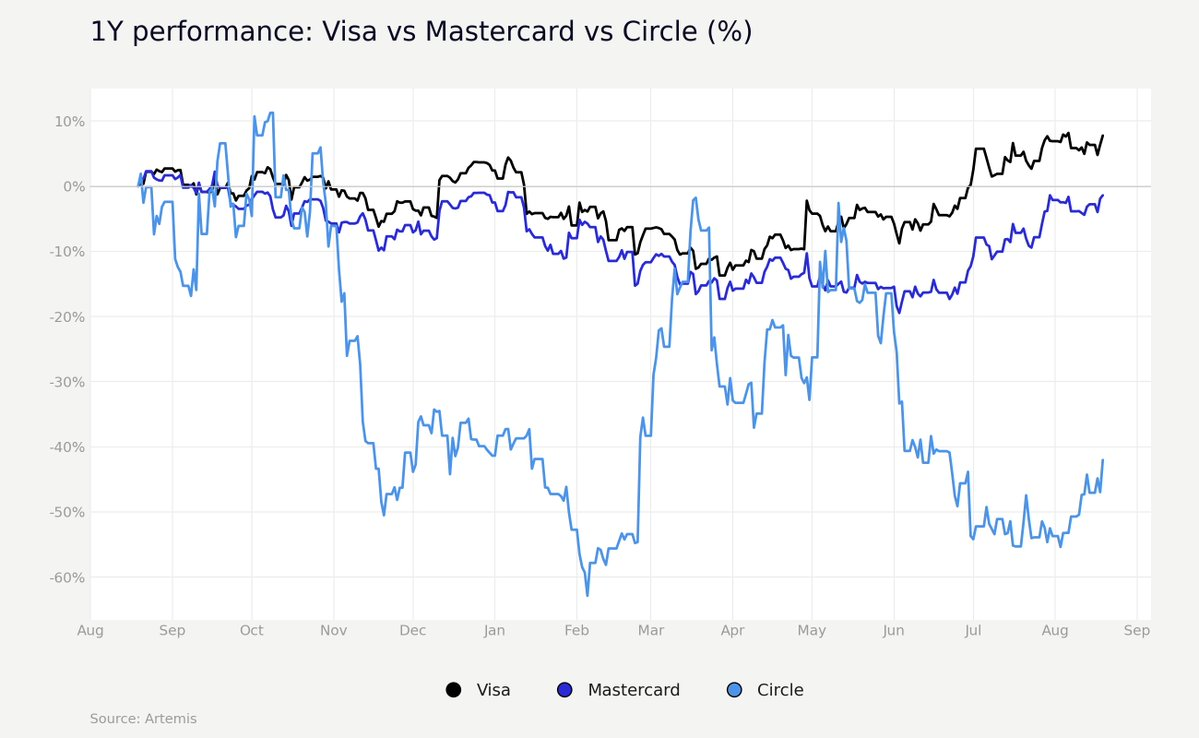
The chart tracks the stock price performance of three payment companies over the past year: Visa is up about 5%, Mastercard is up about 1%, while Circle is down 42%.
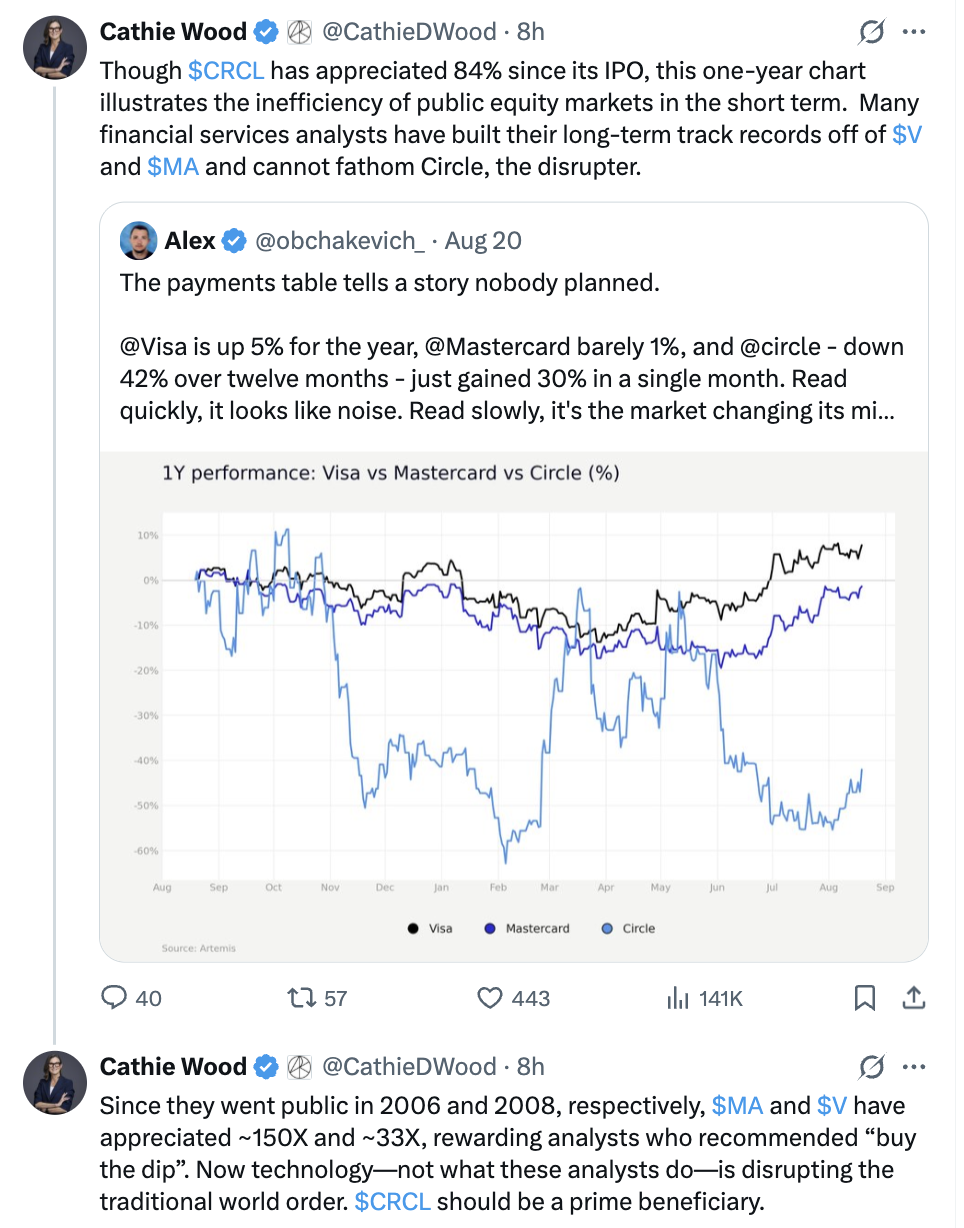
Wood posted on the X platform, stating, "Although CRCL (Circle's stock code) has cumulatively risen 84% since its IPO, this one-year chart precisely reflects the short-term inefficiency of public stock markets. Many financial services analysts base their long-term performance on studies of Visa and Mastercard, failing to understand disruptors like Circle."
She then brought up historical examples, noting that Mastercard's stock price has increased approximately 150 times since its IPO, while Visa has risen about 33 times.
"Analysts who once advised clients to buy these two companies on dips seem to have remarkable foresight in hindsight. However, today, it is technology, not analysts' expertise, that is reshaping the payments industry, and Circle should see growth."
Historical comparisons hold water, but one data point is incorrect
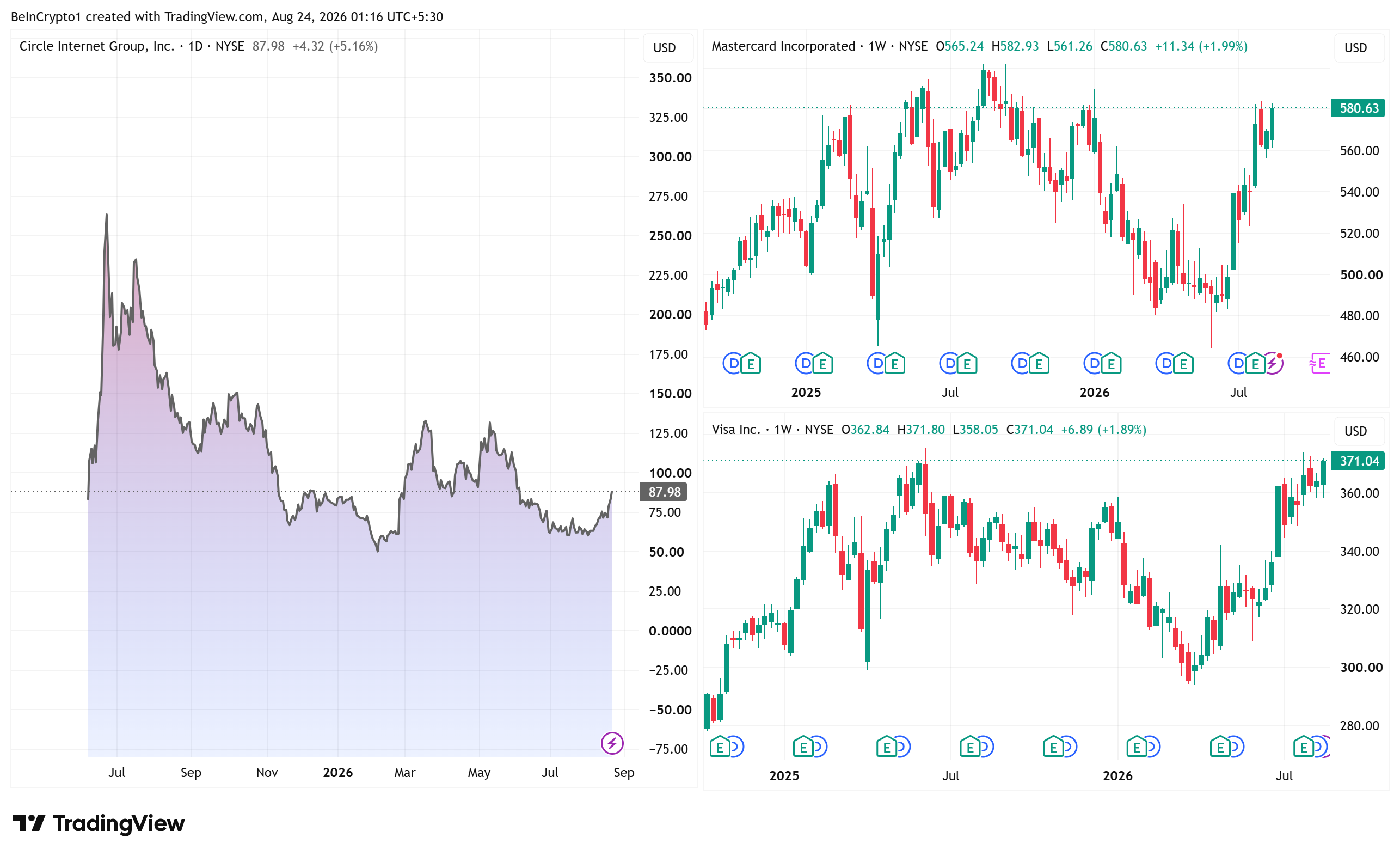
The multiples of price increases for the two traditional payment giants cited by Wood have been verified and are essentially accurate.
Mastercard's IPO price in 2006 was $39, and it later completed a 1-for-10 stock split, which adjusted to approximately $3.9 per share. Compared to last Friday's closing price of $580.63, this reflects a roughly 149-fold increase.
Visa's IPO price in March 2008 was $44, and it completed a 1-for-4 stock split in 2015, adjusting to an effective price of $11. Last Friday’s closing price of $371.04 corresponds to an increase of about 34 times. Wood's calculations in this regard are correct.
However, her statement about Circle's data is incorrect. Circle's IPO is set for June 2025 at an offering price of $31, and last Friday's closing price was $87.98, representing an actual increase of about 184%, rather than the 84% she mentioned.
Discrepancies in Circle’s valuation on Wall Street
Wall Street analysts are not ignoring Circle, which weakens some of Wood's arguments. Among the 21 analysts focused on the stock, 11 gave strong buy ratings, 2 gave buy ratings, 5 held, and 3 rated it as sell.
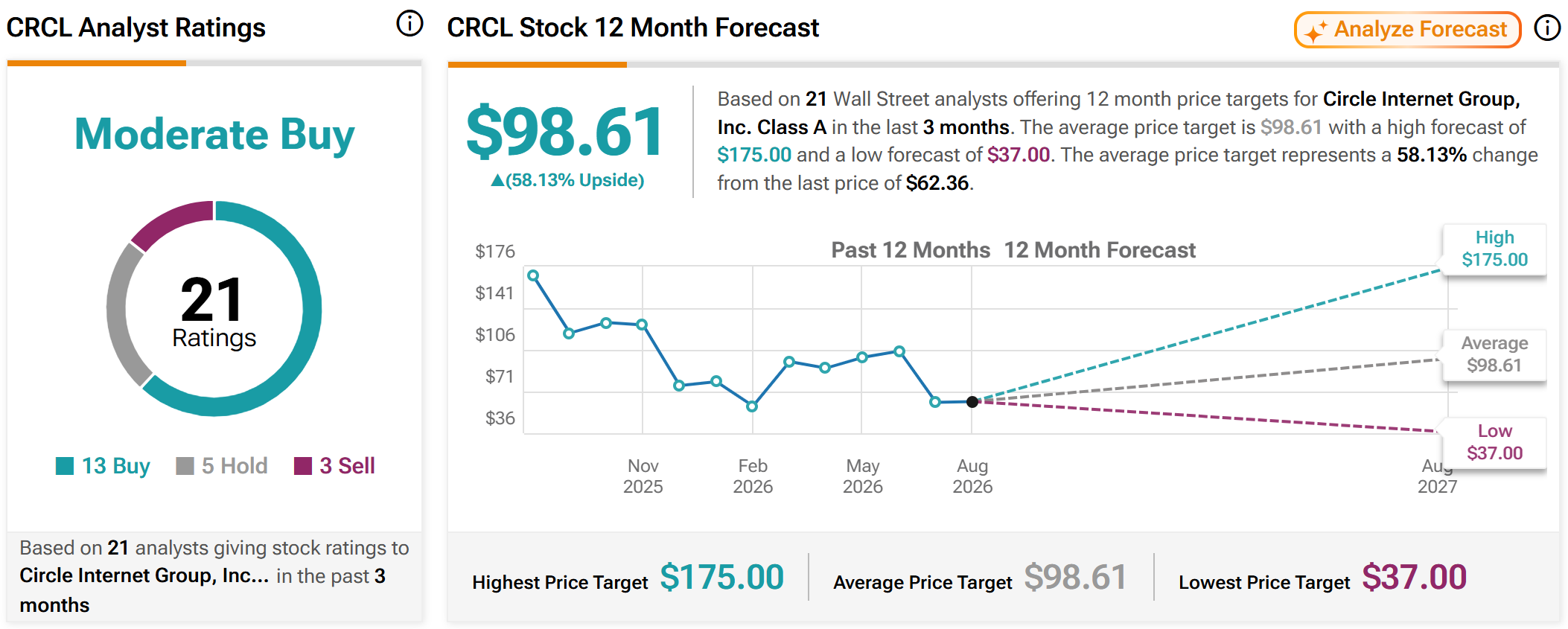
The target price discrepancies provided by the analysts are astonishing, with the most optimistic at $173 and the most pessimistic only $37. The target prices from the same company on the same day differ by 4.7 times, with an average target price of $98.61.
Such wide discrepancies would not occur for established payment networks among analysts. For Circle, there is no unified valuation framework in the industry. A considerable portion of Circle's revenue comes from interest on reserves, which will shrink if interest rates decline; the rest of the revenue is highly dependent on the adoption speed of stablecoins.
Circle's financial report data also confirms this contradiction. The second-quarter financial report for 2026, announced in early August, shows that the company’s revenue grew by about 37% and has achieved profitability, but its market value has still dropped by 30%.
The competitive landscape adds further uncertainty. Circle is building a technology stack based on its own Arc blockchain; at the same time, the OpenUSD alliance, composed of over 140 institutions, also aims to compete in the same payment infrastructure space.
Wood has not executed any hedging operations. Last Friday, ARK's flagship fund held 3,931,968 shares of Circle stock, valued at $329 million, accounting for 5.14% of the fund's portfolio, exceeding the position in Coinbase. The future may prove Wood to be correct. However, the stark contrast between a target price of $37 and $173 underscores one thing: the market has not yet reached a consensus on the true value of Circle.
免责声明:本文章仅代表作者个人观点,不代表本平台的立场和观点。本文章仅供信息分享,不构成对任何人的任何投资建议。用户与作者之间的任何争议,与本平台无关。如网页中刊载的文章或图片涉及侵权,请提供相关的权利证明和身份证明发送邮件到support@aicoin.com,本平台相关工作人员将会进行核查。


