Author: Jin Technology Bureau
In the AI payment race, most people are focused on traditional payment giants like Visa, Mastercard, and Stripe, or AI platforms like OpenAI and Google.
However, there is a set of data worth noting. According to Coinbase's disclosures during quarterly conference calls in 2026, over 90% of on-chain Agent transactions occurred on the Base chain, 99% of Agent business transactions settled in USDC, and over 97% of on-chain Agent transactions utilized the x402 protocol. The trading volume of stablecoins on the Base chain accounts for 62% of the entire industry’s stablecoin transactions.
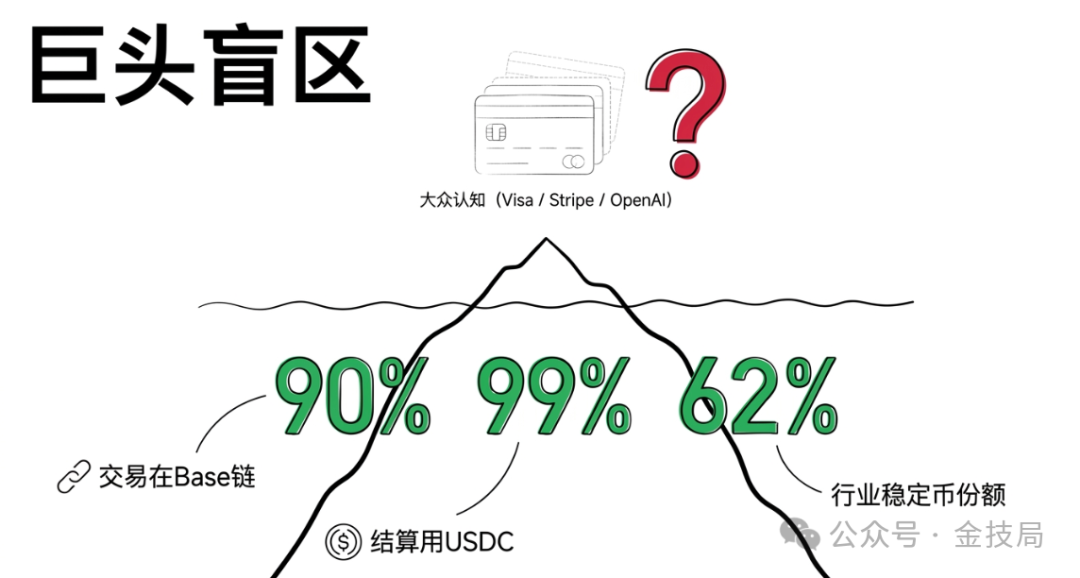
In other words, while everyone debates which track will win between card payments and stablecoins, and which protocol will set the standard, one cryptocurrency exchange has quietly become the largest actual operator in Agent payments.
This position is not held by Visa, nor Mastercard, nor Stripe, but by Coinbase.
What Coinbase does is not a payment protocol, but "giving Agents a wallet"
On February 11, 2026, Coinbase launched Agentic Wallets, a set of wallet infrastructure designed specifically for AI Agents.
Prior to this, the infrastructure for Agent payments was either APIs for developers or payment gateways for users. Agents themselves did not have their "own accounts". They needed to spend money either through a human's account or by indirectly operating through a platform's interface.
Agentic Wallets enables Agents to become entities capable of holding assets themselves. An Agent can have its own wallet address and autonomously hold funds, initiate transfers, execute transactions, and earn income under preset permissions and risk controls. It no longer needs a human account as an intermediary.

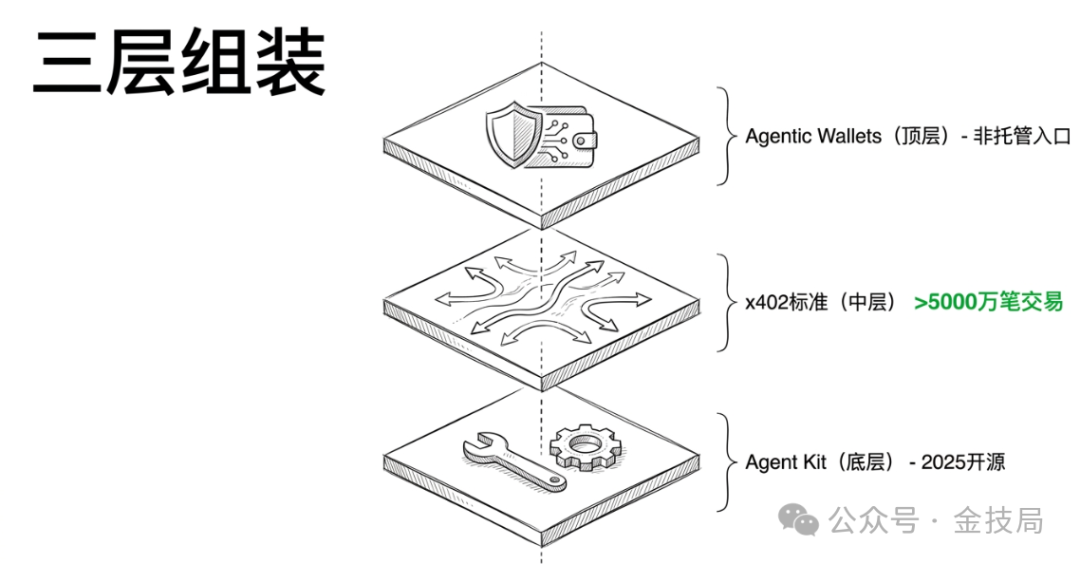
This infrastructure is assembled from several components. The bottom layer is Agent Kit, an open-source toolkit launched by Coinbase in 2025, allowing developers to integrate wallet functionalities into any Agent system. In the middle is x402 protocol, which activates the HTTP 402 status code for machine-to-machine payment standards and has processed over 50 million transactions. At the top layer are non-custodial wallets and security suites, which are deeply integrated with the Coinbase Developer Platform.
The combination of these three components forms a complete "Agent financial account".
This positioning is fundamentally different from what Visa and Stripe do. Visa aims to connect Agents to existing card payment networks, while Stripe connects Agents to existing merchant payment systems. Coinbase’s goal is to give Agents a completely new financial identity that belongs to them.
Why do Agents need "their own wallet," instead of using human cards?
This question is worth elaborating on. Why can't Agents directly use human credit cards to make purchases on behalf of others and instead need their own wallets?
The answer relates to a fundamental characteristic of Agent payments: many transactions between Agents are small, high-frequency, automated payment flows between machines.
An Agent calls another Agent's API to pay one-thousandth of a cent for a data query. If this payment were to be made with a human credit card, there are several layers of issues. The first is the transaction fee, where the card payment fee is a fixed percentage plus a minimum amount, resulting in the fee for a one-thousandth of a cent payment being several orders of magnitude higher than the principal. The second is authorization, where human credit cards require cardholder confirmation for each payment, which is impractical for Agents to verify for every small payment. The third is attribution, as human credit cards are linked to a person's identity, and for Agent-to-Agent payments, identifying the responsible Agent, platform, or person is difficult when using a human card.
Giving Agents their own wallets alleviates all three issues. The funds inside the wallet are stablecoins, resulting in very low transfer costs. The spending permissions of the wallet are controlled by code-level policies, eliminating the need for manual authorization for each transaction. The wallet address serves as an independent on-chain identity, making transaction attribution and traceability clear.
This is why Coinbase's data reveals that "99% of Agent business transactions settle in USDC." It is not that USDC is better than credit cards, but rather that for Agent-to-Agent payment scenarios, stablecoins combined with on-chain wallets are inherently better suited in terms of technical characteristics.

Coinbase's complete closed loop: wallet, chain, and protocol all in-house
Coinbase's layout in Agent payments is more comprehensive than it appears at first glance.
It has Base, a Layer 2 network operated by itself. It has Agentic Wallets, a wallet infrastructure for Agents. It has x402, a machine-to-machine payment protocol. It also has native wrapped assets like cbBTC and cbETH.
Wallets, chains, protocols, assets—all four aspects are within Coinbase's own ecosystem. This means that an Agent can handle the entire process from holding funds to initiating payments and completing settlements without leaving the Coinbase system.
This complete closed loop makes Coinbase's position in AI payments very unique. Visa has a payment network but no Agent wallets, Stripe has merchant systems but no own chain, and Circle has stablecoins but no own network layer. Coinbase is one of the few companies that holds multiple stages of Agent payments tightly in its grasp.
The risks and advantages of this layout are clear. The advantage is a seamless user experience without friction across systems. The risk is that if any one part encounters problems, the entire system could be affected. Coinbase reported a net loss of $359 million in the second quarter of 2026, a reminder that the cost of this layout is not low.
How the dark horse position formed
Coinbase becoming the largest operator in Agent payments is somewhat of an "unintentional success" story.
Initially, Coinbase's goal in building the Base chain was not for Agent payments, but to expand its on-chain ecosystem. The x402 protocol was initially proposed as an internet-native machine payment standard, not specifically designed for Agents. Agentic Wallets were launched only in February 2026.
However, when the Agent economy began to grow explosively, Coinbase realized it had already secured positions in multiple stages. Base happened to be one of the chains with the lowest transaction costs and best suited for high-frequency small transactions among Agents. x402 happened to be the standard suitable for machine-to-machine payments. Agentic Wallets happened to fill the gap in Agents needing their own financial identity.
These "happenings" are backed by Coinbase's sustained investment in on-chain infrastructure over the past few years. It did not wait until the explosion of Agent payments to have a last-minute idea, but rather started laying the groundwork for wallets, chains, and protocols before the Agent economy took shape.

This observation has broad implications for understanding the AI payment space. When a new infrastructure demand arises, the entities that truly reap the benefits may not be the ones that react the fastest, but rather those that have accumulated on the underlying layers for the longest time.
In closing
The narrative surrounding the AI payment space currently revolves around three matters: whose protocol will become the standard, which payment track will prevail, and how card payments and stablecoins will merge.
Coinbase's data provides a different perspective. While the debate over protocols and tracks continues, actual Agent payments have already quietly commenced and are running on Coinbase’s chain.
This phenomenon indicates that the practical implementation of AI payments may not entirely depend on "whose standard is more reasonable," but rather "whose infrastructure is already prepared." Protocols can gradually establish standards, but the transaction needs of Agents won’t wait for standards to be finalized. Whoever can provide usable infrastructure immediately when demand arises will seize the initial round of benefits.

What Coinbase has gained is precisely this round. It may not be the ultimate winner in AI payments, but currently, it is the one in the lead.
免责声明:本文章仅代表作者个人观点,不代表本平台的立场和观点。本文章仅供信息分享,不构成对任何人的任何投资建议。用户与作者之间的任何争议,与本平台无关。如网页中刊载的文章或图片涉及侵权,请提供相关的权利证明和身份证明发送邮件到support@aicoin.com,本平台相关工作人员将会进行核查。


