
Author: CoinW Research Institute
Recently, Hyperliquid has once again become the focus of market attention. On one hand, according to on-chain data, significant withdrawals have occurred from liquidity provider addresses related to Wintermute and Auros Global on the Hyperliquid platform, involving a total amount approaching 100 million USD; on the other hand, traditional exchanges like CME and ICE are also pushing U.S. regulators to pay attention to Hyperliquid, especially concerning the price discovery and regulatory boundary issues brought by perpetual contracts of traditional assets such as crude oil, stock indexes, and Pre-IPO assets.
In the past, the market's understanding of Hyperliquid was largely focused on its on-chain order book, extreme trading experience, and the expansion of its Perp DEX market share. However, as mainstream liquidity providers began to shrink their exposure and traditional exchanges started to apply public pressure, the narrative around Hyperliquid has changed. It is no longer just a crypto-native perpetual trading platform but is evolving into a 24/7 on-chain price discovery system covering both crypto assets and traditional assets.
Below, CoinW Research Institute will analyze the liquidity pressures, growth logic, and institutional risks Hyperliquid currently faces by diving into changes in addresses related to Wintermute and Auros Global, combining current trading data from Hyperliquid and the context of regulatory pushes from CME and ICE, and further explore where this on-chain giant in perpetual trading might head in the future.
I. Two Major Liquidity Providers Withdraw, Hyperliquid Faces Liquidity Pressure Tests
The core of this incident comes from Hyperinsight's monitoring of institutional LP addresses on Hyperliquid. According to Lookonchain's disclosure on May 18, amid recent increased market volatility, two major institutional liquidity provider addresses on the Hyperliquid platform exhibited synchronized large-scale withdrawal behavior, estimating a total scale close to 100 million USD.
Among them, the Auros Global-related LP address closed out all its perpetual positions on the Hyperliquid platform in a short time and transferred about 6 million USD to Binance. Previously, this address provided liquidity for approximately 175 tokens on the platform, with the liquidity scale related to BTC once reaching about 45 million USD. At the same time, the Wintermute-related address also significantly reduced its market-making exposure on Hyperliquid. Hyperinsight's comparative data shows that its liquidity provision for BTC and ETH has decreased by approximately 90%, from about 40 million USD to about 4 million USD.
However, it should be noted that the Wintermute and Auros Global addresses mentioned here are tagged addresses marked by third-party monitoring agencies like Hyperinsight and Lookonchain and have not been officially confirmed by either company.
Wintermute tag address: 0xecb63caa47c7c4e77f60f1ce858cf28dc2b82b00
Auros Global tag address: 0x023a3d058020fb76cca98f01b3c48c8938a22355
Furthermore, data from coinglass indicates that as of May 19, the value of the perpetual account at the Wintermute tag address was approximately 54.65 million USD, with a perpetual nominal position of about 64.33 million USD, still holding 114 perpetual positions. The Auros tag address is even more telling, with a perpetual nominal position of 0 and a perpetual account value of about 898,000 USD.
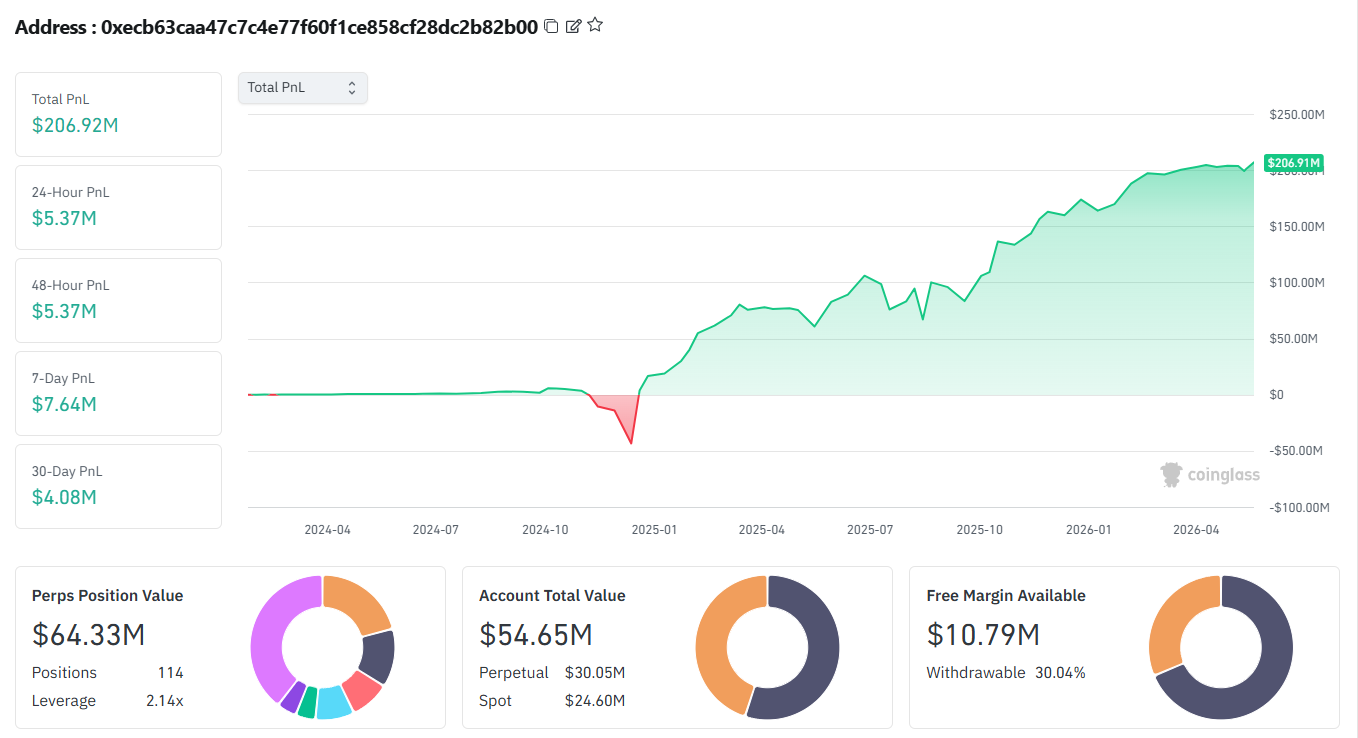
Source: https://www.coinglass.com/hyperliquid/0xecb63caa47c7c4e77f60f1ce858cf28dc2b82b00
It can be seen that this incident should not be simply understood as “two major liquidity providers completely withdrawing from Hyperliquid.” More accurately, the Auros tag address is closer to exiting perpetual market-making exposure, while the Wintermute tag address is still participating in trading, though its risk budget, inventory structure, and quote depth may have changed. This distinction is important. If both institutions completely withdrew simultaneously, it would mean that professional market-making capital is beginning to reassess the risk-reward ratio of Hyperliquid.
II. Mainstream Coin Liquidity Has Not Disappeared, but Absorption Capacity Is Thinning
However, in the crypto market, liquidity provider withdrawals often do not immediately reflect on K-line trends, nor will they necessarily lead to an immediate widening of bid-ask spreads. Especially for mainstream assets like BTC and ETH, even if some institutional LPs reduce their quotes, other traders, arbitrage bots, and internal liquidity mechanisms on the platform may still maintain a relatively tight first-level spread. Therefore, users may not immediately perceive a decrease in liquidity in their daily trading. But this does not mean that the impact does not exist. The real changes often occur in order book depth, slippage costs, and the ability to recover from extreme market conditions.
The role of liquidity providers is not just to offer bid and ask quotes, but to provide a short-term inventory buffer during unilateral market fluctuations. When a large buy or sell order occurs or during continuous liquidations, how much order size leading market makers are willing to place on both sides of the order book will determine whether the price can be smoothly absorbed in a short period. If this portion of institutional capital retreats, then even if trading remains smooth under normal conditions, the order book is more likely to experience slippage expansion, price jumps, and chain reaction liquidations during periods of pressure.
The trading data at the platform level for Hyperliquid remains impressive. According to coinglass data, as of May 19, 2026, the platform has launched 230 perpetual contract markets, with a 24-hour nominal trading volume of about 5.2 billion USD and an open interest of approximately 6.26 billion USD. Among them, BTC, ETH, and HYPE remain the main trading varieties. On the surface, Hyperliquid is still one of the most liquid perpetual contract platforms on-chain.
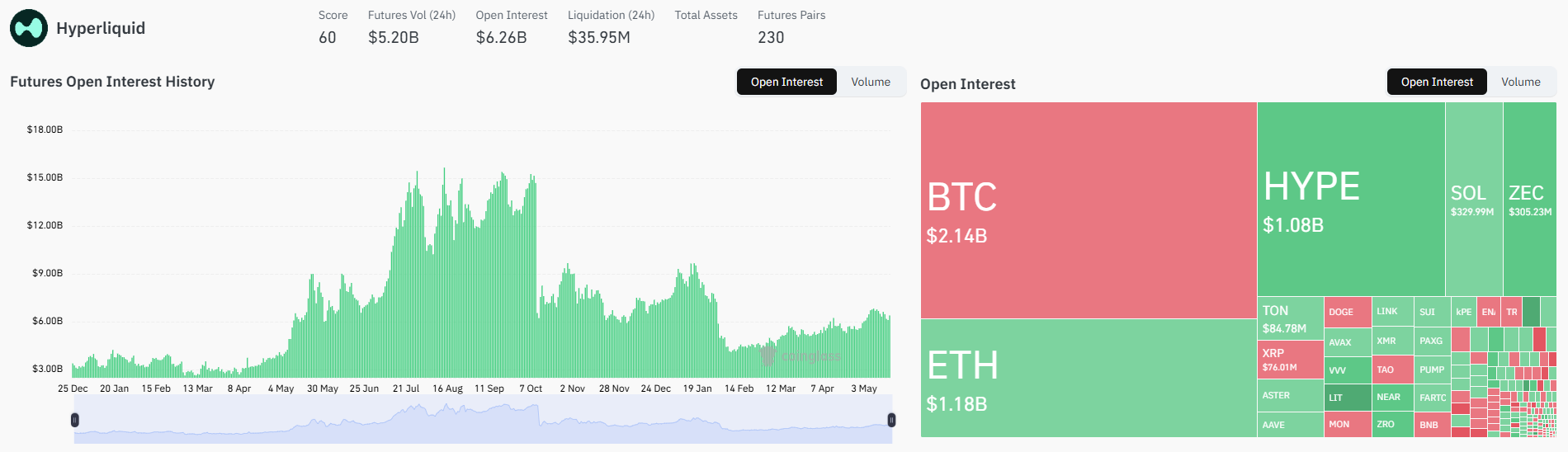
Source: https://www.coinglass.com/exchanges/Hyperliquid
However, it should be noted that total trading volume and real liquidity are not the same thing. Trading volume reflects how much trading has occurred in the market, while liquidity reflects how much trading can still be absorbed at low cost in the future. The former can be amplified by volatility, leverage, and high-frequency trading, while the latter relies more on liquidity providers' inventory, funding costs, and risk appetite.
Thus, the real concern regarding this liquidity provider withdrawal is not whether Hyperliquid's trading volume will significantly decline in the short term, but rather that its liquidity structure is undergoing a change. In the past, Hyperliquid relied on excellent product experience and institutional LP support to form trading depths close to that of centralized exchanges. But when core LPs actively reduce their market-making exposure of mainstream assets like BTC and ETH, it indicates that the platform's liquidity is not entirely endogenous and continues to rely on external professional capital for sustained support.
This also means that while Hyperliquid is an on-chain trading platform, its underlying liquidity logic is not entirely decentralized. The order book model still requires professional market makers to bear inventory risks rather than depend primarily on passive liquidity pools like AMM. When the risk appetite of market makers decreases, the platform may still maintain high trading volume on the surface, but the vulnerability in extreme market conditions will be amplified again.
III. Hyperliquid's Growth Is No Longer Just Crypto Perpetual Growth
From the perspective of crypto native assets, Hyperliquid's success is not difficult to understand. It is based on an on-chain order book, providing a trading experience close to that of centralized exchanges, while through HYPE buybacks, fee capture, and ecological expansion, it has established a valuation logic for an exchange-type asset. For a considerable period, the market's core understanding of Hyperliquid was "on-chain Binance" or "on-chain Perp DEX."
However, it now appears that Hyperliquid is no longer just a perpetual trading platform for crypto assets; it is entering the field of traditional asset trading through its unique mechanisms. Perpetual contracts for traditional assets like crude oil and silver are beginning to enter the platform's top trading volume rankings, sometimes even securing important positions in the top ten trading volume of Hyperliquid. This is very critical. One of the key imaginative aspects of Hyperliquid may not be bringing BTC and ETH perpetuals on-chain, but rather turning the "market closure times" of traditional markets into tradable assets.
The traditional financial market does not operate 24/7. On weekends, holidays, and during unexpected geopolitical events, traditional exchanges such as CME and ICE may be closed. However, risks do not pause because exchanges are closed. Wars, sanctions, interrupted oil routes, central bank statements, political events, etc., can occur while traditional markets are shut down. At this time, the market still needs a place to express expectations, hedge risks, and form price references.
Hyperliquid has found a new growth entry point in this gap. During geopolitical conflicts related to the U.S. and Iran, traditional markets were closed, while WTI crude oil perpetual contracts on Hyperliquid could still be traded in real-time, reflecting price shocks before traditional markets reopened.
This means that Hyperliquid's narrative may have expanded from "crypto asset trading" to "continuous pricing of global risks." It is not just an on-chain casino or another Perp DEX, but is attempting to become a layer of price discovery during traditional market closures.
From this perspective, Hyperliquid's value does not entirely come from decentralization ideals but from practicality. When traditional markets are closed, it remains open; when macro risks cannot wait for the next trading day, it provides a place for immediate price expression. This demand is real and explains why traditional asset trading has seen rapid growth on Hyperliquid.
IV. From Crude Oil to SpaceX, Hyperliquid Is Expanding Its Business Radius
Hyperliquid's rapid expansion into traditional asset trading is closely related to the HIP-3 mechanism. According to official information, HIP-3 allows deployers to create new perpetual contract markets after staking a certain amount of HYPE. Deployers can define market parameters, oracle sources, leverage limits, and settlement rules as necessary.
This mechanism is significant for the platform's growth. It equates to partially opening up the capability of launching new trading pairs from centralized exchange internal teams to external market deployers. As long as someone is willing to bear the costs and provide market design, Hyperliquid can theoretically expand quickly to more asset categories. This transforms it from a crypto perpetual platform into a scalable on-chain derivatives foundation.
At the same time, the latest HIP-4 introduced by Hyperliquid also further expands new product boundaries. Unlike HIP-3, which is mainly focused on perpetual contracts, HIP-4 leans toward Outcome Trading, which involves prediction markets and event contracts. Such contracts are typically priced and settled around the outcomes of real events, such as whether prices reach a particular range, whether a macro event occurs, etc. In other words, HIP-3 enables Hyperliquid to expand to more perpetual assets, while HIP-4 allows it to further enter the fields of prediction markets and event trading.
However, the problem arises here. Perpetual contracts are not just simple spot trading, especially when the underlying assets expand from cryptocurrencies to crude oil, stocks, Pre-IPO, and other real-world assets, the challenges faced by the platform will become complex. Moreover, when HIP-4 further introduces prediction markets and event contracts, the regulatory scope Hyperliquid touches will no longer be limited to derivatives trading itself but may extend to event contracts, gambling, election predictions, sports results, and macro event trading — more sensitive areas.
In other words, the more successful Hyperliquid's growth becomes, the more complex the regulatory issues it faces will be. It is no longer just an unlicensed trading platform but is beginning to transform into a market experiment that moves the most difficult, high-barrier, and controversial layers of price discovery from traditional finance onto the blockchain.
From a product perspective, this innovation is compelling. In the past, average traders could hardly participate in the price discovery of private companies like SpaceX, relying instead on secondary market rumors, private equity valuations, or public market judgments post-IPO. The emergence of on-chain Pre-IPO perpetuities enables the market to continuously price unlisted assets at an earlier stage. Meanwhile, if HIP-4 further develops, it could allow users to express their judgments of macro events, market outcomes, and real events through prediction markets.
However, from a regulatory standpoint, this also means that Hyperliquid is entering more sensitive territory. Pre-IPO assets are not just simple crypto assets; their prices often involve information asymmetries, non-public funding, restrictions on qualified investors, and securities issuance rules. Prediction markets are not ordinary trading varieties either; their outcomes, event designs, and participant scope have long been under regulatory disputes. Once these on-chain prices are widely referenced by the market, they become not just speculative contracts but may influence valuation expectations in private markets, macro-event assessments, and even the pricing of real assets.
V. CME and ICE Pressure, Essentially a Price Discovery Rights Dispute
At the same time, CME and ICE are pushing the CFTC and U.S. legislators to strengthen regulation of Hyperliquid. Their concerns primarily focus on several aspects: Hyperliquid's current anonymous trading model may pose risks of market manipulation and sanction evasion; the rapid growth of crypto and commodity-related trading on the platform may impact key market price discovery, including crude oil; if customer identification and trading supervision are absent, regulators find it difficult to confirm participant identities and trading motives. On the surface, this appears to be a regulatory question regarding on-chain derivatives platforms by traditional exchanges. But at a deeper level, it resembles a dispute over the rights to price discovery.
CME and ICE have long held vital trading and clearing infrastructures for global commodity, stock index, and interest rate derivatives. Their value lies not only in facilitating trades but also in benchmark pricing, liquidity networks, clearing credit, and regulatory recognition. When Hyperliquid starts forming on-chain prices for crude oil, stock indexes, Pre-IPO, and even event contracts during traditional market closures, it actually touches upon the most core protective barriers of traditional exchanges.
This is also why the regulatory pressure on Hyperliquid surged rapidly after traditional asset trading grew. If it were merely a crypto-native Perp DEX, traditional exchanges may not be so concerned. But once it becomes an instant trading venue for weekend oil prices, geopolitical conflicts, stock index expectations, and private asset valuations, the issue shifts from "Is a DeFi project compliant?" to "Who has the right to generate prices when global markets are closed?"
Hyperliquid's response to this is noteworthy. In its comment document submitted to the CFTC, it emphasizes that on-chain trading records are publicly available in real-time, all orders, trades, and settlements are traceable, thus theoretically offering greater transparency than traditional markets. Moreover, 24/7 trading can reduce gaps in trading when traditional markets open, allowing the market to reflect information more continuously.
This response is not without merit. On-chain transparency can indeed reduce some of the risks associated with black-box trading and provide complete data for post-event investigations. But transparency does not equate to compliance. Regulators are concerned not just with whether trades can be seen but also whether participants are identifiable, whether abnormal trading can be intercepted, whether sanctioned entities are excluded, whether market deployers assume obligations, and who is responsible for maintaining market order during systemic events.
More importantly, CME itself is also accelerating its 24/7 trading capabilities. CME's official sources indicate that its plans for crypto futures and options will enter 24/7 trading mode on May 29, 2026; in addition, CME plans to launch products like Nasdaq CME Crypto Index Futures. In other words, traditional exchanges are not opposing 24/7 trading itself, but rather, while incorporating this capability into a regulated framework, they demand that on-chain competitors bear similar compliance costs.
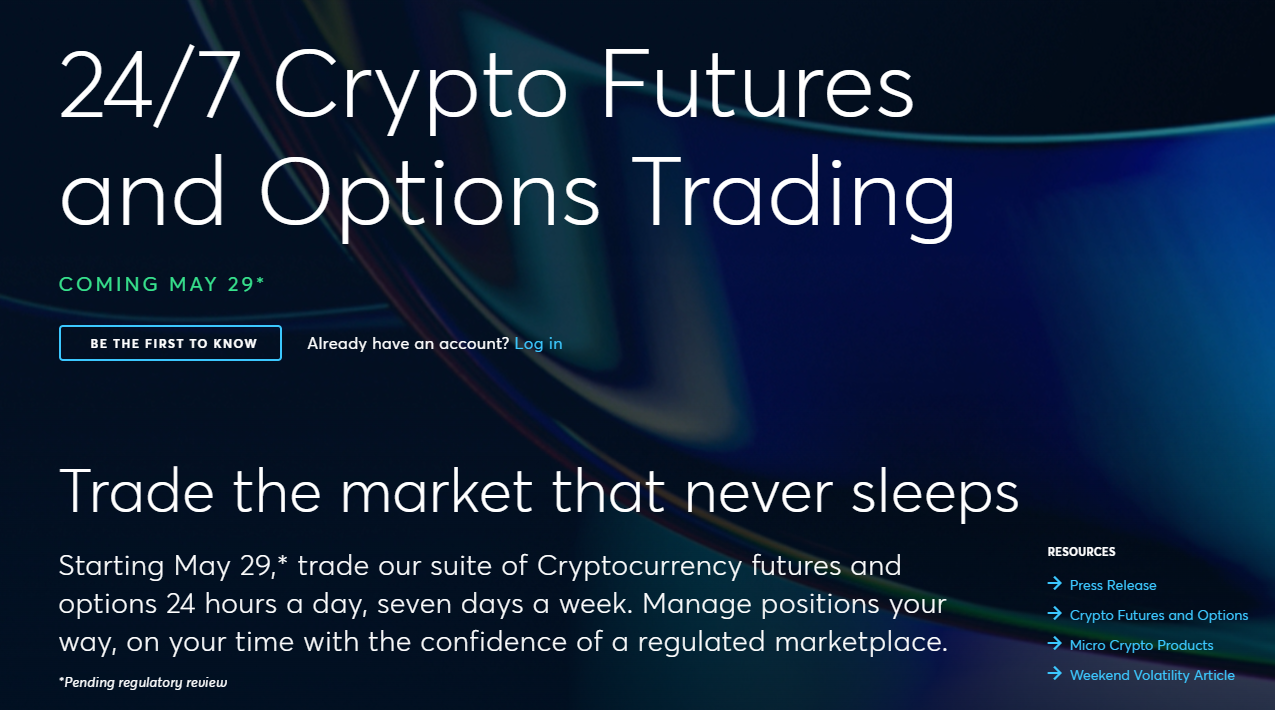
Source: https://www.cmegroup.com/markets/cryptocurrencies/24-7-crypto-trading.html
Thus, it can be seen that the conflict between Hyperliquid and traditional exchanges is not a simple confrontation between old and new finance but a clash of two market orders. One order emphasizes openness, transparency, 24/7 operation, and global unlicensed access; the other order emphasizes access, monitoring, clearing, licensing, and accountability. The former is more efficient, while the latter incurs heavier institutional costs. However, as trading subjects enter crude oil, stock indexes, Pre-IPO assets, and prediction markets, institutional costs are challenging to circumvent in the long term.
VI. Deeper Reflections
Is Hyperliquid genuinely the next-generation exchange for on-chain finance, or a rapid expansion beyond regulatory boundaries? If viewed solely from short-term trading data, it remains in a robust cycle, with trading volume, open interest, HYPE interest, and the expansion of traditional asset trading all indicating that market demand genuinely exists. But when viewed over a longer time frame, the withdrawal of liquidity providers and the pressures from CME and ICE may be revealing a deeper issue: while on-chain trading infrastructure is entering the realm of traditional finance, the corresponding responsibility structures have not matured simultaneously.
6.1 From Crypto Exchanges to Macro Price Discovery Layers
Hyperliquid's early competitive focus was on delivering a better perpetual trading experience on-chain. It solved internal problems within the crypto market, specifically how users could achieve low latency, high liquidity, and a rich array of trading pairs without relying on centralized exchanges.
However, with the advancement of HIP-3 and HIP-4, Hyperliquid is progressing into another phase. It no longer solely serves crypto assets but is beginning to address macro risks, private asset expectations, and real event outcomes. Crude oil prices, stock index volatility, geopolitical events, Pre-IPO valuations, prediction markets, and traditional market closure windows may all become sources of its growth.
This is where it holds the greatest imaginative potential. The time structure of traditional financial markets does not fit the speed of current information dissemination. Information is transmitted in real-time, risks arise in real-time, yet official trading venues for many assets are not open in real-time. Hyperliquid provides an alternative outlet that enables market participants to continue expressing expectations during traditional market pauses.
However, this means that it is no longer just a product issue but a market order issue. A platform that merely allows users to trade MEME or crypto perpetuities still mainly affects the internal crypto circle; but if it begins to influence oil prices, stock indexes, and macro asset expectations, it will naturally come under the scrutiny of regulators and traditional exchanges.
6.2 The Liquidity Illusion Behind Scale Growth
Hyperliquid's data remains impressive, yet the larger the platform grows, the more it needs to be cautious of liquidity illusions. Increased trading volume does not necessarily indicate a healthier market, particularly in highly leveraged perpetual markets, where trading volume can often be amplified by volatility, liquidation, high-frequency arbitrage, and repeated turnovers.
To some extent, the withdrawal of liquidity does not require institutions to turn pessimistic. For market-making institutions, a phase-based reduction in exposure may also be positioning to retain room for more cost-effective liquidity deployment in the future. However, what is critical is whether there are still enough professional capital willing to bear the counterparty risk during unilateral market trends. Changes in addresses related to Wintermute and Auros indicate that institutional market makers are beginning to reassess this issue. They do not deny Hyperliquid's product capabilities but are demanding a higher expectation for future risk compensation.
As regulatory uncertainties rise, traditional asset trading becomes sensitive, and the platform is publicly highlighted by CME and ICE, market makers need to consider not only transaction earnings but also address exposure, compliance inquiries, sudden withdrawals, and tail events. Market-making capital inherently chases returns but is extremely averse to unquantifiable risks. When a particular type of risk cannot be effectively measured by models, the direct reaction is to decrease positions, withdraw orders, and reduce quote depths.
Therefore, the core of this incident is not whether Hyperliquid's liquidity will collapse immediately, but rather that its liquidity costs may begin to rise. If Hyperliquid aims to maintain depth and continually provide market makers with high returns, high growth, and low friction environments, it may need to offer market makers higher returns, clearer rules, or lower institutional risks. Otherwise, the larger the platform's trading volume, the more apparent the liquidity gaps may be during extreme market conditions.
6.3 Responsibility Reconstruction in Open Markets
Hyperliquid's attractiveness lies in its lowering of the barriers to market creation and asset trading. However, as market creation becomes more open, the boundaries of responsibility will also blur.
In traditional exchanges, when a new futures contract is launched, it typically undergoes strict product design, regulatory reviews, risk control models, clearing arrangements, and market monitoring. In the on-chain environment, responsibilities among market deployers, oracles, market makers, protocols, and users get dismantled, and no single entity bears complete responsibility for the final risks.
This may be acceptable in crypto-native assets since participants generally assume high risks and self-responsibility. However, in traditional assets and prediction markets, the situation changes. Crude oil, stock index, and Pre-IPO prices hold externalities; they affect not just speculators but potentially influence expectations in the real market. At the same time, event contracts and prediction markets involve outcome determinations, participant scopes, and price settings for real events. Once on-chain prices begin to be externally observed, referenced, or arbitraged, regulators will demand clearer chains of responsibility.
This is also an issue that Hyperliquid will not be able to bypass in the future. It can continue to emphasize on-chain transparency and the efficiency of 24/7 trading, but if it cannot answer "Who is responsible for market quality? Who is accountable for abnormal trading? Who oversees entrance reviews? Who is responsible for clearing extreme risks?" then its expansion into traditional assets will remain in a gray area.
VII. Conclusion
The controversies surrounding Hyperliquid do not mean the story is over; rather, they indicate that it has truly entered the sight of the traditional financial system. In the past, discussions around Hyperliquid were more focused on whether an on-chain perpetual trading platform could replicate the efficiency of centralized exchanges; now, the market discussions are about whether an unlicensed on-chain market qualifies to participate in price discovery for crude oil, stock indexes, private equity, and even real events.
This is also the most noteworthy aspect of this round of liquidity provider withdrawals. Changes in addresses related to Wintermute and Auros do not necessarily signify that they are dismissing Hyperliquid's product capabilities. On the contrary, professional market makers often have the clearest understanding of where liquidity lies, where trading volume exists, and where profits can be generated. What they are truly repricing is the new regulatory risks, reputation risks, and tail exit risks faced by Hyperliquid as it transitions from a crypto-native exchange to a global price discovery layer.
From this perspective, Hyperliquid’s biggest challenge in the future may not be whether its trading volume can continue to grow, but rather whether such growth will alter its risk profile. If growth primarily comes from BTC, ETH, SOL, and other crypto-native assets, it remains a highly efficient on-chain trading platform. However, if growth increasingly derives from crude oil, stock indexes, SpaceX Pre-IPO, prediction markets, and other real assets, it must address the long-standing questions faced by traditional finance: Who is qualified to create markets? Who is responsible for price quality? Who bears responsibility for abnormal trades? Who maintains order during extreme market conditions?
Therefore, the core contradiction facing Hyperliquid moving forward is not a simple conflict between decentralization and regulation but a rebalancing act between open price discovery and institutionalized responsibility. Its most valuable aspect lies in demonstrating that global risks can be traded in real-time on-chain, while its greatest danger is that once such prices begin to be referenced by external markets, they can no longer remain solely within the narrative of "code is law."
Hyperliquid is entering a more challenging phase; in the past, the market focused on whether its on-chain order book met demands in terms of efficiency, depth, and experience. Now, the true test is whether it can maintain its openness and on-chain characteristics while introducing clearer identity, compliance, and responsibility mechanisms to meet the requirements of traditional finance concerning market structure and regulation. Whether it can achieve this transition will determine whether Hyperliquid will ultimately become a leading Perp DEX or a core variable within the next generation of financial market structures.
免责声明:本文章仅代表作者个人观点,不代表本平台的立场和观点。本文章仅供信息分享,不构成对任何人的任何投资建议。用户与作者之间的任何争议,与本平台无关。如网页中刊载的文章或图片涉及侵权,请提供相关的权利证明和身份证明发送邮件到support@aicoin.com,本平台相关工作人员将会进行核查。


