
Author: Xiaobai
This article is an original submission from the author, and the views only represent the author's personal understanding. ETHPanda edited and organized the content.
Blockchain has always emphasized "controlling your own assets," but few people seriously answer another question: if users cannot understand what they are signing, how real is this control? From blind signing to Clear Signing, Ethereum is filling a very basic and overdue piece of the puzzle, making transaction signatures understandable not just for programmers, but gradually for ordinary users as well.
Blind Signing is not User Negligence
I had a question early on when I started using crypto wallets.
Why every time I click to sign, the wallet presents a string of hexadecimal code?
I clearly clicked Swap, Mint, Claim, Approve on the webpage, but when it comes to the wallet confirmation step, the screen suddenly shows a bunch of things starting with 0x. Many educational videos repeatedly remind everyone not to sign randomly, as many phishing websites steal assets this way.
This is very frustrating.
On one hand, telling ordinary users that signing is dangerous and that they need to look carefully. On the other hand, showing the actual content in a format that ordinary people cannot understand at all.
This is truly not user negligence; the interaction itself is very inhuman.
Later I learned that this situation has a name, called blind signing. When you click confirm, cryptographically you are indeed authorizing a transaction, but from a human understanding perspective, you are actually signing a piece of paper you cannot read.
The problem is not that users don’t know safety is important, but that they do not have enough information to assess whether it is safe or not.
The Ethereum Foundation recently announced that Clear Signing has gone live, with a straightforward goal: to make human-readable transaction signing the default experience. The Clear Signing website explains this even more plainly, See what you sign, allowing you to truly see what you are signing.
It is not just a simple wallet UI optimization, but is addressing the foundational infrastructure that Ethereum has always lacked when targeting ordinary users.
Historically, wallet security mostly helped you sound the alarm before something went wrong. For instance, some plugins check if a website is a phishing site in advance, and if there's a risk, they flash a red alert. Wallets like Rabby have also added many transaction previews and risk alerts, allowing you to see what changes might occur to your asset balance after signing.
These are very useful.
But they are more like adding security personnel next to the transaction rather than resolving the problem at the signing level. You still have to trust the plugin, trust the wallet simulation, trust that it can identify the risks of this website and this transaction.
Clear Signing Aims to Translate Transactions into Plain Language
What Clear Signing aims to do is more fundamental.
It does not merely tell you "this website could be dangerous," but allows the protocol party to write the transaction semantics in a standardized format, enabling the wallet to reliably translate the calldata into actions that humans can understand.
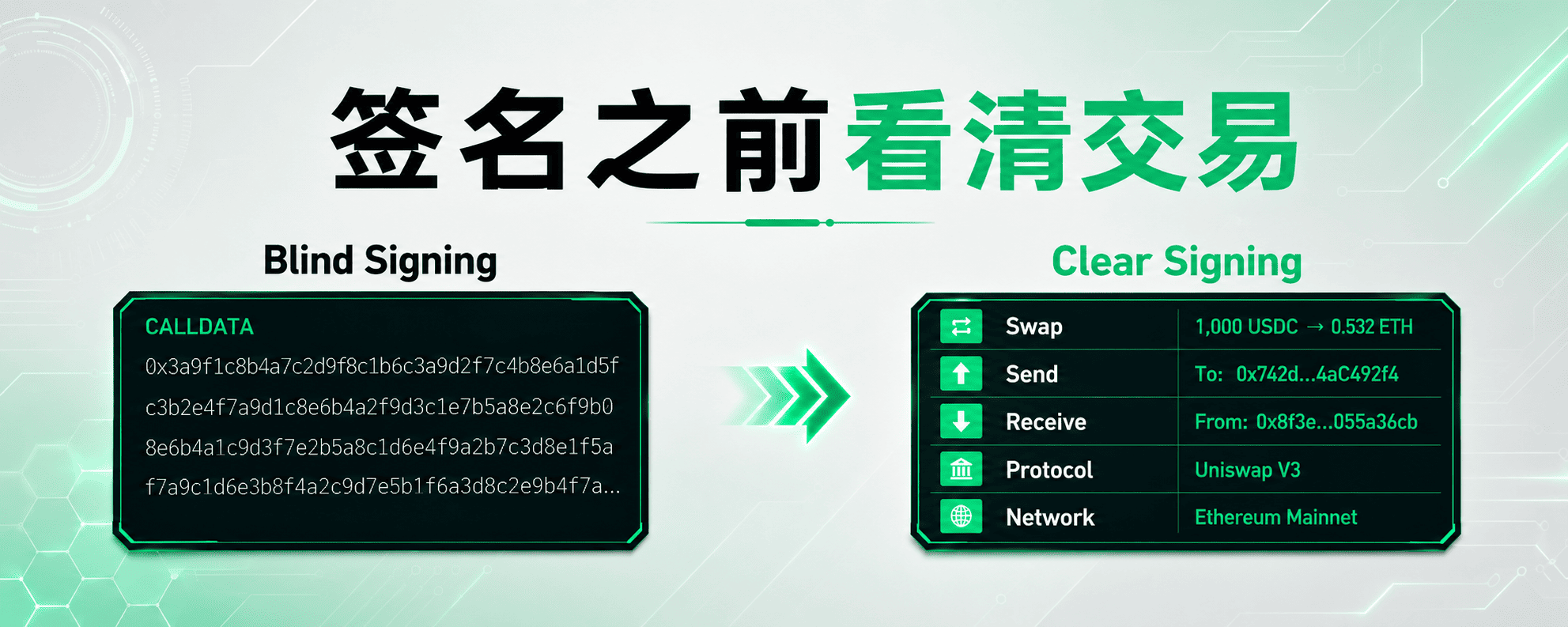
For example, in the past you saw a long string of hex.
In the ideal future state, you should see: Swap, send 1,000 USDC, receive at least 0.42 WETH, protocol is Uniswap V3, network is Ethereum.
This is the signature confirmation page that humans should see.
Here, I can align with what Teacher Ray said. He mentioned a line in his post that I think is very insightful, "Organized code is still code."
This phrase actually highlights the difference between EIP-712 and ERC-7730. EIP-712 transforms the originally chaotic signing content into structured data, but being structured does not equal being human-readable. What ordinary users truly need is not rows of nicely arranged variable names and parameters, but action languages that are easily understood at a glance.
Teacher Ray also described Clear Signing as **"adding a layer of translation between code and ordinary users."** This metaphor is particularly apt.
How ERC-7730 and Registry Work
The core standard behind Clear Signing is ERC-7730.
It defines a JSON metadata format.
In simple terms, it allows the protocol party to write a "translation dictionary" for their contract functions. For a certain function, parameter, or amount field in the contract, how it should be presented to the user is specified in advance by the protocol party according to the standard, and then submitted to a public registry. The wallet checks this dictionary before signing, translating the underlying calldata into a confirmation page that users can understand.
ABI can tell the wallet that there is a uint256 amount here.
But ABI may not tell the user whether this amount has 6 decimal places for USDC or 18 decimal places for ETH, nor can it inform the user whether this operation is a Swap, Stake, Approve, or Claim.
ERC-7730 fills this layer of semantics.
Then the registry plays the role of a public directory. The clear-signing-erc7730-registry repository maintains the metadata files in the registry directory. The protocol party submits describing files, and after wallets and tools read them, they have the opportunity to present transactions in clearer human language.
As of the snapshot from the Clear Signing website on May 7, 2026, the registry has covered 44 protocols and published 346 descriptors. It already features projects like 1inch, Aave, Circle, Lido, Uniswap, Safe, WalletConnect, WETH, etc.
It’s Not a Magic Switch, But the Direction is Right
Although it sounds like a lot, Clear Signing is actually just getting started.
It is not the case that the EF sent a message, and all blind signing issues suddenly disappeared. In reality, there are still many contracts that have not registered according to ERC-7730, and wallets cannot support them all overnight. The official website currently clearly shows that Ledger is already live, while Trezor is still in development. Other wallets, tools, and protocols will need time to integrate.
Thus, Teacher Cos’s reminder about the real issues is critical. Protocols need to complete registration in accordance with ERC-7730, and wallets and tools that support ERC-7730 will be better able to parse and present. Meanwhile, the existing parsing, simulation, and risk alert capabilities of wallets cannot be discarded.
I wholeheartedly agree with this point.
Clear Signing addresses what the transaction claims it will do. Wallets that simulate transactions like Rabby address what might happen after execution. One focuses on intent, while the other focuses on results. A truly good wallet security experience should encompass both layers.
Because attackers will not stop evolving.
If in the future users begin to trust clear signing, attackers might also try to submit misleading metadata or bypass demonstrations using long-tail contracts, unregistered contracts, or complex batch transactions. The official documentation also emphasizes that wallets must decide which registries, review signals, and attestations to trust themselves.
Therefore, Clear Signing is not a magic switch; it is more like a new industry discipline.
The protocol party must write the transaction semantics clearly.
The registry must have review and trust signals.
Wallets must decide which metadata can be displayed.
Users can finally stop being forced to face a pile of incomprehensible text.
I believe this matter is particularly meaningful for the Chinese community.
Many people do not want to enter the on-chain ecosystem; rather, the barriers are simply too high. Most users are not programmers, and even if they are programmers, they may not understand things like Solidity, calldata, ABI, selector, permit, or delegatecall.
Past on-chain experiences often defaulted to expecting users to bear their own understanding costs.
If you cannot understand, it’s because you are not professional enough.
If you were scammed, it’s because you were not careful enough.
If you do not dare to use it, it’s because you have not learned enough.
But this is not the attitude that mainstream applications should have.
If a financial-level system requires ordinary users to understand hexadecimal code before signing, it is not that user education has not been done well, but that the product and infrastructure have not yet matured.
Previously, in the Web3 Winter Internship Program at LXDAO and ETHPanda, I also mentioned similar ideas. At that time, I submitted a PR in Headbook suggesting the addition of security courses, simply hoping to educate people about how wallets parse the first four characters of hexadecimal function selectors to understand function meanings. Back then, I didn’t have a complete plan; I just felt in a very simple way that users should not have to guess their fate looking at hex.
Looking back now, ERC-7730 systematically addresses this issue.
It’s not just about parsing the first four characters of a selector; it allows protocols to write functions, fields, amounts, addresses, and contexts as verifiable, reusable, and sendable structured metadata for wallets.
This is more important than simply querying function names.
Because function names can also be misleading. A malicious function can be called claimRewards, but it can also be called deposit. True valuable displays do not only tell you the function name, but they inform you of the associated action, asset, amount, protocol, network, and risk boundaries corresponding to the signature.
This is what informed consent rights mean.
In its early stages, Ethereum sacrificed a lot of human readability to get smart contracts up and running quickly. This can be understood historically. Without the rapid experimentation back then, there would not have been the subsequent DeFi, NFTs, DAOs, and the entire EVM ecosystem.
But technical debt does not disappear; it just comes back to haunt users in the form of phishing, mis-signing, malicious authorizations, and cold wallet thefts when the user base grows.
Future Prospects
The emergence of Clear Signing at least indicates that the Ethereum ecosystem has begun to take this account seriously.
I do not believe it will change everyone’s wallet experience in a few months. A more realistic judgment is that in the coming years, as mainstream protocols submit metadata, major wallets gradually support it, and auditing and attestation mechanisms improve, clear signing will slowly become the default experience.
But the direction is right.
Blockchain should not remain in the phase where "only those who understand code dare to use it." True popularization is not about making everyone learn to read calldata, but about ensuring that everyone can understand in their own language what they are authorizing before signing.
The world has long suffered from blind signing.
The significance of Clear Signing lies here: it does not just make wallets look better; it slowly returns the right to informed consent regarding transaction signatures back to the users.
免责声明:本文章仅代表作者个人观点,不代表本平台的立场和观点。本文章仅供信息分享,不构成对任何人的任何投资建议。用户与作者之间的任何争议,与本平台无关。如网页中刊载的文章或图片涉及侵权,请提供相关的权利证明和身份证明发送邮件到support@aicoin.com,本平台相关工作人员将会进行核查。


