
Author: Nancy, PANews
In just over a year, the tokenized stock market has seen explosive growth, with daily trading volume surging from zero to nearly $4 billion, continually setting new trading volume records, while the relaxation of U.S. regulations is expected to further push this sector towards mainstream acceptance.
In addition to direct tokenized equity, on-chain pricing for unlisted companies has been pioneered by Hyperliquid through perpetual contracts, and Polymarket has partnered with Nasdaq to launch a private company prediction market, paving the way for valuation discovery and liquidity capture around Pre-IPO assets in the on-chain world.
Polymarket partners with Nasdaq to enter Pre-IPO prediction market
On May 19, Polymarket announced an exclusive partnership with Nasdaq,formally launching a prediction market linked to the performance of private companies, marking the first time a prediction market has ventured into the private market space.
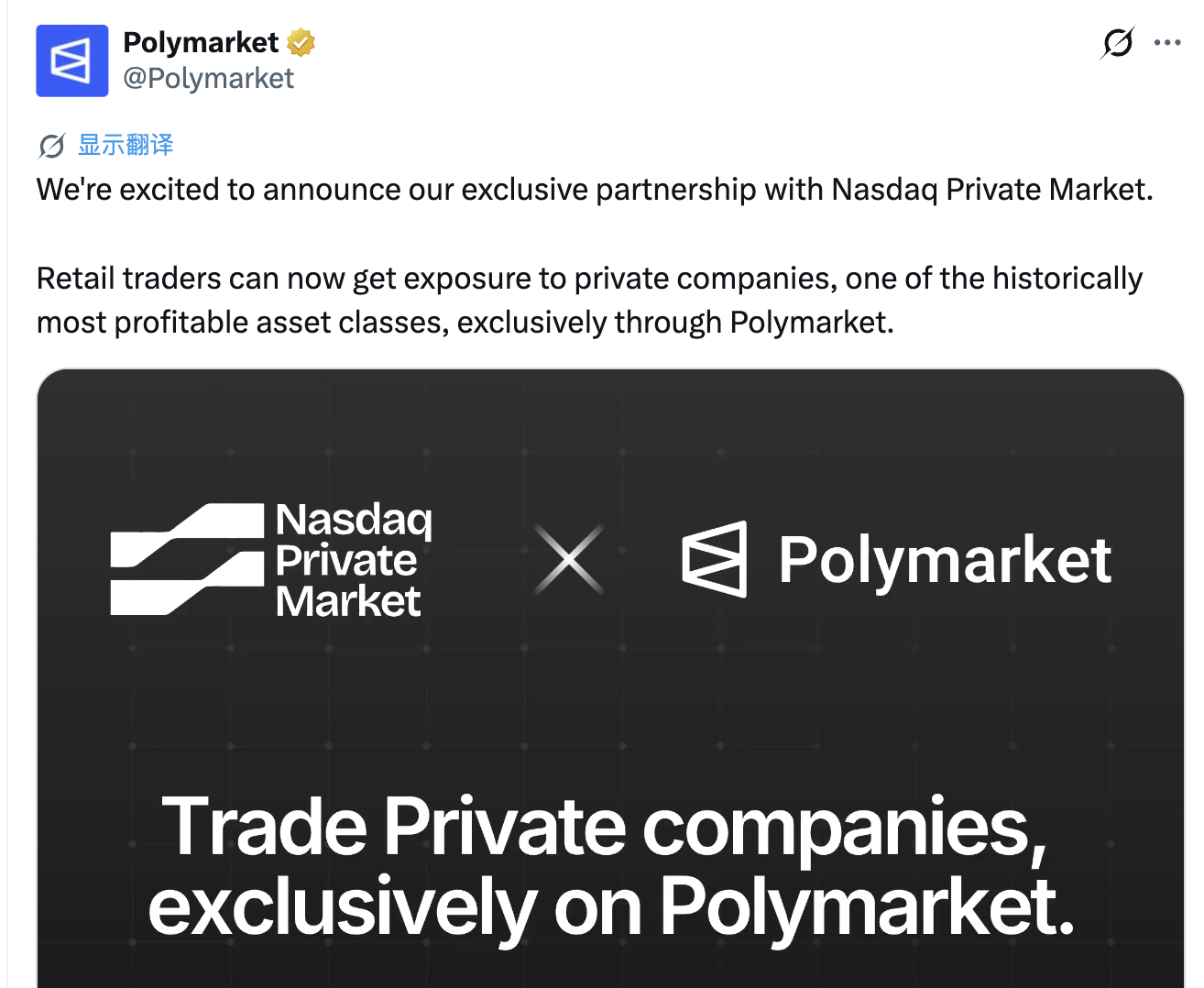
According to the terms of the partnership, users will be able to make prediction trades around metrics such as company valuation, IPO timing, and secondary market trading activity, with the Nasdaq private market serving as the exclusive data provider for settlement, responsible for providing the official data used to determine results.
Notably, this is also the first time Nasdaq's private market has publicly disclosed some private market valuation data for free. In the past, such data was typically only available to institutional clients and required a paid subscription to access.
The introduction of the prediction market allows more users to engage in price speculation, sentiment expression, and expectation trading around these popular private enterprises. Previously, most star tech companies often achieved significant valuation growth before going public, but ordinary users typically lacked channels to participate. According to Nasdaq data, there are currently over 1,600 unicorn companies worldwide valued at over $1 billion, including OpenAI, Anthropic, SpaceX, with a total valuation exceeding $50 trillion.
Of course, the prediction market can also provide real-time market pricing and sentiment feedback for these Pre-IPO assets, forming a more dynamic valuation reference and further promoting the transparency of information flow and price discovery in the private market.
For Polymarket, this partnership not only drives business expansion but also accelerates its transformation into a mainstream financial infrastructure. Although competitor Kalshi has also launched prediction contracts related to private company IPOs, its settlements rely more on SEC filings, company announcements, and other public information, which can be subject to a degree of latency and interpretation. In contrast, Polymarket directly introduces Nasdaq's authoritative data as the basis for settlement, significantly enhancing market credibility and the objectivity of results.
More importantly, the launch of private market-related products also helps Polymarket expand its business into traditional finance, attracting more global users beyond its previous focus on politics, sports, and crypto assets.
For Nasdaq, this collaboration also has strategic significance. By opening private company data to the on-chain market, Nasdaq not only captures valuation discovery and liquidity demand in the Pre-IPO market but also extends its data capabilities to global retail and crypto user groups, increasing the influence and monetization potential of its data products. Moreover, as platforms like Hyperliquid rise, Nasdaq's proactive embrace of the on-chain financial ecosystem enhances its resilience against emerging competition.
Advance price discovery, Hyperliquid challenges Wall Street’s pricing power
Compared to prediction markets, Prep DEX leader Hyperliquid has begun to disrupt Wall Street's long-held pricing power.
Months ago, Hyperliquid's HIP-3 market had already started bringing traditional financial assets like silver, gold, and oil onto the chain, gradually becoming a significant price discovery market during weekends and off-hours for U.S. stocks, drawing attention from the traditional finance community. In April alone, the average daily trading volume of oil-related contracts on Hyperliquid exceeded $700 million.
Recently, Hyperliquid further extended its efforts into the Pre-IPO space, launching perpetual contracts for Cerebras (CBRS) and SpaceX (SPCX). Among these, the CBRS contract had its on-chain price anchored within 3% of Nasdaq's opening price before the company officially went public, while deviations on traditional secondary platforms reached 35%. This means that Hyperliquid has, to some extent, taken the lead in on-chain price discovery for Pre-IPO assets, starting to challenge the long-held pricing power of traditional secondary markets, investment banks, and private equity trading.
According to the data, the trading volume on the Hyperliquid HIP-3 market in the past week was about $17.58 billion, with an open interest of around $2.54 billion. To lower the entry threshold, Hyperliquid has recently updated the HIP-3 documentation and will gradually reduce the hard requirement of 500,000 HYPE staked to deploy perpetual markets; the excess beyond the new threshold can be unlocked, aiming to attract more builders into the space and further promote the expansion of on-chain financial assets.
As Hyperliquid's influence in traditional financial assets and the Pre-IPO market continues to grow, the sense of crisis on Wall Street has also begun to intensify. Recently, entities including CME and NYSE have started urging U.S. regulators to strengthen scrutiny of Hyperliquid due to concerns over potential market manipulation risks and evasion of sanctions.
In the face of regulatory uncertainties, Hyperliquid is also accelerating its compliance efforts. In addition to the Hyperliquid Foundation donating 1 million HYPE tokens to the lobbying organization Hyperliquid Policy Center, with veteran crypto policy attorney Jake Chervinsky leading regulatory communication efforts, Hyperliquid co-founder Jeff has personally traveled to Washington to engage in dialogue with regulatory policymakers, aiming to push the on-chain derivatives market into the U.S. regulatory framework. Furthermore, Hyperliquid has hired experienced public relations expert George Godsal as its external spokesperson, emphasizing that all transactions, liquidations, and funding rates on the platform are publicly verifiable, showcasing a level of transparency far exceeding traditional markets.
In the future, as more Pre-IPO assets migrate to on-chain markets, the valuation system and price discovery mechanisms monopolized by Wall Street are likely to face significant challenges from crypto-native markets.
Daily trading volume reaches new highs, SEC's innovative exemption may be introduced this week
Tokenized stocks are rapidly transitioning from crypto-native innovations to mainstream adoption, with traditional exchanges like the NYSE and Nasdaq now actively engaging in this space.
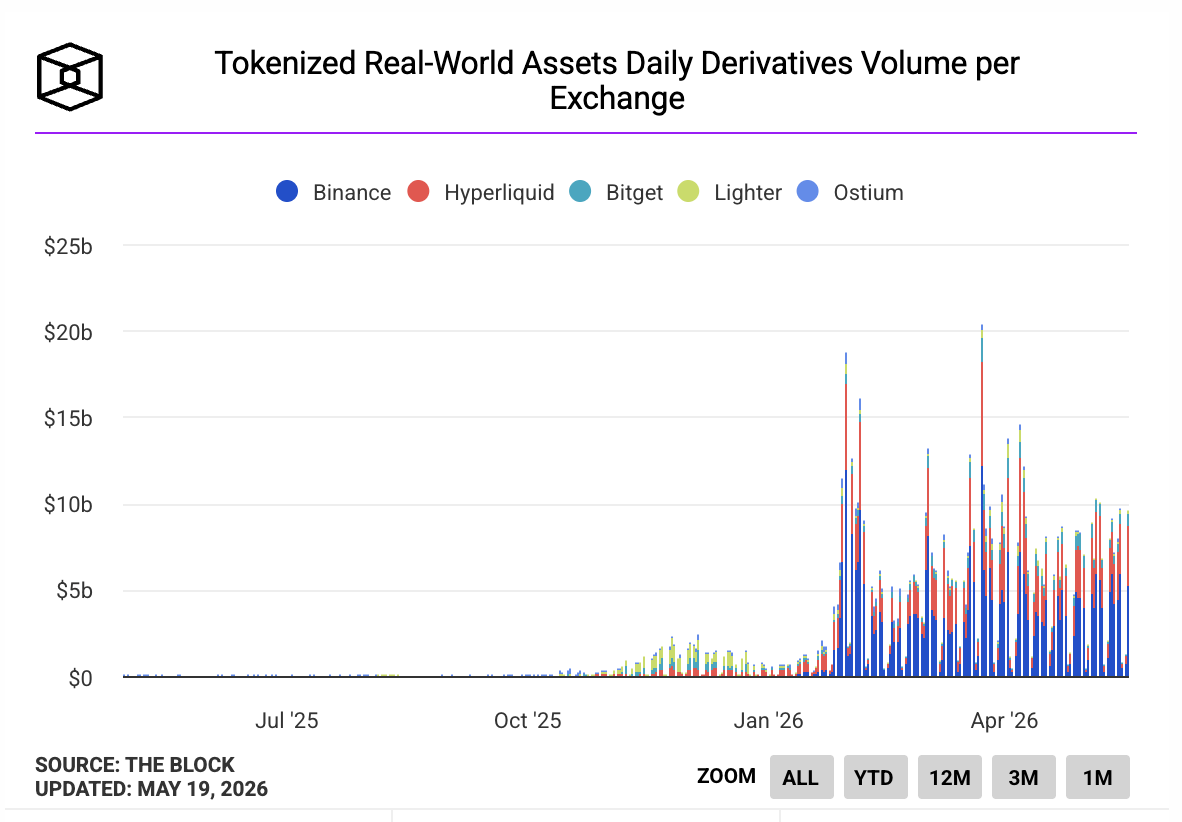
According to data from The Block, as of May 18, the daily trading volume of tokenized stocks has reached an all-time high of $3.57 billion. Most of the trading volume is concentrated on the two platforms, Binance and Hyperliquid, while platforms such as xStocks, Ondo, and Bitget continue to propel the expansion of the on-chain stock market.
At the same time, the loosening policies at the regulatory level in the U.S. are expected to act as a catalyst for further growth in the tokenized stock sector. According to recent reports from Bloomberg, insiders revealed thatthe U.S. SEC may soon introduce innovative exemption rules for tokenized stocks, establishing a new regulatory framework for the crypto versions of publicly traded companies' stocks.
Based on currently disclosed information, the SEC is inclined to allow third-party institutions to issue tokens pegged to stock prices without official authorization from the listed companies and permit their trading on DeFi platforms. This means that the tokenized stock market will gradually form a more open ecosystem of synthetic assets on-chain.
Previously, there have been multiple controversies in the market due to some projects launching related tokens without company authorization. For instance, Anthropic had publicly warned that unauthorized tokenized stock exposure does not possess real equity validity, which once triggered market panic.
Essentially, these third-party issued tokenized stocks are closer to synthetic assets tracking stock prices rather than representing true stock ownership. Some products may not possess the voting rights, dividend rights, and other entitlements that correspond to traditional stocks. According to the current proposals being discussed by the SEC, if relevant platforms are unable to provide equivalent rights protection to users, they may lose the qualification to list related token products.
The innovative exemption rules for tokenized stocks are also seen by observers as the first large-scale test by U.S. regulators of the feasibility of migrating stock trading to a crypto infrastructure. Supporters believe that tokenized securities can achieve near real-time settlement, 24/7 trading, and lower global circulation thresholds, significantly enhancing capital market efficiency; however, opponents argue that the related mechanisms may weaken KYC, anti-money laundering, and investor protection systems, increasing systemic risk in the market.
In light of the popularity of tokenized stocks, ARK researcher Lorenzo Valente warned that the heavily adopted second and third layer SPV packaging structures in the market may become a core hidden danger for the future development of tokenized stocks. He believes that the acquisition of Equiniti by Bullish and institutions like Securitize pushing for real, compliant stock entitlements to be brought on-chain are critical for tokenized stocks to genuinely enter the institutional market. In the future, the market may still see a large number of packaged products, including equity SPVs, debt notes, and other derivative structures; if the underlying rights, transfer restrictions, and investor rights remain ambiguous, tokenized stocks could devolve into speculative assets with multiple layers of packaging.
免责声明:本文章仅代表作者个人观点,不代表本平台的立场和观点。本文章仅供信息分享,不构成对任何人的任何投资建议。用户与作者之间的任何争议,与本平台无关。如网页中刊载的文章或图片涉及侵权,请提供相关的权利证明和身份证明发送邮件到support@aicoin.com,本平台相关工作人员将会进行核查。


