Fraud is rampant, bans are frequent, and transaction fees are high; the Bitcoin ATM industry in the United States is gradually weakening.
Written by: Gino Matos
Translated by: Saoirse, Foresight News
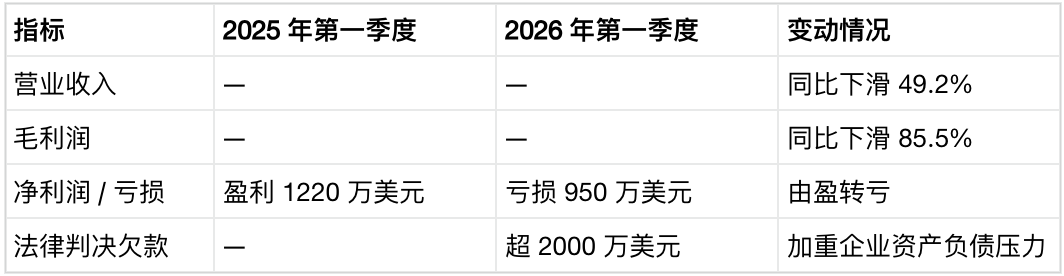
On May 18, 2026, Bitcoin Depot, a leading Bitcoin ATM company, filed for Chapter 11 bankruptcy protection in the Southern District Court of Texas, announcing a complete shutdown of its operations and the disposal of its assets, with all over 9,000 offline machines it had worldwide ceasing operation on the same day as of August 2025.
According to financial statements disclosed by the U.S. Securities and Exchange Commission on May 12, the company’s revenue in the first quarter of 2026 dropped by 49.2% year-on-year, and gross profit plummeted by 85.5%. The management bluntly stated that there is great uncertainty regarding the company's continued normal operations. The company achieved a net profit of $12.2 million in the same period last year, while in the first quarter of this year it incurred a direct loss of $9.5 million.
Bitcoin Depot attributed the deterioration of its operations to: state and local governments implementing operational restrictions, reducing transaction limits on platforms, tightening KYC standards for users, being entangled in various legal litigations, coupled with legal judgments requiring the company to pay over $20 million in cumulative compensation.
A series of operational chaos ultimately pushed the company towards bankruptcy and visually reflects the increasingly stringent compliance regulation, which completely undermined the original profit logic of Bitcoin ATMs.

The Original Positioning of Bitcoin ATMs
Bitcoin ATMs allow users to exchange cash for cryptocurrency without linking a bank account, providing convenience for cash transaction enthusiasts and groups lacking access to formal banking services, while also catering to users who prefer not to trade online and want to complete cryptocurrency transactions offline.
However, this business model has had structural defects since its inception. The Financial Crimes Enforcement Network in the U.S. stipulates that transaction fees for cryptocurrency ATMs can range from 7% to 20%, far exceeding the fee standards of mainstream online cryptocurrency exchanges.
Such high transaction fees can only support emergency trades and one-time small cash exchanges, making it impossible to achieve widespread adoption. These offline machines are inherently expensive entry channels for cryptocurrency; relying on them for low-cost, high-frequency user trading profitability is fundamentally unachievable.
Data from the U.S. Federal Trade Commission shows that in the first half of 2024, reported scams related to Bitcoin ATMs across the country caused total losses exceeding $65 million, with the average loss per scam case reaching $10,000. Statistics from the FBI in 2025 show that the number of complaints related to offline cryptocurrency machines reached 13,460 that year, with total losses amounting to $389 million, an increase of 58% year-on-year.
Among these, the total amount lost by the elderly population aged 60 and above is approximately $257.5 million. The large number of elderly victims has also provided stronger public support and policy backing for regulatory authorities to introduce rectification policies, with measures much stronger than routine anti-money laundering regulations.
Currently, several regions in the U.S. have implemented strict control policies: Indiana has completely banned the operation of all virtual currency self-service machines within the state; Tennessee has directly categorized the installation and operation of such machines as a Class A misdemeanor; Minnesota has also passed relevant bans, set to officially take effect in 2026.
Strict user identity verification mechanisms have significantly reduced transaction volume on machines, while fraud risk warnings and transaction limits have further decreased the revenue from individual devices, compounded by various litigation costs, making the company’s original burden of $20 million in legal debts even worse, which is also a core reason for Bitcoin Depot's bankruptcy.
Measures originally intended to regulate the industry and reduce transaction risks ultimately completely erased any remaining profit advantages of high-fee models.
Industry research integration data shows that the number of global Bitcoin ATM devices increased from 37,722 to 39,158 in 2025, with an average of about 4 machines added daily throughout the year.
By the end of 2025, the number of cryptocurrency ATMs in the U.S. reached 30,617, accounting for 78% of the global total installed quantity, but compared to the 30,119 machines at the beginning of the year, the annual growth rate was only 1.65%, indicating that the market is nearly stagnant.
In contrast, the development trends in other overseas markets are starkly different: Australia added 601 cryptocurrency ATMs throughout the year, with an astonishing growth rate of 43%; Canada's market growth rate was 8.4%, and Europe's market growth rate reached 6.5%. The main reason these regions continue to expand cryptocurrency ATMs is that local regulatory agencies regard these machines as convenient tools to improve inclusive financial services and have not adopted a harsh attitude towards them.
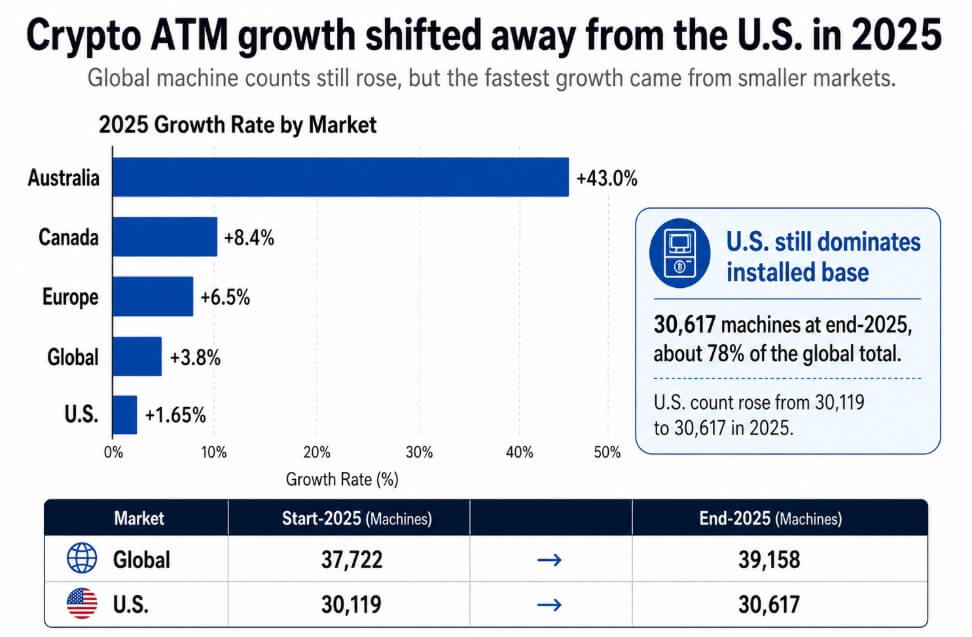
In 2025, the number of global cryptocurrency ATMs grew by 3.8%, reaching 39,158, with Australia growing by 43%, while the U.S. only grew by 1.65%.
Two Future Development Trends in the Cryptocurrency ATM Industry
Optimistic Development Trend
Some investors may acquire high-quality residual assets from Bitcoin Depot, gradually restarting offline machine operations in states where no bans have been implemented, allowing the global cryptocurrency ATM market to continue to expand steadily.
Operators entering the market may actively take on high compliance operating costs, transforming offline machines into regulated formal cash exchange channels. Although transaction scale may shrink and profit margins significantly compressed, they can still operate stably.
Overall profit in the industry is continuously shrinking, but cryptocurrency ATMs still retain a place in the market, specifically serving niche users who cannot or do not wish to use online cryptocurrency exchanges, becoming a legal and compliant cash-to-cryptocurrency trading channel within a segmented field.
Bitcoin Depot has also clearly stated its plan to orderly dispose of all its assets, which means that a large number of offline physical machines still in the company’s possession may be reintroduced to the market after ownership changes.
Under this development model, cryptocurrency ATMs will maintain operational features of high fees and low transaction volume, relying on fixed niche demand to survive, making them suitable only for operators willing to accept a low-profit operating model.
Pessimistic Decline Trend
If the stringent regulatory bans in Indiana, Tennessee, and Minnesota become the mainstream trend in the U.S. market rather than exceptions in specific areas, the market size of cryptocurrency ATMs in the United States will significantly contract.
The existing 30,617 cryptocurrency ATMs in the U.S. account for nearly 80% of the global market share, and the gradual implementation of bans across various regions will directly eliminate a large number of devices. The nearly 9,000 offline machine spots that Bitcoin Depot holds accounted for 23% of the global market share by the end of 2025; if these devices are permanently shut down, the total global installed quantity would suffer a significant blow without need for new regulations from different states.
Even without the imposition of strict operating bans, stringent KYC rules, transaction limits, liability for transaction losses, and an ongoing wave of legal disputes will cause high-fee cryptocurrency ATMs to completely lose their profit margins, forcing machines in the industry to gradually withdraw from the market.

A Cash Transaction Channel Difficult to Scale Up
Today, the channels for the popularization of cryptocurrencies are no longer limited to offline self-service machines. According to statistics from blockchain data analysis firms, the amount of fiat currency flowing into mainstream online cryptocurrency exchanges exceeded $1.2 trillion from July 2024 to June 2025.
Cryptocurrency spot ETFs, mobile digital wallets, stablecoins, and various compliant trading channels for institutions have become the core carriers driving the popularization of cryptocurrencies. In the 2025 cryptocurrency popularization index rankings, India, the U.S., Pakistan, Vietnam, and Brazil rank at the top, with these countries primarily using online exchanges, mobile trading, and compliant institutional trading as their main paths for popularization.
When Bitcoin ATMs were first conceived, they were built as offline trading channels for users accustomed to using cash, allowing cryptocurrencies to enter physical offline consumption scenarios and filling the market gap for offline cryptocurrency transactions.
However, the stark difference in transaction fees between offline machines and online exchanges guarantees that they cannot penetrate the mainstream market; while offline trading scenarios that can bring in high profits have continually spawned scams involving amounts as high as hundreds of millions of dollars.
In the future, only compliant cryptocurrency ATMs in regions with relaxed regulatory policies will remain in the market, continuously serving niche groups with a genuine need for offline cash transactions.
Looking over the industry's development history, it is not difficult to find that cryptocurrency ATMs have been high-cost entry channels since their inception. They have shown the public the potential for offline cryptocurrency trading but have never successfully achieved low-cost transactions, high security, or high convenience in trading, ultimately losing the opportunity to become mainstream trading infrastructure.
免责声明:本文章仅代表作者个人观点,不代表本平台的立场和观点。本文章仅供信息分享,不构成对任何人的任何投资建议。用户与作者之间的任何争议,与本平台无关。如网页中刊载的文章或图片涉及侵权,请提供相关的权利证明和身份证明发送邮件到support@aicoin.com,本平台相关工作人员将会进行核查。


