Author: Nancy, PANews
In just a few months, multiple core members have successively left the Ethereum Foundation (EF), further frustrating an Ethereum community already in low spirits, especially given the current relatively sluggish performance of ETH prices.
Critical period of EF transformation, senior veterans collectively leave
In mid-2025, facing slow execution efficiency, insufficient ecosystem support, and long-standing doubts about governance transparency, the Ethereum Foundation initiated a round of internal adjustments, reorganizing the research and development team and publicly announcing layoffs for the first time. This move has been seen by outsiders as a belated self-correction.
In March 2026, EF released a 38-page mission statement. While reiterating the core vision of Ethereum, the foundation clearly stated that its role has shifted from "the primary guardian" to "one of many guardians." To demonstrate its determination, EF even created a meme of a "SOURCE SEPPUKU LICENSE," indicating that if it fails to fulfill its commitments to Ethereum, it would "face the consequences and take its own life."
However, as the organizational adjustments within EF continued to advance, core members have been continually leaving. Since February of this year, seven core members or senior contributors have successively departed.
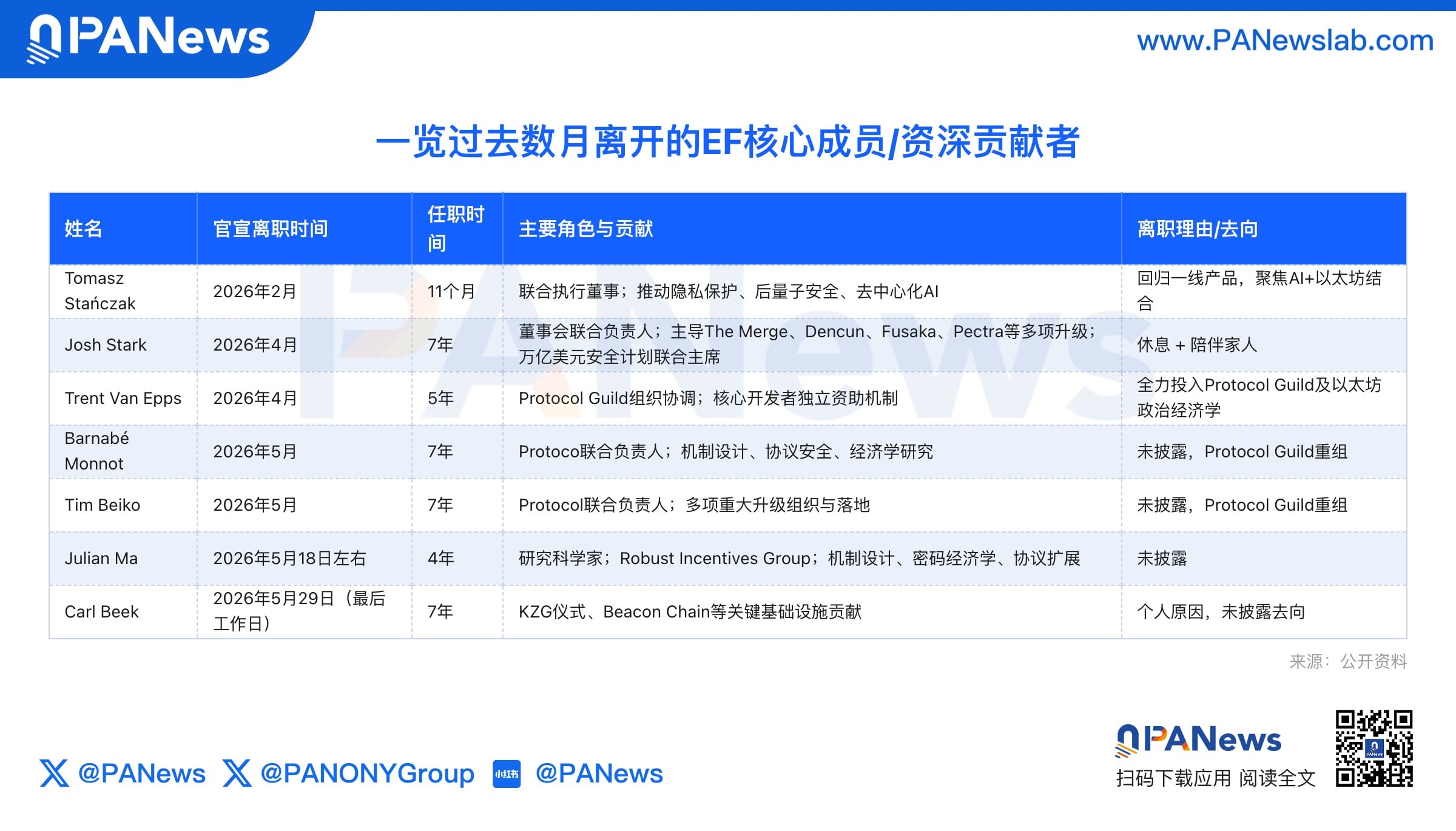
In February, Tomasz Stańczak announced his resignation as co-executive director of EF, having been in office for less than a year. During his tenure, he promoted developments in privacy protection, post-quantum security, and decentralized AI. He stated that the current Ethereum ecosystem is in a relatively healthy stage, and thus he wishes to return to frontline product building, focusing on exploring the integration of AI with Ethereum. At the same time, he pointed out that his independent execution space within EF was gradually shrinking, and continuing to stay on felt more like a transitional handover. His successor is Bastian Aue, who joined EF in 2019. In comparison, Aue has shared less public information and had previously been primarily responsible for organizational coordination and operational optimization.
About two months later, in mid-April 2026, core figure Josh Stark announced his departure after working at EF for seven years. He had deeply participated in several key upgrades of Ethereum, including The Merge, Dencun, Fusaka, and Pectra, and served as co-chair of the multi-trillion-dollar security program. His reason for leaving was simply "to take a break and spend time with family."
On the same day, Trent Van Epps also announced his departure from EF. He had long been responsible for the organizational coordination of Protocol Guild, promoting the funding mechanism for Ethereum core developers, and participating in network upgrades and funding support-related affairs. After leaving, he will focus on Protocol Guild and research on Ethereum political economy. He had previously expressed that the connection between EF leadership and the Milady NFT series was "puzzling."
Entering May, Protocol research co-leader Alex Stokes announced a vacation. Subsequently, former co-leaders of Protocol Guild Barnabé Monnot and Tim Beiko, as well as two senior researchers, Carl Beek and Julian Ma, also left one after another, without publicly stating their reasons.
Although the majority of departing members did not publicly disclose specific reasons for their departure, there are reports suggesting that EF required internal members to sign a document called Mandate based on its emphasized "anti-censorship principle," or face immediate dismissal. This principle emphasizes that no entity should form a lasting and exclusive control over key mechanisms that would interfere with legitimate use or impact system operations. However, this claim has yet to be officially confirmed by EF.
Nevertheless, the outflow of talent from EF has raised concerns about the overall Ethereum ecosystem. Protocol Guild contributor cheeky-gorilla has warned that the health of L1 core development is the foundation of the entire Ethereum ecosystem, but core developers' salaries are 50% to 60% lower than comparable positions in the market, while high-performance new chains like Monad and leading L2 projects are precisely poaching with salaries over ten times higher. He warned that once experienced researchers familiar with underlying protocol logic are lost, Ethereum's key roadmap could face substantial risk of halt.
Protocol team leadership changes, upgrade delay concerns intensify
In just four months, senior veterans from both the executive and research levels have left consecutively, further exacerbating the uncertainty of EF's reforms, especially regarding the adjustments in the Protocol team.
The Protocol team is the core team responsible for the design, research, development, and coordination of Ethereum's base layer, covering security, cryptography, zkEVM, peer-to-peer networking, and other areas. As one of EF's core forces, it has an important impact on the long-term evolution, security, and scalability of the Ethereum protocol.
In response to the personnel changes, EF has also completed the reorganization of the Protocol team this month, appointing three new co-leaders, Will Corcoran, Kev Wedderburn, and Fredrik Svantes, who have each served in EF for approximately 2 to 7 years.
Among them, Will Corcoran is the Protocol research coordinator, focusing on cutting-edge research in zkVM proof systems, post-quantum consensus, Fast Confirmation Rule, etc., possessing cross-team coordination experience and familiarity with the overall architecture;
Kev Wedderburn is the head of the zkEVM team, with deep experience in zero-knowledge proofs, zkEVM implementation, and the combination of research and engineering, and will continue to lead zkEVM-related work, promoting deep integration of the execution layer with zero-knowledge technology;
Fredrik Svantes is the head of Protocol security research, who has long led core work related to Ethereum security, including the multi-trillion-dollar security program, Ethereum Bug Bounty program, and organization of audit competitions, and will deeply participate in cross-team collaboration.
Under the guidance of the new leadership team, Protocol will focus in the short term on advancing the Glamsterdam upgrade launch, preparing for the next Hegotá upgrade, and continuing to promote the implementation of the Strawmap roadmap.
Among these, Glamsterdam is the next major network upgrade for Ethereum, aiming to enhance the throughput capacity of the Ethereum mainnet, with plans to raise the Gas cap from the current approximately 60 million to 200 million, while adjusting the transaction processing mechanism and state database management methods.
However, the originally planned Glamsterdam upgrade for June 2026 has currently been delayed. Based on the latest progress from the testnet and feedback from the Interop meeting, the actual mainnet launch time is more likely to be postponed to the third quarter of 2026. Therefore, some community members and developers are concerned that the recent changes in core personnel may further impact the upgrade pace and execution efficiency.
However, some believe that this round of personnel changes is a normal phenomenon in the EF reorganization process, with some members leaving after completing their phased missions and others adjusting to strategic directional changes. Meanwhile, the new leadership team has gradually taken over, and the core roadmap has not changed. More importantly, as the Ethereum ecosystem matures, EF itself intends to weaken its central role, which helps reduce single-point control risks, alleviate external doubts about the foundation's influence, and further reinforce Ethereum's positioning as a neutral infrastructure.
This aligns with Vitalik's advocated concept of "Walkaway Test," which suggests that even if core developers completely withdraw and no longer maintain it, the protocol can still operate safely, predictably, and stably in the long term.
免责声明:本文章仅代表作者个人观点,不代表本平台的立场和观点。本文章仅供信息分享,不构成对任何人的任何投资建议。用户与作者之间的任何争议,与本平台无关。如网页中刊载的文章或图片涉及侵权,请提供相关的权利证明和身份证明发送邮件到support@aicoin.com,本平台相关工作人员将会进行核查。


