Author: Gu Yu, ChainCatcher
In the recent year of crypto winter, one Web3 startup after another has wilted like fallen leaves. The joyful celebration of the previous bull market has dissipated, replaced by broken funding chains, rampant hackers, and strategic disorientation. Many companies that once flourished thanks to top-tier teams and prestigious VC endorsements are now struggling to survive in the cold wind: some hastily pivot, some sell out at low prices, some quietly shut down, and others suffer catastrophic theft.
A wave of layoffs and resignations has followed, with many senior figures such as Tom Howard, Strategic Officer of CoinList, Abdul Rehman, Head of Monad DeFi, Benjamin Speckien, Head of Security at Celo, and Aleksander Leonard Larsen, Chief Operating Officer of Axie Infinity, leaving their companies.
This is not just a financial crisis but a brutal portrait of industry reshuffling. Essentially, these phenomena arise from the deep collision between technology and capital, products and markets, visions and realities within the Web3 ecosystem, with each story reflecting the confusion and unwillingness of market participants.
Layoffs
Layoffs are a common strategy for crypto projects in a bear market. By cutting non-essential positions in marketing, technology, etc., projects can significantly save on labor expenses and improve operational efficiency, thus ensuring a survival cycle as long as possible while preparing for the next bull market.
In early February, the well-known cryptocurrency exchange Berachain announced a 25% layoff (up to 200 people) and the closure of its exchange operations in the UK, EU, and Australia. Two weeks later, its Chief Operating Officer Marshall Beard, Chief Financial Officer Dan Chen, Chief Legal Officer Tyler Meade, and other senior management team members left the company, with their original responsibilities taken over by other members of the management team.
This occurred just 3 months after its IPO, during which its stock price had already dropped by over 60%, and the bleak market conditions and revenue situation forced it to adopt an aggressive business contraction strategy.
In early January, the Berachain Foundation also announced that it had disbanded most of its retail marketing team, and Chief Developer Alberto would also leave. The project admitted that the effectiveness of a retail-first strategy in the entire cryptocurrency field had significantly declined during the 2024/2025 period.
In August 2025, the modular rollups infrastructure developer Eclipse Labs announced team adjustments, with a layoff rate of 65%. In the same month, Lido announced a 15% layoff due to cost pressures, Sandbox's founder announced his resignation and a 50% layoff, shifting the focus from metaverse business to Web3 applications and Launchpad plans. In July 2025, Eigen Labs announced a layoff of about 25%, focusing its business on EigenCloud.
Layoffs may superficially appear as cost-control actions, but the deeper meaning lies in the company's reassessment of future revenue expectations. When management opts to reduce team size, it is essentially evaluating: in the current market environment, the returns from marginal expansion can no longer cover the new costs.
This also means that Web3 startups are beginning to shift from a "growth-first" approach to a "survival-first" approach. Efficiency issues that were obscured during the bull market are amplified infinitely in the bear market. Whether the organizational structure is redundant, whether market launches are efficient, and whether product iterations truly align with user needs, will all be exposed under cash flow pressure.
Transformation
If layoffs are a form of passive contraction, then transformation is an active adjustment. Even projects with sufficient financial backing need to carefully consider whether their established strategic routes align with current market trends and user needs.
The growth logic many projects built during the last cycle was based on assumptions of ample liquidity and high risk appetite. When these premises disappear, narratives become difficult to reconcile. Thus, we see many projects extending from pure on-chain infrastructure towards payments, AI, RWA, etc., as new options.
Polygon is a typical example. As an established Layer2 project, Polygon has maintained a top-tier position both technically and commercially, but due to the Layer2 track becoming increasingly neglected by the market and struggling to compete with non-EVM public chains like Solana and Aptos, it decided to pivot towards the stablecoin track this January, with the first step being acquiring capabilities and resources related to payments.
In early January, Polygon Labs announced the acquisition of Coinme and Sequence to enhance its regulated stablecoin payment and liquidity core infrastructure. Coinme provides a regulated fiat deposit and withdrawal channel in the US, connecting cash, debit cards, and digital assets within the existing regulatory framework, while Sequence abstracts operations such as bridging, trading, and gas fees for end-users.
Polygon stated that these acquisitions together form the foundation of an open funds stack, aiming to achieve regulated stablecoin payments and liquidity that operates on Polygon's blockchain. Polygon Labs will become a profitable blockchain payment company.
Last month, Solana ecosystem NFT market Maagic Eden announced that it would gradually cease support for EVM and Bitcoin Runes and Ordinals markets, allocating its main resources to its newly launched prediction market project Dicey.
The collective transformation of Bitcoin mining companies has also become a typical case. In November 2025, Bitfarms announced that it would close its Bitcoin mining business within two years and transform its facilities into AI and high-performance data centers. Recently, Bitfarms also announced its name change to Keel Infrastructure, completely disconnecting from "Bitcoin" at the corporate name level.
Cipher Mining announced its name change to Cipher Digital in February and sold its mining field shares to Bitmain for about 40 million USD to focus on becoming a leading developer and operator of next-generation computing data centers.
Selling Out
Even projects with substantial funding must make the decision to sell out due to slow product progress and lack of confidence. A typical case is the decentralized social protocol Farcaster.
In mid-January, the decentralized social protocol Farcaster announced its acquisition by Neynar, with the ownership of the protocol contract, codebase, applications, and Clanker transferred to Neynar, which would be responsible for subsequent operations and maintenance. Meanwhile, the project team returned the full $180 million in financing to investors.
Just one month prior, Farcaster co-founder Dan Romero had announced a major strategic adjustment for the platform, abandoning the "social-first" approach used for over four years to seek product-market fit, switching to a wallet-centric growth model. However, this acquisition means that Farcaster's exploration of the wallet track also did not meet the team’s expectations.
Another decentralized social protocol Lens Protocol faces similar circumstances. Due to a continuous decline in user activity, the original team announced that the protocol had been taken over by Mask Network, and the original team would transition to technical consultants to innovate in the DeFi field where they excel.
The cross-game avatar NFT platform Ready Player Me, previously favored by the industry with a $56 million financing led by a16z, faced a significant drop in user numbers as the NFT track began to decline. Its X account posted only 5 tweets in the past year. At the end of last year, Ready Player Me was sold to streaming giant Netflix, allowing the team members to successfully exit.
Theft
Theft has become the fate of many high TVL protocols, with hackers viewing them as serious "targets". High-value theft incidents happen almost weekly, causing substantial losses to the protocols themselves or deposit users, exacerbating distrust in the market and among users.
In mid-February, the well-known DePin infrastructure IoTeX suffered a hacking incident on its cross-chain bridge, with the validator owner's private key being leaked, leading to unauthorized control of the bridging contract and resulting in a loss of $4.4 million. Following this, IoTeX announced a 100% compensation to users affected by the hacking incident, having almost no impact on the project's operation. However, for many small to medium-sized projects, a hacking incident can be catastrophic.
In early February this year, the Solana-based DeFi protocol Step Finance had about $40 million stolen from its vault due to a breach in executive devices. Subsequently, the team explored various possibilities, including financing and acquisition, but was unable to find a viable solution, leading to the difficult decision to immediately cease all operations.
At the beginning of January this year, the blockchain computing scaling protocol TrueBit was attacked due to an integer overflow vulnerability in its smart contract. The attacker exploited carefully crafted input parameters to trigger an overflow error in the token purchase price calculation function, allowing mass minting of protocol tokens TRU at extremely low or even no cost, which were then immediately destroyed to extract large amounts of ETH from the pool. Ultimately, the attacker profited $26.4 million, and the price of its TRU tokens dropped to zero. After issuing a responsibility announcement in January, the official X account of TrueBit has not been updated since.
Shutdown
Compared to layoffs and transformations, many projects quietly fall behind in the lengthy pull process. They invest substantial funds and human resources in product development, market operations, and listing processes, but both funding and patience are exhausted in one marketing event after another with little impact, resulting in an eventual announcement of cessation of operations.
DappRadar was founded in 2018 and was once the most popular application data statistics website in the crypto industry. Despite raising over $7 million, due to the difficulty of monetizing the data platform, the platform decided to issue tokens in 2021 to expand its cash flow. However, due to the lack of practical support for the token, its price has continually fallen, failing to provide sustainable financial support.
“We have made the difficult decision to shut down the DappRadar platform. Under the current circumstances, operating a project of this scale has become difficult to achieve financial sustainability. After exhausting all possibilities, we had to make this tough choice,” DappRadar stated in its announcement. “As we turn away, we are confident that we followed the right direction, upheld our principles, and injected positive energy into the industry.”
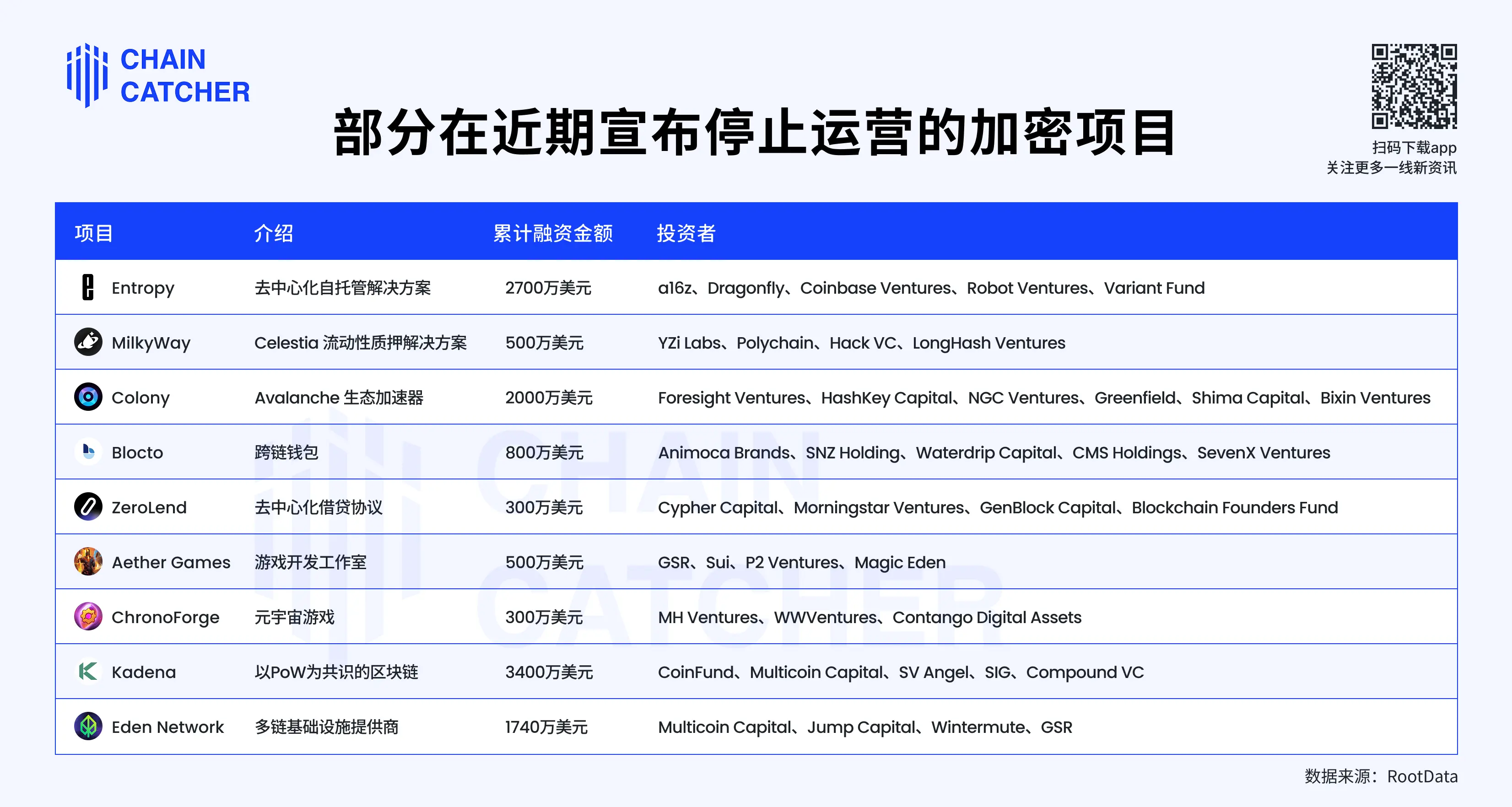
In February this year, the multi-chain lending protocol ZeroLend officially announced it would cease operations after three years. “Recently, several chains that ZeroLend supported in its early stages have become inactive, or their liquidity has significantly declined. In some cases, oracle providers have also stopped their support, making it increasingly difficult to reliably operate markets or generate sustainable revenue. Meanwhile, as the protocol scaled up, it attracted the attention of more malicious actors, including hackers and scammers. Combined with the lending protocol's low profit margins and high-risk nature, this has led the protocol to remain in a state of long-term loss.”
In December 2025, the cross-chain smart wallet Blocto announced its cessation of operations. “Over the past few years, we have incurred over $5.5 million in losses to maintain community services. However, this cannot continue indefinitely. Realizing that our operational funds are running low, we attempted to communicate with the leadership of Flow/Dapper starting in June this year, but were unable to secure a single meeting opportunity. Each email exchange took weeks, while our remaining funds continued to deplete.”
Conclusion
In the early development stage of Web3, the power of narrative greatly exceeds that of the product itself. A grand vision and a seemingly disruptive mechanism are often enough to attract capital and users. However, as macro liquidity returns to rationality, and investors and users begin to recalibrate risk-reward ratios, only those projects with clear cash flow logic, real user needs, reliable technical architecture, and compliance capabilities can truly traverse cycles.
The real cases throughout this article serve as a cold mirror of the same industry, reflecting the structural vulnerabilities accumulated in the Web3 ecosystem during its rapid expansion: excessive reliance on external liquidity, neglect of the business closed loop, and insufficient awareness of security and compliance.
However, this round of winter is not an end but rather a necessary stage for industry maturation. Almost all technological revolutions in history have gone through similar stages: capital frenzy, bubble expansion, sharp corrections, and confidence rebuilding, and Web3 is no exception.
Therefore, rather than viewing these layoffs, transformations, thefts, and shutdowns as pessimistic signals, it is better to understand them as a necessary screening process. As regulatory frameworks become clearer, infrastructure performance continues to improve, and the market self-purifies, the teams and products that remain through this winter tend to possess a stronger awareness of risk and clearer business logic. With the assistance and integration of increasingly powerful AI capabilities, the new cycle of the crypto ecosystem is more promising than ever!
Related Reading: “Institutions embracing crypto while practitioners feel exceptionally frustrated, who will ultimately win?”
免责声明:本文章仅代表作者个人观点,不代表本平台的立场和观点。本文章仅供信息分享,不构成对任何人的任何投资建议。用户与作者之间的任何争议,与本平台无关。如网页中刊载的文章或图片涉及侵权,请提供相关的权利证明和身份证明发送邮件到support@aicoin.com,本平台相关工作人员将会进行核查。


