Author: Max.s
The current cryptocurrency market is undergoing severe structural adjustments. According to the latest trading data (as shown on the chart, ETH/USDT has fallen to around $1,847.84, with a clear recent downward trend), Ethereum (ETH) is experiencing a deep correction driven by both liquidity and expectations.
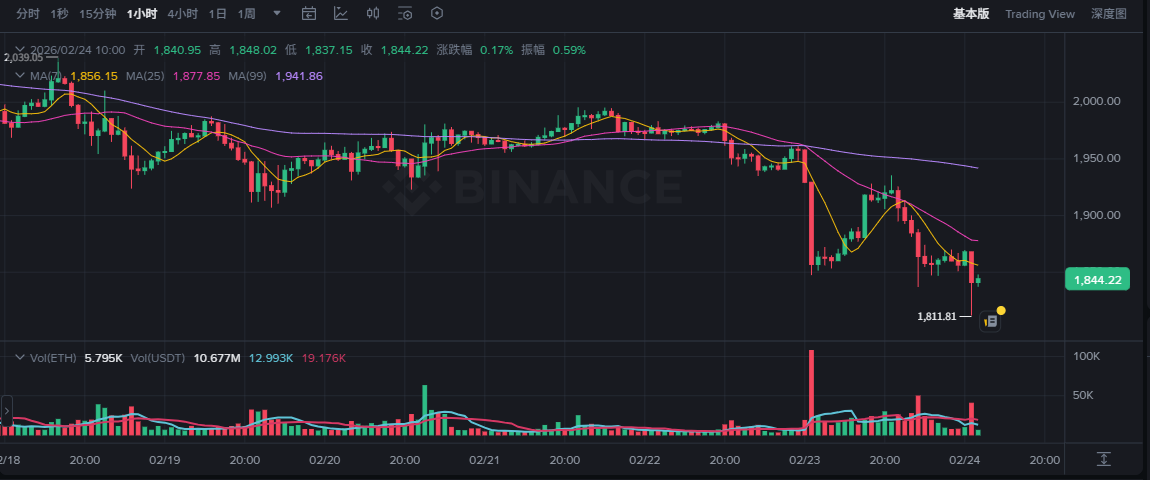
Looking back at the price trends in February 2026, ETH plunged from above $2,360 to the $1,825 range within a short period, a drop of over 22.7%. Behind this price decline is a comprehensive reconstruction that Ethereum is facing regarding its technical upgrades, organizational structure, and compliance environment. For institutional investors and finance professionals, penetrating short-term price fluctuations to understand the changes in the underlying asset logic of Ethereum is the core issue at present.
The most immediate pressure facing Ethereum comes from the ongoing withdrawal of liquidity. This outflow of funds is not a single event, but a resonance of multiple capital routes.
Spot ETF suffers net redemptions: The risk aversion sentiment among institutional investors has significantly increased. For example, on January 29, 2026, the US spot Ethereum ETF recorded a massive net outflow of $155.7 million in a single day. Among them, Fidelity's FETH had a net outflow of $59.2 million, BlackRock's ETHA saw a net outflow of $54.9 million, and two funds from Grayscale also recorded outflows in the tens of millions of dollars. This indicates that traditional Wall Street capital is systematically reducing its risk exposure to Ethereum.
Concentrated sell-off of early chips: On-chain data shows that whale accounts sold approximately 1.43 million ETH within just two weeks. On-chain data shows that whale accounts sold approximately 1.43 million ETH within just two weeks.
Founder cashes out: This month, Ethereum co-founder Vitalik Buterin sold over 8,800 ETH, cashing out about $18.45 million. In traditional financial markets, intensive sell-offs by core management are often seen as significant negatives, further exacerbating market panic.
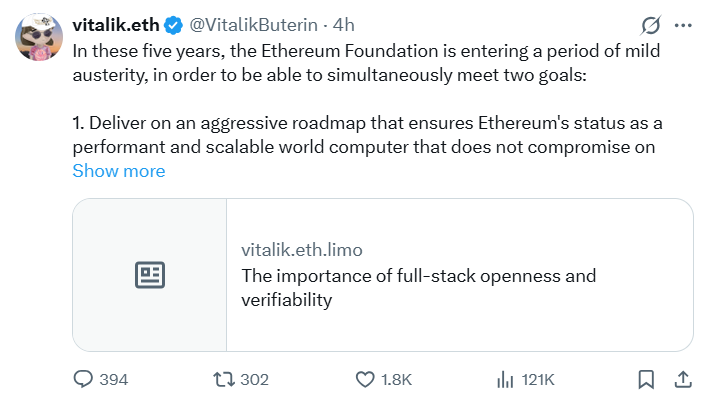
Faced with the harsh winter of the market, the Ethereum Foundation (EF) has shifted its financial strategy defensively. Vitalik Buterin announced that the foundation will enter a five-year "moderate tightening" phase.
From the perspective of corporate finance, this is a classic cash flow management strategy. Its core objectives have two points: first, to ensure that the foundation can continue to finance the development of Ethereum's core underlying technology in the future, avoiding threats to its independence due to excessive resource consumption; second, to guarantee that Ethereum's radical roadmap as a high-performance "world computer" can be delivered as scheduled.
To align with this strategy, Vitalik himself has proactively detached some "special projects" from the foundation's funding reliance, choosing to extract 16,384 ETH and use decentralized staking yield to personally fund the research and development of open-source software, hardware, and privacy-protecting projects with public good characteristics. This internalization of marginal R&D expenditure and focus on core business marks a maturation and restraint in the capital operations of the Ethereum ecosystem.
While prices are under pressure, Ethereum's technical fundamentals show remarkable resilience, even exhibiting a rare phenomenon of "price and volume divergence." Recently, the Ethereum network's TPS (transactions per second) hit a historical high of 75,862, far exceeding the previous peak of 58,786.
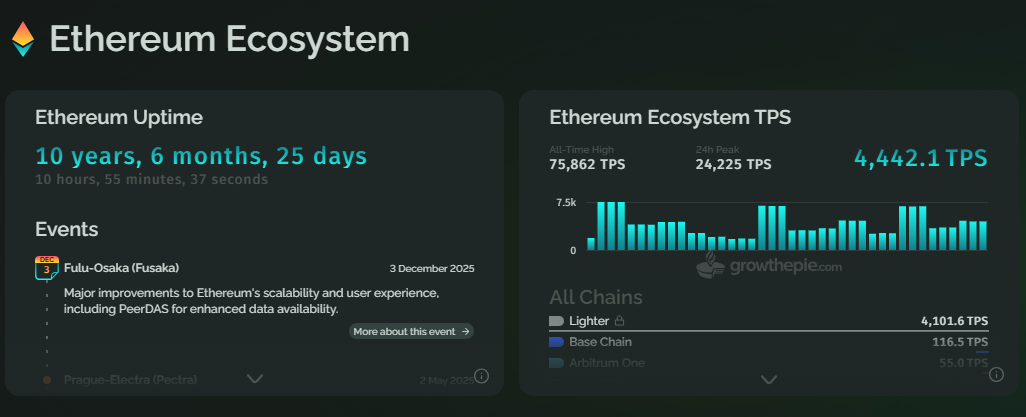
This is primarily attributed to the Fusaka upgrade deployed last December. This upgrade introduced the PeerDAS mechanism, greatly expanding the data throughput of Layer 2 networks. However, with the surge in data capacity, new systemic risks are emerging. Vitalik pointed out that since current block builders still need to download complete data, the network faces serious centralization risks.
To address this hidden danger, Ethereum plans to launch the Glamsterdam upgrade in 2026, which is essentially a fundamental reform aimed at breaking the oligopoly within the network.
ePBS mechanism reshapes interest distribution: At the core of this upgrade is ePBS (separation of proposer and builder within the protocol). It enforces the block building process into the underlying protocol, regulating the bidding process and weakening the absolute dominance of the current few external builders over the market.
Preventing rent-seeking by giants: For financial practitioners, this means that Ethereum is actively intervening in its internal MEV (maximum extractable value) market structure, breaking down the technical barriers of leading capital and reconstructing the underlying logic of staking income.
In addition to the internal structural growing pains, there is also an impending regulatory crackdown looming over the Ethereum ecosystem. The EU's MiCA (Market in Crypto-Assets Regulation), which will come into full effect on July 1, 2026, requires all cryptocurrency companies operating within the EU to meet strict compliance standards.
The implementation of this regulation will directly impact Ethereum's vast on-chain DeFi protocols, liquidity providers, and related derivatives markets, which lack the endorsement of traditional corporate entities. The sharp rise in compliance costs and the early withdrawal of some non-compliant funds are the deep macro incentives behind the recent bloodletting in the spot market.
Ethereum is in a period of differentiation: on one hand, there is the relentless sell-off of short-term capital and the pre-emptive pricing of strict regulations; on the other hand, there is the robust expansion of technical infrastructure and self-revolution aimed at internal monopolies. This is a typical process of "de-leveraging" that exchanges short-term pain for long-term systemic stability.
免责声明:本文章仅代表作者个人观点,不代表本平台的立场和观点。本文章仅供信息分享,不构成对任何人的任何投资建议。用户与作者之间的任何争议,与本平台无关。如网页中刊载的文章或图片涉及侵权,请提供相关的权利证明和身份证明发送邮件到support@aicoin.com,本平台相关工作人员将会进行核查。


