Author: ScalingX
1. Perp DEX Status: Concerns After Prosperity
In February 2026, the decentralized perpetual contract exchange (Perp DEX) sector, after experiencing explosive growth, has entered a new stage where product quality and internal competition coexist.
According to data from Defillama, the highest daily trading volume of Perp DEX reached $7.8 billion. Hyperliquid leads the pack with an absolute advantage, achieving an annual trading volume ($2.6 trillion) surpassing Coinbase ($1.4 trillion). Meanwhile, Lighter and Paradex have quickly opened the market with zero-fee trading; Aster relies on Bnb Chain for dual support from its ecosystem and exchange, while EdgeX has rapidly risen with aggressive incentives; veteran leaders dYdX and GMX have shown insufficient growth in this new round.
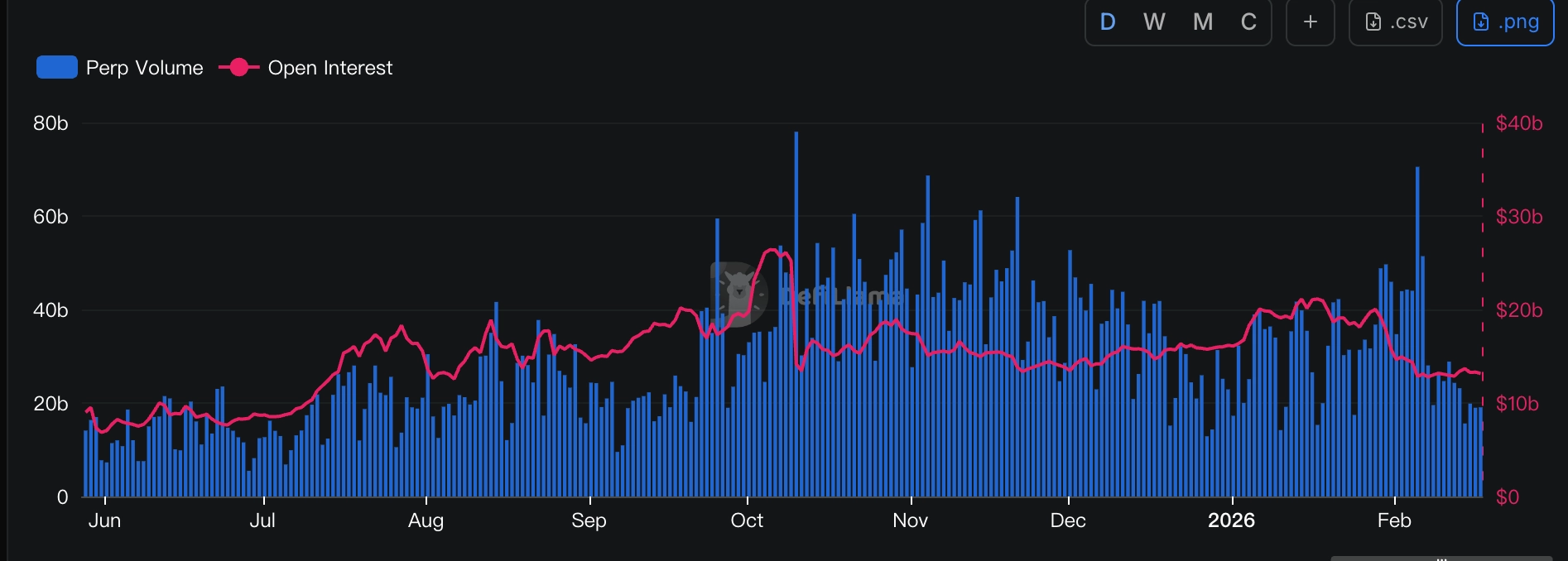
1.1 Market Landscape: From Dominance to Multilateral Rivalry
Hyperliquid dominates the market: On February 16, 2026, Hyperliquid processed a nominal trading volume of $3.5 billion (total market of $19 billion, accounting for 18%), with open interest of approximately $5 billion (total market of $13 billion, accounting for 38%).
Hyperliquid has decreased from about 85% of its peak level at the end of 2023 to the current 20-40%. Competition among peers is extremely fierce.
Ecological niche differentiation of emerging forces:
Lighter: Circle USDC interest sharing (subsidy model) restructures cost structure.
Aster: Captures retail traffic through social fission and aggressive incentives.
EdgeX: Focuses on vertical on-chain derivatives, firmly adhering to the tech enthusiast community.
Paradex: Zero-fee trading through ZK privacy + RPI mechanism.
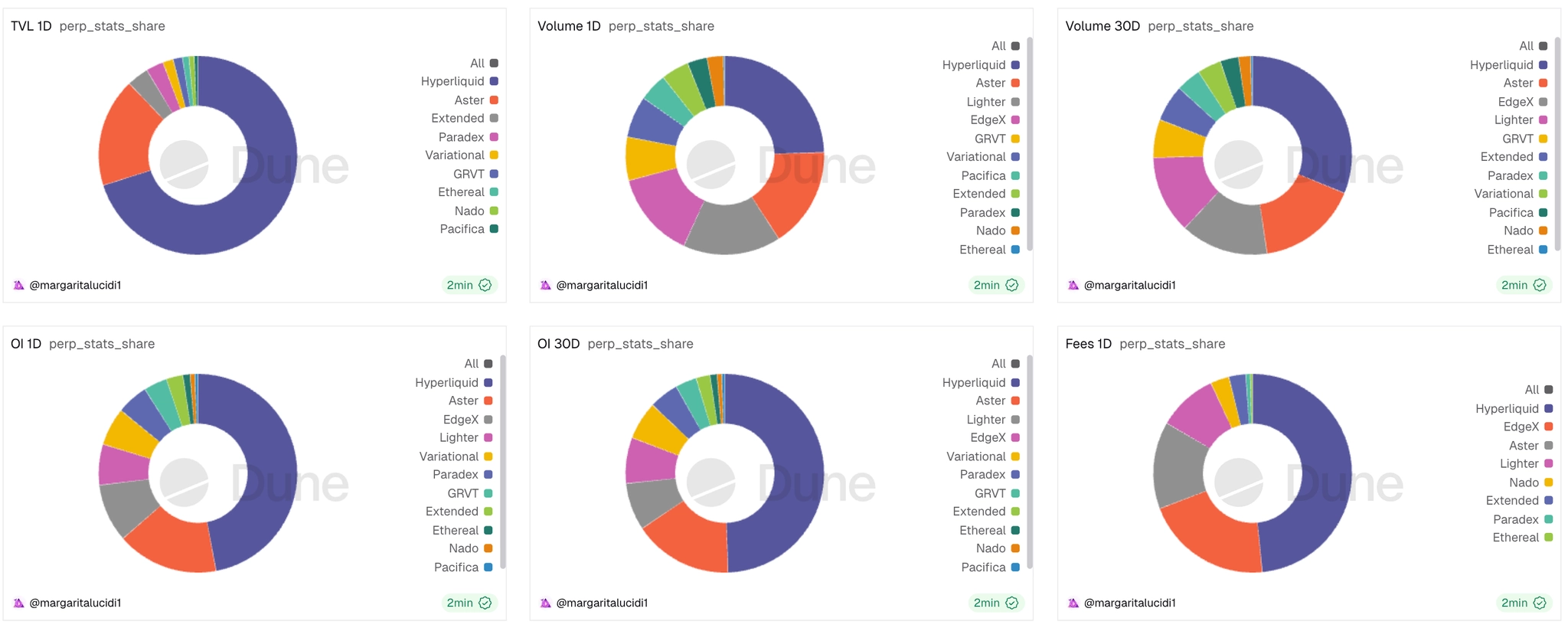
1.2 Three Structural Pain Points Beneath Surface Prosperity
Although trading volume data looks good, the market performance in 2026 reveals three deep-seated contradictions as the Perp DEX sector evolves:
1. Fee Exploitation and Cost Shifting Issues:
Leading protocols capture immense revenue through high fees: Hyperliquid's accumulated fee revenue reached $38.99 million in the first half of February (approximately $2.44 million daily). These costs are ultimately borne by traders, especially retail users facing a taker fee rate of 0.02%-0.05%, coupled with staking, leading to very high actual costs.
2. Transparency Trap and Strategic Hunting Risks:
Hyperliquid's complete transparency architecture leads to large-holder positions, liquidation lines, and trading strategies being completely public. This "transparent battlefield" environment hinders large-scale institutional capital entry.
3. Liquidity Deterioration Caused by Traffic Toxicity:
Whether due to actual incentives or TGE expectations, the user behavior of inflating trading volume has brought significant changes to the entire Perp DEX sector. There are many cases of "high trading volume and low liquidation" suspected to be incentive-driven rather than stemming from real demand. The proportion of high-frequency arbitrage and volume inflation activities is rising, making it difficult for market makers to effectively distinguish between high-frequency algorithm traffic and retail traffic, leading to adverse selection issues.
2. Paradex Overview
In this multi-polar competition, Paradex represents a paradigm shift from "scale wars" to "institutional design"—it does not engage in low-dimensional competition through subsidies or transparency, but rather reconstructs market structure through cryptography and product mechanisms.
Paradex is the first application chain built on Starknet, focusing on providing an institution-level decentralized derivatives trading experience. The project is incubated by Paradigm. Paradigm has robust market-making resources and trading infrastructure, with a core focus on providing retail and institutional users an experience comparable to centralized exchanges while maintaining the transparency and self-custody advantages of decentralized protocols.
Key milestones and data:
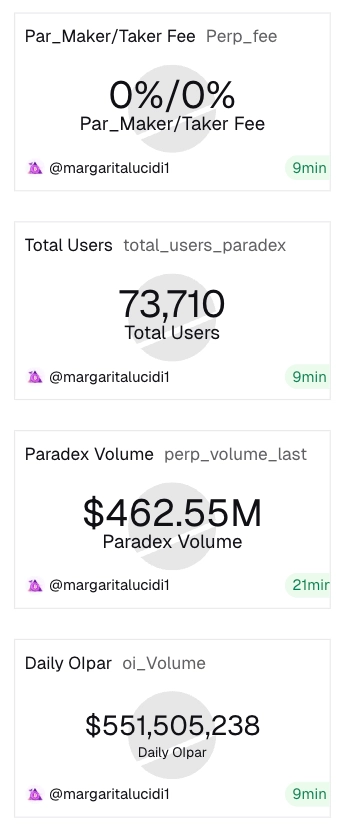
Trading volume growth: During Season 2 (2025-2026), the average daily trading volume grew from $68 million to approximately $2.1 billion.
User growth: From 4,100 users to 73,710 users (17 times).
TVL performance: Peaked at $218 million (January 2026), currently at $176 million (due to technical rollbacks and a 19.3% outflow at the end of Season 2).
Product matrix: Supports over 100 perpetual contract markets, expanding into spot, options, and RWA perpetual contracts.
3. Paradex's Path to Breaking the Deadlock
Faced with issues in the Perp DEX industry, Paradex does not engage in traditional subsidy or scale competition but instead conducts institutional innovation at the microscopic structural level of the market. Its core is to reconstruct the order flow value distribution through mechanism design, providing a sustainable profit environment for market makers while safeguarding retail user interests. This approach is directly reflected in the RPI (Retail Price Improvement) mechanism, which isolates traffic types at the bottom layer, optimizing the economic efficiency of the entire system.
3.1 Zero Fees: RPI Mechanism and Traffic Isolation
Paradex's zero fees are not simply subsidies but instead achieve a sustainable business model through the RPI (Retail Price Improvement) mechanism. This mechanism identifies and isolates toxic traffic through three rigid rules:
1. Isolation of Source Interfaces:
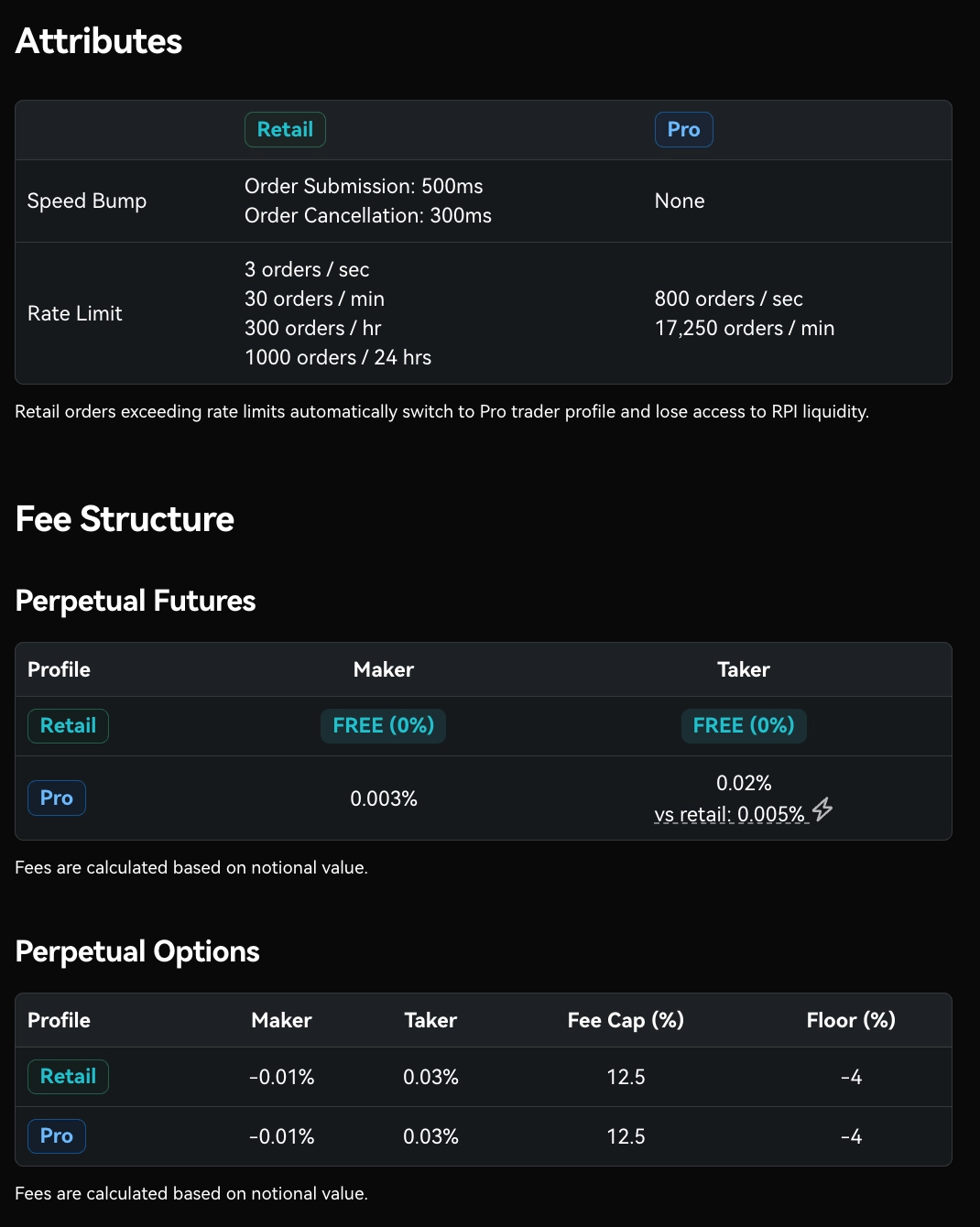
Retail side: Orders submitted via the Web UI are classified as retail and enjoy 0% fees, and can only match liquidity from the RPI order pool.
Professional side: Orders submitted via API (usually algorithmic or high-frequency trading) are automatically tagged as high toxicity, cannot access RPI pools, and must pay standard rates (maker 0.003%/taker 0.02%).
2. Mandatory Speed Delay:
All order submissions are subject to a mandatory delay of 500 milliseconds, and order cancellations have a delay of 300 milliseconds. This effectively prevents high-frequency strategies (typically 100ms).
3. Dynamic Rate Limits:
The system monitors order rates, setting a threshold of 3 times/second. Orders exceeding this limit automatically downgrade to the "Pro" profile, facing higher fees.
Business Logic: Through isolation, market makers are willing to provide tighter quotes for retail orders (due to lower adverse selection risk), thus achieving "retail price improvement." Meanwhile, fees from professional users cross-subsidize the zero fee rate for retail users.
Effect: Retail users enjoy truly zero-cost trading, while the protocol generates income from professional users. According to the DC community, Paradex’s funding rate return mechanism has also contributed some earnings, but the details are not public.
3.2 Privacy: ZK Architecture and Field-Level Hiding
Paradex's privacy protection is its core differentiation, achieving institutional-level confidentiality through end-to-end ZK encryption. The technical architecture is divided into three layers:
Cloud Layer: Order data is stored in Paradex Cloud, visible only to authenticated users.
L2 Chain Layer: Custom RPC configurations mask sensitive fields, defaulting to shielding private data.
L1 Layer: Encryption state differences are verified through ZK, ensuring data is verifiable but not public.
Eight specific hidden field categories:
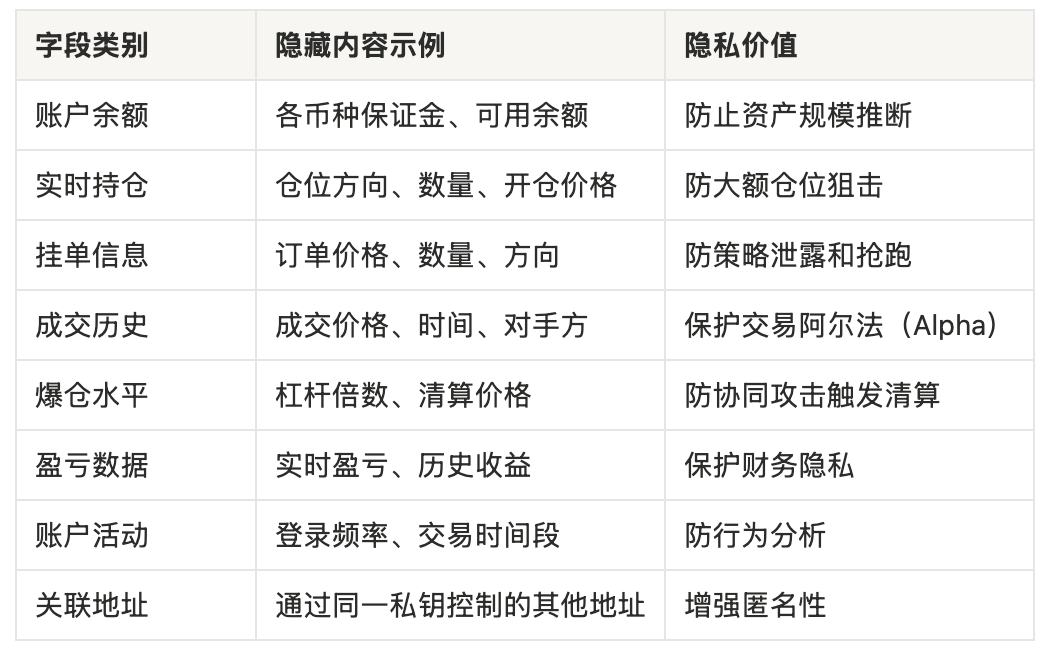
Privacy Council: Composed of the Paradex Foundation, Paradex company, and Karnot (technical partner), holding emergency decryption keys. These are used only to recover user assets when the protocol is unavailable (such as a mainnet failure), balancing privacy and security. The council cannot access user data during daily operations.
Advantages: Compared to transparent on-chain protocols (like Hyperliquid, dYdX), Paradex's privacy model has attracted institutional users, such as hedge funds and high-frequency trading firms, who need to protect strategy and position information. Community discussions indicate that traditional financial companies have already tested its privacy features.
4. Paradex Ecosystem
The Paradex ecosystem currently includes two core digital assets: XP points (experience value system) and MoneyBadgers NFT. Additionally, the protocol has planned a native synthetic dollar, XUSD, but it has not yet officially launched.
4.1 XP Points: Core Credentials for Acquiring $DIME Airdrops
Current Status and Valuation:
Season 2 has ended: as of January 31, 2026, approximately 450 million XP has been distributed.
Season 3 is ongoing: it started on February 1, focusing on spot, RWA perpetual, and options trading.
First round of distribution: Season 3’s first distribution of XP will take place on February 18, 2026, rewarding activities from February 1 to 17.
XP valuation estimate (based on $DIME FDV prediction): According to Whales Market analysis report, the fully diluted valuation (FDV) of $DIME is estimated to be in the range of $260 million to $520 million. Combining the approximately 450 million XP distributed in Season 2 (a major portion of the airdrop pool), the potential value of each XP can be estimated: 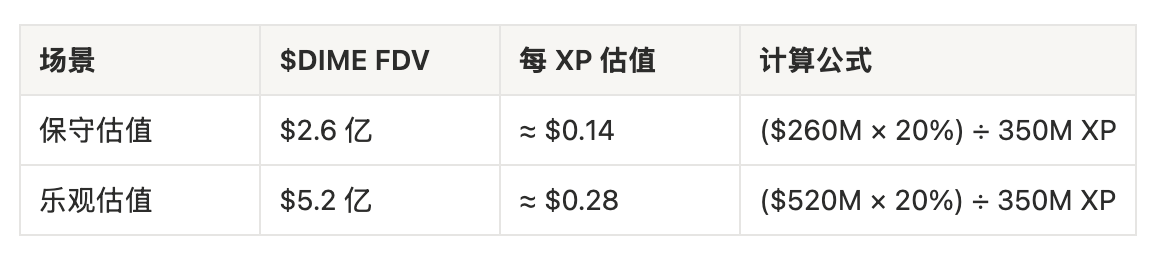 Note: This is a theoretical estimate; the actual airdrop value depends on final TGE prices and specific distribution plans.
View and Operation Entry
Official Dashboard: app.paradex.trade/xp (wallet connection required for login)
Viewing Method: After logging in, current XP balance, historical acquisition records, and rankings can be viewed on the "XP" page.
4.2 MoneyBadgers NFT: Ecological Identity and Rights Certificate
Market Performance and Price: MoneyBadgers NFT completed its box revealing on February 5, 2026, with a total of 10,000 pieces:
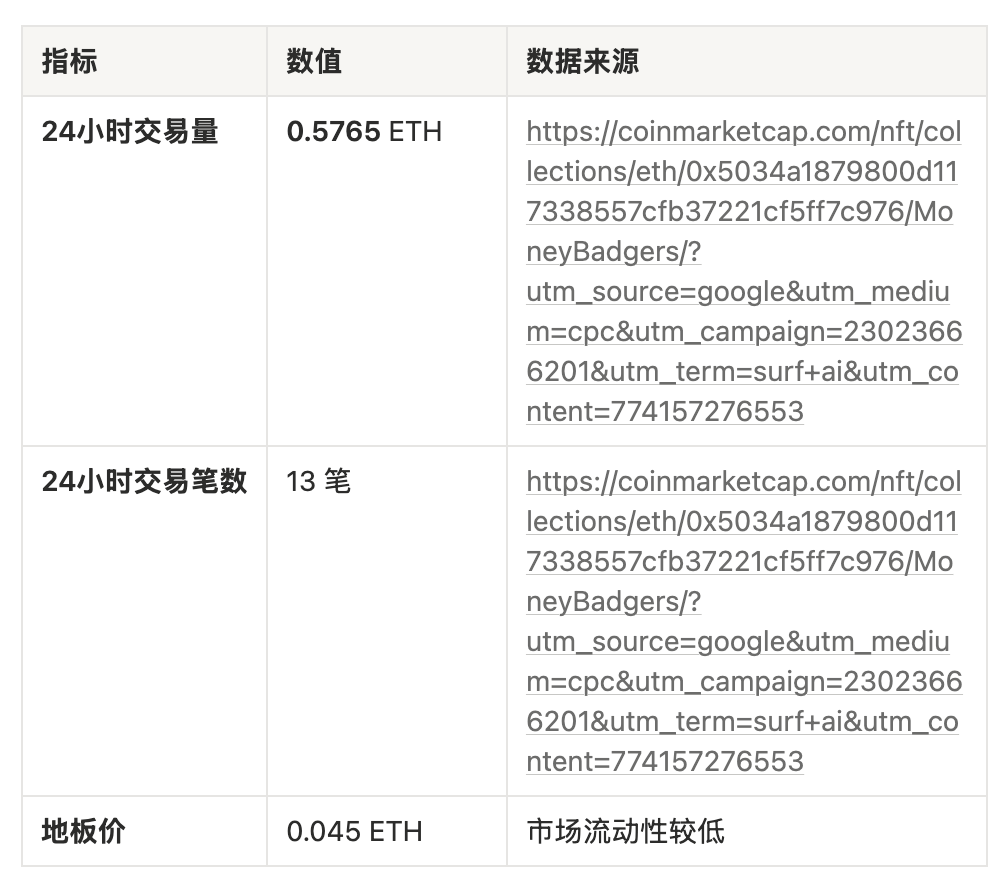
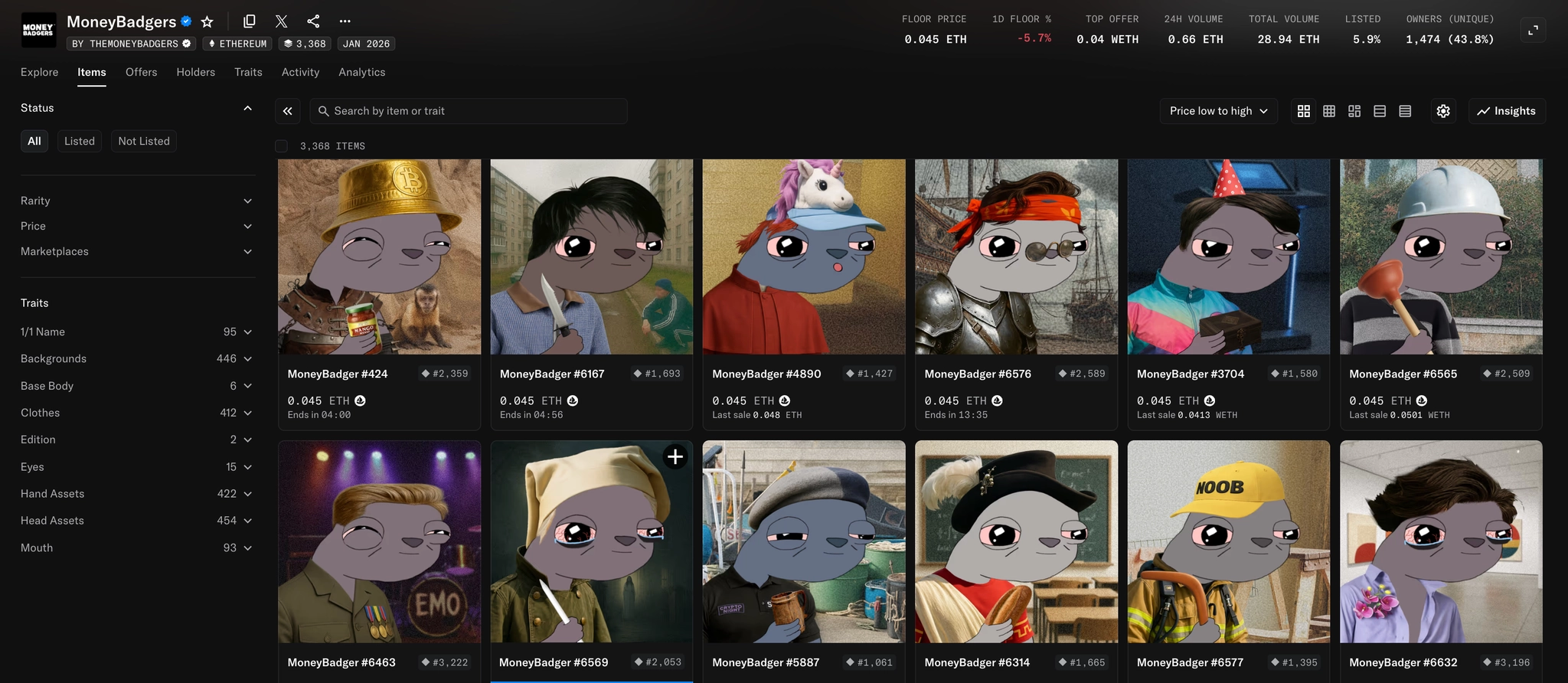
Current Situation Analysis: The NFT market is in an early stage with limited liquidity. Although there are transactional records (13 transactions/24h), a stable floor price has yet to form, indicating that the market is still in a price discovery process.
Acquisition and Viewing Method
Acquisition Conditions: Users who accumulated 25,000 XP during Season 2 can receive a BadgerBox blind box.
Box Opening Entry: "Inventory" page within the Paradex App.
View Holdings: After logging in, users can check their owned MoneyBadgers NFT in "Inventory."
4.3 Potential Asset: XUSD (Native Synthetic Dollar)
Paradex has planned to launch a native synthetic dollar, XUSD, positioned as an "unfreezeable, interest-bearing digital dollar." However, as of February 16, 2026, this product has not yet officially launched, with no public trading or pricing information available.
5. Reasons for Optimism
Addresses Real Pain Points: Directly targets the most sensitive privacy needs of institutional users and profit dilemmas of market makers, which has stronger sustainability compared to external subsidies.
Forward-Thinking Technical Architecture: ZK Privacy + Application Chain Performance represents the direction of next-generation DeFi infrastructure.
Innovative Economic Model: The RPI mechanism achieves cross-subsidization through traffic classification, reducing dependency on external factors.
Unique Ecological Positioning: The first application chain on Starknet, supported by Paradigm's liquidity network.
6. Risks for Pessimism
Risk of Technical Complexity: ZK encryption and application chain architecture increase operational complexity; the rollback event in January exposed stability challenges.
Liquidity Cold Start Problem: Needs to attract both market makers (providing liquidity) and traders (generating trading volume), facing a chicken-and-egg problem, still in the early stages.
Severe Competitive Environment: Seeking differentiated growth paths under the siege of Hyperliquid (first-mover advantage) and contenders like Aster and Lighter.
Execution Risks: Uncertainty regarding RWA product roadmap delivery capability and institutional adoption speed.
Summary
As the first application chain project in the Starknet ecosystem, Paradex has established a unique competitive position in the decentralized derivatives track, leveraging its technological innovations (ZK privacy, sub-millisecond latency), institutional resources (Paradigm incubation, top market maker support), and community operations (XP system, MoneyBadgers culture).
Despite recent technical challenges and TVL losses, the team's demonstrated quick response capability and sincerity in user compensation are commendable. With the approaching $DIME TGE and the launch of new products in Season 3, Paradex is expected to regain its growth momentum.
Key milestones to watch:
$DIME TGE: Expected at the end of February or early March 2026 (specific date to be announced by official sources).
First distribution of Season 3: February 18 (weekly distributions will become routine).
Can TVL stop its decline and rebound?
Progress of new product launches (spot, options, RWA perpetual).
Community airdrop claiming status (post-TGE, XP holders can claim 25% of total $DIME airdrop).
Short-term participants may focus on airdrop trends around the TGE and product release catalysts.
For long-term investors, Paradex represents the technological direction of the next generation of decentralized exchanges, where Paradex's value does not lie in immediately replacing giants, but in verifying the viability of a new paradigm—resolving the transparency trap through ZK privacy and addressing adverse selection through the RPI mechanism, exploring a sustainable third path for Perp DEX.
免责声明:本文章仅代表作者个人观点,不代表本平台的立场和观点。本文章仅供信息分享,不构成对任何人的任何投资建议。用户与作者之间的任何争议,与本平台无关。如网页中刊载的文章或图片涉及侵权,请提供相关的权利证明和身份证明发送邮件到support@aicoin.com,本平台相关工作人员将会进行核查。


