The two-person team, which has never been funded, has completed a total of 16 projects, with the highest market value reaching $300 million. Will FWA succeed this time?
Written by: Sanqing, Foresight News
The Ethereum protocol Fake World Assets (FWA), which relaunched on July 20, created an NFT lottery machine. Depositors lock their NFTs with an ETH deposit in a pool, and others can pay to withdraw them. After winning, they can either keep the NFT or sell it back to the depositor for 85% of the deposit. The proceeds from the sale can be in ETH or the protocol's token FWA. According to DefiLlama data, FWA has generated $5.98 million in fees since its launch, with a TVL of $5.49 million and total revenue reaching $1.45 million. FWA's 24-hour protocol revenue even surpassed that of Collector Crypt on Solana at one point.
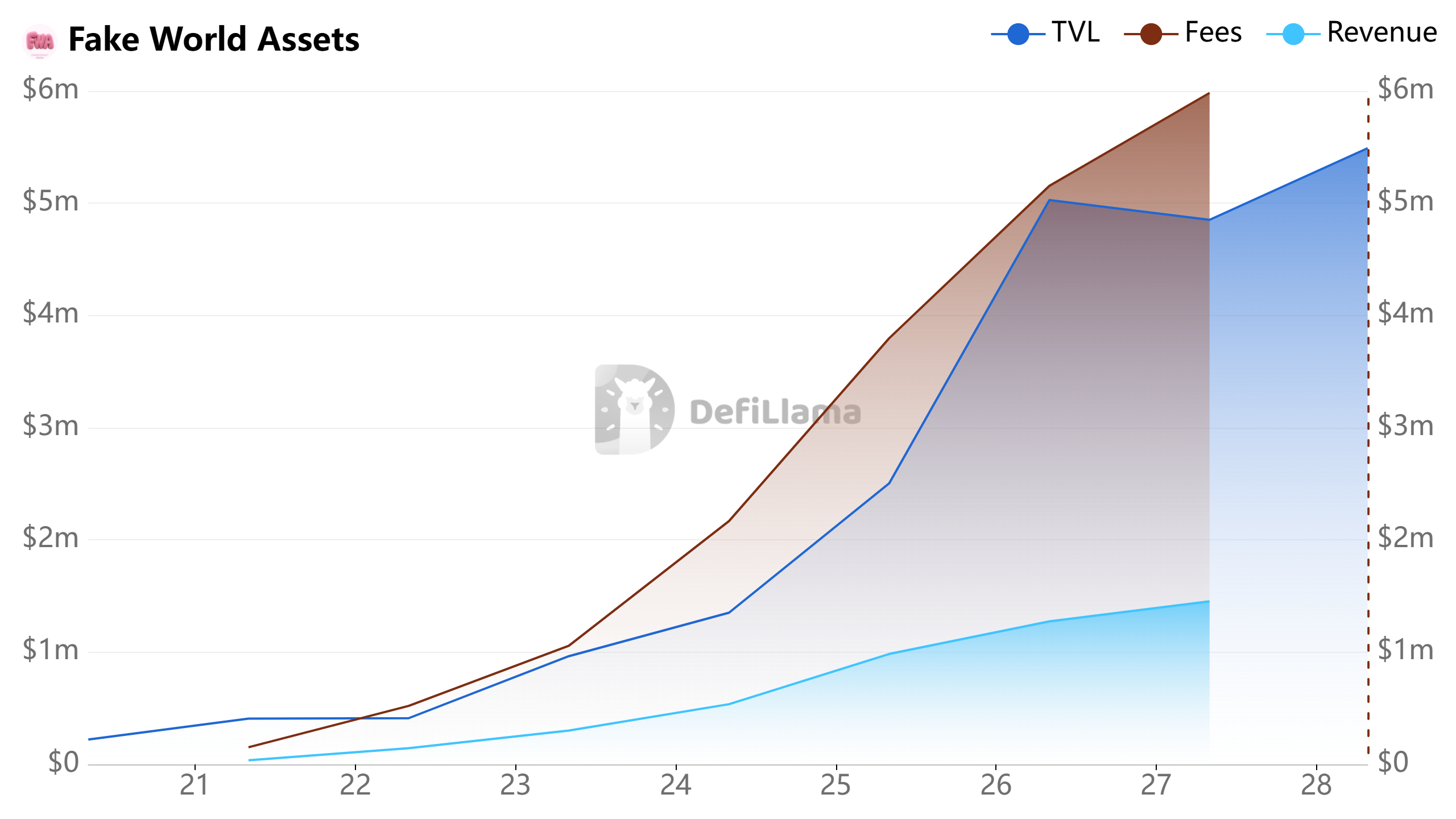
The most expensive position in the protocol has a deposit of 276 ETH. Winning it allows you to recover 234.6 ETH, which is over 2000 times the ticket price, but the odds of winning are approximately 1 in 18 million. As of the time of writing, there are 6,979 active positions in the pool, with a deposit of 2,087 ETH, and the protocol has accrued 1,114.1 ETH in revenue. According to GMGN data, FWA is quoted at $0.02, with a market cap of approximately $20 million, having previously reached up to $38.79 million.
Fifteen Previous Works, and One Lost Punk
TokenWorks is a studio founded by Adam (@Rhynotic) and Teto (@tetonotsorry), claiming to be "an experimental ground for financialization ideas on-chain." The homepage of their website features just three projects, but if you dig into the archive page at the bottom, you can find 15 project retrospectives, ranging from Circle in October 2024 to this May, averaging one every six weeks. FWA is their 16th project.
The most notable project before this is PunkStrategy from September 2025: it charged a 10% trading fee, with 80% used to sweep CryptoPunks at floor prices, reselling with a markup of 20%. The market cap of the token once soared to $300 million.
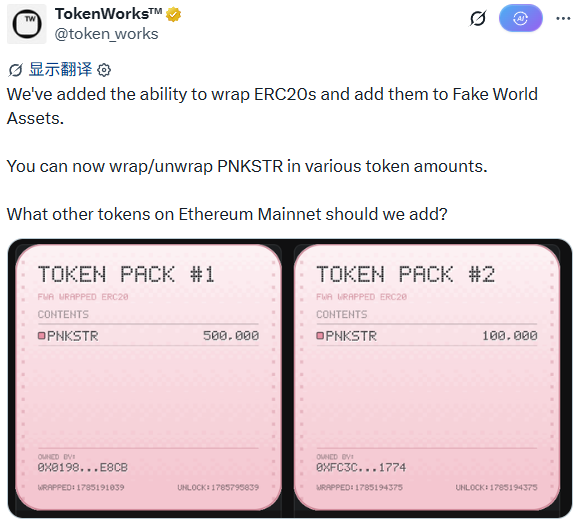
On July 28, the team announced a change: ERC20 tokens can now be wrapped into NFTs for deposit in the pool, with their own PNKSTR being the first supported.
FWA's most recent project before this was Ten Thousand Tokens, launched on May 14, 2026, which featured 10,000 NFTs priced at 0.01 ETH each, where holders had to destroy their NFTs to issue tokens on the platform. On the first day, there were over 100 token issues, one of which touched a market cap of $1 million, and then there was nothing after that.
In their retrospective, the team wrote, "I really liked the concept of this project and was sad to see it fail," attributing the reason to one point: the trading volume on the platform was simply not enough to make the protocol interesting. But the team promised, "Even if the platform is gone, these NFTs will live on in some form within TokenWorks."
Two months later, FWA launched. Ten Thousand Tokens became the largest collection in the pool, with 2,552 positions holding 37.8% of the share and a 38.8% winning probability. These NFTs were minted at 0.01 ETH, and the current median deposit in the pool is 0.1 ETH.
The whitelist also has an unused pathway: by destroying a certain number of Ten Thousand Tokens, a new NFT series can be added to the pool. The required number is currently set to zero, which effectively means it is closed; once increased, these unsellable NFTs will regain a continuous place for destruction.
Thus, the inventory of the previous failed project became the prize pool of this project.
The launch of FWA was not smooth either. On July 3, 2026, during its first launch, someone discovered they could change the protocol status before a Chainlink callback transaction, pointing the draw result at the pool's most valuable position, CryptoPunk #5450, which was worth about $66,000 at that time. The random number provided by Chainlink was fine, but before it took effect, the protocol state was tampered with.
The protocol switched to a withdrawal-only mode at block 25452023, and the team announced a full refund. On July 8, a new contract was open-sourced with a white hat bounty, the audit was completed on the 15th, and purchases resumed on the 20th.
For Depositors: The Deposit is Both a Prize and the Odds
According to the official documentation, a position consists of an NFT and an ETH deposit locked together. This deposit serves three purposes: it is the repurchase price promised by the depositor, it is their own principal, and it also determines how easily this position can be drawn. The weight of the winning probability is inversely proportional to the deposit.
The price of a ticket for a draw equals the harmonic mean of all deposits in the pool multiplied by 1.1. The algorithm for computing the harmonic mean takes the reciprocal of each number, finds the average, and then takes the reciprocal again; it is characterized by dominance of smaller numbers: for example, if there are 9 positions each with a deposit of 0.05 ETH and 1 with 100 ETH, the arithmetic mean is 10 ETH, but the harmonic mean is only 0.056 ETH.
The intent of this pricing structure is to keep the ticket price aligned with what buyers realistically will draw. The harmonic mean is similarly dominated by cheaper positions, and since the winning rate is inversely proportional to the deposit, you are almost always going to draw a cheaper position. However, this also means that the ticket price will not be driven very high by that 276 ETH Punk, as its impact on the price is as small as the probability of it being drawn.
The random number is provided by Chainlink VRF, which stands for Verifiable Random Function. It allows nodes to draw numbers off-chain while also including a cryptographic proof that the contract must validate before accepting the number; if the proof fails, the number is ignored, preventing the project team, miners, and users from knowing the result in advance or changing it afterward.
Buyers pay a separate service fee for this. A lottery draw may not conclude: the pool could be emptied, the ticket price may drift beyond the limits set when the buyer placed the order, or the random number might not return within the time limit, all triggering refunds. The price of the ticket is refunded, but the VRF service fee is not.
For depositors, the transaction fees for each draw are equally divided among all active positions, regardless of how much the deposit is. The documentation outlines the risks: your NFT might be selected earlier than its implied average lifespan based on its weight, terminating gains before the fees can sufficiently accumulate, possibly resulting in a final return lower than you expected.
The protocol's own revenue comes from three sources: a 1% fee on the lottery, a 1% settlement fee when a buyer chooses to keep the NFT, and the 15% discount deducted when a buyer accepts the repurchase. The parameter retainedToProtocol determines whether this 15% goes to the protocol or is refunded to the depositor, and the default currently allocates it to the protocol.
According to on-chain data, a total of 82,679 positions were created over eight days, with 74,609 having been drawn, and only 1,302 being actively withdrawn by depositors. The corresponding field for protocolFeesAccrued in the contract indexer shows 1,114.1 ETH. Among these, the lottery fee revenue is 8,184.8 ETH, with 1% cut amounting to 81.8 ETH, and the remaining 1,032.2 ETH comes entirely from settlements. This money is distributed by an independent accounting contract on the main network at 63%, 7%, and 30% to the main recipient, a fixed secondary recipient, and a batch of NFT holders determined by a snapshot at deployment. The documentation does not specify who the secondary recipient is.
For Buyers: Negative EV Lottery, 80% Bet on Coin Price
Buyers expect the deposit they draw to equal the harmonic mean of all deposits in the pool. The ticket price is 1.1 times that amount, and if they sell it back, they can only get 0.85 times. 0.85 divided by 1.1 equals 77.3%, which is the expected return rate for buyers. The size of the pool, what it holds, and when the draws occur do not affect this number.
According to FWA's Pool Explorer, among the 63,166 settled choices, there were only 3,029 instances (4.8%) where buyers kept the NFT; 9,895 instances (15.7%) accepted the repurchase and took ETH; and the remaining 50,242 instances (79.5%) chose to accept the repurchase but settled in FWA tokens.
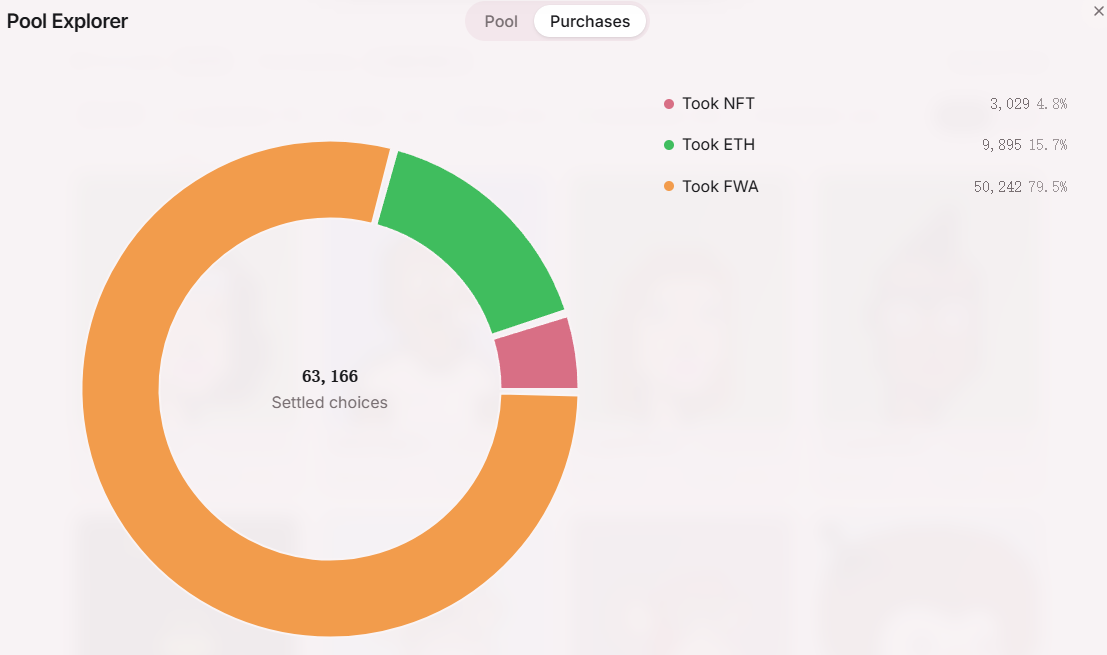
This choice has its basis. Mechanically, when this option is selected, the 85% ETH does not go to the buyer's wallet but instead goes directly to the Uniswap pool to buy FWA, and then the coins are handed to the buyer; if they opt for ETH, the money goes directly to their account. However, the market cap of the same team's PunkStrategy once reached $300 million, and FWA is still in its 15-day issuance period, so betting on its rise is not out of impulsivity.
The cost is that the accounting unit changes. The 77.3% return rate describes the path of accepting ETH, but only 15.7% of people take that route. For the 80% of the other group, their final return depends on the price of FWA, and external purchases of FWA are currently closed, allowing for sales only. The main buying pressure right now is exactly these settlements.
There are also two costs that can easily be overlooked. First, there is a 7.7% chance that the lottery will be refunded, and the VRF service fee is non-refundable. Second, the 10% markup in the ticket price is not fixed as to who it belongs to: if it’s less than a minute since the last draw, it all goes to the depositor; if over an hour has passed, it completely converts into the buyer's token purchase limit, sliding linearly in between. At that point, buyers can take this 10%, raising the expected return rate to 86.3%.
The 15-day issuance period will end on August 4. The team indicated on July 26 that they plan to open external purchases at that time and allocate part of their revenue for repurchasing, distributing it at 40%, 40%, and 20% to depositors, buyers, and destruction, while noting that these proportions can be adjusted at the contract level.
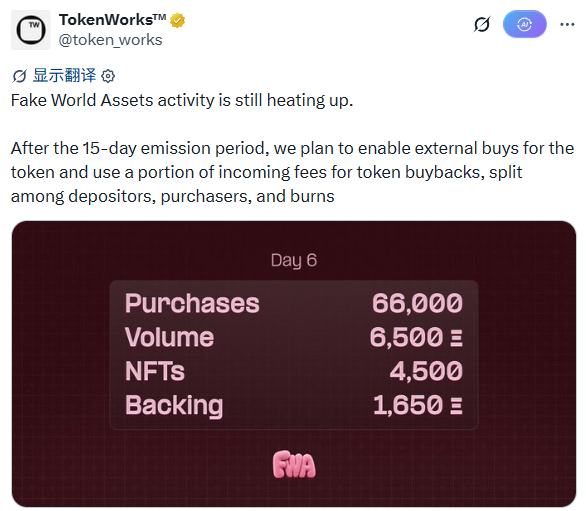
Subsidies will shift from issuance to repurchase, and how much can be repurchased depends on how many people are still willing to continue drawing. After August 4, these numbers will need to prove themselves again.
免责声明:本文章仅代表作者个人观点,不代表本平台的立场和观点。本文章仅供信息分享,不构成对任何人的任何投资建议。用户与作者之间的任何争议,与本平台无关。如网页中刊载的文章或图片涉及侵权,请提供相关的权利证明和身份证明发送邮件到support@aicoin.com,本平台相关工作人员将会进行核查。


