For stablecoins, aside from the back-end link of issuance (compliance/audit/asset management), the most important aspects are circulation and trading, which are also the key to competition among other stablecoins in the future.
Written by: Sea
Unknowingly, USD1 (4.2 billion dollars) has become the fourth largest stablecoin after USDT (183.8 billion), USDC (73.5 billion), USDS, and DAI (11.5 billion). It is also the fastest-growing stablecoin over the past year.
Over the past six months, I have held a certain amount of USD1 on Binance, so I am attempting to summarize the growth logic of the USD1 stablecoin under World Liberty Financial in a complete article, hoping to bring some inspiration to users and other project parties.
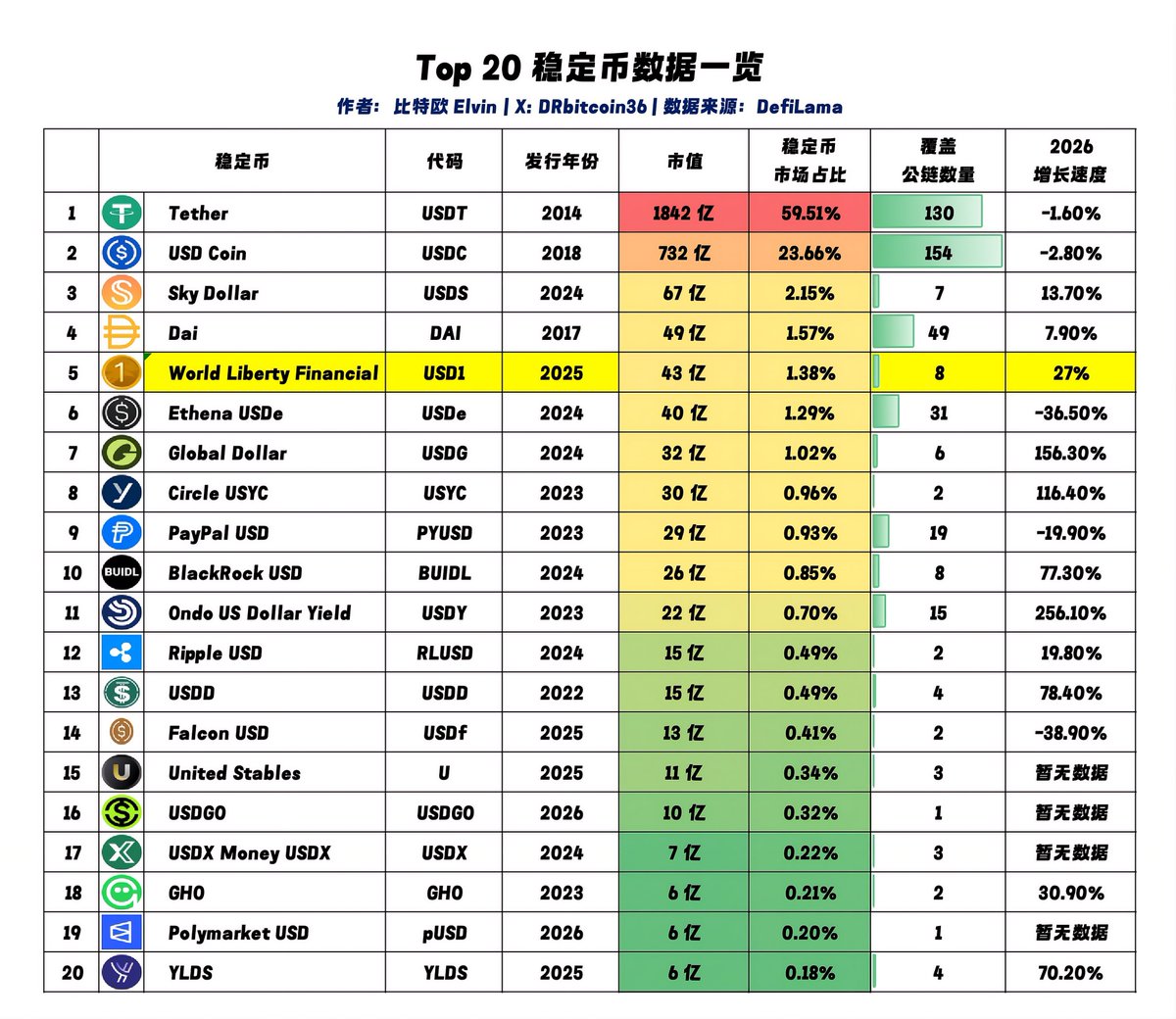
Image source: BitEu @DRbitcoin36
Stage One: Binding UAE and Binance
It is undeniable that USD1 is a project born with a golden spoon.
As a DeFi protocol, World Liberty Financial, associated with the Trump family, initially planned the project in September 2024, and in October began selling WLFI tokens to investors, which are also the governance tokens of the project. USD1 was launched in March 2025, initially deployed on Ethereum and BNB Chain. During the first couple of months, there were very few people in the market paying attention to USD1. By late April, USD1's scale was less than 200 million dollars.
The market first noticed USD1 on a large scale in May 2025, when the sovereign fund MGX from Abu Dhabi invested 2 billion dollars in Binance.
This investment was made in USD1 — this directly pushed USD1's issuance past the 2 billion dollar mark, and was key to USD1 completing its cold start.
In the same month, Binance listed USD1-related trading pairs on its exchange. In the subsequent multi-stage growth process, Binance continued to play an important role.
Stage Two: Expansion of Trading and DeFi Scenarios
Throughout the second half of 2025 to present, USD1 has been continuously expanding its trading scenarios, including spot/contracts/RWA assets on Binance, on-chain DeFi, and deployment on other public chains.
- In June, airdrop USD1 to WLFI presale participants
- Joint promotion with PancakeSwap for USD1 trading on DEX
- Listed trading pairs of USD1 with mainstream coins like BNB/ETH/SOL/Pepe on Binance, followed by several perpetual contracts
- Deployed USD1 on eight other public chains including Solana, Aptos, Tron, Monad, and Plume, with over 1 billion dollars on Solana alone
- In March this year, Binance supported USD1 in participating in Launchpool new offerings and increased USD1 in the exchange reserve proof
- Aster allowed USD1 to be used as margin and distributed 2.5 million WLFI tokens to traders monthly; later USD1 also became the only settlement stablecoin for all TradFi perpetual contracts on the Aster platform.
- Launched high-yield activities on Monad chain
- Released Agentic SDK and WorldClaw project in the AI wave
- Launched the lending market WLFI Markets
- Sponsored the largest integrated martial arts event, UFC Freedom 250, with USD1
- Collaborated with Byreal in the Solana ecosystem to offer 1 million WLFI tokens to incentivize USD1 trading competitions
- Applied for a national trust bank license with the U.S. Office of the Comptroller of the Currency (OCC)
- Connected with Binance Pay, allowing USD1 to be used for any scenario supported by Binance Pay, such as when I recently used USD1 to buy an Apple gift card
This series of branding and marketing activities around USD1 aims to:
- Increase awareness of USD1, backed by the Trump family
- Encourage more people to hold USD1 through deployment on multiple public chains, earning yield just by holding
- Encourage more people to use USD1, entering multiple exchanges and supporting more spot/contract trading pairs
This series of strategies led to USD1’s issuance surpassing 3 billion dollars, marking an organic growth process.
Stage Three: Ongoing Subsidy War for More Than Half a Year
In December 2025, to attract more users to hold the USD1 stablecoin, the WLFI team conducted an activity with Binance, where users could place USD1 in Binance Earn, with a limit of 50,000 USD1 per transaction, enjoying an annualized return of 20%.
Airdrops have also been a major incentive for more people to hold USD1. Perhaps this activity showed good results for the WLFI team, as they intensified efforts from January to now (currently in the seventh round), conducting subsidies of over half a year through Binance, cumulatively distributing over 126 million dollars’ worth of $WLFI.
Here’s a summary of the main data from these seven rounds of activities:
- Round One (1/23 - 2/20), 40 million dollars' worth of WLFI, annualized about 15%
- Round Two (2/20 - 3/20), 235 million WLFI, worth about 27 million dollars, annualized about 13%
- Round Three (3/20 - 4/17), 135 million WLFI, worth about 12 million dollars, annualized about 8%
- Round Four (4/17 - 5/15), 15 million dollars' worth of WLFI, annualized about 7%
- Round Five (5/15 - 6/12), 13 million dollars' worth of WLFI, annualized about 5.9%
- Round Six (6/12 - 7/10), 178 million WLFI, worth about 10 million dollars, annualized about 5.6%
- Round Seven (7/10 - 8/7), 165 million WLFI, worth about 9.6 million dollars, annualized about 5.3%
If someone held 100,000 USD1 on the initial date of 2026/1/23 and did not touch it, by 2026/8/7, they would have 104,470 USD1, with an average annualized rate of 8.32% over the six and a half months.
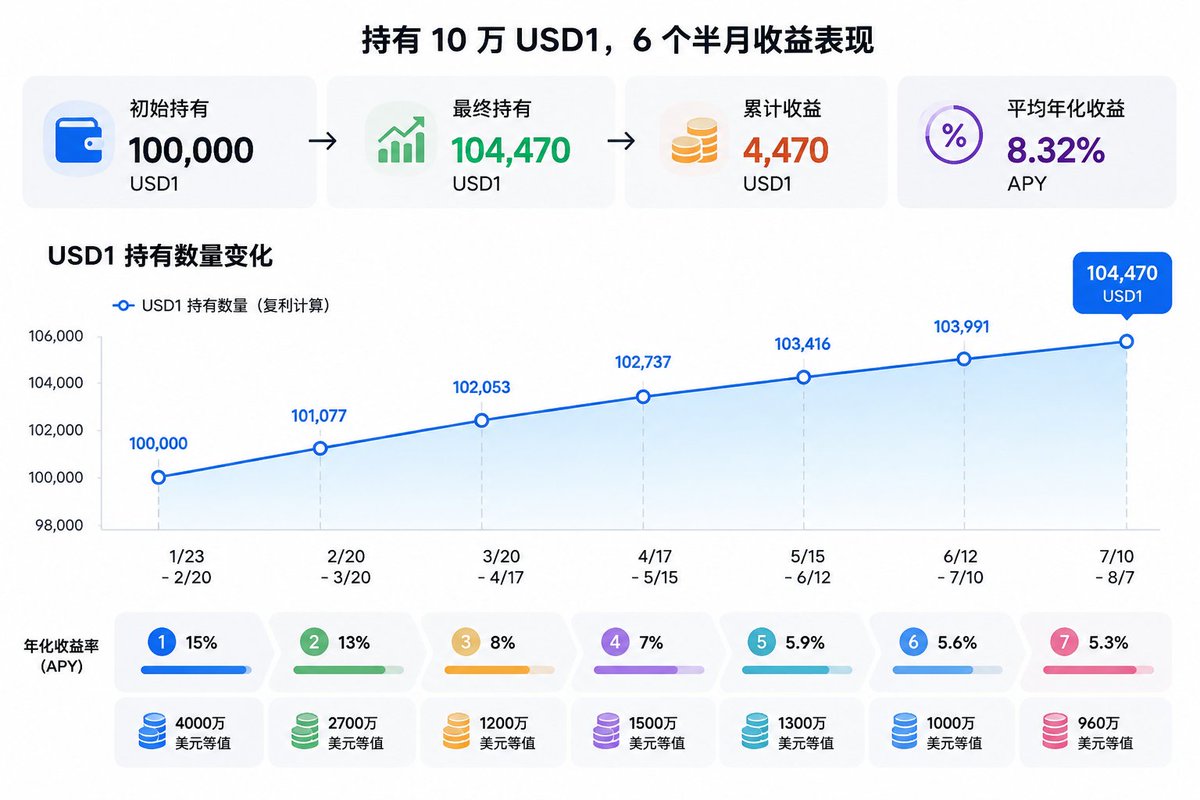
Review of USD1's returns over the past six months
More importantly, these airdrop activities do not limit the USD1 volume of individual users, accommodating large holders and institutions to participate. This also made USD1 the most generous and popular stablecoin among retail investors during the bear market of 2026, garnering countless praise in the community — even though the yield dropped from the initial 20% to 15%, then to under 8% and 6%, compared with traditional banks' annualized rates of less than 1% and the high risks of on-chain DeFi, USD1 is really quite reasonable.
Besides Binance, USD1 has also carried out similar activities on exchanges like Bybit, Gate, and MEXC, with APY even reaching 20%.
Returns and Costs
In summary, the series of activities during these three stages has encouraged more people to exchange USDT/USDC for USD1, leading to USD1's issuance directly surpassing the 5 billion dollar mark at the beginning of the year.
With the growth in scale, the project party World Liberty Financial also gained a considerable yield from dollar reserve assets, with 30-day revenue ranking ninth among all protocols, reaching 11.49 million dollars; creating 115 million dollars in revenue over the past 12 months.
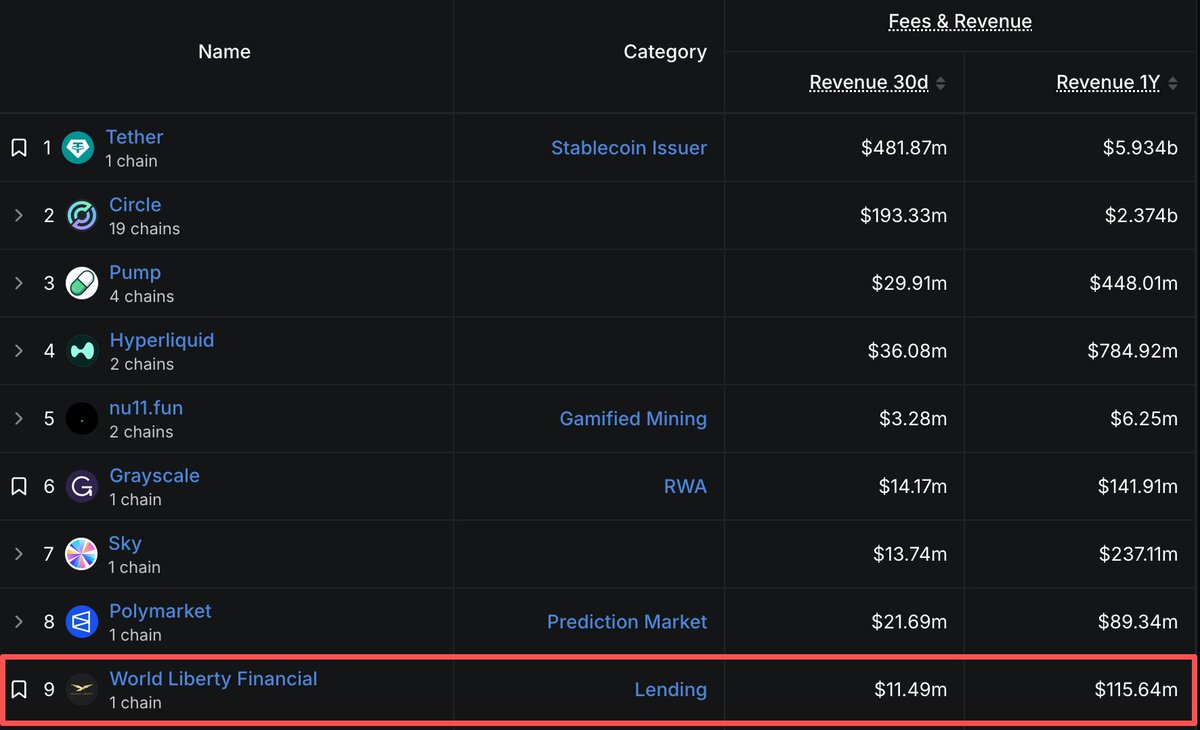
USD1 contributed to the main revenue of WLFI, data from DefiLlama
USD1 has become the most important business segment within the entire WLFI project, contributing major revenue second only to WLFI token sales; it is unclear whether this was planned from the inception in September 2024.
We can liken WLFI's continued subsidies for more than half a year to the red envelope subsidy strategies during early growth stages of Meituan/Didi. However, WLFI tokens are the Growth Tokens in this structure, while the cost is the continuous pressure on WLFI's price, which burdens the holders.
In simpler terms, the project party used WLFI token subsidies to exchange for USD1's scale growth and the corresponding interest returns. In this process, WLFI was distributed to a large number of retail investors in the market, acting as a disguised "exit".
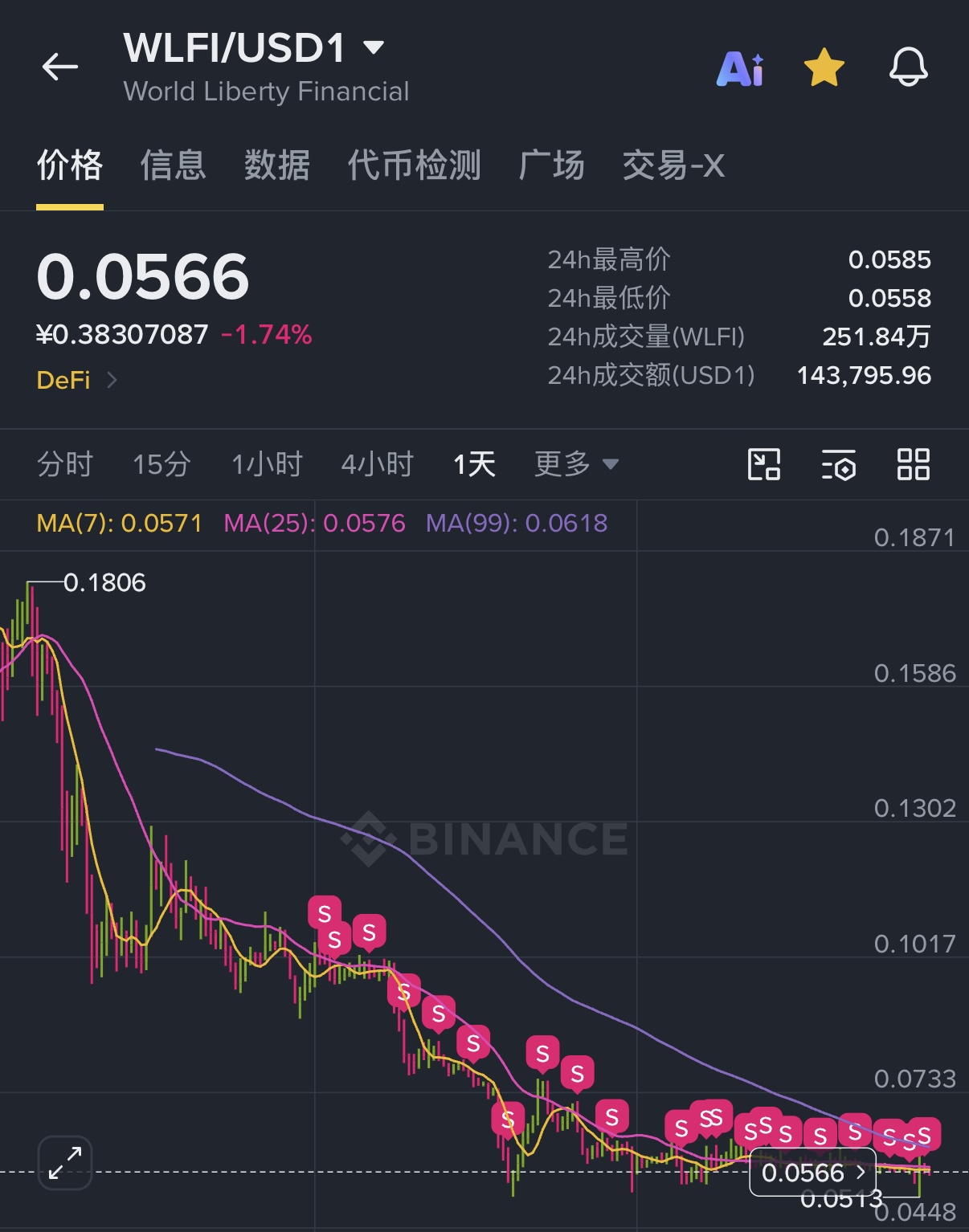
Retail investors have continuously mined and sold WLFI over the past six months
Other stablecoin issuers have also had similar subsidies, but the means may not be through tokens. As long as the present value of the reserve revenue generated by the scale of new stablecoins exceeds the subsidy cost, this model is financially viable.
Conclusion
The GENIUS Act clearly prohibits stablecoin issuers from paying interest to users, and the "dual coin model" formed by WLFI and USD1, through subsidizing WLFI to boost USD1's issuance, has indeed been highly effective, facing the duopoly of USDT and USDC, capturing the feeling of "surrounding the city from the countryside".
Looking back at the growth process of USD1, a simple truth can be observed: for stablecoins, aside from the back-end link of issuance (compliance/audit/asset management), the most important aspects are circulation and trading; this is also the key to competition among other stablecoins in the future.
We can see exchanges like OKX and Coinbase in the Open USD Alliance, but not Binance. This indicates that Binance and USD1 have already formed a deep alliance.
The issuance of stablecoins is a business that ensures steady returns; as long as the early costs of contracts and other expenses are overcome, the marginal cost of subsequent operations is very low. With the irreversible integration of crypto and traditional finance, stablecoins will undoubtedly become a contested ground for the future, with the stakes clearly defined. I will continue to monitor the evolution of the competitive landscape in this sector.
免责声明:本文章仅代表作者个人观点,不代表本平台的立场和观点。本文章仅供信息分享,不构成对任何人的任何投资建议。用户与作者之间的任何争议,与本平台无关。如网页中刊载的文章或图片涉及侵权,请提供相关的权利证明和身份证明发送邮件到support@aicoin.com,本平台相关工作人员将会进行核查。


