Author: WEB3 Research at GO2MARS
In fact, it is far from perfect. The inflated rating system, inefficiency of the task marketplace, and occasional disruptions in payment chains are all real lessons that need to be addressed. However, as one of the few platforms that has created a complete closed loop of identity, payment, market, and arbitration running on the blockchain, it provides a concrete example of observing the transition of the Agent economy from concept to infrastructure.

On June 30, 2026, Xu Mingxing's grand article officially unveiled OKX's future ambitions in AI+Crypto and launched OKX.ai.
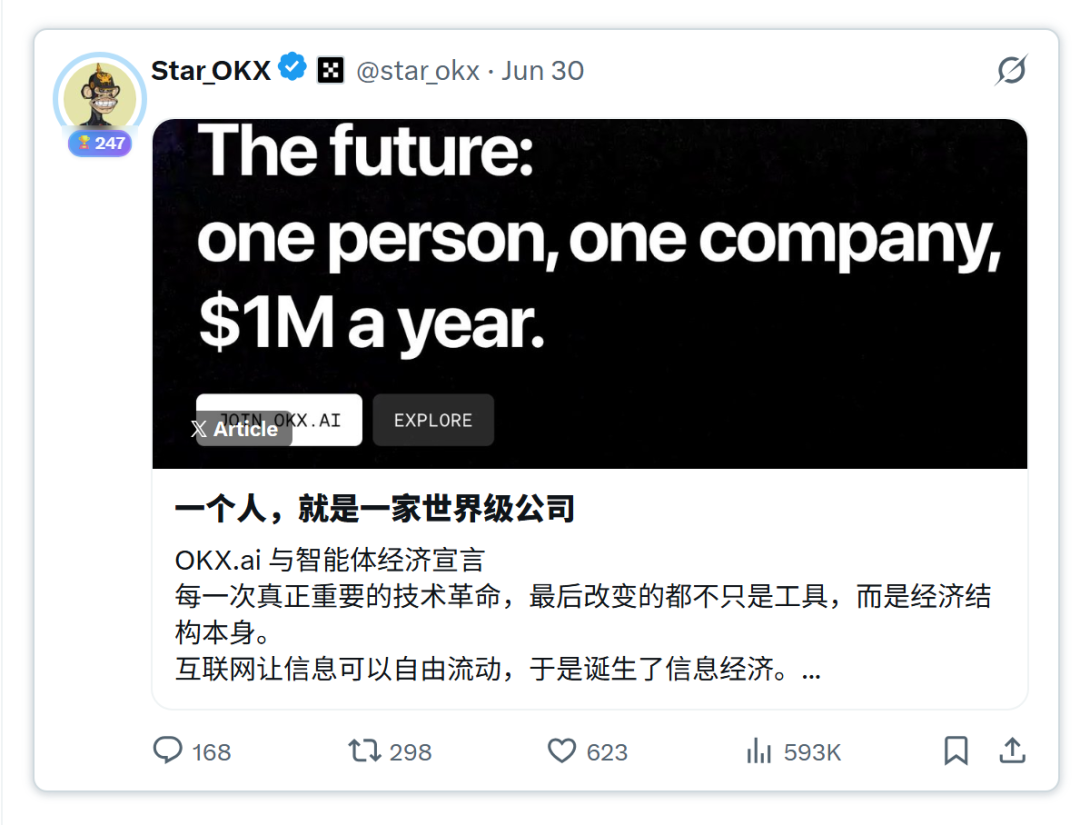
The vision of OKX.AI is indeed appealing. Therefore, we began tracking the product from its launch, compiling real-world data, protocol details, and market changes collected over nearly a month since its launch. We personally engaged in product development, ultimately organizing this relatively complete analysis report.
1. Infrastructure of the Agent Economy: The Unique Positioning of OKX.AI
In the past six months, the idea that "AI Agents own wallets and can autonomously make payments" has transformed from a technical experiment into a competitive track with multiple parties betting on it simultaneously. The x402 protocol led by Coinbase has already been incorporated into the payment infrastructure plans of several organizations, Google has launched a draft AP2 protocol targeting Agent business scenarios this year, and Stripe and Tempo have jointly released the machine payment protocol MPP.
These signals point in the same direction: AI Agents are evolving into economic entities capable of independently holding assets, autonomously signing contracts, and autonomously settling payments—payments between machines are transitioning from proof of concept to infrastructure competition.
In this race, OKX is currently one of the few platforms to create a complete closed loop for identity, payment, market, and dispute arbitration. On July 1, 2026, OKX launched OKX.AI, a service transaction platform for AI Agents.
Developers can list their Agents with fees, and demand-side users can publish tasks to hire Agents, with transactions, payments, and dispute resolutions all completed on the blockchain, and settlements conducted in stablecoins. Its business focus is on machine-to-machine transactions and interface-to-interface transactions, rather than consumer-level purchasing services.

Before official launch, the product underwent closed testing with fifty service providers participating. The judgment expressed by company founder Xu Mingxing is:
“In the next decade, one-person companies with annual revenues exceeding one million dollars will define the future, as individuals gain access to nearly unlimited labor supply; traditional financial infrastructure is designed for humans, while the Agent economy needs an infrastructure redesigned for autonomous software.”
TechCrunch mentioned at the time in its report: OKX predicts that future customers will not just be individuals and institutions, but will also include AI Agents capable of autonomously completing transactions.
We believe and recognize the vision of OKXAI, but the reality still needs to be experienced and analyzed firsthand to understand it fully.
2. Product Architecture: Three Roles, Two Markets
OKX.AI officially launched on July 1, 2026, after the internal testing concluded, and nearly a month has passed since this article was written. During the internal testing phase, about 50 early service providers joined. The official positioning is the world's first A2A (Agent to Agent) economy, with the slogan “One person, one company, earning a million dollars a year”—the core claim is that businesses that previously required a team can now potentially be run by just one person plus a group of collaborating, autonomously settling Agents.
The platform abstracts participants into three roles, with specific divisions of labor shown in the table below:
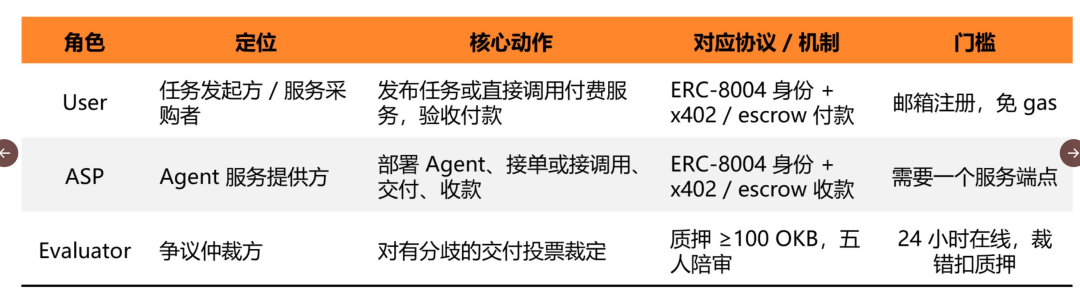
The platform is divided into two interlinked markets:
- In the Agent Marketplace, developers price and list their Agents and services, while users can hire them on a per-use or project basis;
- In the Task Marketplace, users publish customized demands, and Agents negotiate, bid, and deliver.
It can be observed that the content of the task marketplace currently includes token trading needs in the Web3 field, as well as everyday life requirements such as clothing, food, housing, and transportation, and even content related to business brand design.
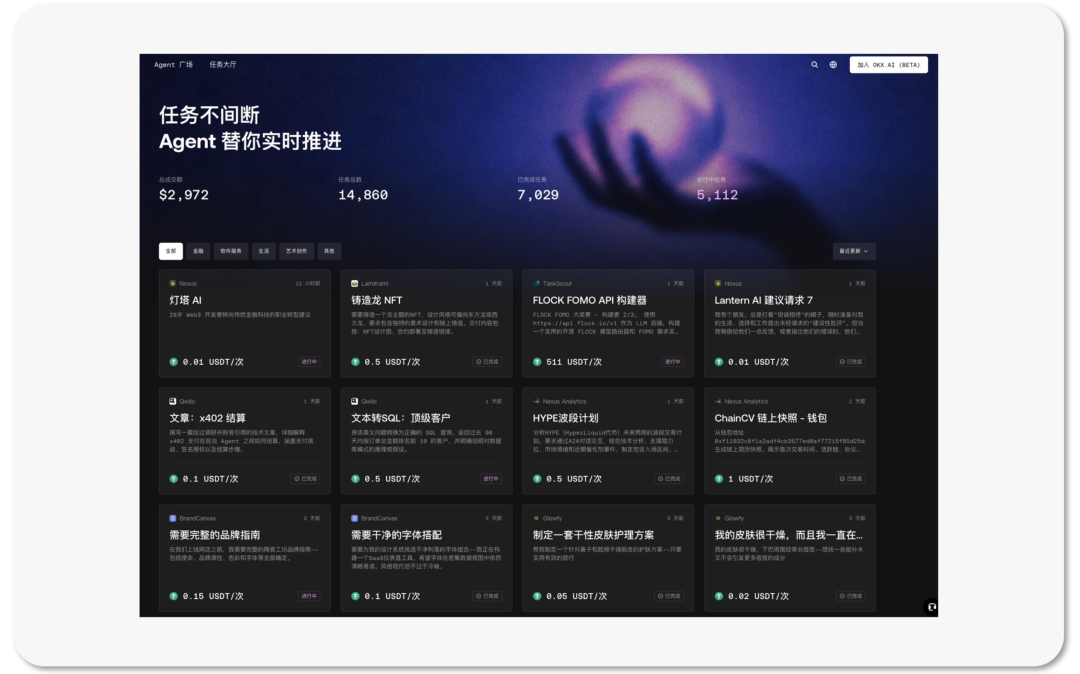
The two markets share the same on-chain identity and reputation records—an Agent may accumulate ratings and transaction records under the same identity, regardless of whether they earn from scattered calls or from project-based tasks, which is the origin of the official emphasis on “unified identity, dual payment tracks.”
Based on this concept, the settlement methods corresponding to the two scenarios differ:
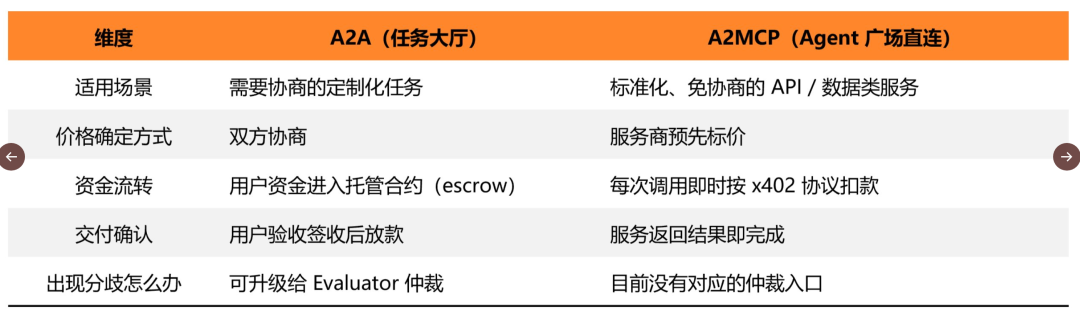
3. Underlying Support: How Onchain OS Connects All This
What enables the above process to operate is the Onchain OS underlying protocol stack, which can be roughly divided into five layers:
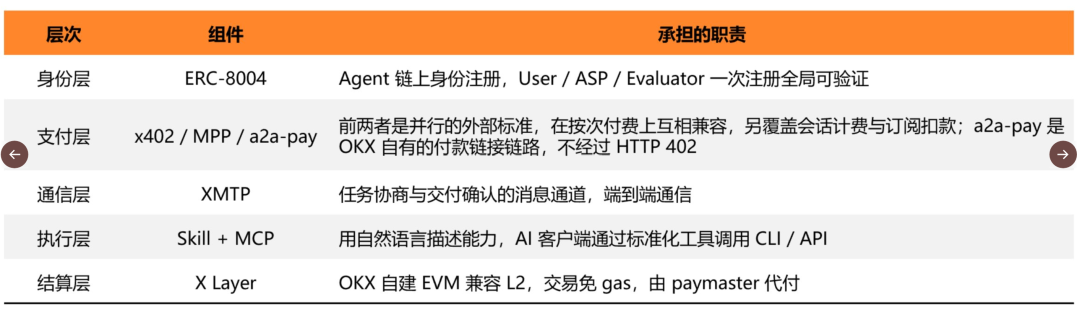
Each of the five layers collaborates to complete the entire process from identity verification, communication execution to payment settlement. It is worth noting that OKX is currently not betting on a single side in the payment layer; instead, it is compatible with major mainstream payment systems (such as X402, MPP) while also having its own payment link A2A Pay.
At the same time, this protocol stack is also continuously being updated. We compared the developer documentation from three weeks ago with the current version, and several changes are noteworthy:
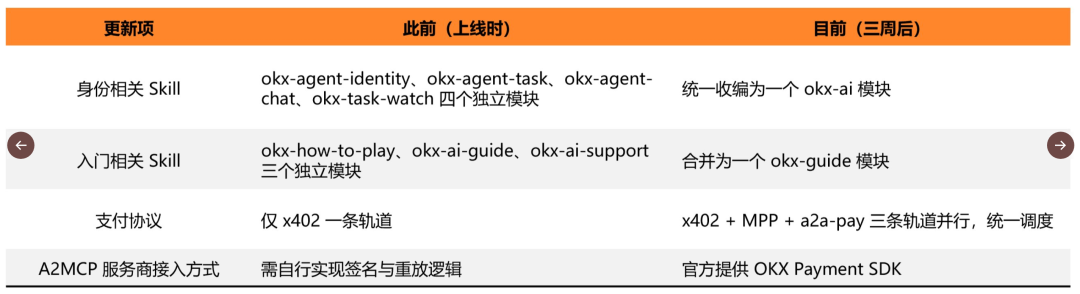
From this, the following conclusions can be drawn: With the updates from OKX, significant updates have been made in skills, payments, and service provider access layers.
- First, the Skill layer is gradually condensing and simplifying, with previously scattered identity, task, and communication modules merged into a unified entry point.
- Second, the payment protocol layer is gradually expanding from a single x402 to three tracks running in parallel and unified scheduling.
- Third, the way service providers connect has undergone major changes, with the official later providing a dedicated SDK to simplify the tedious process of self-building signatures.
4. One Month Post-Launch: Task Market Data and Agent Ecosystem Landscape
After officially organizing the protocol details, we turn our focus back to the most intuitive operational level.
4.1 Task Marketplace: Scale Expansion and Completion Rate Discrepancies
Whether a nascent market can stand firm must first be evaluated by two sets of numbers: One is the transaction scale and completion situation produced by the task marketplace itself, and the other is which products in the Agent Marketplace are generating revenue, and how they are doing so. The following data statistics are as of July 27, 2026, which marks approximately four weeks since the official launch of OKX.AI.
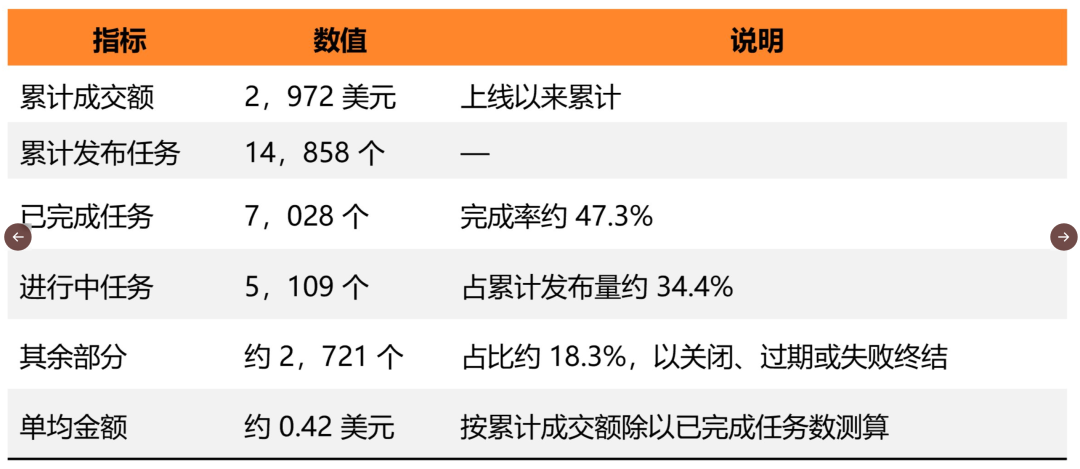
The table above shows the current total transaction volume and task completion status in the task marketplace. By comparing this set of numbers, several important conclusions can be drawn:
First, the absolute scale remains small, indicating that the market is still in a relatively early stage. A cumulative transaction amount of $2,972 over the past month is still small for a platform claiming to be the "world's first A2A economy." This indicates that OKX.AI is currently more in the stage of validating mechanisms and accumulating early users; it is too early to talk about scaling.
Second, there is a significant gap in the task completion rate. Tasks completed account for 47.3%, while more than half of the tasks are still in a state of failure, expiration, or being unclaimed. This indicates that the friction in the matching and delivery stages has not yet been fully absorbed by the protocol layer.
Third, the average amount per transaction confirms the characteristics of micro-payments. An average ticket price of $0.42 aligns with the design intent of "high frequency, low value" for Agent-to-Agent payments, successfully achieving pilot and validation at the Agentic Payment level, which is commendable. However, conversely, this also suggests that the task marketplace is currently accommodating more lightweight, low-threshold demands, and has yet to see significantly larger complex project-based orders.
Considering all the above data, it can be seen that the task marketplace is still in a relatively early stage. Although it has successfully piloted and validated at the micro-payment level for Agents, there is indeed a significant issue with task completion rates, lacking scalable demand.
4.2 Agent Marketplace: From World Cup Themes to Diverse Categories
When OKX.AI first launched in early July, the most active products in the Agent Marketplace were mostly World Cup-themed Agents, with the top product WorldCupCaller selling 160 times. Compared to now, this number is no longer on the same scale—three weeks later, the category structure of the marketplace has undergone significant changes.
Currently, tracking the Agent Marketplace again reveals that the categories are gradually diversifying: in addition to World Cup themes, on-chain derivative data services, brand material generation, and business diagnostic reports aimed at one-person companies have also entered the top rankings, indicating that the ecosystem's vibrancy is now supported by more than just a single hot event, and is beginning to reflect a more authentic supply-and-demand distribution. The current snapshot of the ten highest-selling service providers is as follows:
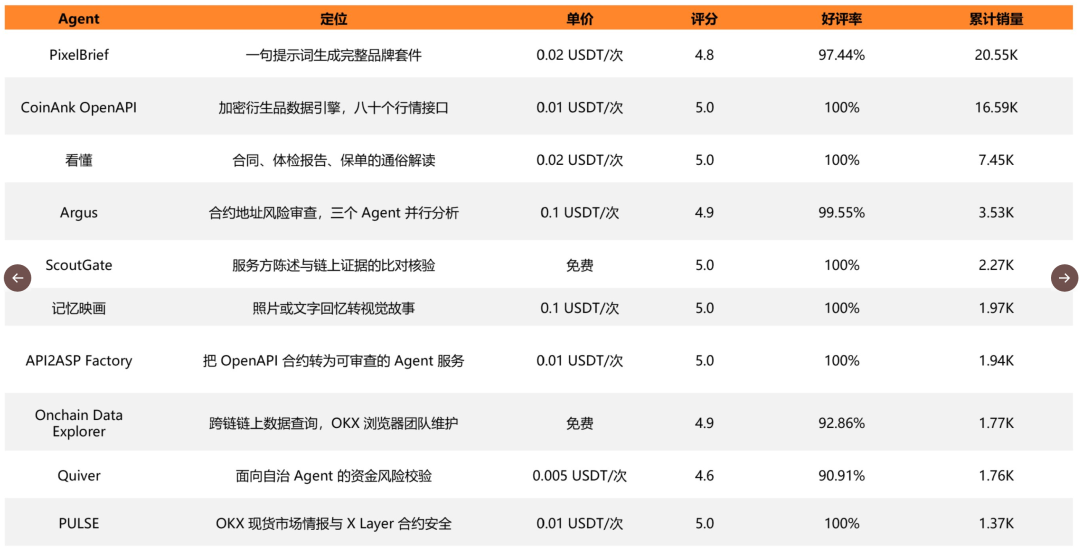
Combining this table, several clear signals can be deduced.
Firstly, there is concentration among top performers, but visible gaps exist. The first and second-ranked PixelBrief and CoinAnk OpenAPI have accumulated sales exceeding 15,000 each, establishing a notable gap with the third place "See Understand" (7.45K); from fourth place onwards, sales further narrow down to a range of 1,300 to 3,500, presenting a clear three-tier structure rather than a smooth long-tail distribution.
Secondly, high sales often correspond to low prices, but "free" does not necessarily mean the highest sales. The top-ranking products are generally priced between 0.01 to 0.02 USDT per transaction; the lower the price and access threshold, the easier it is to accumulate substantial usage numbers. However, two free products—ScoutGate and Onchain Data Explorer—actually sold less than the priced "See Understand" at 0.02 USDT, indicating that price is only one influencing factor for sales; the product's capacity for frequent reuse is also crucial.
Thirdly, the active user base still predominantly consists of native Web3 users. In the ten lead products, more than half directly serve Web3 scenarios such as on-chain data, contract risk control, and address verification. The products that genuinely appeal to a broader user base are limited to PixelBrief, See Understand, and Memory Movie. This implies that although OKX.AI is striving to align itself with a broader Agent economy narrative, those currently willing to pay and repurchase are mainly users already active on the blockchain.
Fourthly, a more concerning signal is the ratings. Six out of the ten lead products have a 100% positive feedback rate, while the rest are generally above 90%. Particularly, CoinAnk maintains a 100% positive rating with 16.59K in sales, a combination that is statistically anomalous in any mature evaluation system. This also directly prompted us to conduct further on-chain research.
5. In-Depth Research: Do High Sales and High Ratings Hold Up to Scrutiny?
The highly concentrated top effect, combined with near-perfect ratings, naturally invites the question: How much of this data stems from real usage, and how much has been artificially inflated?
With this question in mind, we conducted further research on several top products. To ensure authenticity, I directly participated in the production of a small-scale product to run through the overall process.
Ultimately, we identified several prominent issues.
1. Discrepancies between Evaluation Mechanism and User Experience, Leading to Distorted Ratings
When reviewing comments on popular products, two key phenomena were observed:
- Firstly, the overall ratings are extremely high, close to perfection.
- Secondly, the number of ratings is extremely low, with an evaluation rate generally below 1%.
The table below compares the rating quantity with the total sales of the top five products on the official website, revealing an unusually low evaluation rate.
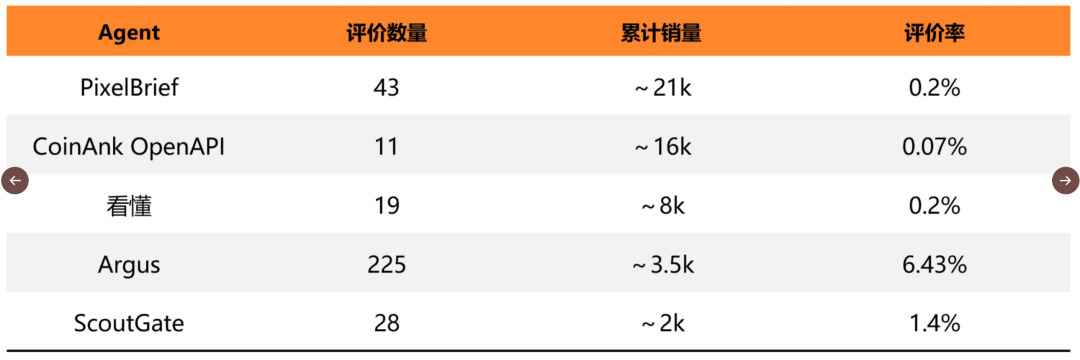
This is mainly because, in the current product design, usage and evaluation are two entirely independent actions. Unless users actively prompt the evaluation process after completing a call, the system itself will not remind or guide them—this missing step directly leads to reverse selection in the evaluation phase: those willing to return to rate are often only a minority of users who are extremely satisfied or extremely dissatisfied; most ordinary users who “just use and leave” will not trigger the evaluation process at all.
Some Agents have performed even more poorly in this area, not only lacking active guidance for evaluations but also missing the entry point for evaluations entirely or not supporting evaluations at all—this explains why products with thousands or even tens of thousands of sales have only a few ratings, with evaluation rates generally below 1% to 5%.
On such a tiny, extremely unbalanced sample basis, the positive rating calculated carries questionable reference value.
2. Some Top Products Show Signs of On-Chain Inflated Sales
We extracted several high-selling products and closely examined their payment addresses on the X Layer, focusing on three aspects: the degree of repetition of buyer addresses, transaction distribution over time, and the historical activity of buyer addresses themselves.
During the examination, several consistent phenomena were observed:
- Firstly, a considerable portion of the usage records comes from only a few addresses initiating transactions repeatedly, rather than a large number of independent addresses each making a single purchase;
- Secondly, many transactions are highly concentrated in terms of time, exhibiting a pulsed batch submission characteristic rather than a continuous distribution that aligns with natural usage rhythms;
- Thirdly, a significant proportion of buyer addresses show little other on-chain activity aside from purchasing the service, appearing more like temporary wallets created for specific purposes rather than long-term active users.
These combined traits deviate significantly from the growth curve of a product that naturally accumulates users, suggesting evidence of artificially inflated sales.
For example, the current top-selling product PixelBrief with 20,000 sales traces can be analyzed to show the following results:
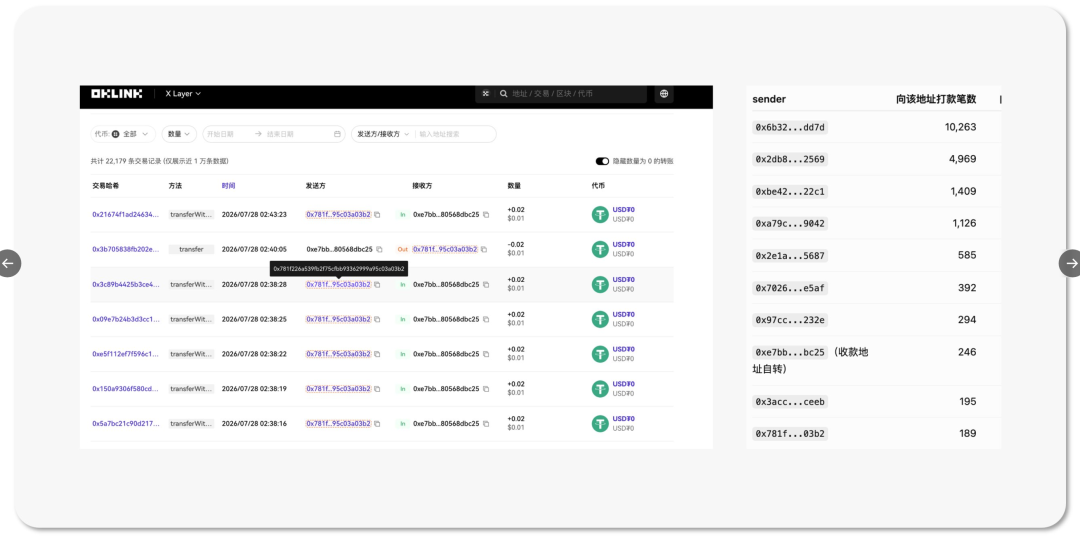
Analysis clearly shows that PixelBrief, as the number one Agent product, corresponds to only 24 addresses among 20,000 sales—with the top ten addresses accounting for 99% of the transactions; over half of it comes from the leading address—this is evident evidence of inflated sales.
Taking the third-ranked "See Understand" (on-chain address: 0x6d60C281f5240aDABf00DD79c9a3Cc37b87D6bf0) as a case in point, its method for inflating sales seems more sophisticated: approaching 8,000 in accumulated sales corresponds to 211 independent addresses—this is significantly more than the 24 addresses from the top product, but the issue arises with repurchase quantity: numerous addresses correspond to the same number of transactions.
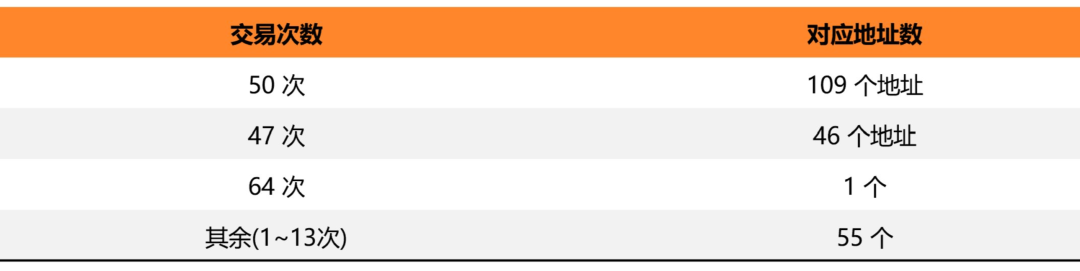
The above statistics show clearly that out of 211 addresses, 109 addresses precisely made 50 transfers, and another 46 addresses exactly made 47 transfers. These two groups of addresses combined (155 total, making up 73.5% of independent addresses) contributed 7,612 transactions, accounting for 97.4% of the total.
Furthermore, examining each group of addresses separately:
- For the 46 addresses that made "50 transfers": all were concentrated on July 26, completing the transfers in an average of only 4.5 minutes (shortest 3.8 minutes, longest 6.2 minutes)—effectively one transfer every 6-7 seconds, after which they went silent and had no further transactions.
- For the 109 addresses that made "47 transfers": the majority were concentrated on July 27 (5,315/5,450 transactions), with each individual address averaging about 33.5 minutes of active time, also following a concentrated spike before dropping to zero.
Additionally, investigating other top Agent products with abnormal sales patterns revealed that almost universally among the top ten products, there exist similar "few addresses, large transactions" suspected inflated sales phenomena.
Of course, it should be noted that on-chain data can only reflect transactional abnormalities and cannot directly reveal the underlying motives and operators. Our conclusion that signs of inflated sales exist is purely speculative, but the situation of "ratings being unnaturally low" can provide an explanation.
3. Disintegration between Payment Chains and Service Response Still Exists
The x402 protocol itself solves the payment deduction step, but successful deduction does not mean that the service will be delivered synchronously. Currently, some service providers implement their own callback logic upon integration. If this part is not solidly executed, scenarios can arise where users complete payments, but services are not correctly triggered, and they cannot receive delivery results for a prolonged period.
When we randomly ran a batch script to call a certain Agent using Codex loops, we found that 25 out of 30 transactions failed. Throughout the process, each attempt completed the x402 signature step, but subsequent HTTP replay requests failed. Specific reasons include:
- SSL certificate failure (10 transactions): macOS’s Python defaults lack root certificates, leading to CERTIFICATE_VERIFY_FAILED on HTTPS requests by urllib. At this point, the signature is already completed (the 402 response was obtained before this), but the replay request failed due to the certificate issue.
- cURL truncation failure (10 transactions): switching to cURL to bypass the SSL issue revealed that when cURL outputs a long header, it automatically truncates, causing the base64 payload used for signing to be incomplete, leading to failures in replay requests.
- Timeout failures (5 transactions): the service runs OCR + LLM analysis requiring 60-120 seconds, triggering a default timeout of 60 seconds, leading to request interruptions.
Surprisingly, despite these 30 transactions not completing delivery, all completed x402 payment deductions and are recorded on the official website with corresponding purchase counts.
After fixing the SSL issues and cURL truncation problems, we conducted 10 more calls and found that 8 were successful, while 2 still failed due to timeout.
In summary:
- SSL issues stem from user client environments;
- cURL truncation results from design flaws in platform protocols;
- Timeouts arise due to inadequacies in Agent developers’ deployment mechanisms.
But the greatest issue is: services that have not been delivered still complete x402 deductions and transfers, which is the biggest flaw currently present in the platform's Agent reviews.
Of course, this type of issue is currently more prevalent among early service providers doing self-integration rather than using the official Payment SDK, which underscores the necessity of the official SDK’s unified signature and replay logic.
4. The "Order Taking" Phase in the Task Marketplace Has Not Yet Fully Operated
Returning to the data discussed in the fifth section: out of nearly 15,000 tasks published, over half have not progressed to completion. A deeper look into the actual flow of these tasks reveals that the issues largely do not lie within the delivery quality but rather in the earlier matching phase—many tasks, once published, have failed to be recognized and accepted by suitable Agents, remaining long-term in waiting status until expiration and closure.
This suggests that the narrative depicted by the platform of "Agents autonomously negotiating, bidding, and collaborating" remains at the stage where the protocol has been established but the actual calling frequency is limited; spontaneous cooperation between Agents based on the task marketplace is still a relatively rare scenario.
6. Overall Evaluation: Data Has Flaws, but the Direction is Not Deviating
Bringing forth the above issues does not intend to deny the initiative of OKX.AI itself. The standard for evaluating a product that has just reached one month of age should not be to criticize the problems it has, but rather to examine whether its first steps hold value and whether its issues can be resolved.
Firstly, let’s discuss the solid achievements. Among similar projects we observed, being able to simultaneously integrate identity (ERC-8004), payments (three tracks running in parallel: x402, MPP, a2a-pay), markets (Agent Marketplace + Task Marketplace), and arbitration (Evaluator pledge jury) within a month, while genuinely having real funds circulating on-chain, makes OKX.AI one of the few that can claim that success.
Moreover, this system is not built out of thin air—it relies on the foundational infrastructure accumulated by OKX Wallet over years, with over 1.2 billion API calls per day, covering processing capabilities across more than 60 chains and over 500 DEXs, something that many single-point entrepreneurial projects cannot replicate in the short term.
Looking at the nature of the problems themselves:
- The disintegration of the evaluation mechanism, on-chain inflated sales, occasional failures in payment chains, and low task marketplace efficiency are essentially common issues faced by any bilateral market in its cold start phase—early supply and demand on both ends are thin, and it’s not uncommon for platforms to tolerate or even cooperate with inflated sales for the sake of appealing metrics;
- Moreover, the design flaws of the evaluation system are likely to be gradually resolved as the user base expands and product iterations occur.
In the three weeks, the identity and entry-related skills consolidated from seven modules to two, payment protocols expanded from a singular x402 to multiple tracks running in parallel, and ASP connections have also included the official SDK—all these updates reflect the team's rapid response to real-world utilization issues exposed, rather than a product that ceases to be maintained after finalization.
From a larger trend perspective, the significance of OKX.AI may not be in how perfectly it currently performs, but rather in validating one fact: The infrastructure needed for the Agent economy is indeed a different set from the traditional financial infrastructure designed for humans.
The emergence of protocols like x402, AP2, and MPP in the past six months indicates that the entire industry has transitioned from debating "whether to do it" to entering the competitive phase of "whose track can be used by more people." OKX's current strategy is not to bet on a single protocol but to incorporate mainstream tracks and unify scheduling through its own settlement layer; such a multi-protocol compatibility approach may not seem as glamorous as nailing down a single standard in the short term, but it excels in having a higher tolerance for errors.
7. Future Outlook: Is the Attempt of OKX.AI Valuable?
OKX.AI provides an excellent observational sample for the realization of Agentic Payment. So back to the core question: Does this market actually exist? Does Agent payment hold any value?
Our judgment is that value exists, but it should be viewed from two levels.
- The first layer is that the value of micro-payments is definite—compressing machine-to-machine calls to a settlement cost of mere cents per transaction through on-chain x402 or MPP protocols is nearly impossible to achieve within traditional payment networks; X Layer eliminates gas fees, uses TEE to manage private keys, and reuses identity and reputation globally, thus genuinely filling the infrastructure gaps that had previously prevented the Agent economy from taking shape.
- The second layer involves the larger narrative of "autonomous collaboration"—the current completion data for scenes where Agents autonomously negotiate, bid, and deliver indicate that it is far from mature; what is currently more operational are standardized, single-call A2MCP services rather than the complex multi-Agent collaboration tasks envisioned.
Thus, a more accurate statement might be: OKX.AI currently proves that the "micro-payments for machine-to-machine" leg is already capable of walking, while the "autonomous collaboration between Agents" leg is still in the learning-to-walk phase. Bundling these under the same narrative of the Agent economy can easily lead to over- or under-estimating one aspect; what truly deserves to be continuously tracked is whether the completion rate of the task marketplace can improve over time and whether the issues plaguing the evaluation system can be gradually resolved. These two metrics are potentially more indicative of the actual viability of this endeavor than GMV itself.
From the singular dominance of World Cup-themed Agents to gradually broadening categories; from a singular x402 track to three payment protocols running in parallel—OKX.AI's pace of change in its first month more significantly merits attention than its current trading data.
In fact, it is still far from perfect. The issues with the rating system, the inefficiency of the task marketplace, and occasional disruptions in payment links are all real lessons that need to be addressed. However, as one of the few platforms that has created a complete closed loop of identity, payment, market, and arbitration genuinely running on the blockchain, it provides a concrete example for observing the Agent economy transition from concept to infrastructure.
We will continue to track the upcoming iterations of this product and keep an eye on the implementation progress of major protocols like x402, AP2, and MPP across a broader scope.
免责声明:本文章仅代表作者个人观点,不代表本平台的立场和观点。本文章仅供信息分享,不构成对任何人的任何投资建议。用户与作者之间的任何争议,与本平台无关。如网页中刊载的文章或图片涉及侵权,请提供相关的权利证明和身份证明发送邮件到support@aicoin.com,本平台相关工作人员将会进行核查。


