Let’s talk about the current trend of Ethereum. Right now, our trading is mainly focused on the 1-hour and 4-hour levels, with a strategy of short-term high selling and low buying.
The reason is simple: I believe the market is still in a consolidation phase, and we have not yet reached the tail end of this consolidation. There is a high probability that there will be a period of consolidation ahead, and it is even possible that there will be a consolidation upward first. Setting long-term short positions directly at this level carries a relatively high trial-and-error cost.
A more reasonable approach is to wait for right-side signals to appear. The so-called right-side signals mainly have two paths:
The first: breaking the low, then shorting at a high after a rebound
The second: first making a new high, then gradually setting long-term short positions
This corresponds to the two expectations we discussed earlier:
Either breaking the new high to squeeze and lure buyers before turning to decline;
Or directly continuing the bearish trend, confirming the downward movement after breaking the low.
Therefore, I personally believe that directly establishing long-term short positions at the current stage is not cost-effective. Especially targeting long-term shorts in the range of 66,000–67,000 results in a larger trial-and-error cost. Because after this round of adjustment ends, the market may continue to consolidate for some time, or even consolidate upward before declining.
How do we view the structure?
From a structural perspective, the current market is in a period of consolidating downward, and this movement is very similar to the previous segment of consolidation downward.
Historically, after that segment of consolidating downward ended, the market experienced a wave of consolidation upward. Essentially, the market is repeatedly moving within a range:
Decline → Rebound → Decline again → Rebound again
Therefore, this time, I believe that after this downward consolidation ends, the probability of another upward consolidation is quite high. The overall view remains - watch for consolidation.
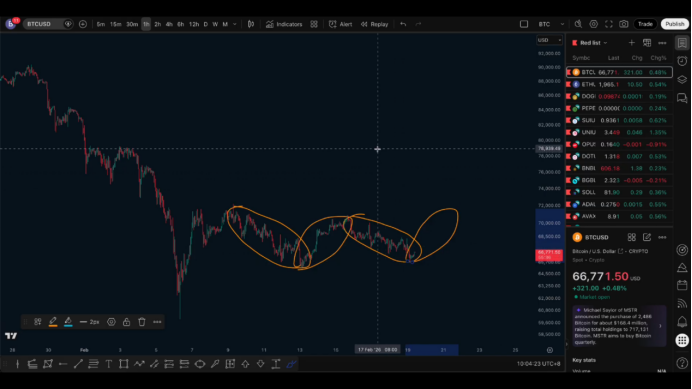
Moreover, this adjustment structure may be quite orderly. A few days ago, I clearly explained the core viewpoint:
If this adjustment ends, the subsequent upward consolidation has a high probability of breaking the previous high.
Once the previous high is broken, it may complete a round of “squeezing and enticing buyers,” followed by the beginning of a new downward trend.
Before the new downward movement truly starts, the market often experiences:
First, liquidating short leverage
Then, luring buyers
Finally transitioning to decline
This is the path I currently lean towards.
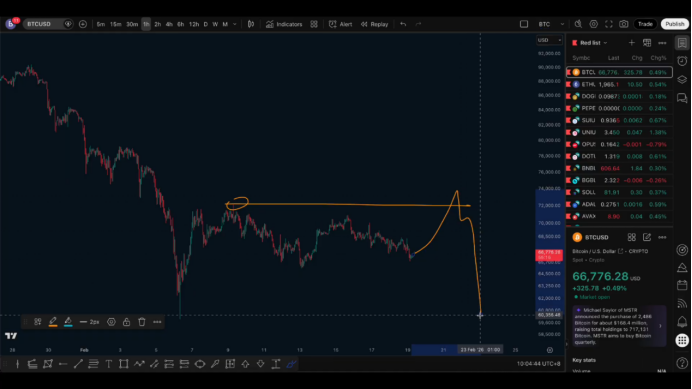
Of course, this situation may not occur. Therefore, the significance of discussing expectations lies here - once the trend does not align with our expectations, how should we respond?
What if the other situation occurs?
Assuming the low is effectively broken, then the bearish trend can be confirmed. But be aware:
❗ Breaking the low ≠ immediately chasing the short
Because under my current judgment of consolidation, even if the low is broken, the market will likely first see a rebound.
Moreover, the probability of a rebound breaking the new high after a break is very low; it is more likely that the highs will gradually decrease.
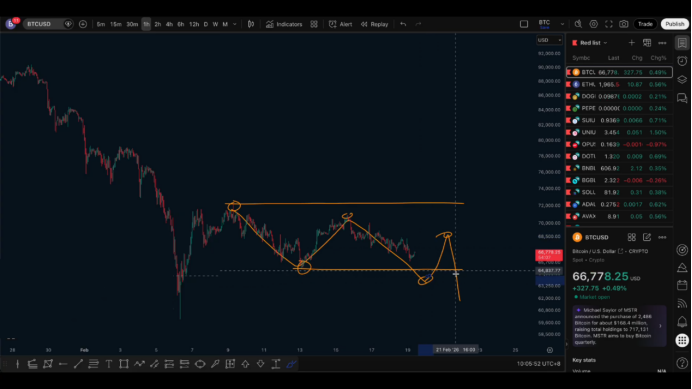
So the correct rhythm is:
Breaking the low to confirm the trend → Waiting for a rebound → Setting short positions at a high
This is a more reasonable right-side bearish approach.
Now, let’s look at Ethereum (ETH)
Compared to Bitcoin, Ethereum’s structure appears slightly weak.
Currently, the most critical resistance level for ETH is at 2,000.
The structure at this level is very clear:
Previously it was support
Support broke
Rebounded twice to test and confirm resistance
Completed the switch from support to resistance
Then declined again
During the recent adjustment, we can see multiple tests, but it has never effectively broken through. Therefore:
2,000 is currently the most important resistance level for Ethereum
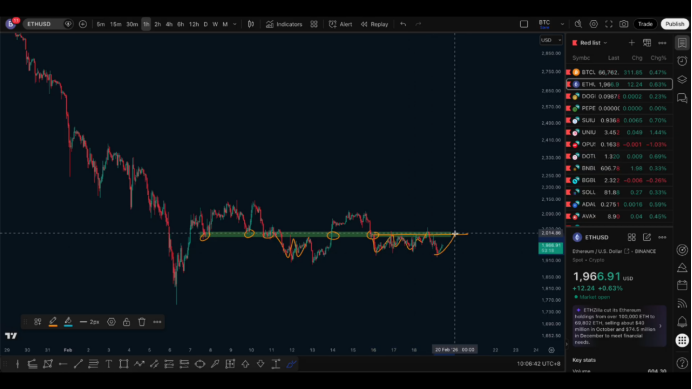
My personal view is:
If the market rebounds to around 2,000
It would be reasonable to consider attempting to set short positions
With stops above 2,100
From a trading perspective, at the current stage, if one wants to short, the structure of ETH is actually cleaner and gives easier opportunities than BTC.
Why do we say ETH is weak?
We previously discussed a little trick for judging trend continuation: observe the changes in momentum within the consolidation structure.
If during the consolidation process, we see:
High points gradually declining
Low points essentially staying flat
This indicates that the market’s center of gravity is shifting downward.
And a downward shift in the center of gravity means:
Bullish momentum is weakening
Bearish momentum is strengthening
Returning to the current ETH structure, you will find:
The upper high points continue to decline
Key resistance levels remain effective
The range converges from wide fluctuations to narrow fluctuations
This is a typical manifestation of a weak trend.
After such a structure, the market is highly likely to welcome a new wave of decline.
Therefore, my suggestion is:
If you want to lean towards short positions, prioritize looking for opportunities with ETH.
Follow me, join the community,let's progress together.

免责声明:本文章仅代表作者个人观点,不代表本平台的立场和观点。本文章仅供信息分享,不构成对任何人的任何投资建议。用户与作者之间的任何争议,与本平台无关。如网页中刊载的文章或图片涉及侵权,请提供相关的权利证明和身份证明发送邮件到support@aicoin.com,本平台相关工作人员将会进行核查。


