Author: Zhou, ChainCatcher
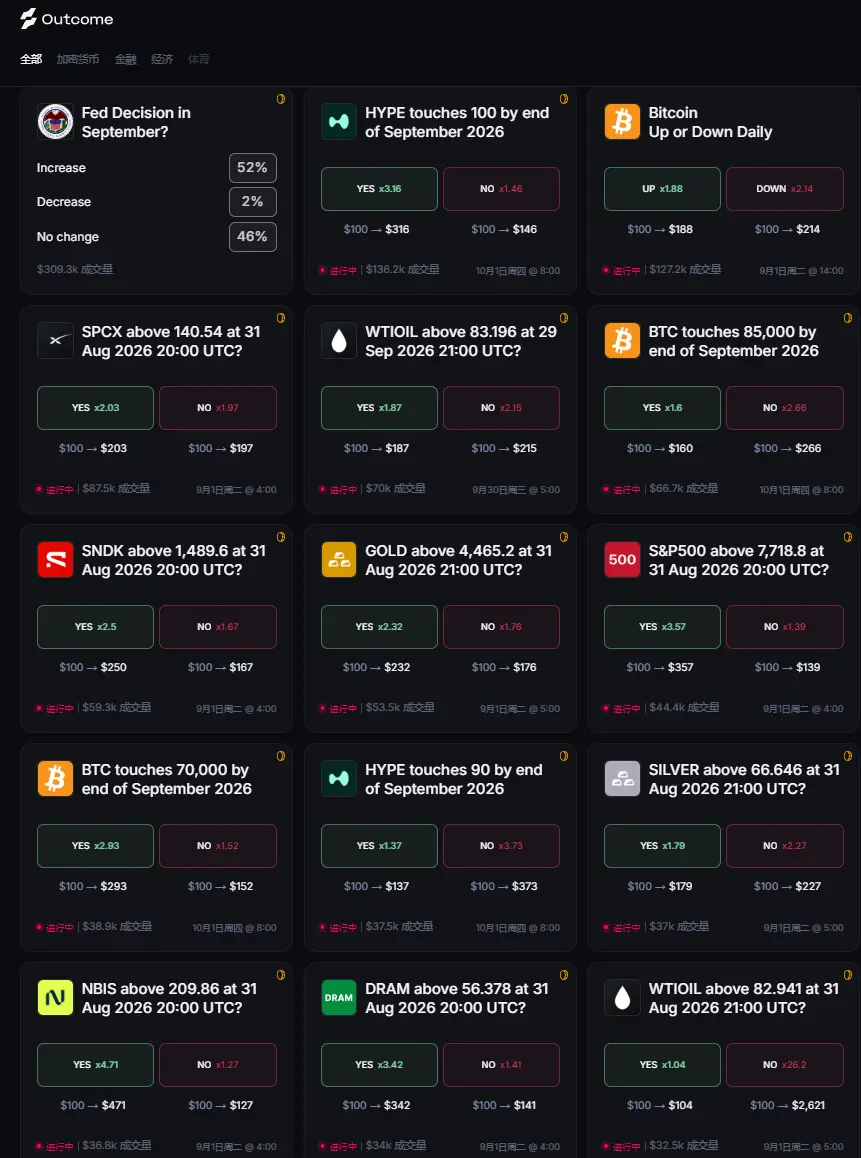
On August 29, Hyperliquid's HIP-4 officially opened for permissionless deployment. Outcome, as the first third-party Builder to complete the mainnet deployment, launched over 20 prediction markets at once, with trading volume surpassing one million dollars within two days. According to multiple KOL feedback, Outcome's transaction fees are more than an order of magnitude lower than those of Polymarket.
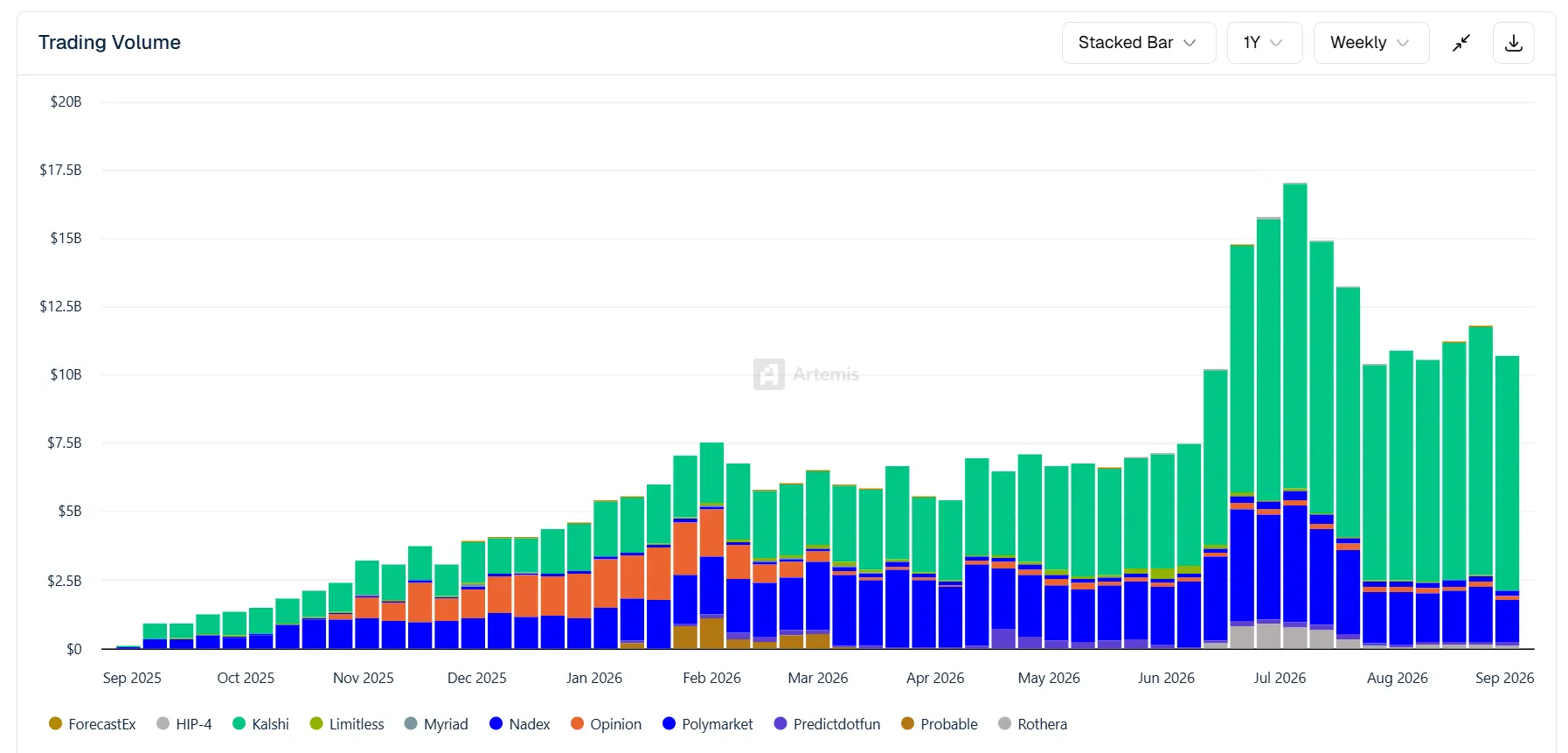
Looking at the established players in the prediction market, Polymarket and Kalshi, the two have already widened the gap significantly. According to Artemis data, Kalshi's weekly trading volume is around 9 billion dollars, which is more than four times Polymarket's approximately 2 billion dollars, with both having a combined market share exceeding 90%, and their valuations have entered the tens of billions of dollars range.
Hyperliquid's HIP-4 has taken over half a year from the initial proposal to permissionless mainnet. Many view it as a strong competitor to Polymarket and Kalshi. It directly replicated the permissionless model validated in the perpetual contract track to the prediction market, lowering the entry threshold. Is this a true disruptive attack that can really pry loose existing market shares, or just another repetition of a story wherein the crypto circle raises expectations before giving way?
Permissionless Mainnet Launch, Outcome Takes the Lead
It is reported that on September 16, 2025, contributors including Kalshi’s crypto head John Wang submitted a community proposal titled Event Perpetuals, which pointed out that HIP-3 oracles were not suitable for binary events.
On February 2, 2026, Hyperliquid officially announced the formal plan, directing efforts to Outcome Trading, still referred to as HIP-4.
The mainnet activated on May 2 was a later version, at that time the market was still deployed by validators, with the first product being daily settled Bitcoin binary contracts, expanding in late May to off-chain events like Federal Reserve resolutions and CPI.
In mid-July, the community began calling for the opening of permissionless deployment, a test net was successfully run, and on August 14, the official fee details were published. By the end of August, the permissionless mainnet officially went live, lowering the deployment threshold from 1 million HYPE during the proposal stage to 500,000 HYPE (currently worth over 40 million dollars).
According to official documentation, deployers stake 500,000 HYPE, locking it for 6 months. If the market is misdefined, settlement errors occur, or a week passes without settlement, the stake can be voted to be confiscated by validators. The initial quota for each deployer is 100 outcomes, with a maximum of 500 deployed per day, recovered after settlement. Regarding fees, there are no charges for opening positions or minting; fees arise only during closing and settlement, with multipliers set by the deployer, and the protocol and deployer sharing the revenue equally.
The method of obtaining deployment rights in HIP-4 differs from HIP-3. In HIP-3, the initial three assets in a perpetual sector could be deployed directly, and for each new asset thereafter, participation in a Dutch auction was required, with prices declining over time. The more HYPE one was willing to offer, the more likely they were to obtain the deployment position, with auction parameters directly inherited from HIP-1's spot asset auction settings. HIP-4 bypassed this bidding process, allowing deployers to obtain deployment qualification directly by staking 500,000 HYPE, eliminating competition.
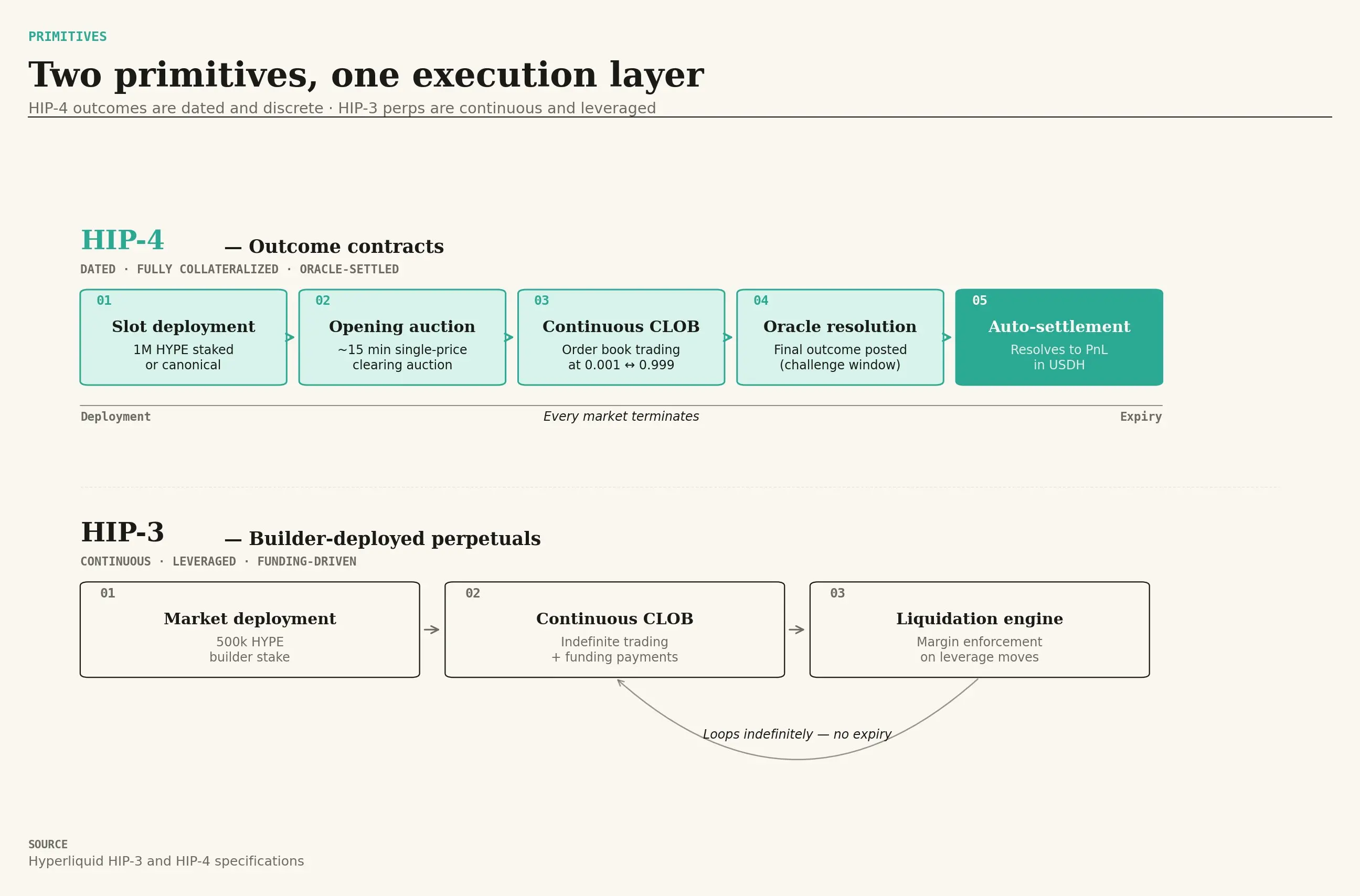
Mechanically, HIP-4 did not directly adopt the perpetual contract oracle from HIP-3. Researcher Petro D. pointed out that a perpetual contract oracle could at most change about 1% of the marked price, which is suitable for continuously priced assets like oil and Tesla, but event contracts need to jump from 0.5 to 1 at the moment the result is revealed. Following this logic would require 50 jumps, taking nearly 50 minutes, during which there are plenty of risk-free arbitrage opportunities.
Therefore, HIP-4 designed a separate type of contract that linearly interpolates the price before expiration, with the authorized oracle providing the binary result at expiration, allowing for on-chain instant settlement. The settlement currency is USDC, with no leverage, no forced liquidation, and no funding rates, meaning the maximum loss is just the principal.
This type of contract can share the same margin account with perpetual contracts and spot trades, which Polymarket and Kalshi cannot achieve, as their funds are locked in Polygon wallets or custodial accounts and cannot hedge on-chain positions.
Outcome has become the first third-party Builder to complete its deployment. According to its official announcement, Outcome began building projects based on Hyperliquid even before HIP-4 appeared and had staked 500,000 HYPE before the requirements for HIP-4 were announced.
The team launched over 20 markets on the first day and simultaneously opened over 1 million dollars in trading rewards. The categories are no longer limited to crypto: price contracts previously written on HIP-3 perpetuals for S&P 500, NASDAQ, gold, silver, SK Hynix, and WTI crude oil have all been initiated, with sports betting also on the way; domains related to the Premier League, La Liga, and the UEFA Champions League have been pre-registered.
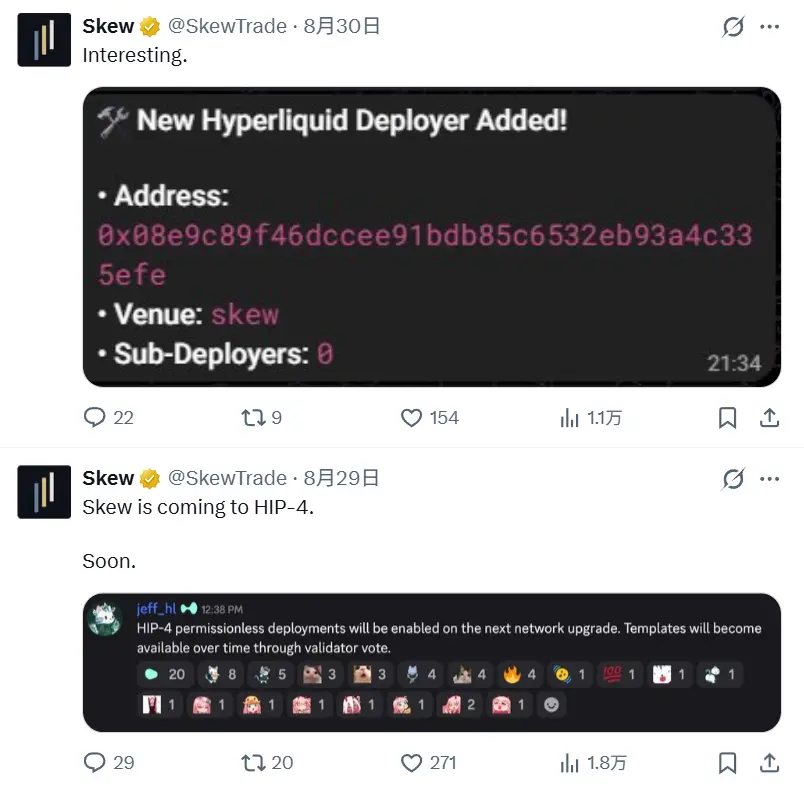
Market news indicates that the second group able to see an independent prefix on Hyperliquid is Skew. On August 30, the official launched skew: prefix Bitcoin hourly rise and fall contracts, with third-party dashboards already including its on-chain address. They partnered with Nasdaq-listed Hyperion DeFi with 500,000 HYPE, originally planning to deploy HIP-3 but switched to HIP-4 market.
In addition, HIP-3 leader trade.xyz and its backer Unit show on-chain monitoring that stake addresses are still moving funds in increments of 500,000, and the community generally expects that the 500,000 HYPE released around September 5 will be used for deploying HIP-4.
Many community users believe that more Builders entering the space means more HYPE being staked and more transaction fees flowing back to buybacks, reinforcing HYPE's value. However, this flywheel narrative does not sound as certain.
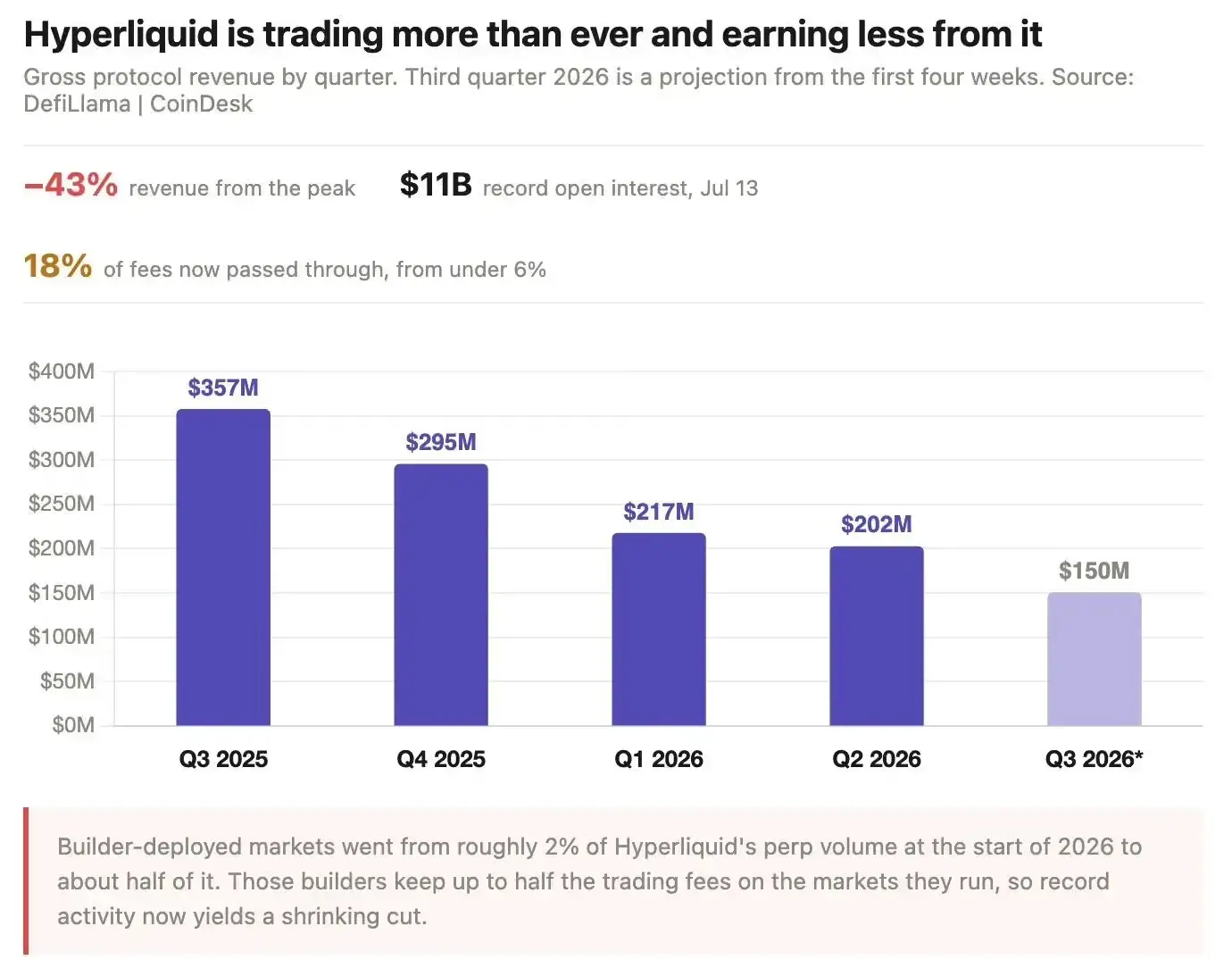
According to DefiLlama on-chain data, Hyperliquid's gross income has fallen from about 357 million dollars peak in Q3 2025 to around 202 million dollars in Q2 2026, a decline of over 40%. Meanwhile, trading volume has reached a historical high, an important reason being that the percentage of transaction fees flowing to Builders has continued to rise.
A Strong Competitor to Polymarket and Kalshi?
Currently, there is much discussion in the market about HIP-4's fees being significantly lower than those of prediction market platforms like Polymarket and Kalshi.
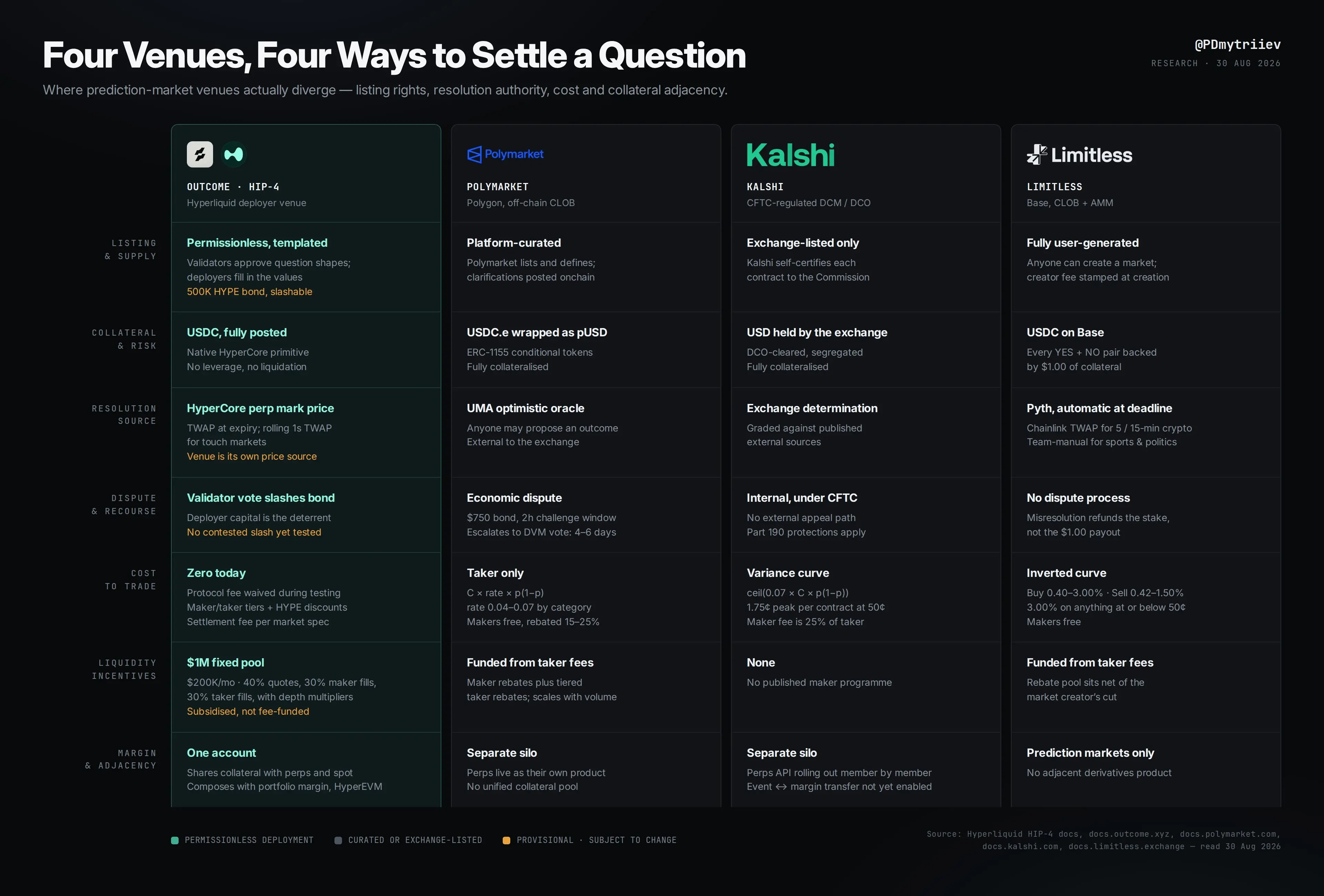
Specifically, according to research by @0xinvariant, taking 100 shares with a unit price of 0.5 dollars and a principal of 50 dollars, Outcome’s round-trip costs about 7 to 14 basis points, while Polymarket's crypto markets are about 700 basis points, sports markets about 500, and political and macro markets about 400, showing a significant difference.
However, Polymarket's geopolitical and election markets have been free of charge for years; in such cases, Outcome becomes relatively more expensive. Furthermore, Polymarket returns 15% to 25% of the fees collected to the limit order market makers, while Outcome has no such arrangement, with fee advantages mainly concentrated in high-frequency short-cycle categories like crypto and finance.
Galaxy Research reports that Hyperliquid’s user base is entirely different from that of Polymarket or Kalshi. The latter two have spent years crafting products designed to attract non-crypto users, while Hyperliquid serves active crypto-native traders through terminal front-end services, making its user funnel relatively niche.
The report also shows that on the first day of the mainnet launch for HIP-4 on May 2, prediction market trading volume accounted for only 0.7% of the total industry volume, with Bitcoin segmented daily trading volume accounting for about 20% of Hyperliquid and Polymarket in that category after 25 days.
Meanwhile, in April, Kalshi and Polymarket's market shares were 47% and 38.9% respectively, while Hyperliquid was still in the single digits. More than four months later, according to Artemis data, by late August, HIP-4's weekly transaction volume was only 4.2 million dollars, accounting for less than 0.04% of the total weekly trading volume in the industry.
According to Artemis data, trading volume in prediction markets significantly surged during the World Cup, rising from pre-tournament weekly volumes of 5 to 7 billion dollars to nearly 17 billion dollars in peak weekly trading around mid-July, then tapering off, with August's weekly trading volume stabilizing around 10 to 12 billion dollars.
Specifically, Kalshi remains the largest market segment, but Polymarket's share has significantly expanded during the World Cup, and even after the event ended, it did not completely revert, stabilizing at higher pre-event shares, while the previously notable sports platform Opinion has seen its share diluted.
Additionally, a report from May indicated that about 3.3% of Polymarket wallets are simultaneously active on Hyperliquid, contributing about 12% of Polymarket’s trading volume, with 1 in 8 Hyperliquid users also using Polymarket. At that time, permissionless deployment had not yet opened, and this competition largely contended for existing users, with limited incremental opportunity.
In fact, it’s not just Hyperliquid attacking the prediction market; reverse competition has already begun. Polymarket launched its own perpetual contract product on April 21, with up to 10x leverage covering assets like Bitcoin, Nvidia, and gold; Kalshi followed on May 29, offering CFTC-regulated crypto perpetual contracts with funding rates settled every 8 hours, becoming the first institution in the US to receive regulatory approval for perpetual contracts.
However, Polymarket has its own weaknesses. Data shows that about 75% of users churn within 90 days, and only 8% to 11% remain active a year later. During the November 2024 elections, monthly active users reached 321,500, but three weeks later, it dropped to 245,000. This issue of maintaining user engagement primarily during significant events is a challenge for native prediction market platforms.
Prediction market player @timemoonc pointed out that Polymarket first charged fees on crypto transactions in January this year, continuously raising rates in February and March, and expanded fees to the entire platform with the V2 version at the end of March. He speculated that Polymarket might be worried about falling behind in chain-based competition, so it sought to retain as much profit as possible while still holding pricing power before HIP-4 is fully rolled out.
Conclusion
In the short term, Hyperliquid's current market share is not even close to Kalshi and Polymarket, making talk of disruption premature. However, from a mechanical standpoint, a unified margin account allows traders to hold perpetual, spot, and prediction market positions with the same funds, which no independent prediction market platform can rival without a complete product overhaul.
Previously, ChainCatcher suggested in the article titled Can Hyperliquid Win in the Prediction Market? that prediction markets are fundamentally a content and operations business, and HIP-4 needs to prove its capabilities in topic supply, credibility building, and user profile matching. These areas are not traditionally Hyperliquid's strengths and are unlikely to be resolved quickly.
Thus, the current opening of permissionless deployment is merely the supply side; whether depth can keep pace, whether settlements can withstand contentious trades, and whether fee advantages can endure, all need to be validated by the market.
免责声明:本文章仅代表作者个人观点,不代表本平台的立场和观点。本文章仅供信息分享,不构成对任何人的任何投资建议。用户与作者之间的任何争议,与本平台无关。如网页中刊载的文章或图片涉及侵权,请提供相关的权利证明和身份证明发送邮件到support@aicoin.com,本平台相关工作人员将会进行核查。


