After Walsh reaffirmed his anti-inflation stance at Jackson Hole, the swap market raised the probability of a rate hike in September to about 60%, with the two-year U.S. Treasury yield posting its largest single-day increase in over two months on Friday. However, several institutional investors made it clear that they remain unmoved: ABN AMRO, Brandywine, and DWS all maintain an underweight position in long-term U.S. Treasuries, believing that "words do not equal actions."
Written by: Zhang Yaqi, Wall Street News
Federal Reserve Chairman Walsh's hawkish remarks at Jackson Hole heightened market expectations for a rate hike in September, but due to his previous months of "inactivity," bond investors are generally skeptical about whether the Fed will actually take action.
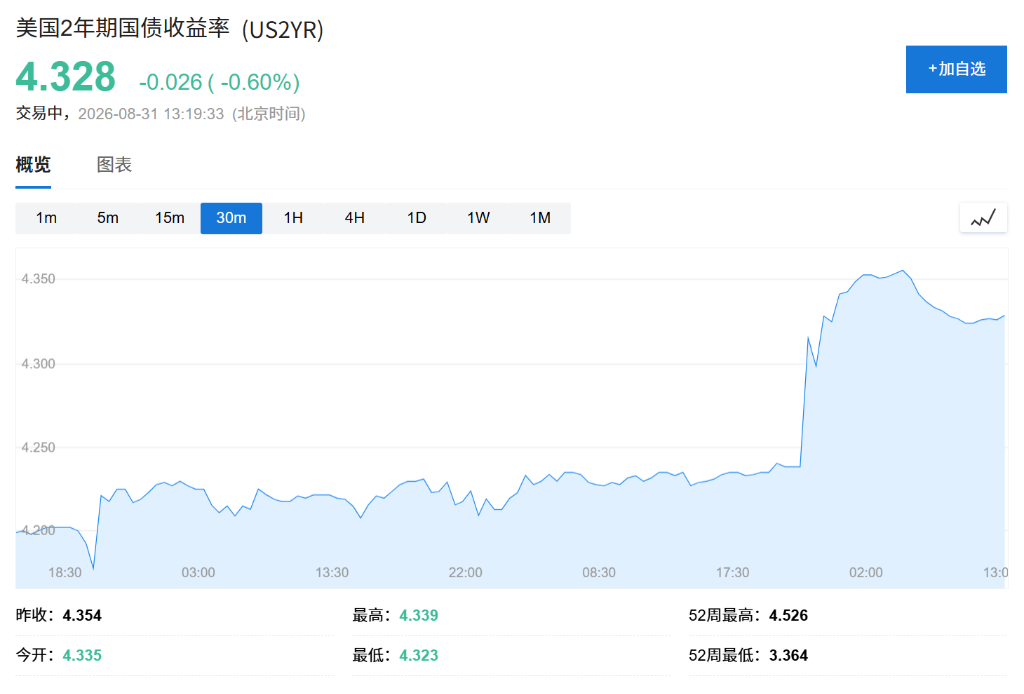
After Walsh reiterated his commitment to lowering inflation last Friday, swap market traders estimated that the probability of a rate hike by the Fed at its next meeting in mid-September has reached about 60%. The policy-sensitive two-year U.S. Treasury yield fell slightly by 2 basis points to 4.32% during Asian trading after posting its largest increase in over two months last Friday.
Despite Walsh's persistent statements aiming to contain inflation, he maintained interest rates unchanged in both June and July, raising doubts in the market about whether he would take action this time. Investors are concerned that if the Fed remains inactive again, it could exacerbate credibility concerns in the market, which have previously driven long-end Treasury yields to their highest levels in nearly twenty years. The next direction of the market will heavily depend on upcoming economic indicators. This week's monthly employment report and subsequent inflation data will be key in determining the Fed's rate decision in September, with investors on high alert to assess the direct impact of these data on the monetary policy path.
"Saying is one thing, doing is another"
Tracy Chen, portfolio manager at Brandywine Global Investment Management, stated:
"But saying is one thing, action is what proves it."
She maintains an underweight position in long-term U.S. Treasuries, although she has slightly reduced that position following the Treasury Department's announcement this month to "at least double" its purchases of 10 to 30-year bonds.
Christophe Boucher, Chief Investment Officer at ABN AMRO Investment Solutions, also holds a reserved stance:
"The reaction function remains unclear. If Walsh still does not support a rate hike in September, and inflation remains sticky, credibility concerns may resurface."
Since Walsh took over in May, investors have found it difficult to adapt to his communication style, which provides little forward guidance. ING noted in a research report on Friday that while Walsh appears unwilling to provide forward guidance, his words have implied forward guidance. His first press conference after taking office in June calmed the market by reaffirming the 2% target, causing the two-year yield to surge and the curve to flatten; in July, however, it triggered the opposite reaction, with the curve steepening sharply, the largest increase since August 2025, as investors felt he failed to clarify the reasons for keeping rates unchanged.
Fiscal measures prompt investors to reduce long-end underweight
Another support for long bonds comes from the fiscal side. The U.S. Treasury announced this month that it will "at least double" the purchases of 10 to 30-year outstanding debt, which has prompted some institutions to reduce their long-end underweight positions. Tracy Chen mentioned she still maintains her underweight view on long bonds but has lowered her position following the Treasury's announcement. Daniel Siluk, head of global short duration and liquidity at Janus Henderson, stated that he remains cautious about the duration on the back end of the curve and prefers to hold front-end duration.
Data becomes a key variable, beware of "the market doing the Fed's work"
This Friday's monthly employment report is the next critical variable, as prior data showed that U.S. job growth through March was weaker than earlier reports indicated. Walsh described U.S. employment as "performing well," expressing more concern about price stability, and noted that while recent inflation data has improved, it has yet to form a meaningful trend.
George Catrambone, head of fixed income at DWS Americas, reminded that there is a risk of "the market doing the Fed's work," meaning that there is an excessive pricing of rate hikes, while the Fed does not follow through due to tepid data; in his view, recent reports on retail sales and employment have not shown an economic resurgence, making Treasuries "quite attractive."
Goldman Sachs analysts, including George Cole, emphasized the importance of follow-up: "If there is no clearly positive inflation news, follow-up will be key. If September is seen as a toss-up, and the Fed remains inactive again without offering a clear explanation, the risk of the curve repeating the July FOMC situation will be quite high." Edward Harrison, a macro strategist at Markets Live, pointed out that since the 30-year yield initially declined after Walsh's hawkish remarks, this indicates that the Fed's credibility has somewhat improved, which may ultimately help long-duration fixed-income assets by lowering real yields and break-even inflation rates.
Next, attention should be paid to this Friday's employment report and subsequent inflation data for further adjustments to September rate hike pricing.
免责声明:本文章仅代表作者个人观点,不代表本平台的立场和观点。本文章仅供信息分享,不构成对任何人的任何投资建议。用户与作者之间的任何争议,与本平台无关。如网页中刊载的文章或图片涉及侵权,请提供相关的权利证明和身份证明发送邮件到support@aicoin.com,本平台相关工作人员将会进行核查。


