Author: Wall Street Watch
Over the past year, investors who followed the Trump administration's equity stake in publicly listed companies have reaped substantial profits. However, as the midterm elections approach, with the Democratic Party likely to regain control of at least one chamber of Congress, this stock price feast driven by government endorsement faces multiple risks—lawsuits, congressional hearings, political backlash; any one of these could reverse the gains of related stocks.
On August 29, Bloomberg reported that polls show an increasing chance of Democratic victory, and market strategists warn that once the Democrats control the Senate or House of Representatives, congressional investigations targeting government-owned companies will follow, impacting both corporate brands and stock prices. Meanwhile, a shareholders' lawsuit is challenging the legality of the government’s stake in Intel in court—if the court rules that the Chips Act does not empower the Commerce Department to exchange equity for subsidies, the legal foundation of the entire government holding portfolio will be shaken.
Market strategists point out that most of the gains in these stocks are derived from a brief burst following announcements, followed by substantial declines, indicating that the momentum brought by government endorsement is inherently fragile. Henrietta Treyz, co-founder of research firm Veda Partners, candidly states that "the Democratic-led committee's summons of corporate executives and government officials for hearings is one of the risks that investors need to pay attention to right now."
Government Equity Surge: Remarkable Gains, But Mostly Fleeting
The Trump administration has implemented an unprecedented strategy: exchanging government funds for equity in publicly listed companies, directly injecting national capital into private enterprises. This approach quickly ignited market enthusiasm, as retail and institutional investors competed to bet on the next "government-chosen" target.
The numerical results are quite striking. Since news of the Trump administration negotiating a stake in Intel emerged last year, Intel's stock price has risen over 300%; MP Materials has risen 87% since the Department of Defense invested $400 million in it last July; Trilogy Metals has increased by 73% since the U.S. government agreed to acquire a 10% stake last October.
However, the structure of these gains merits caution. Trilogy Metals surged from $2.09 to a high of $10.60 within days of the announcement, only to quickly retreat to $3.62. MP Materials once skyrocketed over 150% within five weeks after the government's investment, but subsequently fell nearly 27% over the year. Intel peaked in June after Trump announced that Apple would collaborate with it to design and produce semiconductors; since then, it has dropped 37%, making it one of the worst-performing stocks in the S&P 500 during the same period.
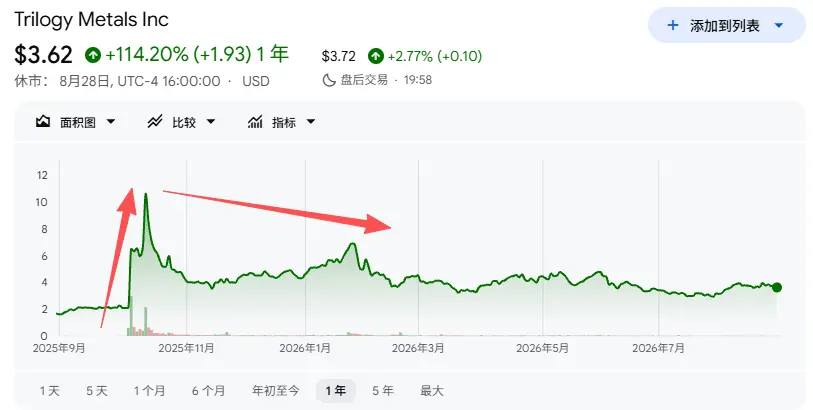
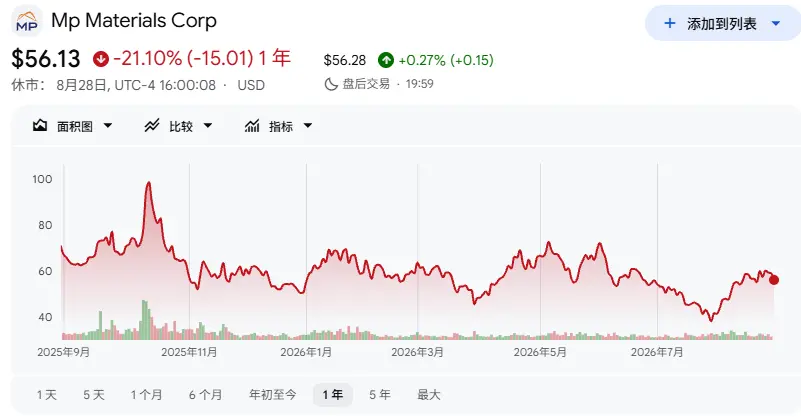
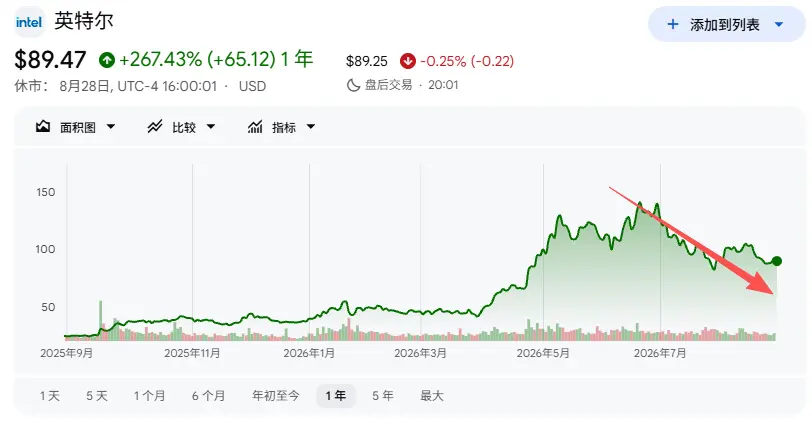
Aniket Shah, global head of Washington, sustainability and transformation strategy at Jefferies, attributes this surge to a certain logic: "You now have a government customer and spokesperson, and the market believes it will lead your company to success." However, the sustainability of this logic is increasingly under scrutiny.
Election Risks: If Democrats Flip, The Hearing Room Will Become A New Battlefield
The midterm elections represent the most immediate political risk hovering over these stocks. Polls indicate that the Democrats are likely to win a majority in at least one chamber of Congress, and once they gain chairmanship of committees, the investigation machine will immediately start.
Democratic Senator Elizabeth Warren has taken the lead. She wrote to Commerce Secretary Howard Lutnick, questioning the legality of the government’s stake in Intel. If the Democrats win the Senate, Warren will assume the role of chairwoman of the Senate Banking Committee, giving her the statutory power to summon witnesses and obtain documents.
Henrietta Treyz states that the Democrats "will seek every opportunity to critique the president for as long as possible." She anticipates that the Democratic-led committee will summon corporate executives and government officials to testify on Capitol Hill, "which poses risks to corporate brands and stock prices, making it one of the most critical concerns for investors right now."
This political pressure is not unprecedented. In 2009, both the Bush and Obama administrations faced fierce criticism from Republicans for the government’s stake in General Motors, giving rise to the Tea Party movement. The difference now is that the government was rescuing a company on the brink of bankruptcy back then, while today, the Trump administration is actively "picking winners"—this shift in logic may alter both the nature and intensity of political backlash.
Legal Risks: If Lawsuit Succeeds, The Entire Holding Portfolio Could Be Shaken
Compared to election risks, legal risks may be even more profound. Currently, a shareholder lawsuit is challenging the legality of the government’s investment in Intel in court, and the outcome could have cascading effects on the entire government holding portfolio.
The lawsuit claims that the Chips Act did not authorize the government to require equity as a condition for issuing subsidies and accuses the Intel board of breaching its fiduciary duty by characterizing the deal as "extortionate." Lutnick has submitted a motion to dismiss the lawsuit, arguing that the relevant arrangements are authorized under federal law and are crucial for the U.S. defense industrial base; Intel's CEO Lip-Bu Tan and other board members have also filed motions to dismiss.
Josh Lipsky, senior director of the Atlantic Council's Geo-Economics Center, warns:
"If the court ultimately rules that the Chips Act does not grant the Commerce Department authority over what was done to Intel, this will broadly affect many such transactions."
Ann Lipton, a law professor at the University of Colorado, further points out that such a ruling would also cast doubt on the Commerce Department's equity investments in other companies utilizing Chips Act funds, including IBM and GlobalFoundries.
Mark Malek, chief investment officer at Siebert Financial, candidly expressed the market's dilemma. His company holds Intel stock, and he stated:
"It is precisely the government's investment that has truly turned the situation around and has been a crucial factor in maintaining stock prices. If this factor disappears, what happens next? That is why we did not increase our holdings."
Structural Risks: Politically Driven Stock Price Momentum Will Eventually Return to Fundamentals
Above all the risks, there is a more fundamental issue: when the logic behind stock price increases is political rather than based on fundamentals, that momentum is inherently very fragile.
Gina Martin Adams, chief market strategist at HB Wealth Management, notes that the risk of government "endorsement" always exists.
"It may have a direct positive impact on stock prices, but to some extent, this could be a result of investors chasing political trends, which makes stock price momentum quite weak."
Matt Gertken, head of geopolitical and U.S. political analysis at BCA Research, characterizes the current situation as a "interventionist path" that has not been fully tested and digested within the U.S. system. "This process will have its ups and downs," he says.
From a broader perspective, the Trump administration's strategy overturns the traditional logic of government intervention in private enterprises—previously it was about rescue, now it is about support.
This shift has created considerable stock price gains in the short term but has also sown the seeds for overlapping political, legal, and market risks. Analysts believe that as the countdown to the midterm elections continues, investors are reevaluating: how far can this government-backed trading continue?
免责声明:本文章仅代表作者个人观点,不代表本平台的立场和观点。本文章仅供信息分享,不构成对任何人的任何投资建议。用户与作者之间的任何争议,与本平台无关。如网页中刊载的文章或图片涉及侵权,请提供相关的权利证明和身份证明发送邮件到support@aicoin.com,本平台相关工作人员将会进行核查。


