Before entering Bithumb, Upbit's FOLD Korean won trading pair accounted for about 55% of the total network trading volume.
Written by: angelilu, Foresight News
Original release date: August 28
On August 28, the Korean mainstream exchange Bithumb officially announced the launch of the The Interfold (FOLD) Korean won trading pair. Stimulated by this positive news, FOLD briefly touched $0.1, a nearly 15% increase compared to before the announcement. As of the time of writing, FOLD is reported at $0.092, with a circulating market cap of approximately $30.33 million and a fully diluted valuation (FDV) of about $120 million.
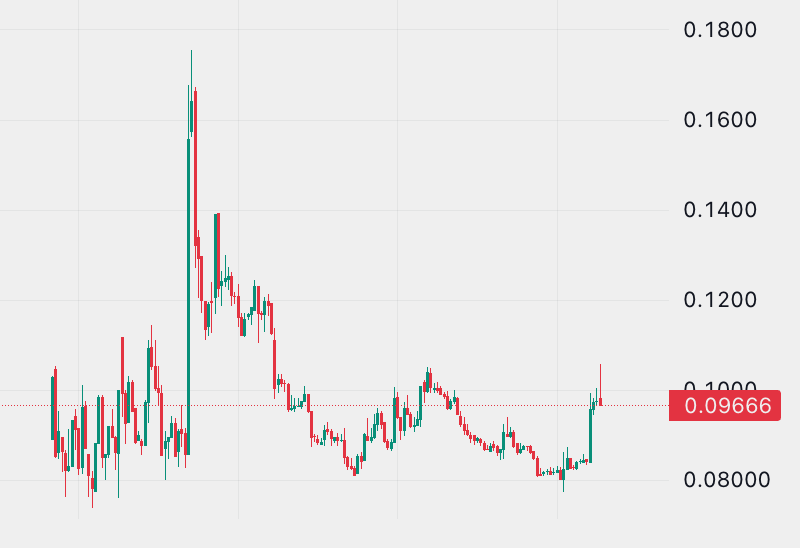
This is FOLD's third mainstream exchange launch in nine days. On August 19, The Interfold completed its TGE, and the token was available for transfer. On the same day, the first phase of the mainnet, Network Alpha, went live, with FOLD hitting its historical lowest price of $0.03467 on the day. On August 23, Upbit launched FOLD in the Korean won, Bitcoin, and USDT markets, and FOLD reached its historical highest price of $0.1754 that day. On August 25, Kraken also launched FOLD/USD.
It is worth noting the distribution of liquidity. Before entering Bithumb, Upbit's FOLD Korean won trading pair accounted for about 55% of the total network trading volume, while the two pools on Uniswap V4 combined accounted for just over 30%. This time, Bithumb is only opening the Korean won pair, unlike Upbit which also offers BTC and USDT, meaning that the new liquidity is entirely in Korean won.
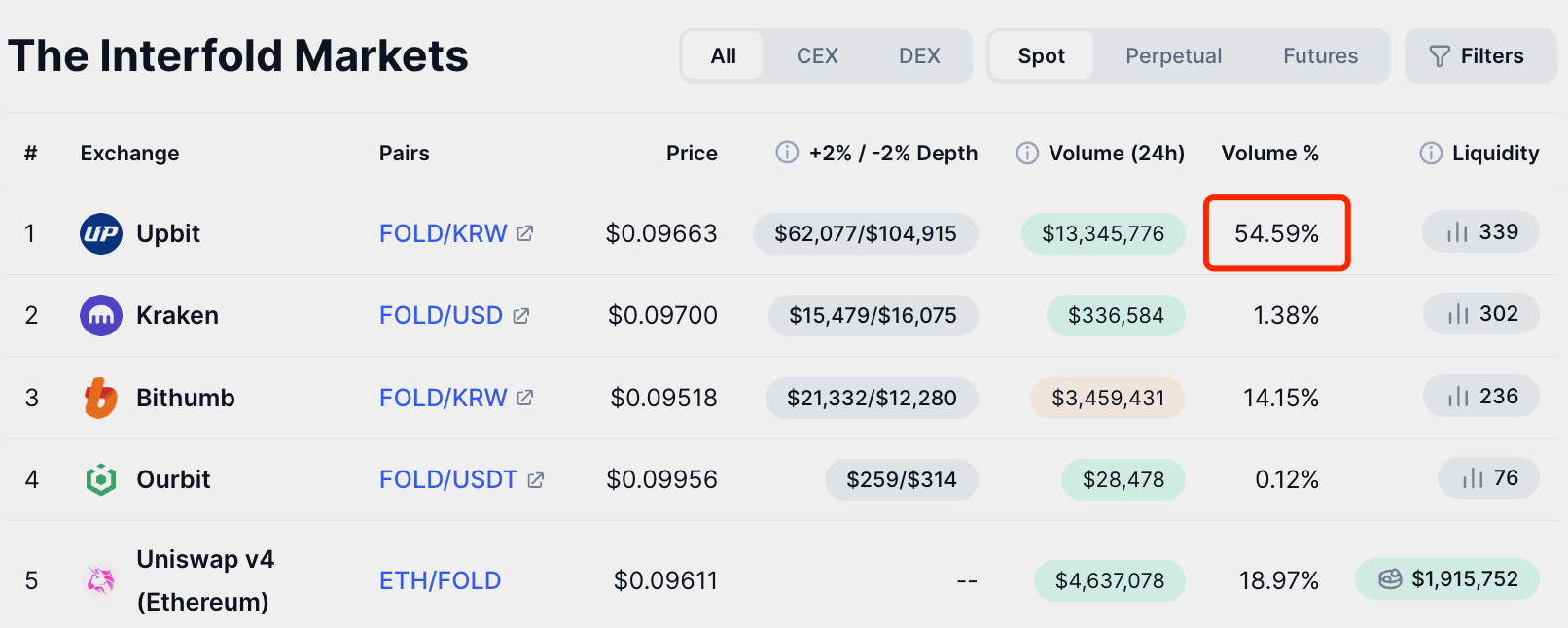
A project developed by Gnosis Guild, which has been publicly endorsed by Vitalik Buterin, is an Ethereum privacy infrastructure project, and its pricing power is currently mainly in the hands of speculative Korean traders.
Review of FOLD Token Pricing Mechanism
Before entering exchanges, FOLD had two public pricing events, both completed on Uniswap's Continuous Clearing Auction (CCA).
The first was from July 8 to 10, requiring participants to complete KYC via Predicate. The clearing price was approximately $0.023, corresponding to a fully diluted valuation of about $27.6 million. The fundraising was oversubscribed, but not all tokens were sold; this auction had a maximum sale of 120 million FOLD, but only 43.66 million were actually traded, making up just 36.39% of the maximum amount. Buyers had to wait 40 days for the cooldown period before being able to transfer.
The second was from August 17 to 19, just before the end of the cooldown period, auctioning 24 million FOLD, which is 2% of the total. This time, everything sold out, but the clearing price was about $0.0224, only 4% above the floor price.
The two auctions were separated by a 40-day gap and a mainnet launch, with little change in price. One was oversubscribed but unsold, and the other sold out but was very close to the floor. This is the valuation given by a group of KYC-completed participants under conditions without an exchange and without candlestick charts, approximately $27.6 million. At the current price of $0.096, the paper returns for participants in both auctions are between 4.2 to 4.3 times.
In terms of supply, FOLD has a total supply of 1.2 billion, with 27.22% circulating at TGE. The investor share of 14.71% and CCA auction share of 12.50% were both unlocked at TGE with no lockup, totaling 27.21%, which matches the circulation ratio closely. This means that every FOLD currently in circulation almost entirely comes from these two pools, while the two auctions actually only sold 5.64% of the total amount, with the remaining portion not disclosed in detail by the officials.
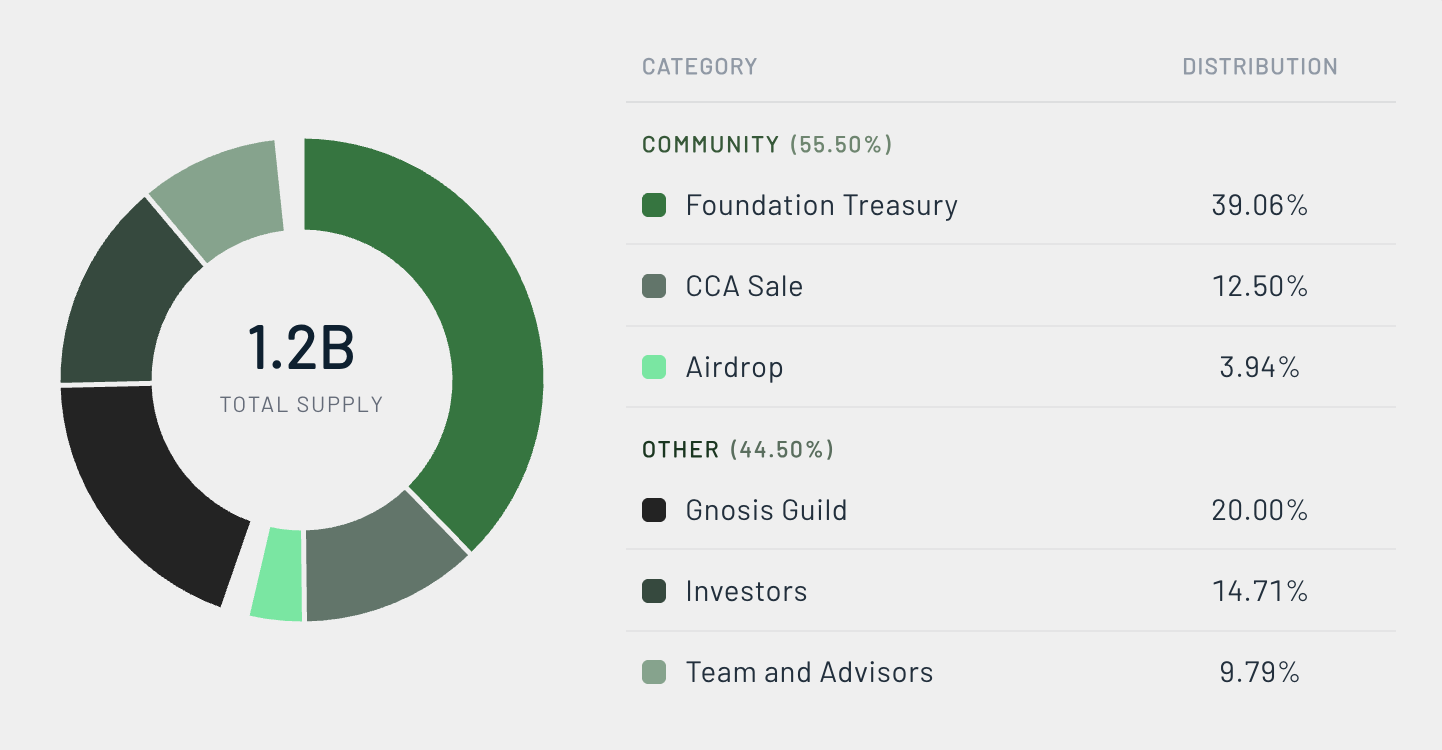
What needs more attention is the unlock schedule. The largest share, the foundation treasury takes up 39.06% and Gnosis Guild's 20% will be unlocked linearly starting September 1, 2026, over 48 months. The 3.94% airdrop and the 9.79% for team advisors will also start unlocking linearly over 24 months from the same date. This means that about 21.63 million additional tokens will be introduced each month, equivalent to 6.6% of the current circulating supply, totaling about $2.08 million at $0.096, while FOLD's current daily trading volume fluctuates between $4 million and $11 million.
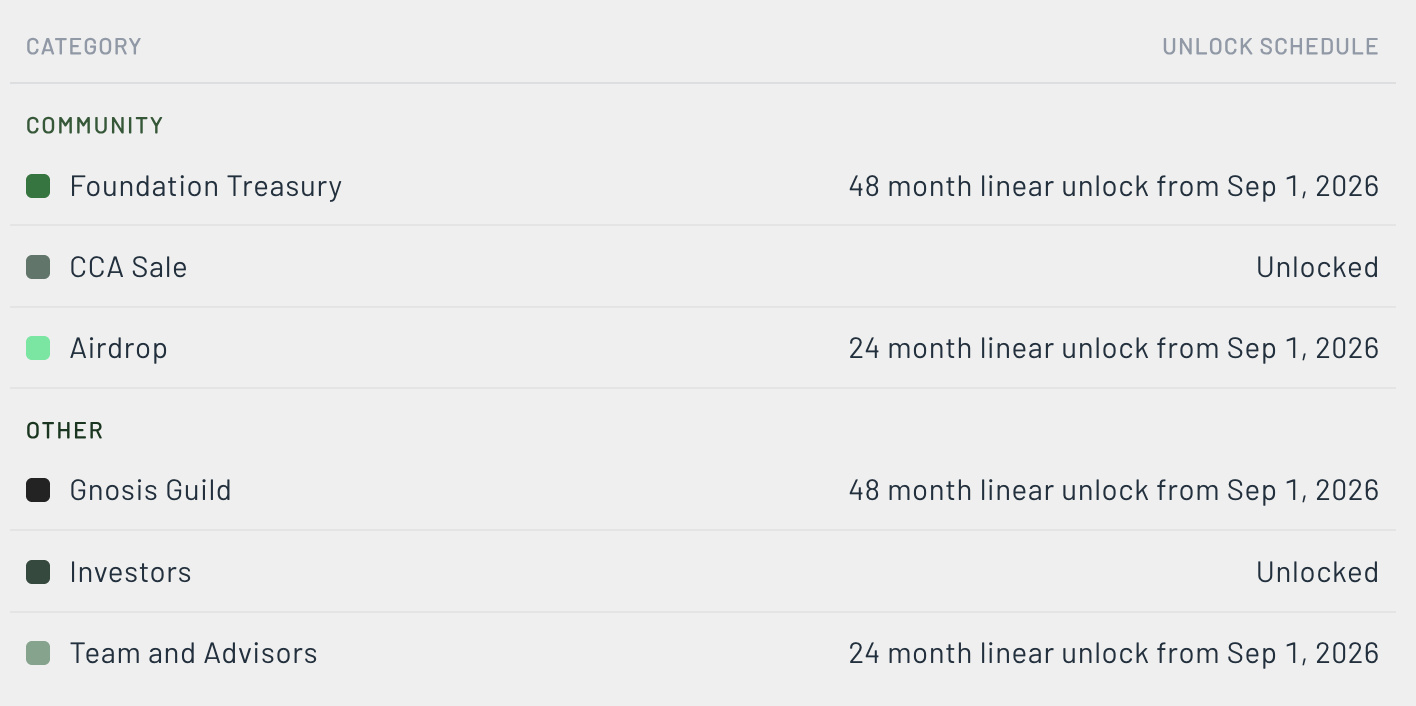
This means that after Bithumb launched FOLD today, FOLD will welcome its first linear unlock in four days.
The Interfold has launched Network Alpha
The Interfold, formerly known as Enclave, was developed by Gnosis Guild, the team that created the Zodiac DAO framework. The problem it aims to solve is very specific: on-chain voting is public, allowing anyone to verify what votes any address has made, which makes vote buying verifiable. Its approach is to ensure that voters cannot prove to any third party what they voted for, fundamentally eliminating the basis for bribing votes. Vitalik Buterin publicly stated on May 28 that this is essentially a generalized realization of the MACI concept he has been advocating for nearly a decade.
Recommended reading: 《What is The Interfold supported by Vitalik》
The Interfold launched the Network Alpha on August 19, which the officials define as "the first production phase of the mainnet." The encrypted execution environment (E3), composed of fully homomorphic encryption, zero-knowledge proofs, and multiparty computation, is now available on the mainnet, with the ciphernode committee executing distributed key generation and threshold decryption, with end-to-end verifiability of the on-chain lifecycle. The officials also listed the boundaries: the committee is capped at 19 nodes, with a threshold of 9, the operator collection remains permissioned, and public registration "will open soon," while the current time for distributed key generation is measured in hours.
This time scale determines what can actually run now. A DAO governance vote typically counts in days from proposal to deadline, and waiting a few hours is acceptable; however, use cases mentioned in the project documentation like sealed-bid auctions, multiparty collaborative analysis, and AI coordination require responses in seconds or minutes.
Currently, the only application truly running on the network is The Interfold's own governance, which uses the CRISP solution integrated with Aragon. When Aragon announced the integration in July, this solution was still in the testnet phase. FOLD is used in the system for node staking, E3 request payments, and governance, but the official has yet to provide numbers for the minimum staking amount, E3 fee rates, and penalty clauses.
According to the official community arrangement, there will be a live demo on September 2, which will be the first complete demonstration of this system in a public setting since the launch of Network Alpha.
What to watch next
This path of listings is not yet complete. Both Upbit and Bithumb, the two main exchanges in Korea, are online, but top exchanges like Binance, OKX, and Coinbase still have no FOLD spot market, leaving room for future catalysts for exchange listings. In contrast, the linear unlock starting from September 1 is a certain and calculable incremental supply.
What truly determines whether this project still has value are three things: whether the public ciphernode registration will open as scheduled, if the number of nodes can exceed the 19-node limit, which determines whether the staking demand for FOLD truly exists; the time taken for distributed key generation can drop from "hours" to what scale, which is a hard threshold for use cases like sealed-bid auction; and after the live broadcast on September 2, whether the first production-grade E3 application that does not belong to Interfold itself will appear.
免责声明:本文章仅代表作者个人观点,不代表本平台的立场和观点。本文章仅供信息分享,不构成对任何人的任何投资建议。用户与作者之间的任何争议,与本平台无关。如网页中刊载的文章或图片涉及侵权,请提供相关的权利证明和身份证明发送邮件到support@aicoin.com,本平台相关工作人员将会进行核查。


