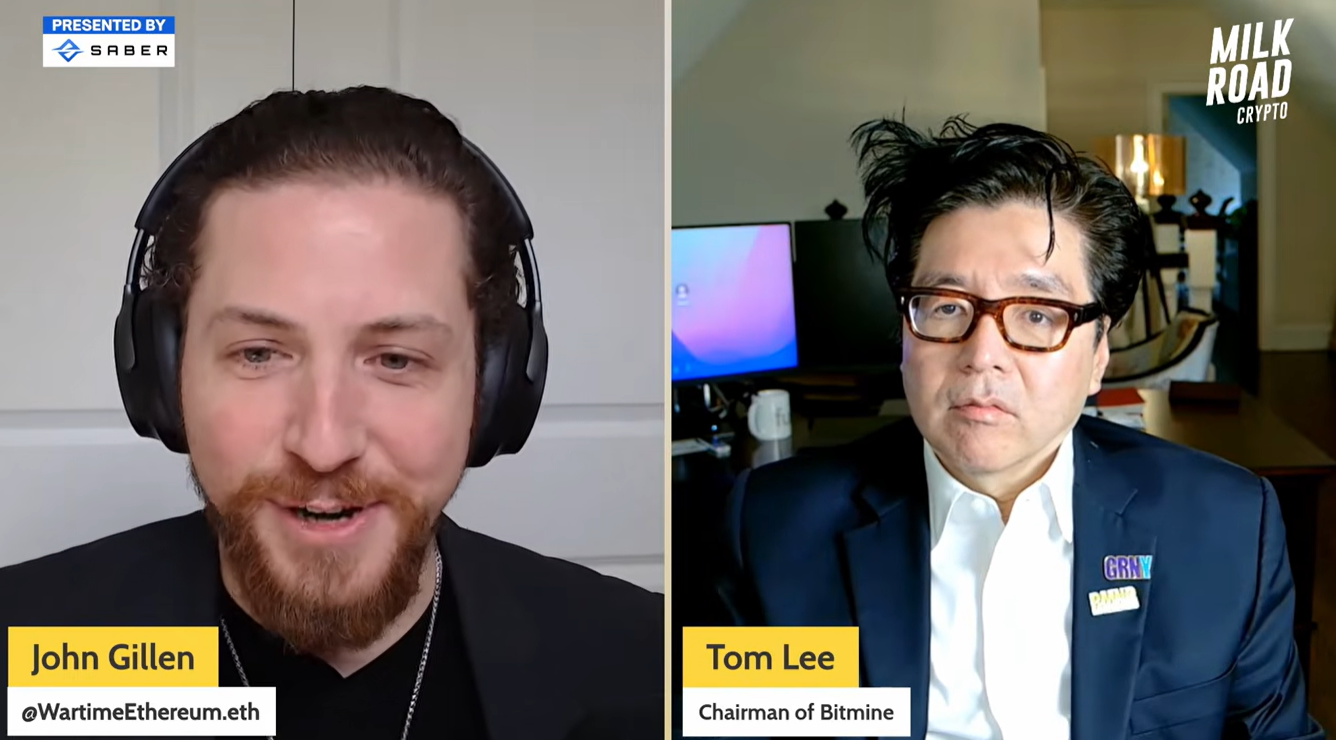
Source: "Milk Road Show"
Organizer: Felix, PANews
Tom Lee, Chairman of Bitmine, recently appeared on the "Milk Road Show" and discussed Ethereum's core position in the financial system over the next five years. Tom Lee pointed out that due to the trend of tokenization and the demand from AI agents for on-chain transactions, ETH is currently in a stage of being severely undervalued. He believes the current market trend is a "course correction," indicating that the ETH to BTC ratio will experience a significant rebound.
PANews has organized the highlights of the interview.
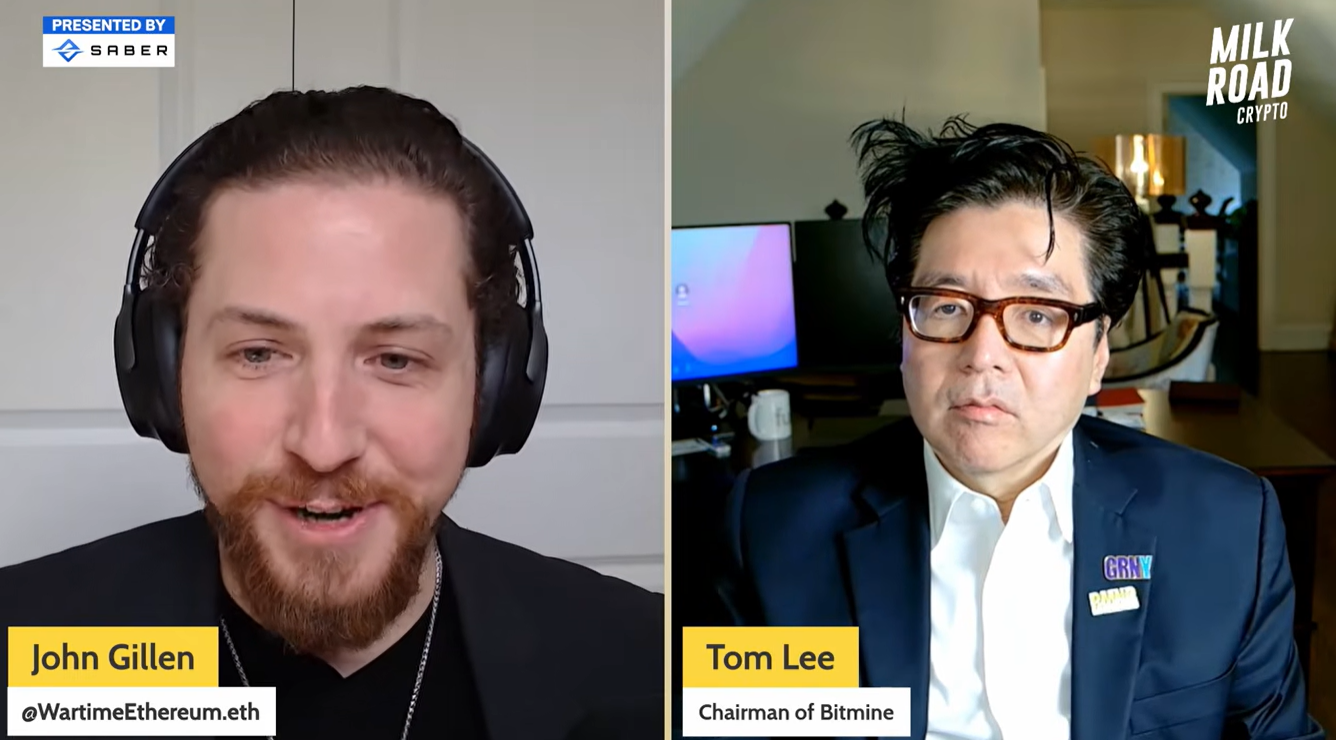
Host: What are your thoughts on last week's market trends and this surge in Ethereum?
Tom Lee: I know everyone has different opinions on this. But our view this year has been: the fundamentals of cryptocurrency have been continuously strengthening. This forms a stark contrast to the past "crypto winter." Previous crypto winters were often accompanied by project failures, capital withdrawal, and a shrinking of application scenarios. But this time is completely different. We are seeing a huge momentum in asset tokenization. Many prestigious traditional large financial institutions are building tokenized products, with a particular preference for the Ethereum platform. Additionally, with the growth of AI capabilities, there are more and more signs indicating that AI agents fundamentally do not want to use traditional financial systems, so the crypto track is the most reasonable choice for them.
Therefore, in our view, last week’s surge can be called a "course correction." Because market prices are finally beginning to acknowledge that we should no longer be in a deep crypto winter. As you said, the massive liquidation happening in the market is precisely indicative of how many people were shorting and completely misreading the situation. As the famous John Russell said, "All rebounds start with short covering." So we believe this is just the beginning of a larger market trend.
Host: Do you think a pullback will happen? Or has this already started a new round of the crypto bull market?
Tom Lee: I believe that for those currently with no exposure to any crypto assets or under-allocated, this is clearly a "tactical" buying opportunity. My advice is, if you look back at past crypto cycles, ask yourself one question: If you were allowed to buy in the 4 weeks before the market hit the bottom or in the 1 week after it hit the bottom, what would you do? The answer is obvious; everyone would choose to buy without hesitation within those two windows.
If last week was the bottom, then you are buying 1 week after the bottom; if the market pulls back next (which is completely possible), then you would be buying within the 4-week window before the bottom. In any case, as long as you make a tactical buying decision, you will be grateful to yourself in the future. I believe that anyone trying to perfectly predict the market bottom and waiting to buy until the rebound's midpoint will ultimately miss out on a significant portion of the profits.
We have released a classic statistic that has been validated for over a decade: nearly all gains in cryptocurrency occur within the best 10 days of the year. If you miss these crucial 10 days, your annualized return is actually negative.
So how many such super surge days have occurred in all of 2026? Probably only 1. This means that from now until the end of this year, cryptocurrencies still contain substantial upward potential.
Host: Last week, Robinhood CEO Vlad Tenev published an article calling for attention to the "tokenization super cycle." What are your views on this tokenization super cycle? What does it mean, and how will it change today's financial markets?
Tom Lee: I believe the "tokenization super cycle" may be the most precise and vivid explanation of the technological transformation that is currently underway. The reason Vlad's comments carry such high credibility is that he is himself a market-validated innovator who has disrupted traditional finance, having founded and scaled a company to such a massive size.
Robinhood has brought a disruptive revolution to traditional stock and asset markets, with the most intuitive innovation being its "zero-commission trading." But what Vlad has done right is completely overhaul and reshape the user experience of finance.
In the past, users on those outdated traditional brokerage apps had to face lengthy and rigid trade confirmation forms; when they switched to Robinhood, they could complete trades with just a swipe of their fingers—this minimalism and smoothness illustrated Vlad's strong innovative understanding.
Today, our current financial infrastructure is long overdue for a complete upgrade suitable for the 21st and even 22nd centuries. Today's financial system is an extremely bloated and complex machine: it is composed of countless stacked intermediary institutions, outdated legacy systems, and disconnected networks. The completion of a transaction requires various interface connections and massive human intervention.
While many believe that the current system operates quite well (and it does maintain operation at low speed), its speed, error rate, and operational costs are far from comparable to those running on a blockchain.
This is what Vlad's vision points to: If the financial system were to fully transition to the crypto track, it would not only release faster and lower-threshold capital pathways but, more importantly, create unimaginable innovative space.
Because once you can move assets in a purely digital form, at extreme speed, many things we have never defined as "money" will instantly transform into circulating digital currencies. This is the true release of nuclear-level energy.
Today, one dollar has evolved into a digital dollar through stablecoins; stocks are also evolving into "software" that operates on the blockchain through tokenization. And once you turn stocks and currencies into software, we can convert other things traditionally not considered money, such as membership points, personal credit, influence, sponsorship rights, and even discounted values of forward contracts, into digital money. They were hard to monetize in the past, but now they will be thoroughly financialized and monetized.
How large a market can this create? You could calculate like this: Today's traditional financial system is extremely vast, with over 150 trillion dollars in liquid assets. But this enormous empire is essentially driven by two extremely singular asset classes: bonds and stocks. Everything else in financial products traded is undoubtedly just derivatives of these two base assets.
Once tokenization is implemented, the potential market we face will no longer be just that 150 trillion, but will skyrocket to over 500 trillion dollars. This includes intellectual property, future licensing rights, unexploited resources, and more. Therefore, the term "super cycle" is not only not exaggerated, it may actually underestimate the terrifying scale of this wave of crypto technological innovation.
Host: As the world strides toward an era "dominated by intelligent agents on-chain," how does Ethereum maintain and continue to expand its absolute dominance in this ecosystem?
Tom Lee: When facing the future, there are things we can be 100% certain about and things that are full of uncertainty. One thing we can be absolutely certain of is that in the next 5 years, AI intelligent agents' autonomy and financial decision-making will witness a tremendous leap forward.
Another certainty is that the current traditional financial channels (such as Visa, banking systems) were completely designed for "humans," and all risk controls and multi-tiered credit approvals were made to guard against credit risks in human-to-human transactions. They cannot accommodate the economic activities of AI intelligent agents at all.
But how can AI intelligent agents use a physical Visa card? Traditional payments require validating through 24 different systems back and forth, while AI intelligent agents might be executing a micro transaction at a frequency level of just cents, or even fractions of cents—something entirely incompatible with traditional digital and trading systems, and the speed of traditional tracks cannot support AI's high-frequency demands at all. Therefore, they absolutely will not use traditional financial systems.
So, the remaining paths are only two: Either use crypto channels (like the Ethereum network), or create an entirely new currency system that belongs to the world of AI intelligent agents from scratch. If AI intelligent agents indeed created their own autonomous currency system, that would mark the beginning of a disaster and fear for all humanity. Because that means humanity will be completely kicked out of the control chain of economic circulation. Imagine if AI intelligent agents trade entirely within their self-created closed-loop economy while using their own issued credit media, only reluctantly converting to dollars when they occasionally need to purchase tangible hardware or resources from humans—what a chilling future that would be?
Therefore, from both the perspective of top-level design safety and due to government’s stringent regulatory policies, humanity must be forcibly embedded into the financial decision-making closed loop of AI intelligent agents.
Looking globally, the only way to achieve this today, providing underlying mathematical rules, is through crypto networks. We can set hard behavioral boundaries and credit limits for AI intelligent agents on-chain through smart contracts, thereby giving them financial autonomy while completely eliminating the systemic risks of them absconding with funds.
Host: Why consistently buy ETH every week? Why start buying back company stock recently?
Tom Lee: When we founded Bitmine a year ago (on June 27, 2025), the mission was very pure: to play one of the most core and fundamental roles in the reconstruction of the future global financial system. We firmly bet that Ethereum will inevitably become the ultimate settlement layer for future global finance.
We aim for the Ethereum share we want to acquire to neither be too large to prevent centralization of the Ethereum network, nor too small to allow us to enjoy significant network value gains. After precise calculations, 5% is the perfect golden balance point.
This goal has also received strong recognition and support from the Ethereum Foundation and several founders. Because at this scale, Bitmine can serve as an extremely powerful "market stabilizer" for the entire Ethereum network, while guiding and empowering the development of the entire ecosystem in a healthy manner. For example, we have played an essential foundational role in assisting and anchoring a series of external entities split from the Ethereum Foundation.
The reason we insist on consistently investing weekly is primarily based on our sovereign valuation system, where Ethereum is still extremely undervalued. It will not only perfectly capture all spillover benefits from the migration of finance to the blockchain in the future but will also serve as a guardian of human wealth and the ultimate firewall against regulating AI intelligent agents' behavior.
So, what valuation should Ethereum bring? For us, Ethereum's intrinsic present value is far higher than today's $2,500. Even the previous historical peak of about $5,000 still did not reflect Ethereum's true potential.
We can look at a very simple indicator: the price ratio between Ethereum and Bitcoin. This ratio is currently stagnating around 0.03. At the peak of the bull market in 2021, this ratio had reached 0.08. But remember: the prosperity of 2021 was underpinned solely by some air-based meme coins and speculative NFTs.
And what are we discussing today? It's the "comprehensive tokenization of trillions of traditional assets" and the "AI intelligent agents finance." Therefore, this time the Ethereum to Bitcoin exchange rate will not only easily reclaim the high point of 0.08 but may even potentially surge to 0.25 or even parity at 1:1. This means that the current ETH is literally a chip picked up from the ground.
This is why we buy without hesitation every week. Through this action, we have effectively forced the market to drain 5% of Ethereum's liquidity, creating a massive "liquidity sedimentation black hole."
In the future, this large and highly concentrated Ethereum position will unleash extremely formidable strategic and ecological barriers: it can serve as seed capital to incubate and encourage a multitude of DeFi frontier innovations; in the upcoming next crypto cycle, dozens of companies valued at billions, constructed on new crypto financial tracks, will emerge, and Bitmine will have a unique capital advantage to deeply participate in or even directly create them.
As for the company stock buyback you mentioned, we previously passed an authorization for a common stock buyback of up to $4 billion. At the beginning of the buyback, this fund was even enough to purchase 50% of the company's circulating shares. The core intention behind setting up the buyback was to prevent our company’s stock price from deviating excessively from the fundamental value of the company (that is, the net value of Ethereum represented by each share). When we initiated this program, we found the price of BMR to be very attractive. By buying back and destroying stocks, we can substantially increase the number of Ethereum represented by each share.
Over the past five weeks, we conducted the largest stock buyback in the history of the entire crypto industry: accumulating nearly 20 million shares of company stock in the open market at an average price of less than $15. Now, our stock price has soared to $26. From any financial dimension, this is a textbook example of successful capital operation.
Host: The Ethereum Foundation underwent a structural split this year, evolving into more functionally distinct, independently operating external organizations, such as ETH Labs, ETH Systems, and Ethereum Institutional. Meanwhile, Bitmine is almost the cornerstone supporter of all these emerging institutions. As a long-term investor, how should one understand this significant evolution of Ethereum's governance structure and ecological landscape? What is the top-level strategy behind it?
Tom Lee: This indeed traces back to a major transformation that occurred within the Ethereum Foundation earlier this year. The Ethereum Foundation had gradually evolved into a large, bloated organization burdened with too many missions. As Ethereum matures, it no longer makes sense to cram all these diverse efforts into one basket called the foundation.
For instance, should the commercial development work to engage large corporate clients be led by a neutral non-profit foundation? Or should the foundation act as backend support while establishing independent entities in the front to connect with Wall Street? The same reasoning applies to privacy protection technology and even cutting-edge technological development like ETH Labs. They ultimately made a very wise conclusion: those functionalities should be independent and set up specifically outside the foundation. This brings two huge strategic advantages:
First, it can enable external collaborations that cannot be achieved within the framework of the foundation. This includes large external financial institutions, tech giants, and so forth. Second, it can attract a large group of outstanding core Ethereum developers to directly hold shares and participate without needing to be forced into a non-profit foundation as employees.
When this historic restructuring occurred, we believed that Bitmine should play a "stabilizing anchor" role, providing initial support to each independent entity. In our view, some of these entities are "public goods investments." Our standard for measuring their success is by no means "what direct financial returns and dividends will this entity bring us". We support it simply because it is an extremely correct and necessary path for the long-term prosperity of Ethereum, enabling it to stand undefeated in future global competition.
It has been proven that since these independent entities were established, they have secured countless impressive victories in the market. This is undoubtedly a massive success.
Host: From your perspective, how can Ethereum begin to turn its vision into reality? What do you think is the next biggest hurdle on the road to achieving this goal?
Tom Lee: Much of what I’m about to share constitutes my personal industry observations and opinions and does not represent absolute facts.
My entire career has been spent largely on traditional Wall Street. I know too well the internal ecology and pain points of these institutions. We need to understand a very harsh but extremely critical reality: Just because the technology you developed is far superior in magnitude to existing solutions does not mean the traditional financial system will adopt it.
When will they show rapid adoption? Only when they see a practical, operational killer application scenario with a clear return on investment.
Traditional institutions prefer to engage with organizations that fully understand and meet their compliance and business needs. I believe the newly established independent entities (those split from the Ethereum Foundation) possess this qualification because their core team members have been deeply entrenched in this institutional market for many years.
More core is the point that these entities understand under what circumstances Wall Street will compromise: that is when this new technology can bring a tenfold improvement to their current business. The crypto track evidently offers a tenfold leap in technological performance and settlement costs. But we must also ensure that these institutions can immediately see a tenfold return and effectiveness in their financial reports or business profits.
Host: During the remaining time in 2026, what are the core driving forces pushing the ETH to BTC ratio back? Do you think this historic breakthrough can stand firm and continue to ferment?
Tom Lee: I firmly believe that the ETH to BTC ratio will continue to soar in the coming time, and returning to the historical high of 0.08 is merely the first step target.
I still hold a strong belief in Bitcoin’s long-term prospects. In my view, Bitcoin is not just digital gold; its function and efficiency as a gold substitute asset far surpass those of physical gold. Bitcoin still has multiple times the potential for growth in the future. However, if we are to write the grandest and most core story of the entire cryptocurrency world over the next five years, that story is certainly not about digital gold but about the "comprehensive tokenization super cycle of assets" and the "reconstruction of human wealth by AI intelligent agent finance."
As Vlad has said, the vast majority, indeed almost all of this super wave, will happen and solidify on Ethereum. This is the underlying logic of why Ethereum is bound for a great comeback.
Specifically, from now until the end of this year, I believe there are four golden catalysts that will ignite the market:
One is the "Clarity Act" is expected to be officially passed in September. Many believe that the crypto world does not need regulation. But this act serves as a "safety cushion" crucial for traditional financial institutions' survival. Once there is a clear regulatory entity and written compliance rules, the huge compliance funds on Wall Street can establish trillion-dollar businesses on the crypto track legally and formally. Even without passing, the crypto industry has already proven capable of insane innovation without regulation, but that does not prevent it from providing nuclear-level superpowers to the market upon approval.
Two is the immense short and observing funds that have been suppressed in the over-the-counter market are now flooding in. A large amount of capital had been waiting for the so-called October low due to clinging to the "crypto four-year cycle theory." And now, there are only 5 weeks left until October. Those who have been aggressively shorting, holding large cash reserves, and who previously exited to speculate in AI concept stocks are suddenly waking up: cryptocurrency is essentially the core settlement landscape downstream of AI prosperity.
Three is the strong return of international funds, represented by Asia. Markets in Asia such as South Korea were previously chasing their local stock markets, but now they are rapidly redirecting their focus back on crypto assets.
Four is the performance competition among top global financial institutions. This is a cold hard statistical fact: since June 30 this year, the best-performing asset globally has been none other than cryptocurrency. Ethereum surged by 54% during this period, while gold only gained 13%, and U.S. stocks saw single-digit increases. Imagine, when the quarterly settlement on September 30 arrives, if Ethereum still stands atop the list of global asset returns, what kind of frantic FOMO-driven purchasing and position chasing will ensue among global fund managers to avoid underperforming their peers in the entire fourth quarter from September 30 to December 30?
With these four catalysts, the ETH to BTC exchange rate will easily breach this year's highest level. Even if we make a very conservative, restrained financial valuation, assuming the exchange rate only recovers to 0.04, as long as Bitcoin hits $150,000 as expected, Ethereum’s price will be directly locked at $6,000. Considering that 0.08 is its historical ratio high, this is evidently an extremely conservative number.
Related Reading: Ethereum finally "recovers"! ETH returns to the golden line, what is different about this round of rebound?
免责声明:本文章仅代表作者个人观点,不代表本平台的立场和观点。本文章仅供信息分享,不构成对任何人的任何投资建议。用户与作者之间的任何争议,与本平台无关。如网页中刊载的文章或图片涉及侵权,请提供相关的权利证明和身份证明发送邮件到support@aicoin.com,本平台相关工作人员将会进行核查。


