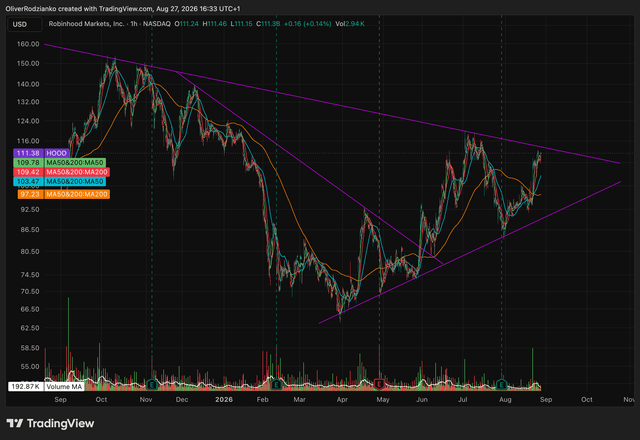
Since my last analysis of Robinhood (HOOD), the stock price has risen by 61.5%. At that time, I gave it a "buy" rating and titled the article "Robinhood: A World-Class Entry Point." Now, I believe that the technical patterns are becoming favorable again, but we are not yet in a phase that warrants aggressive accumulation with clearly asymmetric risk and reward. If the stock price returns to around $95 per share, I would be more eager to buy, although I am also aware that this may not happen. In the short term, below $100 may be a more realistic entry area. However, my preferred strategy remains to wait for HOOD to break through the current resistance level and reach around $115 before buying. This would indicate that the bulls genuinely wish to continue pushing the stock price higher, and the price may quickly surge to $120 and further rise to $140 within a few months.
[Original image location: HOOD 1-hour cycle price chart (author's chart)]
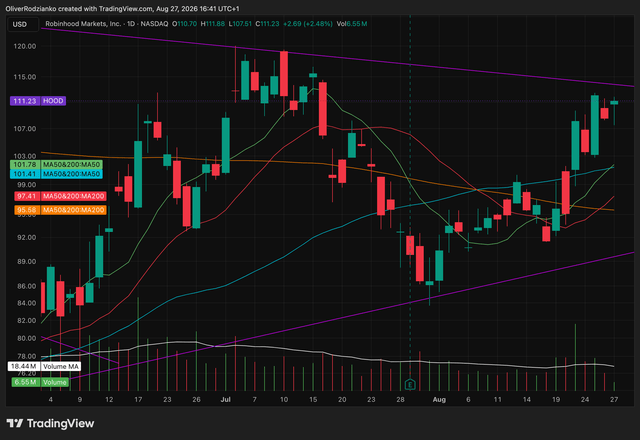
Other technical indicators also tell me that now is a good time to closely monitor HOOD and prepare for entry. A bullish golden cross just appeared on the daily chart recently, a signal that occurred in early August. The stock price is currently only slightly above the 50-day and 200-day moving averages, while the 10-day moving average is clearly situated above the 20-day moving average. From the daily chart perspective, the stock price does not show significant signs of being overstretched, which makes me believe that this upward trend still has room to continue.
[Original image location: HOOD daily price close-up chart (author's chart)]
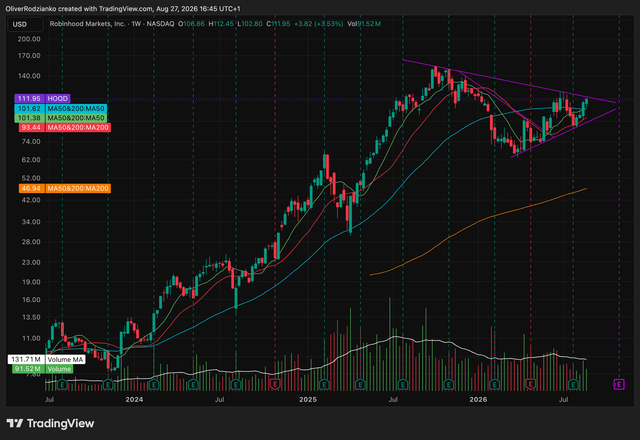
When I observe the weekly chart, I see a stock with a higher valuation, consistent with its fundamentals. The 200-week moving average is significantly lower than the current stock price, but fortunately, the stock price is not too far from the 50-week moving average, so from a relative value perspective, the current pricing can at least be considered reasonable. The reason I say this is that the consensus expected long-term EPS growth rate for HOOD over the next 3-5 years is a CAGR of 18.6%, compared to only 11.5% for the industry. However, we still cannot avoid the fact that HOOD does enjoy a valuation premium, as evidenced by its forward non-GAAP PEG of 2.34 times, which is 114.5% higher than the industry median. Personally, based on the current technical outlook, I believe this premium will continue to exist. To prevent this valuation premium from disappearing, adopting tactical stop losses should be sufficient.
[Original image location: HOOD weekly chart (author's chart)]
If I were to enter now and bet on an upward breakout of the resistance level, I would set my stop loss just below the 50-week moving average, around $100. If I choose to wait for the stock price to pull back to the support area around $90-$95 before entering, my stop loss would be set at $85. My preferred strategy remains to wait to buy after the stock price breaks above approximately $115, as that would confirm further upward momentum and indicate that the current resistance has truly been overcome.
Operational Aspect
Robinhood has expanded its product positioning from being merely a trading app to a primary financial account targeting the younger generation of users. A very clever flywheel is gradually forming: Robinhood first attracts users through trading and prediction markets, then converts those users into Gold subscribers, and ultimately deepens customer relationships through retirement accounts, banking services, credit, and investment advisory services. Gold currently has 4.84 million subscribed users, retirement account assets are approaching $35 billion, banking deposits exceed $3 billion, and the number of Gold Cardholders has surpassed 1 million. This is already a complete and mature financial ecosystem, and it is significantly stickier for users compared to sporadic trading actions.
Rothera, Bitstamp, TradePMR, and Robinhood Chain have further expanded the company's story toward the direction of a global financial platform. The company currently has over 1 million international accounts, while its stock token services cover over 120 countries, indicating that there is still a very long growth runway ahead. If the trend of widespread adoption continues, this growth potential is sufficient to support the company’s high valuation.
However, risks do indeed exist on the operational side, which may cause the technical trading logic I mentioned earlier to fail. This is also why I believe that for active traders, most positions should set stop losses, although not all positions necessarily must. For me, HOOD is clearly a stock that should have stop losses set. New products do not allow HOOD to completely escape market cycles, so it is important to remember that if the economy enters a recession, a series of negative sentiment catalysts may arise. For example, declines in trading volume, reduced margin financing, shrinkage of customer assets, and deteriorating credit quality. Furthermore, prediction markets and tokenized assets still face regulatory uncertainties, and these two areas are exactly some of Robinhood's most exciting growth opportunities, so any regulatory changes could rapidly weaken market sentiment toward the company.
Key Macro Catalysts to Watch
The ideal macro environment for HOOD is a soft landing: this means cooling inflation, stable employment, moderate interest rate decreases, rising stock and crypto assets, while the market still retains sufficient volatility to keep Robinhood's trading customers active. While higher interest rates benefit the company by generating more income from cash and loan services, they also suppress asset prices and affect HOOD's valuation. Therefore, lowering interest rates is generally a more ideal and bullish result, preferably driven by declining inflation. It is evident that if emergency interest rate cuts occur due to economic recession, this would not be favorable for HOOD holders.
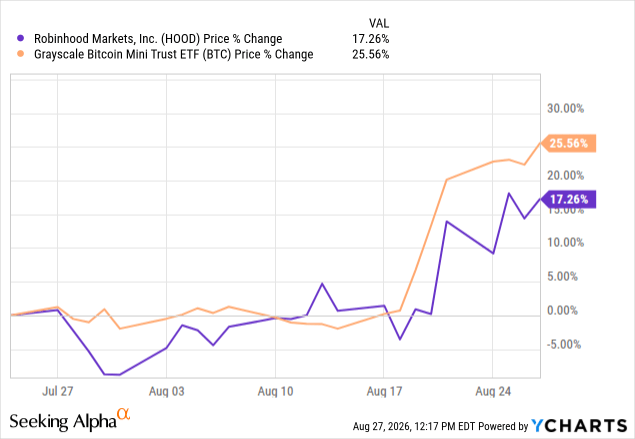
Market liquidity remains the fastest catalyst: brief volatility spikes can promote trading activity, but prolonged bear markets often lower client asset sizes, margin financing, and investor confidence. I also believe we need to consider that HOOD may gain significant tailwinds from the next cryptocurrency bull market cycle. In July, Robinhood's cryptocurrency trading volume fell by 62% year-on-year, but August's rise of Bitcoin (BTC) is helping HOOD, and I anticipate that this sentiment tailwind will continue.
[Original image location: Robinhood-related market data chart (YCharts)]
Fundamental Target Price
From a technical perspective, although HOOD currently does exhibit a valuation premium, I believe this premium is relatively sustainable. Therefore, I would apply a forward price-to-earnings ratio—close to current levels—around 40 times, based on December 2027, to my forecast of a normalized EPS of $3.25 for December 2028. This results in an implied target price of $130 twelve months from now, while the current stock price is $111.50. According to this model, the potential upside is approximately 16.6%. However, since the market often prices stocks in advance due to momentum and excessive emotion, stock price increases often occur as short-term spikes before they cool off. Thus, in my view, a rise to $130-$140 within the next six months is reasonable, even if this price ceiling can only be briefly maintained. If such a situation occurs, I would choose to exit and rotate the funds into other opportunities.
Conclusion: Buy
I remain bullish on HOOD, but I also acknowledge that it might be wiser to exercise a bit of patience before entering. I prefer to buy after a breakout occurs rather than anticipating a breakout in advance, as this approach is more effective for momentum trading and allows me to get better returns on the time I invest in a stock. HOOD appears poised to break out at any moment, but we are not yet at that real point. Therefore, adding it to the watchlist is a good choice for now. However, if there is already another stock in the market whose breakout pattern is so obvious that it is almost "yelling buy," I would abandon HOOD and investigate that opportunity. You don't need to develop an emotional dependency on the companies you invest in; what you truly need is for the fundamentals, technicals, and macro environment to align favorably, combined with asymmetric risk management. That is the way for traders to win. Never fall in love with your stocks, not even Robinhood. What you should fall in love with is the trading pattern.
免责声明:本文章仅代表作者个人观点,不代表本平台的立场和观点。本文章仅供信息分享,不构成对任何人的任何投资建议。用户与作者之间的任何争议,与本平台无关。如网页中刊载的文章或图片涉及侵权,请提供相关的权利证明和身份证明发送邮件到support@aicoin.com,本平台相关工作人员将会进行核查。


