
30 trillion dollars.
This is the TAM figure that Anthropic is preparing to include in its IPO prospectus—Total Addressable Market, which translated to plain language means "assuming I completely monopolize this business, what is the maximum amount I can earn in a year."
The total GDP of the United States is about 32.4 trillion. A company that has been established for five years with fewer than four thousand employees has drawn its revenue ceiling to nearly the size of the entire U.S. economy.
Three months ago, SpaceX wrote in its prospectus that its TAM is 28.5 trillion, claiming to have "the largest actionable market in human history," with 26.5 trillion coming from AI. Just when the record hadn't even cooled off, Anthropic stepped in and added another 1.5 trillion.
It's like two people comparing who has a bigger mouth: one says I can swallow the sun, and the other one says not only can I swallow the sun, but I also have to add a Mars.
This ruler has already been broken
TAM figures are something technology companies must report when going public, and they have always been the least accountable item. Uber reported 6 trillion in 2019, stating that it covered all private vehicle miles combined with public transportation; WeWork reported 3 trillion in its eventually aborted IPO. Both of these figures were ridiculed at the time.
In the AI era, the ruler has completely collapsed.
Last year, 191 technology companies in the S&P 1500 had combined revenues of 2.4 trillion dollars. Anthropic's 30 trillion is 12 times the total of all these companies.
Aswath Damodaran, a valuation professor at New York University known as the "Dean of Valuation," had previously told the Wall Street Journal before SpaceX's IPO that 28.5 trillion "has reached the end of a reasonable range and is still being pushed out." Now facing 30 trillion, he probably dropped his glasses on the spot.
How are these numbers calculated? The answer is: by including all the work that AI models can potentially accomplish in the future. Programming, writing, customer service, legal work, financial analysis, medical diagnostics… everything that humans do, as long as AI could take over, is packaged and labeled with a price.
This is no longer assessing the market size of an industry; this is pricing the entire cognitive labor that humanity can delegate.
Revenue really is growing sharply, but it's thousands of Anthropic short of 30 trillion
Don't rush to call it pure boasting; Anthropic's growth data is truly explosive:
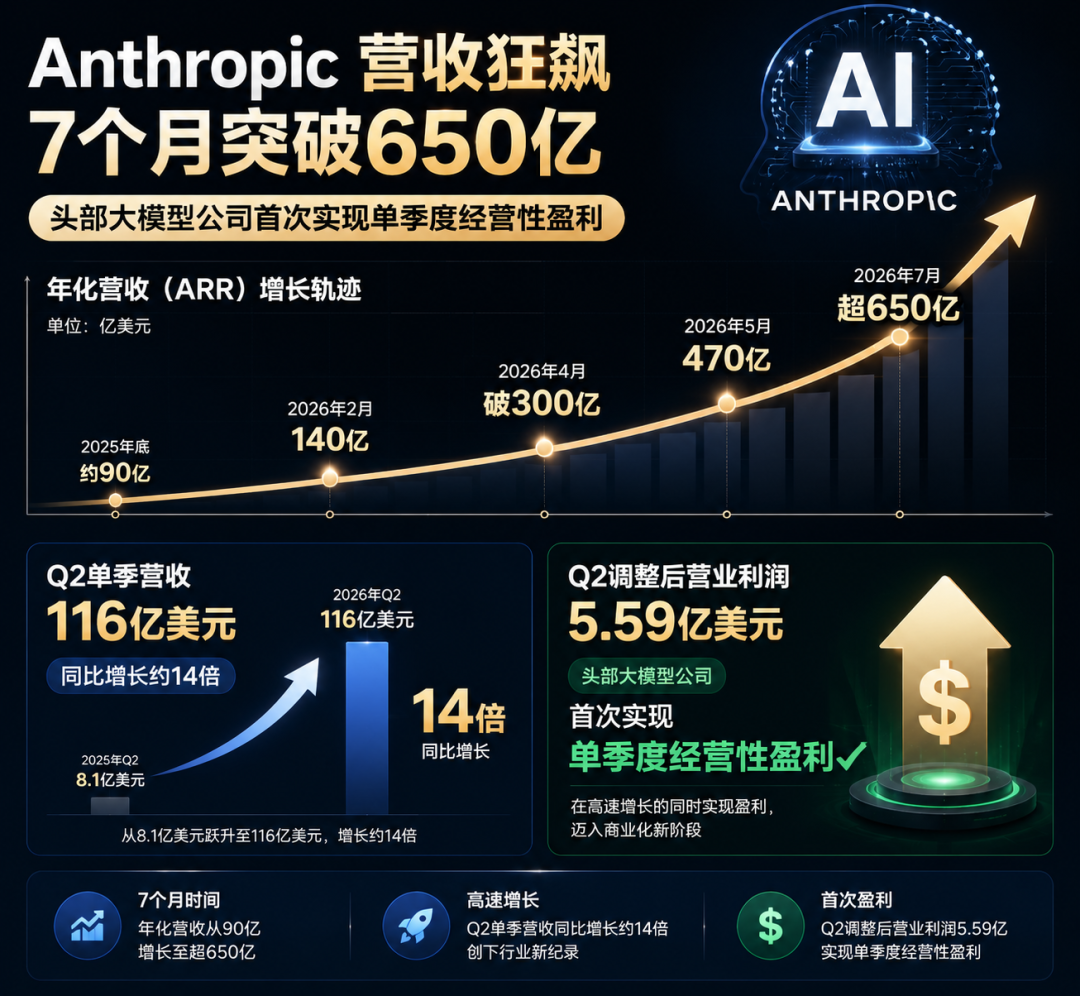
By the end of 2025, annualized revenue is approximately 9 billion dollars;
In February 2026, it reached 14 billion, in April it broke 30 billion, in May it reached 47 billion, and in July it surpassed 65 billion;
Q2 single-quarter revenue was 11.6 billion dollars, a year-on-year increase of about 14 times;
More importantly, Q2 adjusted operating profit was 559 million dollars—marking the first time a leading large model company achieved operating profitability in a single quarter.
Google has invested approximately 3 billion, and by October of last year, its book value exceeded 124 billion, a 40-fold return; Amazon poured over 13 billion while tying a ten-year computing partnership; Microsoft, Nvidia, Micron, Samsung, and SK Hynix all entered the fray with capital.
However, taking the 65 billion ARR from the 30 trillion TAM, the penetration rate is only 0.22%. Even if Anthropic itself predicts that revenue will reach 190 billion to 200 billion by 2028, that would only account for 0.67% of 30 trillion.
So the story it presents to investors is: the market is so large that even if I only capture six thousandths, it can sustain a 2 trillion valuation. This doesn't sound like a business plan; it resembles a mathematical problem—if the denominator is large enough, even a small numerator seems reasonable.
A 2 trillion valuation corresponds to about 43 times the current annualized revenue. Wall Street's investment banks have already skipped over today and are directly anchoring the price using expected revenue from 2028. This follows the same pattern as SpaceX extending its forecasts to 2029.
Flagship model struggles to sell, a hidden danger
Beyond the growth narrative, there is data worth noting.
According to Ramp's analysis of consumption data from 70,000 companies in the United States, Anthropic's latest flagship model Fable5, which has been on the market for over two months, accounts for only 11.4% of the company's overall product sales. Fable5 is priced at 10/50 dollars per million tokens for input and output, with a benchmark score of 70.5; whereas the previous generation Opus5 costs only half as much, scoring 70.0 on tests, with a single task cost of 8.23 dollars, more than half cheaper than Fable5's 17.32 dollars. Enterprise customers are voting with their wallets, and Opus5's spending share has already surpassed that of Fable5.
This indicates one thing: the marginal improvement in model capability is becoming disconnected from the price that customers are willing to pay. When "the old model that costs half is sufficient," the story of using the flagship model to increase ARPU becomes harder to tell.
This also explains why Anthropic is eager to push its TAM to 30 trillion—simply selling API and model subscriptions cannot support a 2 trillion valuation. It must convince investors that AI will permeate all work processes like water and electricity, and what Anthropic is collecting is a “cognitive labor tax,” not just software subscription fees.
A public benefit company, dreaming the largest capital dream in history
The most ironic aspect of Anthropic's identity is that it is a public benefit corporation. Its charter states that it cannot solely maximize shareholder profits, and its values declaration states that "ultimately, the mission is the reason we are all here."
CEO Dario Amodei has a personal fortune of about 15.5 billion dollars, and he and his sister Daniela, along with seven other co-founders, have pledged to donate 80% of their wealth, amounting to over 86 billion by current valuation.
However, during the IPO push, Axios reported that Anthropic directly asked candidates during cultural interviews: "What would you think if one day the company abandons its AI ambitions for safety reasons and the stock price falls to zero?" One candidate honestly replied, "I wouldn't be happy," but the interviewer seemed dissatisfied.
On one hand, it's packaged the entirety of what humanity can delegate to AI into a 30 trillion figure to present to Wall Street, and on the other, it's turning the same IPO into an interview question asking employees "would you still work here if it all goes to zero." On one side is a public benefit charter of mission over profit, and on the other is one of the largest IPOs in human history.
After going public, every quarterly earnings call, analyst inquiries about gross margin, and shareholder demands for returns will clash head-on with the word "mission." After SpaceX went public, its stock price fell from 225 dollars to 104 dollars and then bounced back to around the 135 dollars issue price, showing a preview of this kind of tearing.
Conclusion: The story can be grand, but the price must ultimately deliver
From Uber's 6 trillion to SpaceX's 28.5 trillion to Anthropic's 30 trillion, the history of TAM expansion is the evolution of the capital market's pricing logic on the "ceiling of the track." Ten years ago, a 6 trillion story was worth hundreds of billions in valuation; today, the 30 trillion story anchors at 2 trillion.
Anthropic is expected to go public in September or early October, raising up to 100 billion dollars, with a valuation of approximately 2 trillion, potentially becoming the first listed frontier large model company ahead of OpenAI. The S-1 public document may be released by the end of this month, at which point gross margins, customer concentration, cloud computing commitments, and free cash flow—numbers that have long been ambiguous in the private market—will be revealed in the sunlight.
30 trillion TAM is a banner, not a financial report. It can make a 2 trillion valuation seem like merely "six thousandths of market share," but it cannot answer a fundamental question: as more work is done by AI, the reasoning cost per unit task decreases. How much profit can Anthropic actually retain from this 30 trillion?
That professor from New York University is right; the numbers have already crossed the "end of reasonable range." Whether Wall Street will ultimately pay up will be seen in the September prospectus.
免责声明:本文章仅代表作者个人观点,不代表本平台的立场和观点。本文章仅供信息分享,不构成对任何人的任何投资建议。用户与作者之间的任何争议,与本平台无关。如网页中刊载的文章或图片涉及侵权,请提供相关的权利证明和身份证明发送邮件到support@aicoin.com,本平台相关工作人员将会进行核查。


