Transforming the City.
Author/Wu Qiong
Report/Investment Circle PEdaily
This moment has been long awaited.
Recently, Yangtze Memory Technologies Co., Ltd. (abbreviated as: Yangtze Storage) has had its IPO accepted on the Science and Technology Innovation Board and has officially submitted its prospectus. In this IPO, Yangtze Storage intends to raise 33 billion yuan, making it the largest IPO in the history of the Science and Technology Innovation Board.
This means that Yangtze Storage is set to break the record just established by Changxin Technology.
Looking back a month ago, when Changxin Technology landed on the Science and Technology Innovation Board, its market value soared to 4 trillion. Interestingly, both Changxin Technology and Yangtze Storage were established in 2016; one is from Hefei, and the other is located in Wuhan, collectively known as the “Domestic Storage Twins.” With Changxin Technology successfully going public, its backing, Hefei State-owned Assets, gained a trillion return.
Now, it's Wuhan’s turn.
The Next Trillion IPO
Hubei State-Owned Assets Wins

Let’s start from 20 years ago.
In 2006, Hubei Province and Wuhan City invested over 10 billion yuan to establish Wuhan Xinxin, building the first 12-inch integrated circuit production line in central China, laying the foundation for the subsequent development of the integrated circuit industry.
Fast forward to 2015, and the development of memory chip technology was confirmed as a national strategy. Subsequently, a national integrated circuit industry investment fund and local funds were established, and a wave of domestic memory chip production began. Hubei was given high hopes to break the overseas companies' monopoly— the following year, a national memory base was established in Wuhan Guanggu, and Yangtze Storage was formed based on Wuhan Xinxin.
Since then, Yangtze Storage has made rapid progress, achieving breakthroughs with its first 3D NAND flash memory chip, the introduction of Xtacking architecture, and the successful research and development of 128-layer 3D flash memory chips… a super unicorn in the memory chip industry has emerged from Guanggu. According to TrendForce data, in the first quarter of 2026, Yangtze Storage ranked third globally and first in China among NAND Flash manufacturers by sales revenue and shipment volume.
As the AI computing power ignites the super cycle of memory, the moment for Wuhan has come—recently, Yangtze Storage's IPO has been accepted on the Science and Technology Innovation Board, and an official prospectus has been submitted, with the intended fundraising amount being 33 billion yuan, setting a historical fundraising record for the Science and Technology Innovation Board.
This means that Yangtze Storage will surpass Changxin Technology's 29.5 billion yuan, becoming the largest IPO in the history of the Science and Technology Innovation Board.
Some analysts predict that Yangtze Storage's future market value may be on par with Changxin Technology—after going public, Changxin Technology's market value surged to 4 trillion. An indicator is that Changxin Technology turned its losses into profits in the first quarter of this year, with a net profit attributable to its parent company of 24.762 billion yuan; Yangtze Storage performed even better, achieving operating revenue of 47.042 billion yuan and a net profit attributable to its parent of 33.379 billion yuan during the same period.
However, because the two companies are in different niche markets, with varying competitive landscapes and product portfolios, this is more of an extremely optimistic market estimate. The more common judgment now is that Yangtze Storage's market value will exceed a trillion after its listing.
As Yangtze Storage releases its prospectus, more lesser-known stories come to light—the company was previously known as Yangtze Storage Limited, jointly established by Xinfei Technology, the large fund (Phase One), Hubei Science Investment, and the State-owned Fund. Among these, Xinfei Technology, Hubei Science Investment, and the State-owned Fund are all local state-owned assets in Hubei. At that time, the net asset valuation of the company was approximately 13.4 billion yuan.
For the next ten years, Yangtze Storage had little public financing news, but Hubei State-owned Assets always accompanied it. According to the prospectus, currently, there are seven shareholders holding more than 1% of Yangtze Storage's shares—Hubei Changsheng, Xinfei Technology, Large Fund (Phase One), Large Fund (Phase Two), Guanggu Industrial Investment, State-owned Fund, and Yangtze Industry Group, holding 26.54%, 25.35%, 11.97%, 11.38%, 9.25%, 5.90%, and 2.53% respectively.
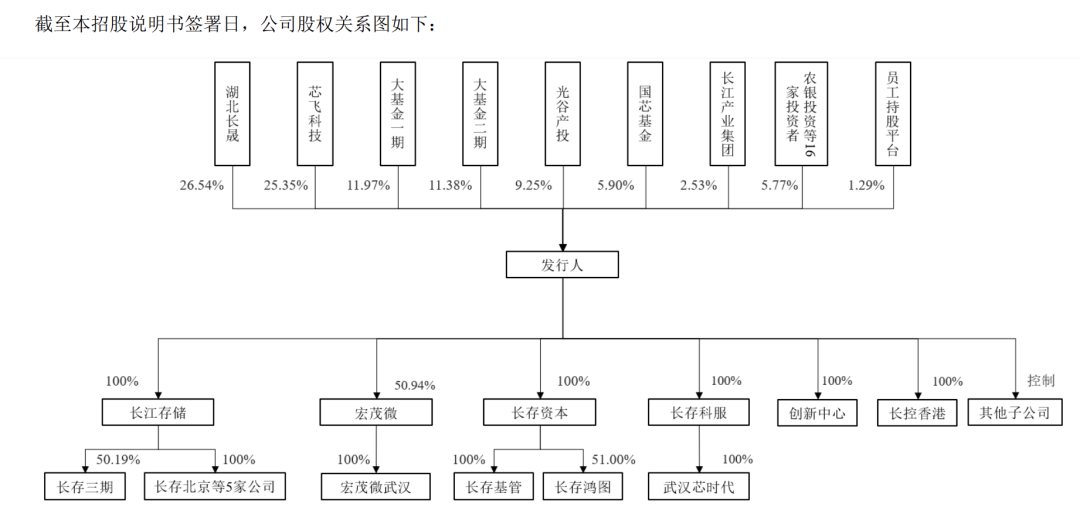
Five of these have a background of Hubei State-owned Assets—digging deeper, the largest shareholder, Hubei Changsheng, is wholly owned by the state assets of Hubei Province, Wuhan City, and Wuhan East Lake High-tech Zone; Xinfei Technology is jointly invested by Hubei State-owned Assets and the Large Fund; Guanggu Industrial Investment is a specialized industrial investment platform in Wuhan East Lake High-tech Zone; the State-Owned Fund is also backed by various levels of state assets in Hubei; Yangtze Industry Group is 100% controlled by the Hubei Provincial State-owned Assets Supervision and Administration Commission.
Ten years of companionship has led to today's turnaround. If we calculate Yangtze Storage's market value at a trillion after its listing, the corresponding market value of the stake held by Hubei's State-owned Assets system will exceed several hundred billion yuan, marking a most touching scene of industry cultivation.
Wuhan Becomes Popular
A Batch of Star Stocks Emerging

Unless something unexpected happens, Yangtze Storage will become the first trillion-market-cap listed company in Hubei.
This year, many eyes are focused on Hubei and Wuhan. Just as the recently circulated “Seven Stars of Guanggu” —Yangtze Storage, Changfei Fiber, Huazhong University of Science and Technology, Guoxuan High-tech, Fenghuo Communication, Gode Infrared, and ZTE Mobile, all emerged this year, reflecting the true picture of the outbreak of Wuhan's optical communication industry.
Among them, Huazhong University of Science and Technology has a market value exceeding 100 billion, with numerous state-owned assets behind it. Looking back to 2020, to better seize development opportunities, Huazhong University determined to conduct a reform of separating school from enterprise, and to transfer some shares of the company through public solicitation of transferees.
Soon, Guoheng Fund made the cut. Delving into its shareholder lineup—Wuhan Guochuang Innovation Investment Co., Ltd., Wuhan Industrial Development Fund Co., Ltd., and other capital from Wuhan gathered. According to the transaction details, Guoheng Fund acquired 19% of Huazhong University of Science and Technology’s shares, originally held by Huazhong University of Science and Technology’s Industry Group, for approximately 4.291 billion yuan, making Huazhong University of Science and Technology its largest shareholder; the actual controller changed to the Wuhan State-owned Assets Supervision and Administration Commission.
At that time, Huazhong University had not yet released its hard technology growth potential, with its market value only at 20 to 30 billion. Wuhan State-owned Assets still firmly chose to enter.
Now, Huazhong University of Science and Technology has a market value exceeding 100 billion, earning a substantial return for the patience shown at the time—calculating the value of Guoheng Fund's 19% shares, this stake is now worth over 19 billion yuan. Rough estimates suggest that Wuhan State-owned Assets gained a floating profit of 15 billion from this acquisition.
From Yangtze Storage to Huazhong University of Science and Technology, the core of the story is remarkably similar: local state-owned assets firmly invested during valleys, providing long-term support, and ultimately waiting for the era of hard technology to burst forth. According to Hubei Daily, “Over the past decade, state-owned assets at the province, city, and district levels have continued to intensify their support for the storage industry, with cumulative financial support exceeding 30 billion yuan, even as companies faced long-term losses; state-owned asset shareholders still added investments.”
This companionship also brings value realization. Represented by Yangtze Storage, Huazhong University of Science and Technology, among others, Guanggu has now gathered 16,000 optoelectronic information companies, becoming the world's largest R&D and manufacturing base for optical fibers and cables, the country's largest R&D and production base for optoelectronic devices, and the country’s advanced storage R&D and production base… all originating from here.
A trillion-level industrial cluster is rising—currently, Wuhan's optoelectronic information industry has surpassed 850 billion yuan in total scale. According to Wuhan's “14th Five-Year Plan,” Wuhan will cultivate two trillion-level clusters in optoelectronic information and life health, pushing optoelectronic information towards a world-class industrial cluster.
China's Urban Reshuffle

This year welcomes a significant IPO year, and many cities are celebrating.
The most typical case is Hefei. Previously, the stories of attracting BOE Technology Group and NIO to achieve an industrial turnaround are well-known, and now with Changxin Technology successfully listing on the Science and Technology Innovation Board, Hefei's State-owned Assets are once again making history.
Currently, the latest market value of Changxin Technology exceeds 3.7 trillion, ranking as the “number one” in A-shares by market value. According to the prospectus, Qinhua Capital, Changxin Integration, Hefei Jixin, etc., held approximately 45.16% of Changxin Technology's shares before its issuance, among which Hefei's state-owned assets system holds approximately 36.79%. Based on the latest market value, Hefei's state-owned assets' shareholding corresponds to a market value exceeding a trillion.
For state-owned assets, financial returns are secondary; the more profound significance lies in the changes in the industrial ecosystem. After Changxin Technology settled in Hefei, a large number of semiconductor equipment, materials, and testing companies located nearby began to support the local industrial cluster's development. Currently, Hefei has gathered over 450 upstream and downstream enterprises in the integrated circuit sector, forming an industrial ecosystem that covers the entire chain of design, manufacturing, testing, materials, and equipment.
Consequently, Hefei is rising—by the close of trading on July 27, excluding Changxin Technology, the total market value of other A-share listed companies in Hefei was approximately 1.28 trillion, ranking 19th among cities nationwide. Including Changxin Technology, the total market value of A-share companies in Hefei exceeds 4.56 trillion, surpassing 15 cities including Suzhou, Hangzhou, Wuxi, Chengdu, Guangzhou, and Tianjin, rising to 4th place nationwide.
One investment can change the industrial fate of a city, which is perhaps an enviable opportunity for many cities.
But the path is often hard to replicate. It should be noted that over the past ten years, Changxin Technology experienced continuous substantial losses, with Hefei's state-owned assets accompanying it all the way, never withdrawing their investment. Yangtze Storage is the same, only turning losses into profits by 2024. Patience is needed before value realization, along with the courage to take responsibility.
Especially in hard technology sectors like semiconductors and advanced manufacturing, it has never been about luck. Also, there are Zhongji Xuchuang in Suzhou, and New Easy Win in Chengdu… none have escaped the test of time.
Recently, GDP data for the first half of 2026 was released. Among them, the most noteworthy is Anhui’s turnaround with 27,370 billion yuan, returning to the top ten nationwide. Moreover, Zhejiang, Shanghai, Beijing, and Hubei have also seen growth rates higher than the national average. Changes in urban patterns occur in the midst of continuous industrial transformation.
A new round of urban reshuffle has begun. As history repeatedly proves: a company can change an industry, and an industry can change a city.
免责声明:本文章仅代表作者个人观点,不代表本平台的立场和观点。本文章仅供信息分享,不构成对任何人的任何投资建议。用户与作者之间的任何争议,与本平台无关。如网页中刊载的文章或图片涉及侵权,请提供相关的权利证明和身份证明发送邮件到support@aicoin.com,本平台相关工作人员将会进行核查。


