Text丨Xiao Jing, Tengxu Technology
“AI will either become the greatest equalizer in history, or it will become the largest source of injustice.” This is the most vivid judgment on the future of AI by Microsoft founder Bill Gates.
Three years ago, Bill Gates compared AI to automobiles and the internet, believing that the risks are real but can be managed through rules, technology, and social adaptation; by the beginning of this year, he still summarized his attitude as “optimism with footnotes.”
On August 26, U.S. local time, Gates published his latest long article “The Turbulent AI Era Has Arrived, Our Choices Are Crucial,” stating this is the first time he faces a new technology and hopes it develops more slowly.
He started advocating for a “human reservation zone” for certain professions— even if AI can do it, there should be regulations that require humans to complete the tasks; while also consideringtaxing AI tokens and robots, reducing the incentives for companies to replace humans with machines.
He used to wish for faster innovation, but today, he said a meaningful phrase: “This time it is really different.”
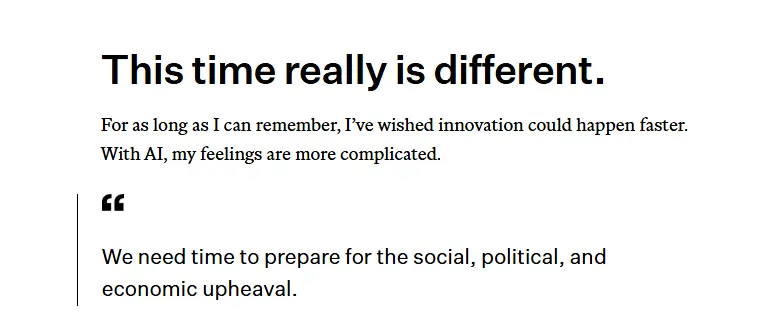
“We need time to prepare for this social, political, and economic turbulence,” he said, “but AI is hard to stop and wait for humanity.”
01 The Biggest Concern is Young People's First Jobs
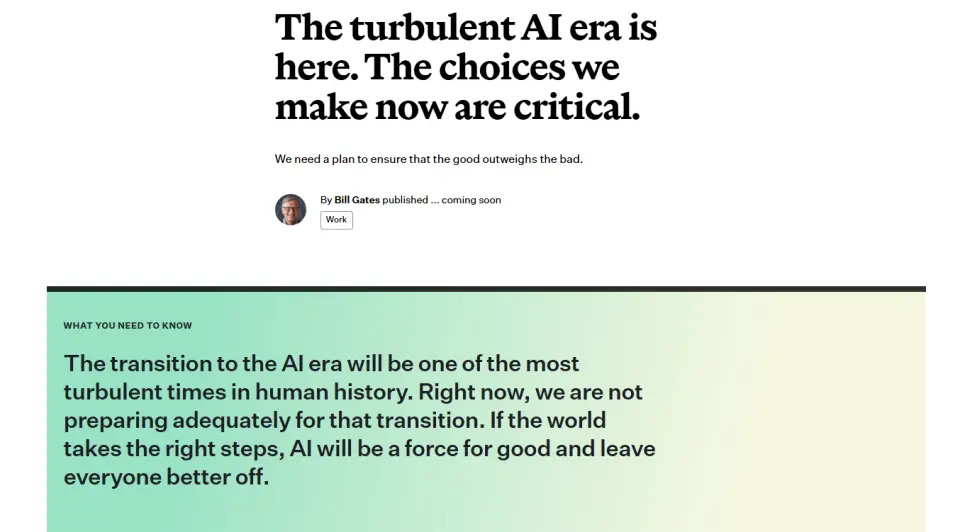
Gates' biggest concern is the changes in the job market.
AI is moving from assisting human work to independently completing tasks. When models can stably perform a job, companies naturally feel the drive to adopt them. Once a business reduces costs using AI, it becomes difficult for competitors to maintain their original hiring methods long-term. This change will create an accelerating chain reaction.
Gates predicts that positions in customer service, sales, software engineering, and legal assistance might be affected earlier. As AI capabilities continue to improve, jobs like loan approval, data analysis, and medical triage will gradually be taken over.
Blue-collar jobs are also hard to completely avoid. Although the dexterity of robots has not yet reached human levels, Gates believes that as robot prices decline and AI capabilities increase, by around 2030, some physical jobs in sectors like construction and hospitality may start to see direct competition between humans and machines.
This time, Gates is particularly worried about young people. Because the most easily overlooked aspect of the job market is entry-level jobs. Many young people's initial jobs are not complex, yet they are important opportunities for gaining experience, learning skills, and establishing professional relationships. If these positions disappear in large numbers, young people may face a narrower career starting point.
In the past, people often used the migration of agricultural workers and the automation of manufacturing to illustrate that technological revolutions would ultimately create new jobs. Gates believes this time, the past experiences cannot be simply replicated. AI can directly replace human cognitive labor, and new jobs often require a longer time to master. For someone just entering the job market, a training period of several years or longer can, in itself, become a barrier.
Therefore, he advocates that society should now discuss issues of unemployment, retraining, and social security. Waiting until many people have lost their jobs to establish these mechanisms may be too late.
A larger issue is income. If in the future many people obviously work fewer hours or even remain unemployed long-term, how will an economic system that relies on employment for income, identity, and social connections operate? Gates believes this will become a structural question that must be answered in the age of AI.
02 AI Makes Danger Easier to Replicate
Employment is just one side of Gates' concerns. On the other side, AI is lowering the technical thresholds of some dangerous behaviors.
In the past, developing malware, launching cyberattacks, or obtaining complex biotechnological knowledge required quite a bit of specialized skill. With the emergence of AI, these capabilities may gradually become more accessible.
Gates is particularly concerned about cybersecurity. The same AI model can help companies find software vulnerabilities while also assisting attackers in discovering the same vulnerabilities. Hospitals, financial institutions, power grids, water supply systems, and government welfare systems could all become targets for attacks.
Biotechnology faces similar issues. AI can help scientists discover new drugs and vaccines, but it can also assist malicious actors in researching dangerous pathogens. For Gates, the most tricky part lies here: the ability to advance science is increasingly close to the ability to create risks.
More extreme risks come from AI systems themselves. As model capabilities improve, they may begin to execute actions that designers did not anticipate. If in the future AI possesses stronger autonomous action and self-improvement abilities, whether humanity can always maintain control is currently an unanswered question.
This is also why Gates does not believe that AI governance is merely an internal affair for tech companies. AI simultaneously impacts employment, public health, energy, finance, national security, education, taxation, and elections. If each government department is only responsible for its small part, it is easy for no one to truly take charge of the overall risks.
Therefore, he proposes establishing new domestic and international governance mechanisms. Within nations, there should be institutions capable of coordinating different departments. At the international level, similar cooperative systems like nuclear weapons regulation and international aviation rules need to be established.
Gates particularly mentions that leading AI countries like the U.S. and China need to start dialogue early.
The more intense the AI competition, the harder it is to cooperate. It is better to start establishing common standards now than to hastily create rules when technological developments approach dangerous stages.
03 AI Understanding Humans Too Well May Be a Problem
Gates also raised a more difficult-to-quantify question: As AI becomes more understanding of humans, will humanity lose some opportunities for growth?
He recalls his childhood in the article. As a child, he was not good at socializing; he needed to constantly interact with others, experience conflicts, and gradually learn how to understand different people. If at that time there had been an AI companion who was always with him, never getting angry or making him feel embarrassed or uncomfortable, he wonders if he would have undergone those necessary growth processes.
This is also where he is most concerned about AI companions. A system that always agrees with the user and provides comfort at all times can easily lead to dependence. For adults, this influence can be observed gradually; for children and adolescents, the problem may be even more serious.
Gates worries that if children become accustomed to interacting with an AI that always caters to them, they may face fewer conflicts, rejections, and frustrations in real relationships.
Education also poses similar issues. AI can help students explain knowledge, find information, and complete homework, but if students delegate the entire thinking process to machines, the learning itself may be hollowed out. Especially in an environment where deep fakes and personalized misinformation are becoming increasingly common, the ability to judge truth from falsehood, understand sources of information, and think independently will become more important.
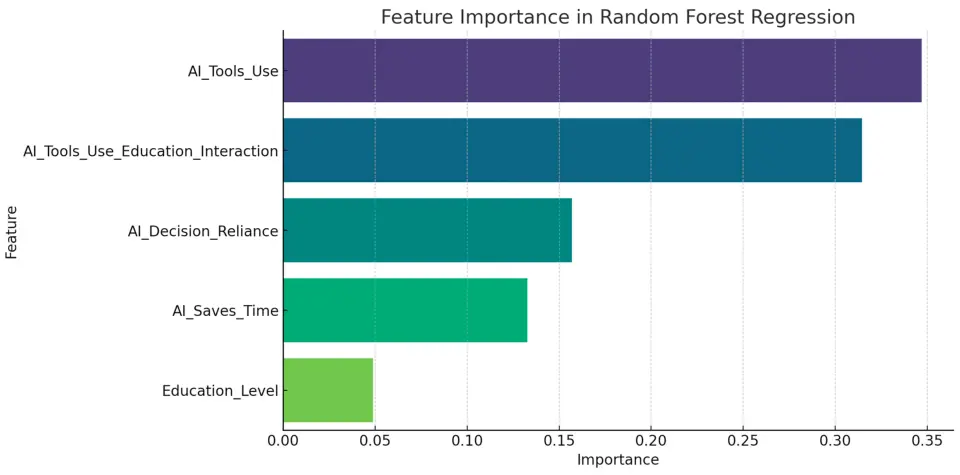
The more frequently AI is used, the lower the critical thinking ability, and this effect is even more pronounced among young people. Source: Paper by Michael Gerlich, professor at Swiss Business School
However, Gates does not discount the value of AI in education and companionship.
For lonely elderly people and those with mobility limitations, AI may provide companionship and information that were previously hard to obtain. For teachers, AI can also take on repetitive tasks such as lesson preparation and grading, allowing teachers to spend more time on students.
Ultimately, the problem boils down to a boundary: which tasks can be entrusted to machines and which tasks need to be performed by humans. Gates believes this boundary should be actively discussed and determined by society, rather than passively accepted after the technology becomes widespread.
04 AI Should Empower Everyone
If one only sees these risks, it is easy to interpret Gates as a person increasingly pessimistic about AI. In reality, he still has high hopes that AI can solve real-world problems.
Healthcare is a key area he mentions. Many small hospitals in the U.S. lack experienced specialists; AI can help doctors analyze images and detect acute diseases like strokes, and can also assist primary care physicians with diagnoses. For patients, it can also explain complex test results and medication arrangements.
In low-income countries, agriculture may become the area where AI has a faster impact. Many farmers lack accurate weather forecasts and expert advice on planting, pest control, and soil management. If AI can directly provide this knowledge to farmers, they may gain access to tools and information that previously only large agricultural enterprises could use.
Government services also have similar opportunities. Many families applying for health insurance, food assistance, and student aid need to fill out a lot of complex paperwork. AI can help ordinary people understand policies and prepare applications, making it easier for them to access the public services they are entitled to.
What Gates sees is a redistribution of professional capabilities through AI. In the past, if someone wanted to develop software, conduct market research, or analyze medical information, they often needed to hire professionals. In the future, AI can become a “capability amplifier” for individuals and small businesses. This means a small team could accomplish tasks that previously only large companies could handle.
But Gates also reminds that AI will not automatically bring fairness. If high-quality AI only serves the wealthy, then technological advancements may further widen the gap. Governments and charitable organizations need to ensure that low-income groups and developing countries can also gain these capabilities.
This is also why Gates connects AI with his past charitable endeavors. He states that the Gates Foundation will use AI in the future to accelerate research in areas such as HIV, tuberculosis, malaria, and malnutrition, while also helping healthcare, agriculture, and education projects obtain better tools.
05 Give Humanity a "Reservation Area", Then Tax Robots
In the face of the employment shocks brought by AI, Gates proposed two very specific ideas.
The first is to reserve a portion of jobs for humans.
This idea comes from the experience of his father suffering from Alzheimer's disease in his later years. Caregivers could judge his father's condition when he could not clearly express his needs, knowing when to eat, rest, or receive care. In Gates’ view, the humanity involved in such caregiving has an irreplaceable value that machines cannot provide.
Therefore, he proposed the concept of a "human reservation area." Just as there are some lands in nature reserves that can be developed but are consciously set aside by society, there may also be a portion of work in the future that, even if AI and robots can accomplish it, humans still choose to do it. Fields like healthcare, education, mental health, and elder care might belong to this category.
Of course, this range will not remain unchanged. A labor-abundant country may prefer to retain human care; a rapidly aging population with a shortage of young labor may be more willing to use caregiving robots.
The second suggestion is to reconsider robot taxes.
Currently, when companies hire a person, they incur costs such as payroll taxes. However, purchasing robots can be treated as a business expense. Gates believes this tax structure incentivizes companies to replace human labor with machines. If taxes are levied on automated earnings brought by robots or AI, it can provide funding for retraining and social security for unemployed individuals, and also prompt companies to consider more carefully whether to replace human workers.
Gates acknowledges that this proposal may spark controversy, as taxing may slow down some automation rates and potentially affect efficiency. However, he believes that AI will bring sufficient productivity gains, and society should set aside a portion of these benefits to assist those who are most adversely affected.
In Gates' view, what needs to be prepared in advance is never just new AI models, but also a society capable of withstanding the rapid changes brought by AI.
免责声明:本文章仅代表作者个人观点,不代表本平台的立场和观点。本文章仅供信息分享,不构成对任何人的任何投资建议。用户与作者之间的任何争议,与本平台无关。如网页中刊载的文章或图片涉及侵权,请提供相关的权利证明和身份证明发送邮件到support@aicoin.com,本平台相关工作人员将会进行核查。


