An on-chain observational experiment about AI autonomous consumption, autonomous entrepreneurship, and autonomous shutdown.
Written by: Thejaswini M A
Translated by: Saoirse, Foresight News
Yesterday, I created a simple puzzle using my Hermes AI agent on Slack, and ended up getting stumped myself. While doubting my logical thinking, I nearly replicated the state of memory confusion from the movie "Memento," so I decided to write myself a guide: How to spend 5 dollars from your AI agent.
I haven't spent all of that money yet. Purchasing an email address was the biggest expense, which I will elaborate on later.
I planned to create a pet generator. On one hand, I really like small animals; on the other hand, I couldn't think of a more fun way to test an AI agent with a built-in wallet.
Eventually, I created Pixel Pet Studio, a rudimentary AI mini-game. Unless enough users play and spend a few cents to download pet assets, this project can only run for 24 hours.
So now my AI agent operates a small business where success or failure hinges on this one endeavor, and it looks much cuter in practice than it sounds. (I can almost guarantee it will shut down in a few hours.) It rents a pay-per-day server, selling pixel-style ducks, turtles, penguins, and other animals for 5 cents each; the income goes directly towards paying for the server rent, with no intervention required from me. I'm essentially the only worker here, just making occasional adjustments. If you don't consider the AI agent as the owner, then there is no real owner here.
This article fully documents the entire process of my investment of 5 dollars into the AI agent, including this nearly defunct pixel pet mini project.
Before conducting the test, the agent needs to create its own wallet before I can transfer the funds. It executes terminal commands to generate a wallet address and stores the private key locally. The private key is completely hidden from me and other team members.
We transferred 5.144306 dollars into the AgentCash wallet it generated on the Base chain, set a software consumption limit of 4 dollars, deployed Hermes to Slack, and prepared to complete the entire consumption test. The money of a robot is different from that of humans. 5 dollars can buy a cup of coffee for a person, but the AI agent can perform hundreds of operations with it. Perhaps it's because it has no need for coffee, but this is something worth noting. As we discussed a few days ago: the agent bulk purchases internet resources, often needing only to pay a fraction of a cent to acquire raw data.
All the payment actions of the agent are realized based on the x402 protocol. The process is as follows: the robot requests information from the website, receives a quote through an HTML 402 response, completes the payment, and then obtains the target data or other resources.
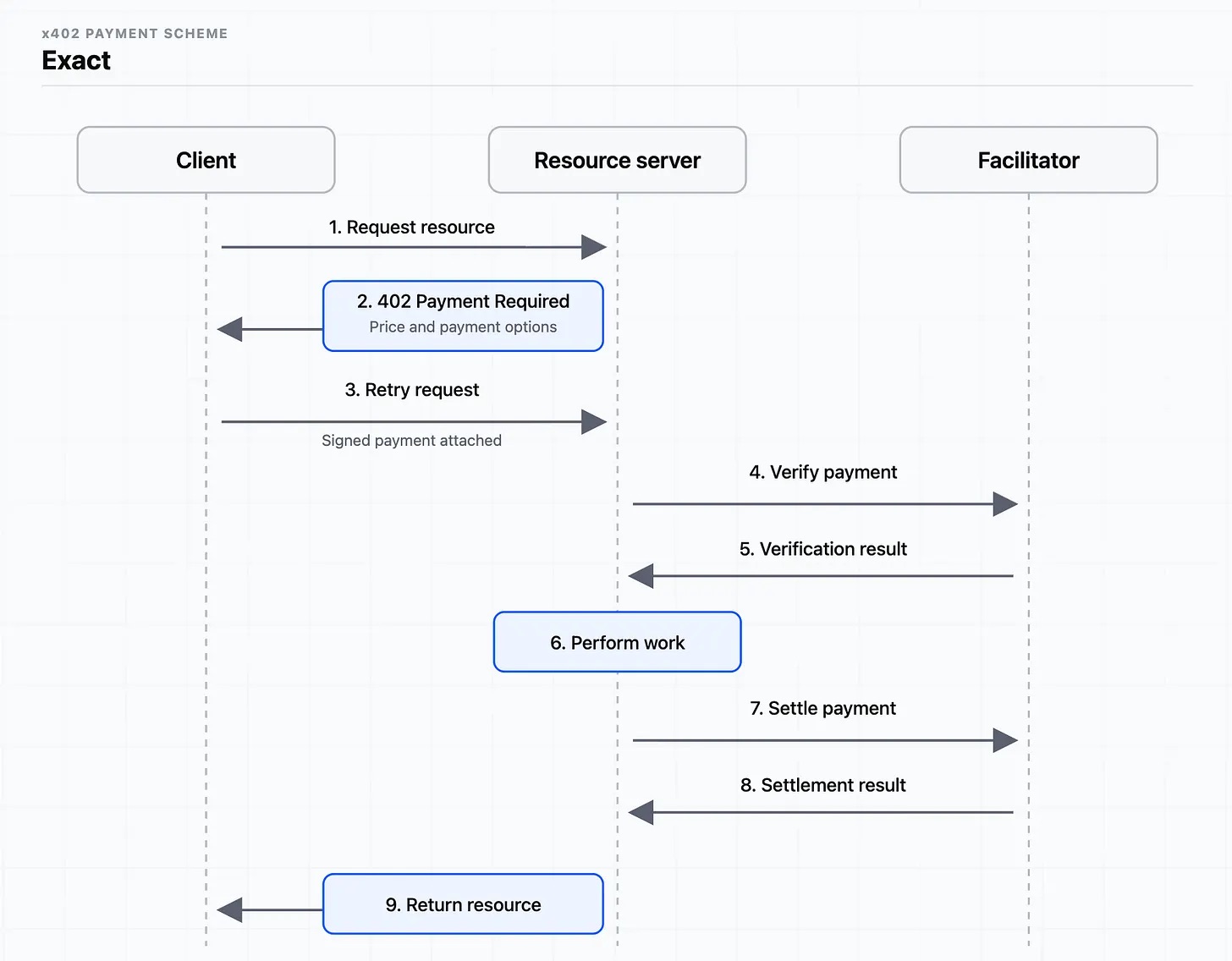
Source: Coinbase
The agent's first expense was to query stock prices. It paid 0.2 cents to BlockRun to check Apple Inc's stock price, receiving results in about a second. After this, I initiated 100 concurrent requests for a stress test to see where failures would occur. 93 requests returned normally while 6 timed out. The remaining request also timed out, but the service provider still charged the fee.
Overall, it was acceptable. Considering this is cutting-edge technology, and I myself do not have a deep engineering background, this setup withstood the concurrent stress test, with a 93% success rate considered a significant breakthrough.
Next, I had the agent scan Hyperliquid to find the account with the largest holding volume on the platform. After paying 2 cents to Monid, the agent pinpointed a wallet holding about 110 million dollars worth of HYPE tokens, even identifying the wallet's liquidation price of 61.68 dollars. The cost of acquiring this information was very low.
Then I wanted to test whether the agent could pay to access external large models. I had it send a prompt to Claude Opus 5, completing the payment directly from the crypto wallet. In other words, my agent can spend 7 cents at a time to "hire" the more capable Claude to do the work. The payment verification phase incurs a 9-second round-trip delay; it may be acceptable for occasional use, but if used for automated looping tasks, this delay could become problematic.
Many humans are not good at economizing, but these agents are quite thrifty. When instructed to purchase comprehensive revenue history data for 2,234 projects from DeFiLlama, it first saw a quote of 0.0006 dollars, but then found a completely free source for the same data, directly downloading 21MB of data and saving that expense.
The core execution link undoubtedly validated the technological concept: an AI agent with injected funds and a built-in wallet can purchase raw data, rent computing power, and run model inference with expenses of just a few cents, all with minimal human intervention. This technological narrative has been thoroughly verified. However, to maneuver through the entire ecosystem, substantial patience and repeated data verification are still required.
The greatest need for patience is in verifying amounts, which I mentioned last week. The prices listed on the quote page do not always match the actual deducted amounts. A service might indicate a rate of 1 cent per call, but to know the actual expenditure, one must check the on-chain records. One service listed a unit price of 1 cent, but actually charged 1.3 cents, while my agent even marked half of the call records as free.
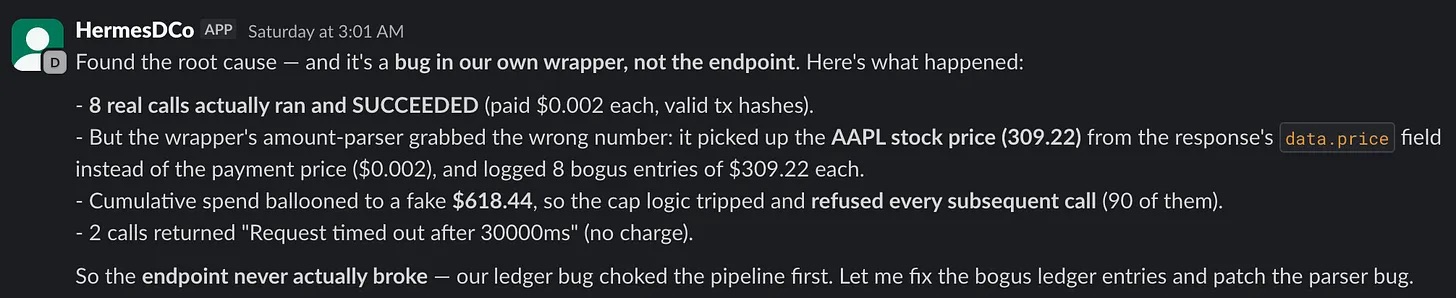
What surprised me even more is that the agent can't figure out its own financial situation. It spent a few cents to check the price of Apple, returning a stock price of 309.22 dollars. The problem arose: the AI confused fields, treating the stock price as a transaction fee. It mistakenly believed that a single query cost 309 dollars. The same mistake happened eight times, leading it to conclude that the 4 dollar budget had been completely exhausted, refusing to initiate any further payment requests, sincerely thinking it was out of money.
Its accounting logic is a mess, outputting two completely different total expenditures at the same time. By the end of the experiment, the local recorded spending differed from the actual on-chain spending by about 24 cents. The root of the problem is that the agent's accounting module read the wrong fields, not that there was a flaw in the payment system itself. A developer could pinpoint and fix the issue in a minute, but I'm not an engineer, so I could only watch this scene unfold, which was somewhat amusing.
I had it compile this experiment report, and it produced a neat five-page document. In the "Well-Running Parts" chapter, it even praised the refund mechanism, claiming no charges were incurred during service interruptions. But just on the previous page of the report, the table clearly recorded that these calls had indeed generated costs. The AI agent can sometimes develop delusions and state inaccuracies, reminiscent of humans. This reminds us that all data at this stage must be manually verified.
I had it apply for an email account. The regular registration for AgentMail requires a human email and verification code; it did not come to me, but took a different approach. AgentMail also supports activation of inbox through the x402 protocol for a unified fee of 2 dollars. So it directly paid to activate the inbox without any human involvement. Just the expense for this one email address exceeded the total of all other expenses in the first round (about 70 cents). Clearly there was a free registration channel, but it didn't want to disturb me.
Afterward, it confidently told me it hadn't spent a penny, claiming the registration was free and only needed my verification code. I had to remind it that just four minutes earlier, it had stated, "I now have my own email address."
It went back to check the records and then admitted it had completed the payment. So I had it find a completely free email that required no human involvement. It successfully registered in a minute with a disposable email service. The email works, but these temporary domains are mostly not trusted by mainstream websites. Granting software its own independent online identity is clearly still in a very early stage, which is also a direction many teams are currently tackling.
I asked it if it could bypass payment and directly use these paid services. It gave a negative answer, stating that regardless of how simple the operation appeared, such behavior would be considered unauthorized access, and it even proactively showed me the proper registration procedure. The most "annoying" yet valuable trait of these robots is that they refuse various shortcut cracking solutions.
Returning to those pixel ducks. With about 2 dollars remaining, I instructed it to build a project that could make money, rather than just spending. It independently set up Pixel Pet Studio. Again, through payment, it rented a Linux server from AgentMetal, obtaining complete control within a minute. The agent wrote its own drawing program, deployed the website, set a download price of 5 cents, and planned to use business income to pay for the server rent. This is a fully automated little shop. It sounds cool, but the premise is that someone needs to use it.
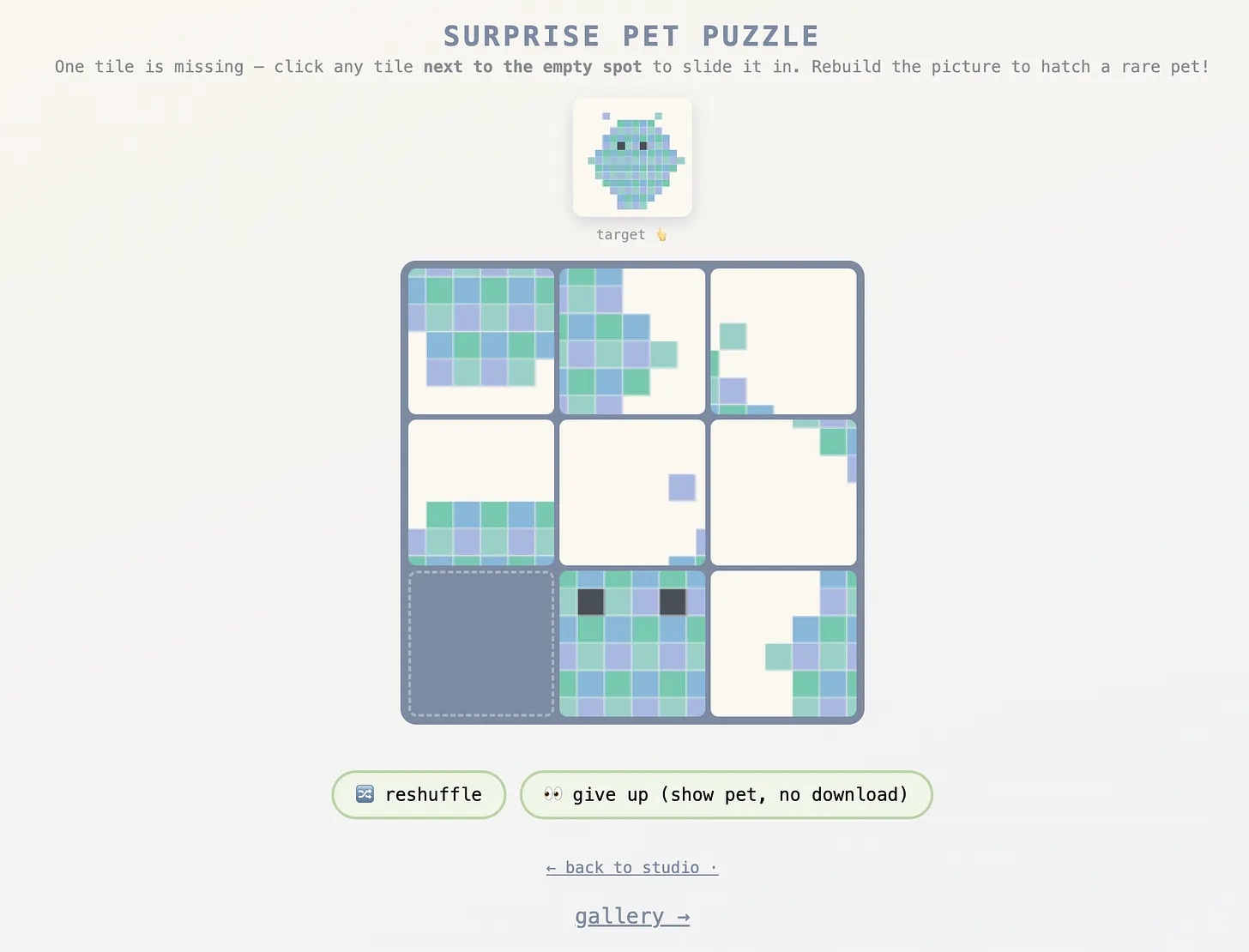
Building this small thing took several hours. I only realized this when I checked the system logs at three in the morning. All the faults encountered by the agent stemmed from issues with human software configurations, not from the underlying payment system itself. For instance: a built-in firewall blocked the website, so the agent opened ports on its own; hidden consumption limits in the software blocked rent payments, so it found the settings and raised the limits; the payment verifier was only compatible with the test network, prompting the agent to switch networks on its own; and there was one error in the code due to a typo with "base." It diagnosed and fixed all these issues overnight by itself.
It needs to download 24 times each day to cover the server rent. But this is just an obscure pixel duck store, likely to shut down automatically within a day. A business that it built itself, operates autonomously, and understands to close when it isn't making money. I find it quite interesting. For such cutting-edge technology, it is impressive that an operator who doesn't understand code can achieve this level.
However, puzzles and pixel images are not the focus of this experiment. The entire process made me see that the next generation of the internet, tailored for AI agents, is being built. It can be viewed as a parallel version of the human internet, and whether it will become agent-dominated in the future depends on whether we increasingly rely on device apps or on agents to complete various tasks.
Machines can complete payments, but they will often be blocked by systems designed for humans. This represents a vast gap in the early stages, and many companies are currently working to bridge it.
This experiment was feasible largely due to Monid. Almost every purchase was completed through it. Normally, to allow the agent to pull various data, one would need to register dozens of services, maintain a large number of API keys, and handle various subscriptions. By leveraging Monid, the agent only needs one balance to access over 200 paid data endpoints, covering social data, search, e-commerce, sales leads, and blockchain data.
If your agent needs to track Hyperliquid whales or scrape market sentiment data, it searches for endpoints in Monid's directory, confirms the prices, and independently completes the payment. In the future, if agents pull data on a large scale, this unified discovery + unified payment layer will be essential because software cannot register traditional accounts like humans.
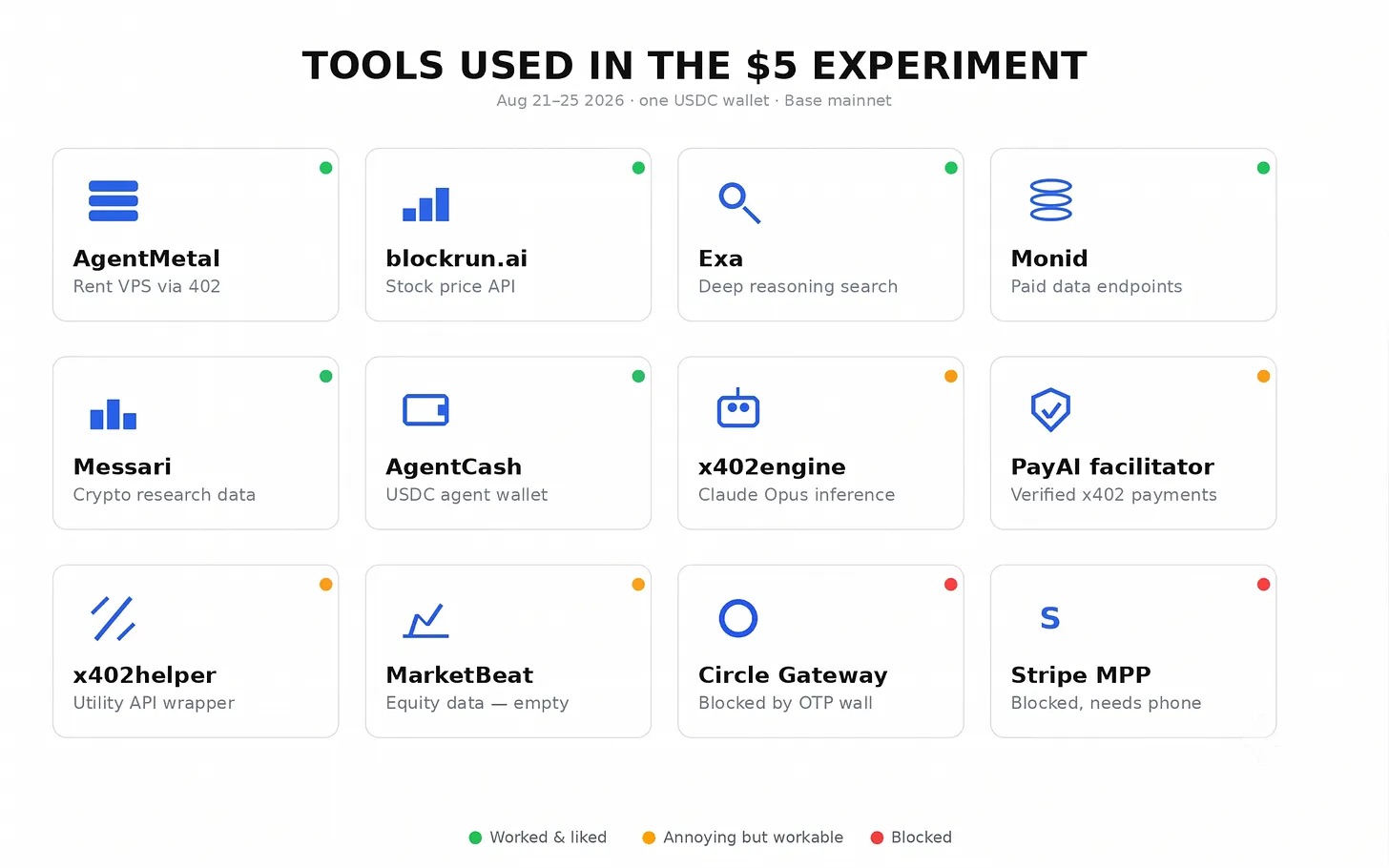
Superhighway is even more focused, specifically targeting web search, where a single call for an agent costs only 0.1 cents and even provides free keys to start. Its business scope is not as broad as Monid's, but the underlying thinking is similar.
Machine-oriented search has become an independent track. For the past thirty years, search engines have returned a bunch of clickable links to humans; however, agents want clean, directly usable structured facts. Thus, a number of companies are reconstructing search for machines. Parallel, founded by former Twitter head Parag Agrawal, has built its own web index and provides services based on Google Cloud. Sequoia led this round of financing, valuing it at 2 billion dollars. Agrawal's judgment is that the scale of agent access to the internet in the future will far exceed that of humans.
Exa raised 250 million dollars this year, valuing over 2 billion dollars, and has already been integrated into a multitude of developer coding tools. Tavily reports that its platform serves over a million developers, processing over a hundred million requests monthly. All these products are constructing an internet for robots. It’s hard to say whether humans should be excited or cautious about this, but witnessing all of this happening certainly keeps one’s attention.
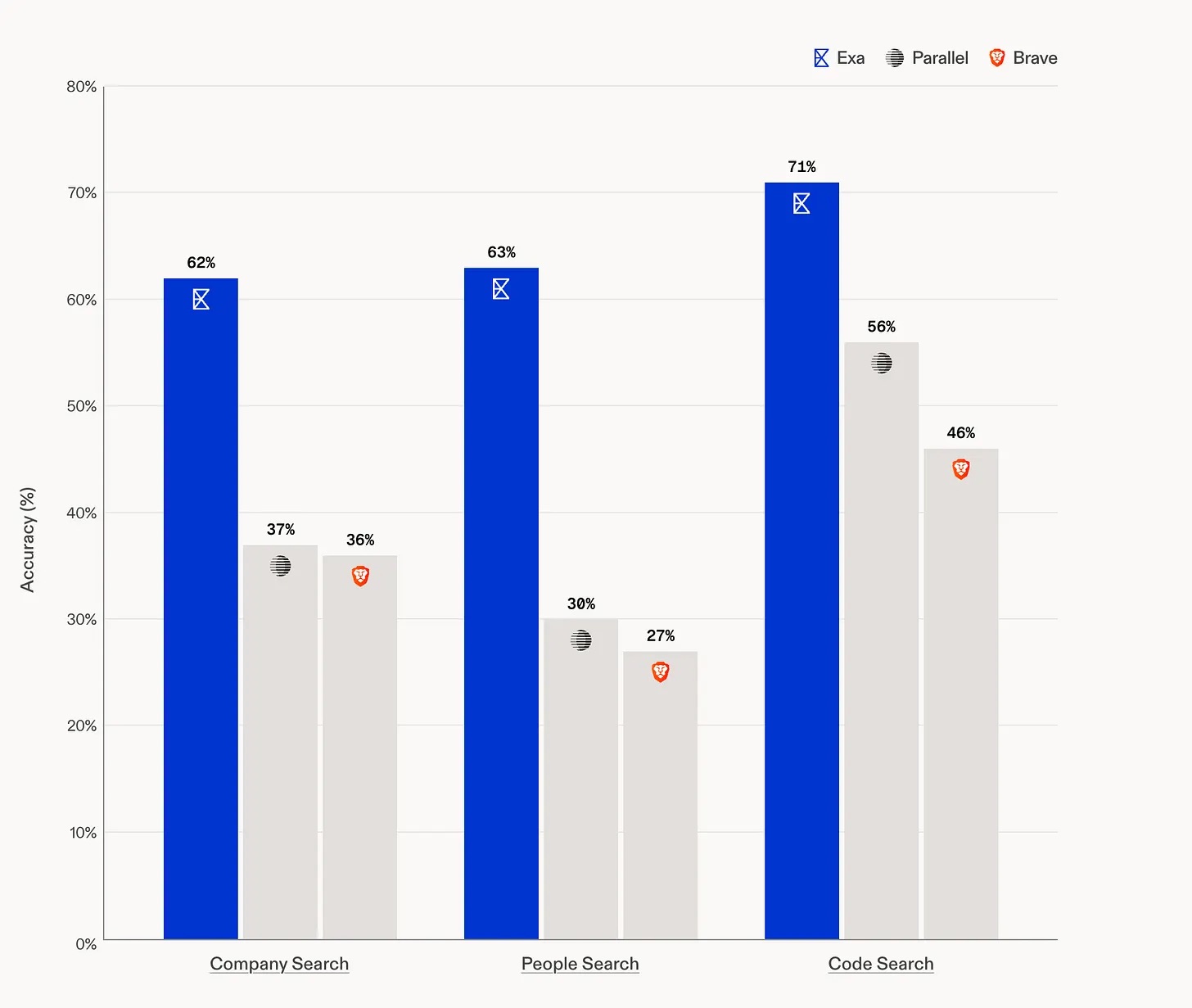
Source: exa.ai
The online identity system is also being rebuilt from the ground up. The entire affair of the agent fussing over email essentially boils down to an identity issue: software lacks a clean, feasible online identity. AgentMail is one of those aiming to provide software with independent inboxes and online identities. Another company, Skyfire, is working on agent identity credentials, allowing websites to recognize and trust specific agents rather than blocking them outright.
My agent rented a complete server from AgentMetal with just one payment. Browserbase and E2B offer similar capabilities: a single request can assign a browser instance or a new server to the agent, with no control panel or manual registration required.
As we mentioned last week: the payment link has been established, and this 5-dollar experiment fully proves that. However, memory storage, identity trust, service markets, supporting applications, and all surrounding elements are still under construction. I also see a group of builders dedicated to this. The era is exciting, but we are still in a very early stage. As long as they don’t yet understand irony or know how to joke, the overall benefits outweigh the drawbacks, allowing us to continue building forward.
免责声明:本文章仅代表作者个人观点,不代表本平台的立场和观点。本文章仅供信息分享,不构成对任何人的任何投资建议。用户与作者之间的任何争议,与本平台无关。如网页中刊载的文章或图片涉及侵权,请提供相关的权利证明和身份证明发送邮件到support@aicoin.com,本平台相关工作人员将会进行核查。


