Proposed cancellation of the 512 validator synchronization committee, deactivation of existing light clients, and no complete implementation code and specifications for the ZK alternative.
Written by: Liam 'Akiba' Wright
Translated by: Saoirse, Foresight News
A new merged Ethereum proposal plans to abolish the synchronization committee composed of 512 validators within the network, cancel the rewards for the committee; instead, off-chain zero-knowledge proof technology will be used, leading to the complete elimination of the current Altair light client interface.
The draft EIP-8390 estimates that by removing the rewards weight corresponding to the synchronization committee, the annual issuance of ETH in the consensus layer will decrease by about 33,800 coins.
With the substitute proof services, migration interface, and supporting economic support plans not yet specified, Ethereum is set to abandon the native mechanism designed for light clients to synchronize with the beacon chain.
The synchronization committee consists of a sample of 512 validators, and the messages they output allow light clients to synchronize with the Ethereum network in a lightweight manner without processing the entire set of validators.
This proposal was officially integrated into the Ethereum EIP code repository at Coordinated Universal Time August 24 at 02:04. However, it is currently only a draft version, intended for discussion purposes, and is not a finalized network upgrade. The proposal does not specify an activation epoch, nor is it included in the official Ethereum roadmap, with specific launch arrangements left to each client development team to decide.
In the initial updated version of this draft, the author's discussion post has yet to include any external review comments.
Decrease in issuance, but security aspects need reassessment
In the Ethereum consensus reward calculation formula, the weight of the synchronization committee accounts for 2/64. EIP-8390 will directly remove this portion of the weight and will not reallocate this share to other modules; thus, the total issuance of the consensus layer will drop by 2/64, which is equivalent to 1/32.
Snapshot data referenced in the draft indicates that there are a total of 901,505 validators in the network, with a total staked ETH of 42,328,615 coins. Based on an estimated total issuance of about 1,082,000 coins of ETH per year in the consensus layer, the cancellation of the synchronization committee will reduce the annual issuance by approximately 33,800 coins of ETH.
A reduction of 1/32 in issuance does not equate to a direct drop of 3.125% in actual earnings for all validators. This reduction is only targeted at the consensus rewards allocated to the synchronization committee; the actual earnings of validators also include other consensus rewards and execution layer earnings.
The Altair protocol itself does not contain specific confiscation rules for validators signing malicious synchronization committee messages. Another proposal that attempted to add this penalty mechanism, EIP-7657, has now been marked as stagnant. This proposal warned that any application with an asset size exceeding 512×32 ETH (i.e., 16,384 coins of ETH) cannot solely rely on the light client protocol and must be accompanied by other protective measures.
This value is based on a warning designed under the premise of a maximum effective balance of 32 ETH, but it also highlights the core contradiction behind EIP-8390: sampled signatures can help light clients synchronize with Ethereum, but the protocol does not have a confiscation mechanism for malicious synchronization committee messages.
Removing this sampling mechanism merely replaces the existing accountability flaw with another external dependency. In the future, light clients will need to verify the Casper FFG zero-knowledge finality proof that covers the entire set of validators, serving as the final source of truth for the synchronized network. This proof will become the basis for clients to determine the finality of the network without processing the entire set of validators.
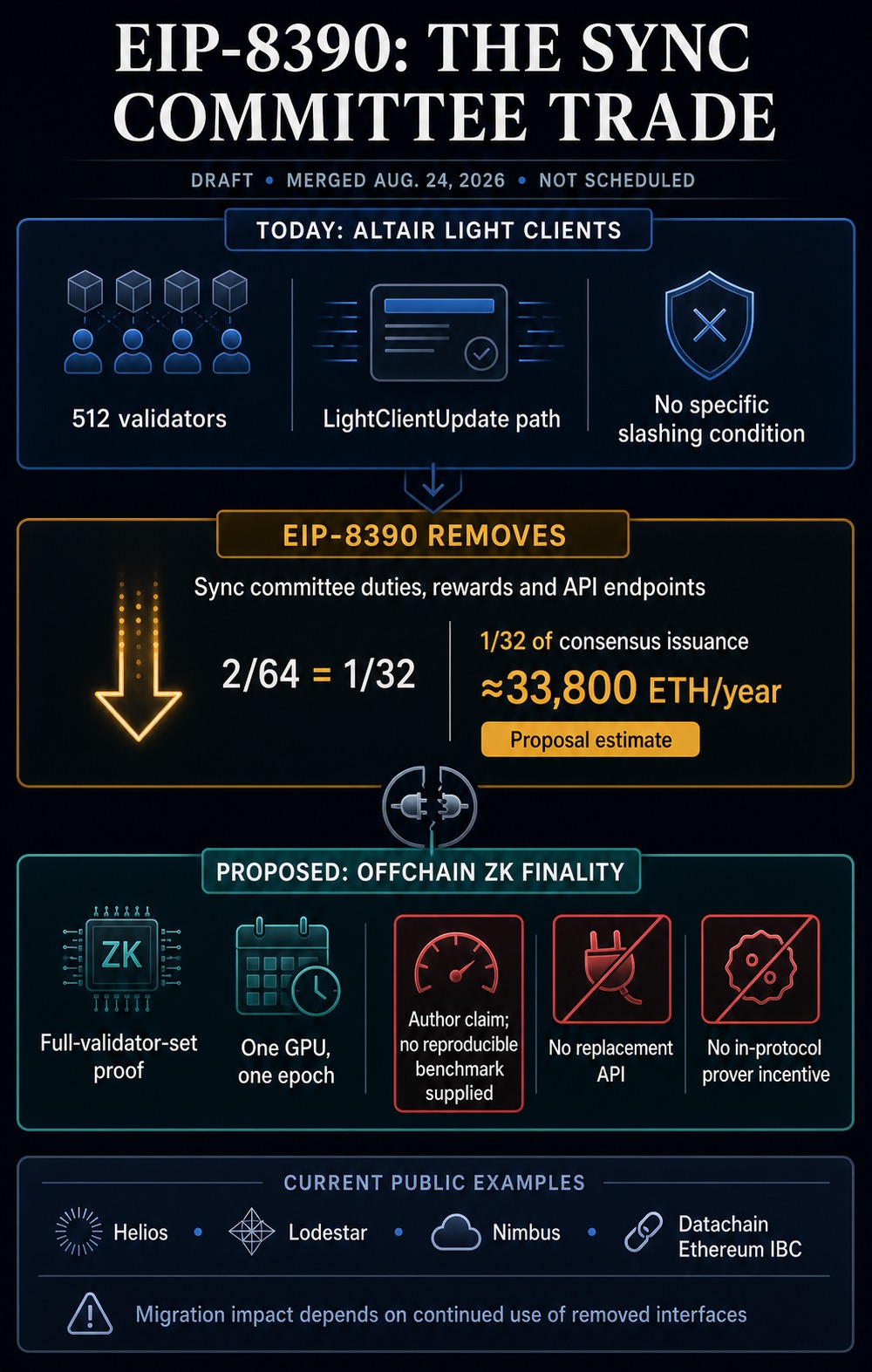
Illustration of the EIP-8390 proposal, which aims to remove the synchronization committee of Ethereum and shift finality determination to off-chain zero-knowledge proofs.
Ethereum light clients will rely on yet-to-be-developed alternatives
EIP-8390 will remove the validator duties corresponding to the synchronization committee, network messages, light client data structures, and multiple beacon API interfaces. The proposal document explicitly states: all deployed Altair light clients that achieve synchronization through LightClientUpdate will directly cease to operate after this hard fork takes effect.
Affected software includes all projects using the standard Altair update process: Helios, an embeddable wallet and decentralized application that relies on consensus nodes supporting the Ethereum light client beacon interface; Lodestar, a client-side light client toolkit developed based on this interface.
Nimbus has exposed a light client interface compatible with this set of updates; the Ethereum IBC client developed by Datachain also relies on the beacon RPC to obtain LightClientUpdate and FinalityUpdate data to construct block headers.
The above are the confirmed affected projects; the actual extent of the impact post-fork will depend on whether they continue to use the interfaces that are about to be removed and whether maintainers will launch corresponding migration versions.
The current Altair technical specifications define the update process used by the above mentioned projects. EIP-8390 directly abolishes this process but does not provide an alternative beacon API specification or client migration standards.
EIP-8390 claims that a single GPU can complete the Casper FFG finality proof within an epoch, and the client validation of this proof only takes milliseconds. However, the draft does not provide reproducible implementation code, circuit designs, hardware configurations, or benchmark tests to support this claim.
Another openly available design related to the complete set of validators shows that in an environment with a 64-core CPU without GPU acceleration, preprocessing takes nearly a minute, and some aspects of proof assembly are still considered future work to be developed. While this solution has made progress, the hardware environment is entirely different.
This EIP does not define proof services, client interaction interfaces, reliability models, operational subjects, or sources of funds. The draft also clearly states that it will not introduce incentives for generating finality proofs within the protocol, although off-chain funding or public goods funding models may still potentially materialize outside the protocol.
Ethereum effectively replaces an imperfect trust mechanism with a set of infrastructure that has not yet been written into specifications. The proposed reduction in issuance is explicitly quantifiable, but the availability of alternatives, migration paths, and economic models are all unresolved.
For EIP-8390 to proceed towards formal activation, it must have a tested light client interface, a migration plan available for the existing Altair ecosystem, and must ensure that the public proof generation service can operate reliably when users depend on this service.
免责声明:本文章仅代表作者个人观点,不代表本平台的立场和观点。本文章仅供信息分享,不构成对任何人的任何投资建议。用户与作者之间的任何争议,与本平台无关。如网页中刊载的文章或图片涉及侵权,请提供相关的权利证明和身份证明发送邮件到support@aicoin.com,本平台相关工作人员将会进行核查。


