AI Deepfake Fraud Outbreak! Losses in 2026 Have Soared by 263%, Crypto Users Need to Be Cautious
Summary:
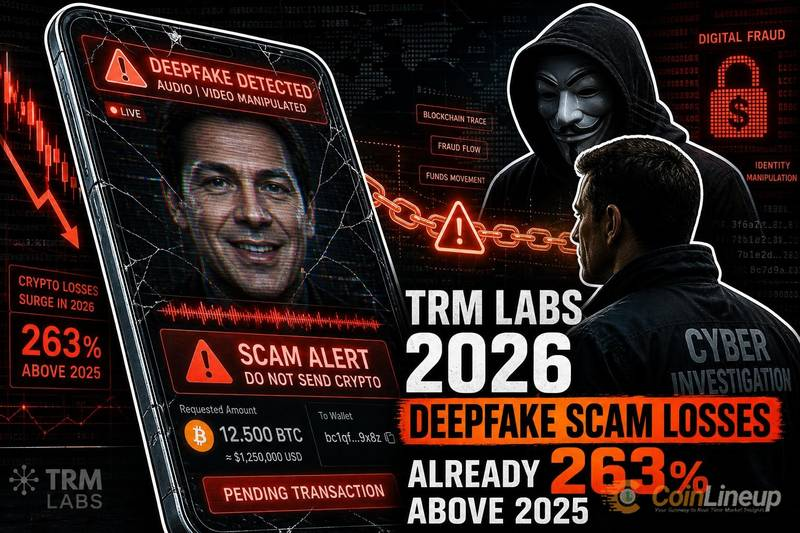
TRM Labs' latest report shows that from 2026 to now, losses from deepfake fraud have exceeded the total for the entire year of 2025 by 263%. As AI-generated videos and voices become increasingly difficult to distinguish from real ones, scammers are using "fake identities, fake customer service, fake celebrities" to lure users into voluntarily transferring assets. Deepfakes are becoming one of the fastest-growing security threats in the crypto industry.
Key Points Summary
Data from TRM Labs indicates that losses from deepfake fraud have exceeded the total for 2025 by 263% from 2026 to now.
AI-generated videos, voices, and images are being used to impersonate project teams, customer service from trading platforms, internet influencers, and public figures.
The method of fraud is shifting from "direct wallet attacks" to "coaxing users to transfer assets themselves."
Transfers of crypto assets are usually difficult to reverse; once sent out, recovery is extremely challenging.
For ordinary users, the most important security habit in the future may not just be protecting passwords, but learning to verify "whether the person you see is really who they say they are."
Why Has AI Fraud Suddenly Become More Dangerous?
In the past, many fraudulent messages were not difficult to identify.
Poorly written text, strange URLs, and obviously unreasonable profit promises often left traces.
But AI is changing this.
Current deepfake technology can generate videos, voices, and even interactive content that looks very real. Scammers can use these tools to impersonate project founders, well-known figures, staff from trading platforms, or even your acquaintances.
A "real-person" video, which might have been considered credible evidence in the past.
But now, the videos and sounds themselves can no longer prove identity.
An Important Change in Fraud Methods is Occurring
The data from TRM Labs reflects not just an increase in the number of frauds.
More importantly, the methods of fraud are evolving.
In the past, attackers may have tried to directly steal users' wallet private keys or exploit technical vulnerabilities to breach accounts.
Now, an increasing number of scammers are choosing another method:
They make users transfer assets themselves.
For example, a fake video tells you your account is at risk.
An AI voice mimicking customer service asks you to "verify your wallet" immediately.
There are even people impersonating project leaders, issuing so-called urgent announcements or investment opportunities.
Technically, they do not need to crack your wallet.
They just need to deceive you.
Daily sharing of real-time trading strategies, free position diagnostics, solutions, and market insights, scan to follow the official account"Bit Radar",join the community for strategies!

Why Are Crypto Users More Likely to Become Targets?
Crypto assets have a unique issue:
Transfer speeds are fast, and in many cases, reversibility is difficult.
Once a user confirms a transaction and sends assets to a scam address, recovering them is often very challenging.
This means that a scammer only needs to succeed once to potentially cause massive losses.
Moreover, the emergence of AI is lowering the production threshold for scams.
In the past, creating a high-quality fake video required a professional team.
Now, ordinary people can quickly generate sufficiently realistic content using AI tools.
Fraud is transitioning from "technical attacks" to gradually evolving into "psychological attacks."
Trading Platforms Are Also Strengthening Anti-Fraud Measures
In the face of growing AI scams, platforms are clearly beginning to take action.
More and more trading platforms are introducing on-chain monitoring, risk identification, and AI anti-fraud systems, hoping to identify abnormal behaviors before funds are transferred.
But the problem is:
Technology can help detect risks, but it cannot completely replace users' own judgment.
The most dangerous scams in the future might not be those that can be identified at a glance as fake news.
But rather those messages that seem "too real."
In the Future, Seeing a Video Should Not Instantly Mean Trust
For ordinary users, the biggest change brought about by this incident is actually quite simple.
In the future, upon seeing these situations, one should verify one more time:
Sudden customer service calls.
Urgent notifications requesting immediate transfers.
Video statements from project founders.
Voice help requests from friends or acquaintances.
So-called insider investment opportunities.
Especially when the other party constantly emphasizes "act now," "limited opportunities," "your account is about to be frozen," extra caution is required.
Truly important information is best confirmed through official websites, official accounts, or multiple independent channels.
Conclusion
In 2026, AI may be bringing new technological opportunities to the crypto industry.
But at the same time, it is also becoming a new weapon for scammers.
Data from TRM Labs shows that losses from deepfake fraud have already significantly exceeded those of the entire year of 2025, indicating that a new security issue is rapidly expanding.
In the future, protecting assets may not be as simple as just securing private keys.
You also need to learn to discern:
Is the video you see real?
Is the voice you hear real?
Is the person urging you to transfer money really who they say they are?
In the age of AI, the most dangerous scam might be the one that looks completely unlike a scam.
Daily sharing of real-time trading strategies, free position diagnostics, solutions, and market insights, scan to follow the official account"Bit Radar",join the community for strategies!

免责声明:本文章仅代表作者个人观点,不代表本平台的立场和观点。本文章仅供信息分享,不构成对任何人的任何投资建议。用户与作者之间的任何争议,与本平台无关。如网页中刊载的文章或图片涉及侵权,请提供相关的权利证明和身份证明发送邮件到support@aicoin.com,本平台相关工作人员将会进行核查。


