The 10-year US Treasury yield approaches 5%, the Treasury Department unleashes buyback tools, and Bitcoin is a highly sensitive barometer for global liquidity.
Written by: Arthur Hayes, former co-founder of BitMEX
Translated by: Saoirse, Foresight News
Editor's note: The sensitive range of US Treasury yields approaching 5% puts pressure on global risk assets. This article begins with the first act of the bond market narrative, then shifts the focus to the crypto market, reviewing past experiences of reverse repos triggering bull markets, analyzing the actual effectiveness and constraints of the Treasury's bond buyback policy in light of current market interactions, and thus deducing potential market changes faced by Bitcoin and other crypto assets in the context of liquidity shifts.
Please set aside your rational thoughts for a moment, unleash your imagination, and follow my narrative.
Act One
On Saturday night, the newly renovated Brooklyn Mirage Club, now known as New York Pacha, is truly the heart of American hegemonic order. A group of top-tier elites, dressed in luxurious attire, gathers here, swaying to the music of Keinemusik.
The protagonist of the story, US Treasury Secretary Scott Bessent (the author cheekily refers to him as "Buffalo Bill"), swaggeringly walks over to his exclusive booth behind the VIP DJ area. A wicked smile curls at the corners of his mouth as a thought flashes through his mind: "Since Elvis borrowed Southern gospel music to appear on The Ed Sullivan Show, I’ve never seen a group of white people with such good rhythm."
Kenny G from Citadel is present, celebrating his triumphant blow against high-leverage speculator Leopold Aschenbrenner from San Francisco. Bessent can't help but steal a couple more glances. He had always heard that Kenny G resides in Miami, assuming he preferred Latina women. "Who is this stunning woman next to Kenny G… Upon closer inspection, it turns out to be Leopold’s wife." Nothing is more exhilarating than humiliating a high-leverage speculator from the West Coast, even if this woman is merely of average Bay Area standards; live in the moment.
To Bessent's surprise and anger, sitting next to Kenny G is his predecessor, former US Treasury Secretary Janet "Bad Gurl" Yellen. Yellen waves at him and continues talking with Hunter Biden. Bessent privately criticizes the party atmosphere. He even speculates that Yellen might indulge in revelry tonight. Deeply imbalanced, Bessent wonders how she can afford the $20,000 booth. He quickly realizes that holding a government position inherently means a huge profit margin. Bessent himself is already very wealthy, so he doesn't need to milk it; but for ordinary politicians like Ro Khanna and Nancy Pelosi, such operations are routine.
Yellen shouts over the noise to Bessent: "Hey, kid, how has the market treated you lately?"
Bessent's body visibly twitches with anger. This week has been overwhelming for him; the US Treasury market has performed miserably. He had to suddenly announce that the Treasury Department would double the buyback size of long-term bonds in an attempt to suppress yields. Unfortunately, the market's rebound lasted only one trading day. By the weekend, yields had returned to levels seen before the policy announcement. He really wants to call his true mentor, George Soros, for advice, but wonders if Druck would answer his call.
Yellen continues to stoke the flames: "Don’t you think you’re better than me? Think you understand the market better than the academics?" She bursts into a fit of laughter mimicking former Vice President Kamala Harris: "You’re just Trump’s puppet, hahaha. Essentially, we’re no different, you arrogant guy. Have fun!"
With that, Yellen completely lets loose. A group of male companions wearing diamond dog collars customized by Jacob the Jeweler follows her. She leans in to one of her male companions and whispers Cardi B's lyrics: "I want you to drive that big Mack truck right in this little garage." It is indeed "a little garage" now, and she has quite a stash of Reta hidden in her hand.
Fuming, Bessent passes by Arthur and Ansem's booth, where a group of crypto gamblers are engaging in animated discussions. Arthur waves to Bessent, and when he approaches, says: "I just saw everything. Don’t pay attention to the haters. The crypto world is on your side. You have no choice; we support you, keep going! Never stop printing money. Once the market crashes, the rich won't receive their free bonuses, and ordinary people in America who naively believe in capitalism will end up with nothing. If there are no bonuses, AOC will raise our taxes. My God."
At that moment, Bessent is determined to be a Treasury Secretary who fulfills his duties to the fullest. If Trump needs a trillion dollars to prop up the market, he'll find a way to make it happen.
Scene Change
No matter how much their pre-office rhetoric differed, Bad Gurl Yellen and Buffalo Bill Bessent are essentially the same kind of person. They are both constrained by politicians—politicians who can't control themselves and are always willing to spend money for all sorts of ridiculous reasons. But both believe that holding the highest financial power in the US is worth the price. Thus, whenever the Treasury market experiences severe turbulence, they deploy clever money-printing strategies.
When the Treasury prints money to suppress Treasury yields, it releases dollar liquidity into the market, and this liquidity eventually flows into Bitcoin and the crypto market. I will compare two historical segments: Yellen and Bessent changing the market landscape, followed by Bitcoin entering a bullish trend. The first segment took place at the end of 2023, when Yellen massively issued short-term Treasury bills, reducing the supply of long-term bonds; the second is now, as Bessent intervenes in the USD/JPY exchange rate and enlarges the Treasury buyback scale. After Yellen launched this money-printing scheme, Bitcoin rebounded strongly from its lows; and my judgment is that when Bessent confidently follows in his predecessor's footsteps and massively releases dollar liquidity, Bitcoin will similarly repeat this scene.
5% Threshold
For some reason, both Yellen and the current Bessent are extremely fearful of the 10-year US Treasury yield approaching 5%. The 10-year Treasury yield is the most critical pricing anchor in the American financial order. The interest rates for 30-year fixed mortgages (with prepayment options), corporate bonds, and various consumer credit products are all anchored to the 10-year Treasury. Once the yield exceeds 5%, the financing costs for households and companies will become unbearable, cooling economic activity. This is why regulatory bodies desperately defend this threshold.
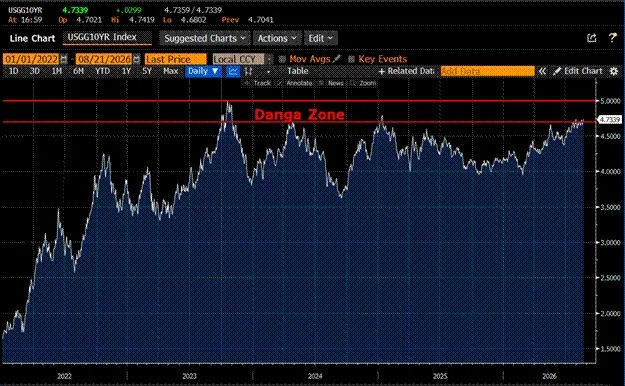
This chart shows the 10-year US Treasury yield from 2022 to 2026; the red line at 5% marks the "danger zone," nearing which will force the Treasury Department to inject liquidity into the market.
Short-Term Treasury Bills vs Long-Term Bonds
Short-term Treasury bills (T-bills) have a maturity of less than a year; while bonds (bonds) have a longer maturity. The shorter the maturity, the closer it is to cash, making it more liquid and attractive to money market funds (MMFs). Money market funds hope to achieve the highest possible yields while bearing minimal interest rate and counterparty risk. Storing funds at the Federal Reserve is the safest choice— the Fed can print money to settle debts without Congress’s approval. The Fed has a reverse repo tool, RRP, where eligible institutions can deposit funds and earn a yield close to the federal funds rate.
Theoretically, lending to the US government in US dollars is risk-free because the government can print money; but in reality, repaying debts requires Congressional approval. This is why the debt ceiling farce rattles market nerves: investors cannot hold securities with maturity payment uncertainty. If politicians refuse to pass spending bills, bondholders won't receive their principal and interest. Thus, if money market funds want to hold short-term Treasury bills, their yields must be slightly higher than the reverse repo RRP to compensate for this policy risk.
The environment at the end of 2023 was very similar to today; the most pressing issue for American voters was the cost of living. At that time, President Biden's team was well aware that ordinary people had realized the consequences of interest rate cuts or balance sheet expansion; this route wouldn't work. With the 2024 election looming, the government had to consider the survival pressure on voters. Yellen understood that her boss needed liquidity to support the market while maintaining the appearance of not blatantly printing money or stimulating inflation. Thus, she devised a clever scheme for covert money printing.
At that time, about $2.5 trillion was sitting in reverse repos (RRP). The issue with this money is that lying on the Fed's balance sheet, it cannot be repledged by banks to generate credit, resulting in a money multiplier equal to zero. But if money market funds withdraw money from RRP to buy higher-yielding short-term Treasury bills, the banking system can repledge this asset. Liquidity surges into the bond market, lowering yields while raising stock prices; for us crypto players, this also created the bottom for Bitcoin after the FTX bankruptcy.
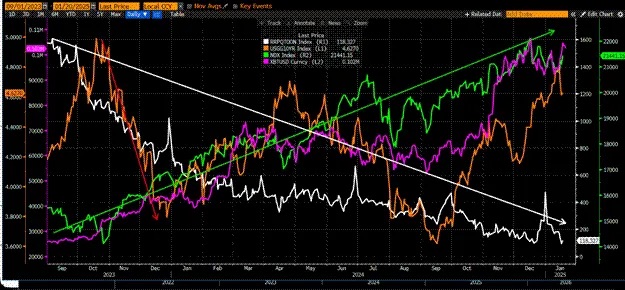
The chart clearly illustrates this transmission logic. The Treasury expands the supply of short-term Treasury bills, causing bill prices to fall, and yields to rise significantly above RRP levels, prompting profit-seeking money market funds to shift their funds from the reverse repo. By the time Bessent takes office on January 20, 2025, the RRP balance has shrunk from $2.5 trillion to $100 billion. This equates to $2.4 trillion of liquidity injection (funds originating from pandemic stimulus plans), pouring into the financial markets as the Nasdaq 100 and Bitcoin prices soar, with the 10-year US Treasury yield swiftly retreating from the dangerous 5%, while the federal funds rate remained around 5.3% without adjustment.
Crypto traders, make sure to understand this chart; the roots of market optimism lie here. If you cannot understand why the Fed maintains the highest interest rates since 2008 while simultaneously shrinking the balance sheet, yet Bitcoin and risk assets still soar, you will miss the newly started bull market. The academic community even coined the term Activist Treasury Issuance (ATI) to describe Yellen's magical operation.
Today, Bessent faces the same dilemma as Yellen. His boss is keen on spending big, this time for an unwinnable war in the Middle East. However, it does not matter where the president spends the money; the Treasury Secretary's task is to help the government borrow money at an affordable cost.
Distorted Operations
Everyone loves cash assets that can earn interest. Short-term Treasury bills are the highest-yielding and safest quasi-cash instruments within the dollar system. Therefore, everyone is willing to hold short-term Treasury bills; even the crypto circle holds derivatives of them, such as stablecoins like USDT and USDC. Bessent knows well that as long as he is willing to supply, the market can absorb massive amounts of short-term Treasury bills. But the issue is that short-term Treasury bills mature within a year; the higher the proportion of short-term debt, the faster the rolling of compound interest on debt occurs. Each week, the Treasury must issue growing amounts of debt to cover new fiscal expenditures and repay maturing old debts, leading to accelerated growth of total US debt.
By increasing the proportion of short-term Treasury bills in total debt, Bessent can lever the most important marginal buyer—the Federal Reserve. Currently, the Fed creates bank reserves and prints money to buy short-term Treasury bills through the Reserve Management Plan (RMP). The purchase scale of RMP is determined by New York Fed President Williams, who leans towards easing, also known as the "dovish" stance of the Fed. If Williams assesses that the market lacks dollar liquidity, he will order traders to create reserves by buying short-term Treasury bills in the open market. Essentially, the Fed is printing money to foot the state’s bills.
With the Fed absorbing short-term Treasury bills, Bessent can issue a lot of short-term debt to acquire funds for repurchasing medium- to long-term bonds. Bessent manipulates the yield curve wantonly, like a tone-deaf child playing the violin. As early as after the "Liberation Day Incident" last year, he hinted at having this powerful weapon of bond buybacks. At that time, Trump had once wanted to use aggressive tariffs to completely rewrite the global trade landscape, but after the market plummeted, he backed down. Bessent warned the market not to test his policy tools. More than a year later, Bessent took action, announcing large-scale buybacks to forcefully suppress long-term yields.
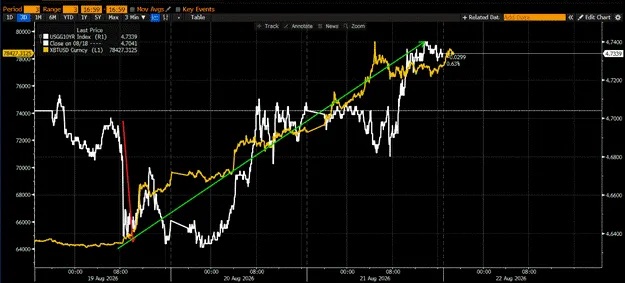
The white line is the 10-year Treasury yield, the yellow line is Bitcoin. After Bessent announced the expansion of long-term bond buybacks, both rose simultaneously in the short term, confirming the market's expectation; however, the Treasury yield rebounded afterward, indicating that the buyback effort was insufficient to suppress rates.
On August 19, Bessent suddenly announced, without warning, that the long-term bond buyback scale for the next fiscal quarter would increase by a mere $20 billion. As soon as the news broke, the 10-year yield briefly dipped, but the extent was limited. Bitcoin awoke from slumber, surging strongly for two consecutive days. But this was precisely the reason for Bessent’s displeasure at the party: just one trading day later, the 10-year US Treasury yield had surpassed the levels seen before the policy announcement again. Why did this happen?
First, the scale of Bessent's intervention is far from sufficient. The total debt has reached $40 trillion, and $20 billion in buybacks is a drop in the bucket. Second, the market senses panic signals. Just weeks prior, Bessent proposed eliminating the cap on FIMA tools, allowing Japan and other major holders of US Treasuries to use their US bonds as collateral for direct loans from the Fed, rather than selling bonds in the open market to avoid a crash. Third, and most importantly, the market believes that as long as the 10-year yield continues to push higher, it can force Bessent to replicate Yellen’s approach, finding ways to inject trillions of dollars in liquidity into the market. Bitcoin is a smoke detector for global liquidity; it sensed this signal keenly. If Bessent is indeed an upgraded version of Yellen, then Bitcoin is set to embark on a violent rally from its lows.
Bessent's Next Steps
There are several evolutionary paths ahead.
For assets like Bitcoin that are highly sensitive to dollar liquidity, the worst-case scenario is that US politicians led by Trump choose to reduce fiscal spending. However, I believe the likelihood of this happening is very low, as a new round of elections is not far off. The Democratic Socialist Party, represented by AOC, is gaining momentum, painting a utopian vision where there are no rent payments and free food. Trump and the Republicans must present a corresponding "prosperity narrative": printing money for rich donors to hold onto their assets, weaving a dream that ordinary people can become wealthy simply by believing in “socialism for the rich while capitalism for the poor.” You’ll see supporters dressed in Philipp Plein gear, replicating Miami Vice looks, while women undergo cosmetic enhancements at the most expensive clinics in Coconut Grove.
Setting aside such apocalyptic fantasies and returning to reality, let's look at the means Bessent has to activate the money-printing machine.
The best-case scenario for Bitcoin: Bessent mimics the Bank of Japan's bond market intervention model, announcing that as long as the yields on 10-year and above bonds exceed 5%, there will be unlimited buybacks. In the initial phase, bond prices would soar, yields would quickly drop, and the market would temporarily respect Bessent. But every intervention that contradicts market economic principles ultimately faces scrutiny, and the market will test Bessent to see if he is truly willing to wield the dollar cannon to fulfill promises.
The most likely middle ground (unless the MOVE volatility index exceeds 130 and the market experiences acute stress): Bessent will gradually increase buybacks while exploring other niche tools to indirectly release liquidity.
Another obvious tactic is to utilize funds from the Treasury’s General Account (TGA) to support buybacks. Buffalo Bill Bessent has already leaked this proposal to CNBC. The TGA account holds about $1 trillion.
I believe that unless there is a real burst of the AI credit bubble in the coming years, the Fed will find it difficult to directly lower interest rates or restart unlimited QE on a political level. Don't forget, voters are primarily concerned with the cost of living; even teenagers scrolling through short videos understand that lowering interest rates and QE equals printing money.
The Bull Market Is Coming
Whether Bessent floods the market quickly or gradually, Bitcoin will continue to rise. Volatility will amplify; even with the overall direction upward, there will still be fierce short-term corrections. Therefore, unless you are a full-time trader, do not use leverage. Buy Bitcoin or small-cap coins you are optimistic about, hold on without selling, and wait for the policies from Bessent to take effect.
At Maelstrom Fund, we are fully invested in risk assets. Bitcoin, Ether, Ethena, Ether.fi are our core bets, and we expect them to soar.
免责声明:本文章仅代表作者个人观点,不代表本平台的立场和观点。本文章仅供信息分享,不构成对任何人的任何投资建议。用户与作者之间的任何争议,与本平台无关。如网页中刊载的文章或图片涉及侵权,请提供相关的权利证明和身份证明发送邮件到support@aicoin.com,本平台相关工作人员将会进行核查。


