Author: Claude, Deep Tide TechFlow
Deep Tide Guide: On August 12, OpenAI, along with five scholars, published a 69-page working paper that connected over 17 million real usage records of ChatGPT Enterprise with employee ranks, task classifications, and financial data of publicly listed companies. The conclusion is quite counterintuitive: the narrative that "AI first replaces junior employees" is disproven by the data, revealing that young people who have been with the company for only a few years are the ones using it the most aggressively across all levels; at the same time, the spread of AI is strengthening rather than leveling the differences within enterprises, with adopters' median income, market value, and R&D expenditures being an order of magnitude ten times greater than those who have not adopted it.
On August 12, a working paper titled "How Organizations Use AI: Evidence from ChatGPT" was uploaded to arXiv. The authors are Aaron Chatterji from Duke University, Prasanna Tambe from the Wharton School, David Holtz from OpenAI, and two other scholars, comprising 69 pages. Unlike typical industry questionnaires, this paper correlates ChatGPT Enterprise account records with employee ranks, message content classifications, and financial data of US publicly listed companies, covering more than 1,500 organizations and over 17 million messages within a six-month observation window. In other words, OpenAI has for the first time laid out its real usage data from enterprise clients directly to the academic community and the public.
Those who use it the most are not executives; young employees with just a few years on the job send eight to nine more messages per week than the company average
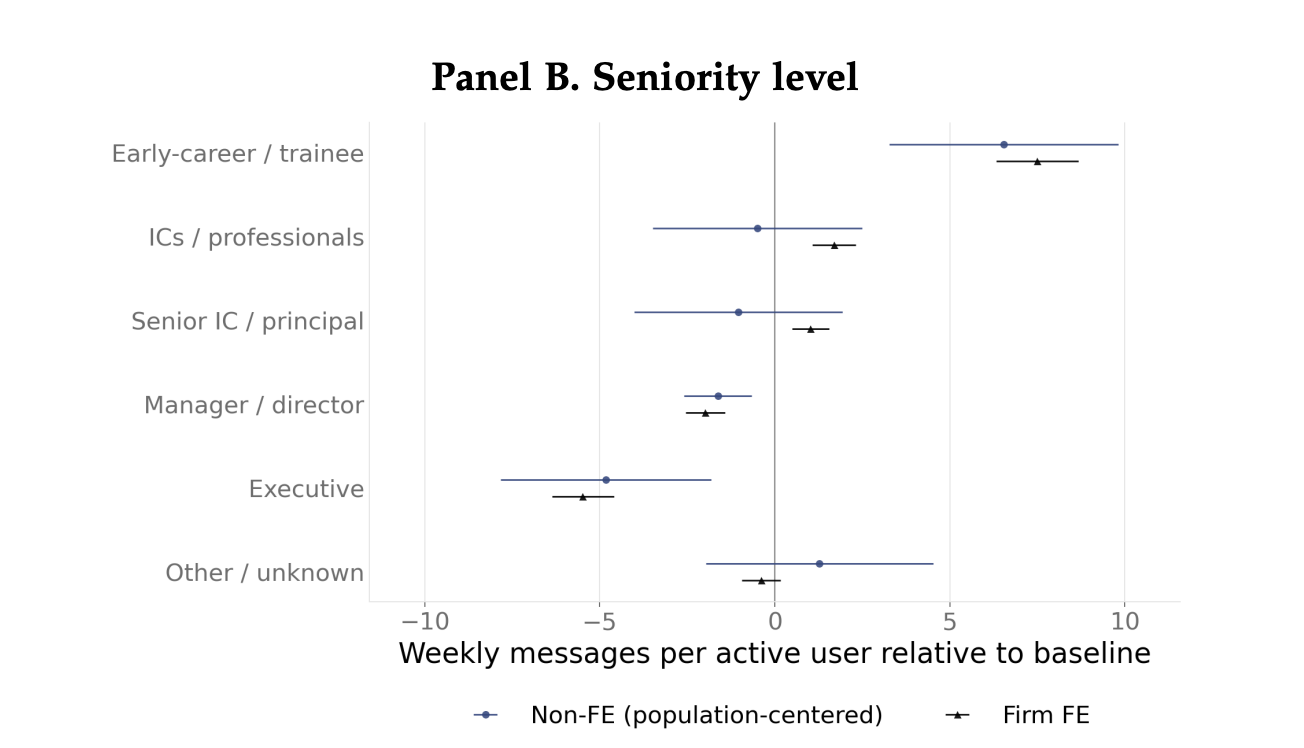
In terms of numbers, early-career employees and trainees make up only 7% of weekly active users, the smallest group; managers and directors account for 24%, while executives make up 10%. However, if we replace "who is using it" with "who uses it intensively," the picture changes completely: early-career employees send an average of eight to nine more messages per week than the average user in their company, making them the most intensive users across all levels; executives, founders, and partners, on the other hand, send fewer messages than the company average.
This means the widespread concern that "AI first replaces junior employees" is not observed in large enterprises. The group presumed to be the most vulnerable is precisely the group that utilizes AI as a key tool. The authors of the paper also specifically discuss this contrast: junior employees are closest to the dirty and heavy work, have the least work inertia, and thus the marginal improvements brought by tools have the greatest impact on them, making them learn faster and use it more effectively.
The real growth lies not in new customers, but in old customers using it deeper
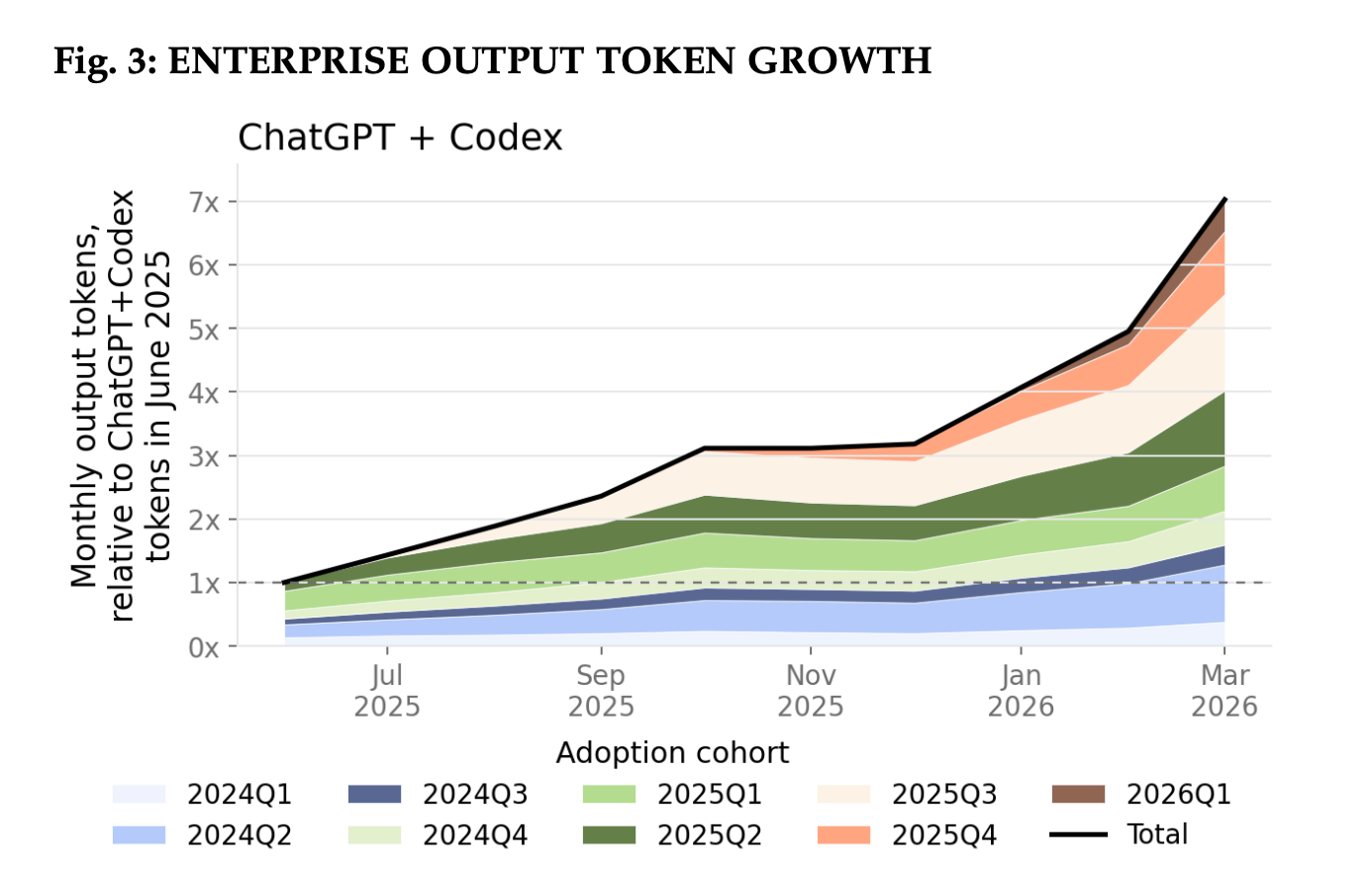
The overall numbers are even more astonishing. From June 2025 to March 2026, the total token consumption of ChatGPT Enterprise increased by about seven times. Breaking it down, companies that adopted it before June 2025 also saw their internal consumption increase by about four times, meaning a significant portion of the growth came from existing customers using it more deeply, rather than an influx of new customers.
More notably, at the beginning of 2026, the usage rates of companies that adopted it at different points in time accelerated simultaneously. This does not resemble a gradual result that each company discovered at their own pace, but rather a product capability that has collectively jumped a level, raising the usage intensity for everyone at once. For companies, the data indicates that purchasing ChatGPT is merely an entry ticket; the real variable is whether there is increasing utilization after adopting it.
A tenfold gap: Early adopters among large companies are leaving their peers further behind
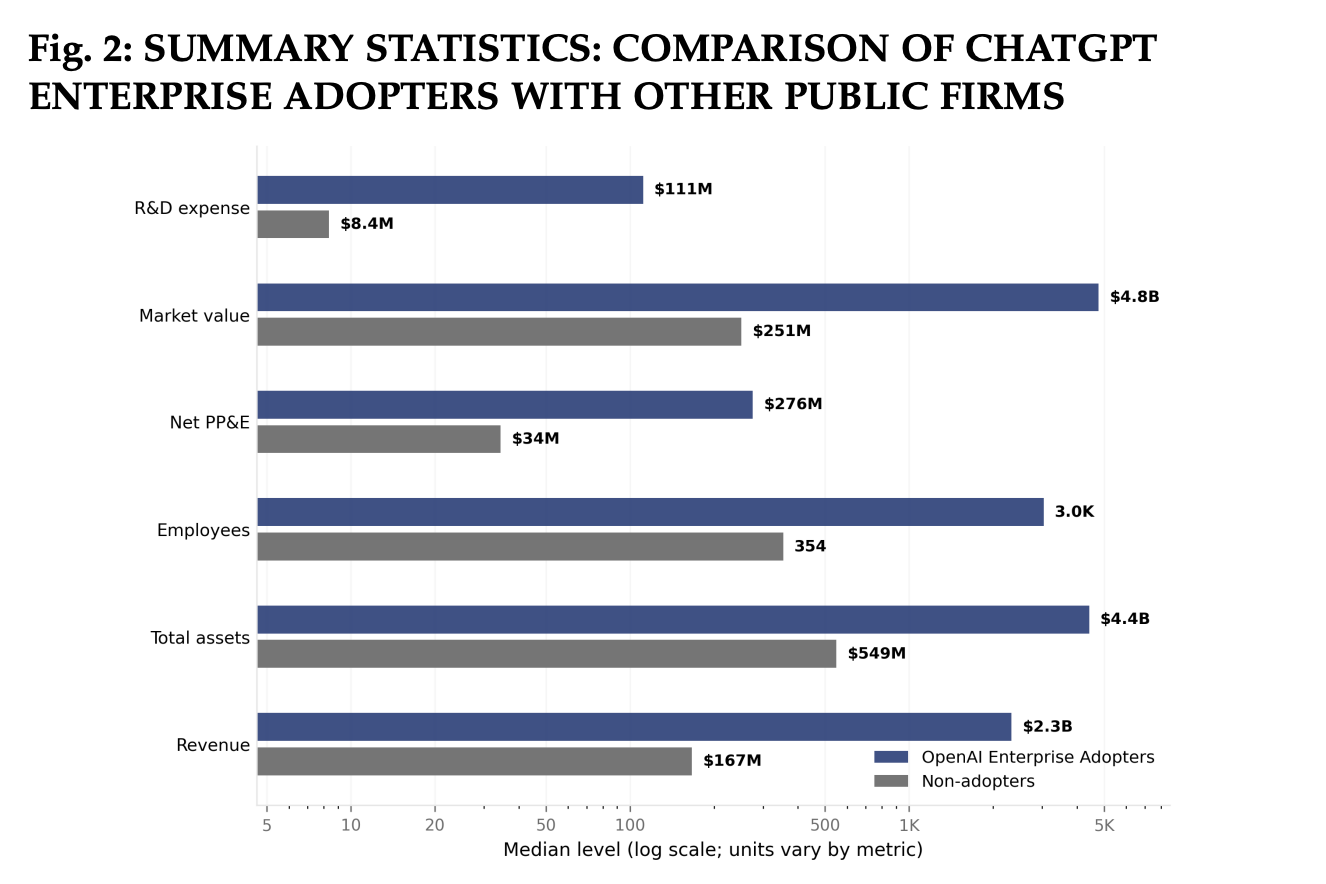
Zooming in on the company level reveals the report's most brutal findings. Among US publicly listed companies, the gap between companies that have adopted ChatGPT Enterprise and those that have not is dramatic: median income stands at $2.275 billion compared to $210 million, median market value at $5 billion compared to $316 million, and median R&D expenditure at $113 million compared to $9.9 million, all representing a tenfold difference.
Companies in the top 5% of revenue have a 9.8 percentage point higher adoption probability; even within the same industry, the top 5% exceeds by 11.3 percentage points. Furthermore, the businesses with the deepest utilization are precisely those with the highest average market value, remaining consistent even after adjusting for industry and scale factors. The paper's own conclusion is very direct: the initial spread of AI will reinforce, rather than flatten, the existing gaps among enterprises.
For investors, this report provides a rare real-world sample: the market is already rewarding companies that are "deep users." The financial metrics difference is clearly visible between those with a few thousand licenses bought and left to gather dust as an "AI concept," and those truly integrating AI into their workflows.
No killer application; it's a long tail of 60 types of tasks
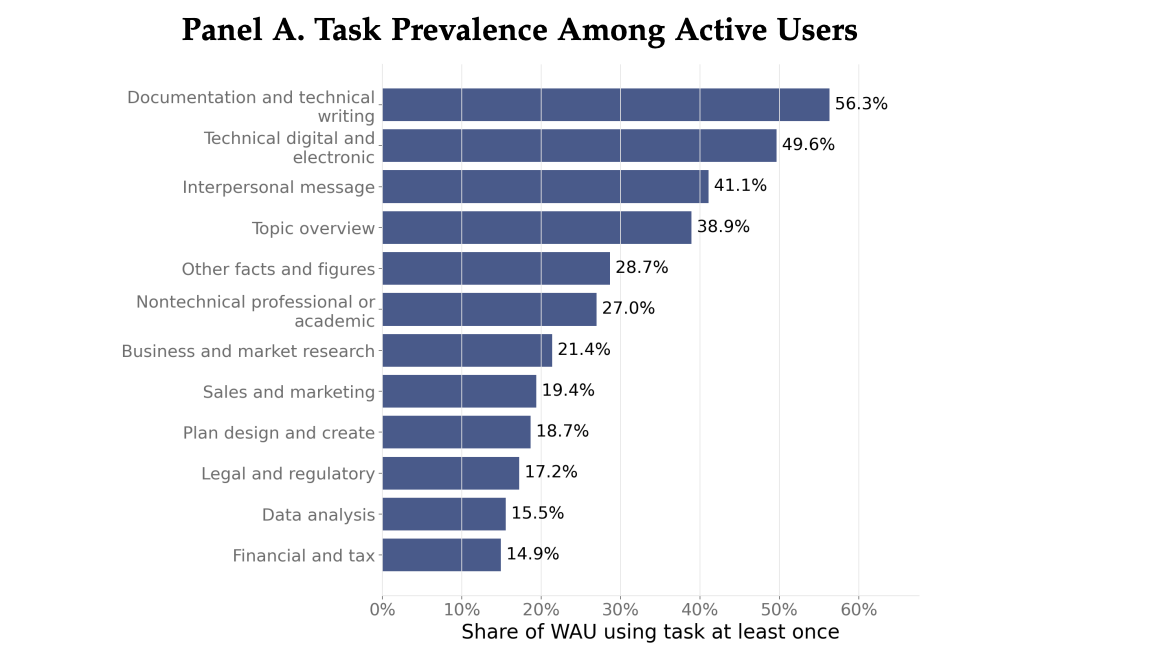
So what exactly are companies using AI for? The paper categorizes over 17 million messages into 60 types of work tasks: more than half of active users use it weekly for document and technical writing, nearly half for technical and digital tasks, but the remaining distribution is very scattered, with many people using it for message communication, topic research, fact-checking, sales and marketing, planning, legal work, data analysis, and financial tax tasks.
The tasks align strictly with job roles: engineers mainly handle technical work and debugging, finance deals with financial tax, and sales and marketing pursue sales and marketing, but no exclusive tasks for any one role can overshadow the general tasks that everyone uses. Industry differences also exist: the financial and insurance sector has a significantly higher proportion of financial tax tasks, while the retail, information, and entertainment sectors have more concentrated sales and marketing tasks. The same tool leads to different usages growing in each industry.
This also explains why there is no "killer application"-like workflow emerged. AI in enterprises resembles a layer laid beneath all knowledge work: each role takes a small piece, which together constitutes real penetration.
AI has not leveled the playing field; it has divided companies into two worlds: those that can use it and those that cannot
The most poignant statement from the report is hidden in the conclusion: in the initial spread of AI, it will reinforce rather than level the gaps between enterprises. Initially, everyone thought AI was an equalizing tool, but the data suggests it is more like a magnifying glass, with those who got on board early and engage deeply running faster and faster. For individuals, the anxiety that "AI first replaces junior employees" has been disproven by data, but another layer of risk is just beginning: AI will not replace everyone; it will replace those who are unwilling to utilize the tools. Young people have already written the answers in the message records; now we’ll see who keeps up.
免责声明:本文章仅代表作者个人观点,不代表本平台的立场和观点。本文章仅供信息分享,不构成对任何人的任何投资建议。用户与作者之间的任何争议,与本平台无关。如网页中刊载的文章或图片涉及侵权,请提供相关的权利证明和身份证明发送邮件到support@aicoin.com,本平台相关工作人员将会进行核查。


