Previously, we talked a few times about the US stock contracts on Hyperliquid during live streams. I wonder if any friends have participated in it? How was your experience? Feel free to chat in the comments. My own sentiment from the trading is that Hyperliquid should be the place with the best liquidity in on-chain US stocks currently.
Today, we will discuss a new direction that is gaining more and more attention: on-chain US stocks.
Many people might be puzzled at first: how can US stocks go on-chain? Don’t be intimidated by the words "on-chain", it is actually easy to understand. In the past, we had to open a securities account to trade US stocks, but now some on-chain platforms have also launched trading products that are linked to US stock prices. They look like stocks and will rise and fall with company news, but they are not true company stocks in the real sense.
For example, several that have recently risen sharply: NBIS is focused on AI cloud, MU is Micron, specializing in memory chips, SNDK is SanDisk, and DELL is well-known to everyone. On the surface, it seems a few stocks are rising together, but digging deeper, the market is actually trading on the same logic — how much more money will be poured into AI infrastructure, how many devices will be purchased, how many data centers will be built.
Today, we won't engage in complex formulas or guess tomorrow's rise and fall, but we will clarify the ins and outs of this market trend while also reminding everyone what pitfalls can easily cause one to jump in headfirst due to the heat.
Let me put the most important sentence upfront: what you buy on-chain is not real stock.
The NBIS, MU, SNDK, and DELL you see on-chain are not the same as the real stocks you buy in your securities account. They are more like "trading contracts that track stock prices" — when the corresponding stock rises, this contract usually rises too; if the direction is misjudged, one can also lose money.
What is the difference? When you buy real stock, you hold a share of the company and are a shareholder; when trading on-chain contracts, you are just betting on price fluctuations, you cannot become a shareholder, receive dividends, nor do you have voting rights.
Why break this down? Because on-chain contracts can carry leverage. To put it plainly, it's about using small amounts of money to leverage large trades; when profits are made, they can be magnified, and when losses occur, they will also be multiplied, leading to serious liquidation. Thus, all the prices mentioned later are reference prices on the on-chain contract page, not the official spot prices from the securities exchange. Though the names are the same, the trading products are completely different.
Do you have any knowledge about the exchange Hyperliquid?
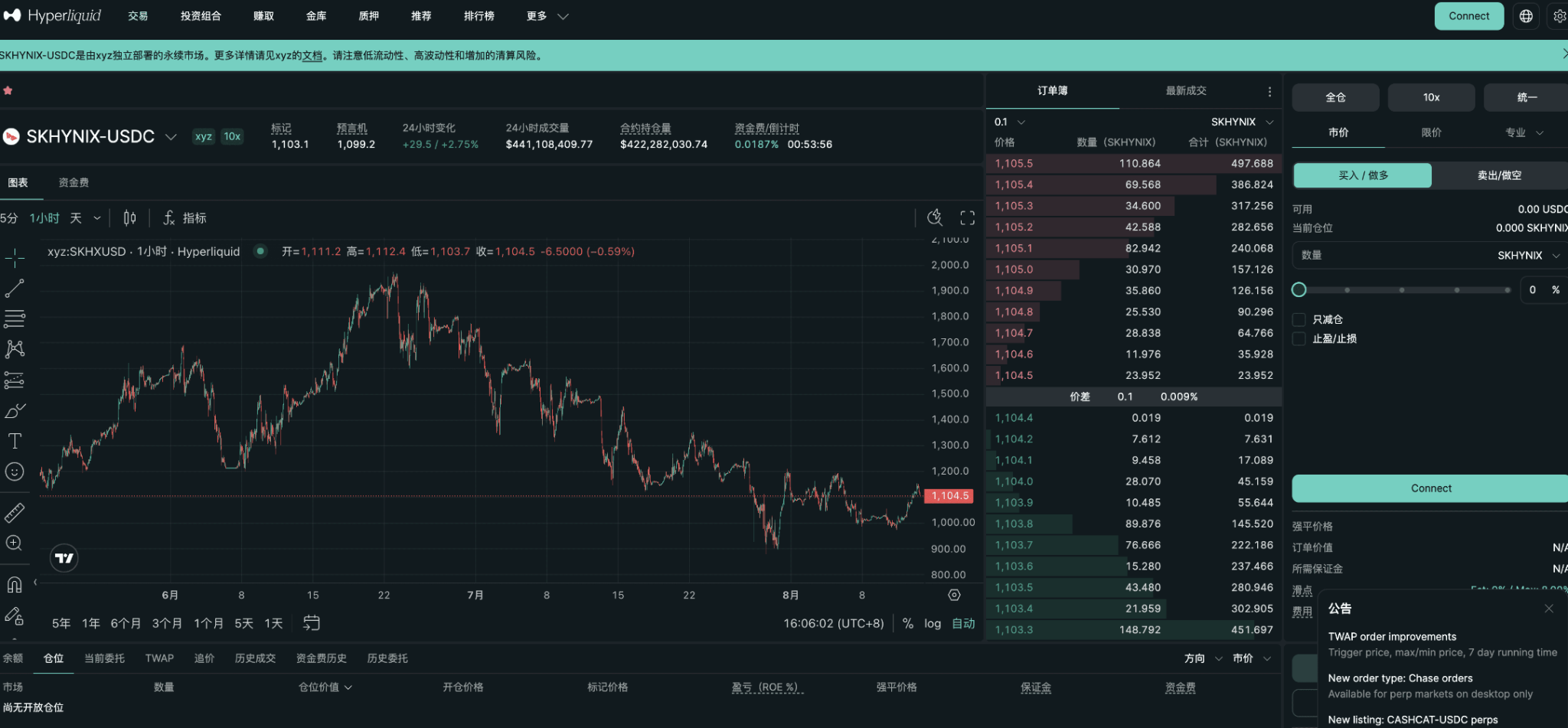
All the targets we discuss today revolve around the prices on this platform.
Some may have already noticed: why are the prices on-chain and in stock software different for the same name? It’s not necessarily because someone has incorrect data, more so because the rules of the two markets are different.
The US stock market has fixed opening and closing hours and cannot trade when the market is closed. But on-chain contracts are 24/7, so after the US stock market closes, if new information is released, the on-chain price will move first, and when the US market opens the next day, both sides will find a new balance.
Moreover, the on-chain market has its own buy and sell orders; when participation is low and depth is thin, a large order can by itself push the price down or pull it up sharply. Just like the previous incident with SK Hynix, where those holding the actual stock remained unaffected, while those going long on-chain suffered massive losses. Therefore, when looking at on-chain US stocks, one cannot just compare a single number; it is essential to see if it is the same time point and the same type of quotation.
What really determines whether you get liquidated or make a profit is the price on-chain; remember this point firmly.
Let’s look at the data and see which on-chain US stock products are the most active today.
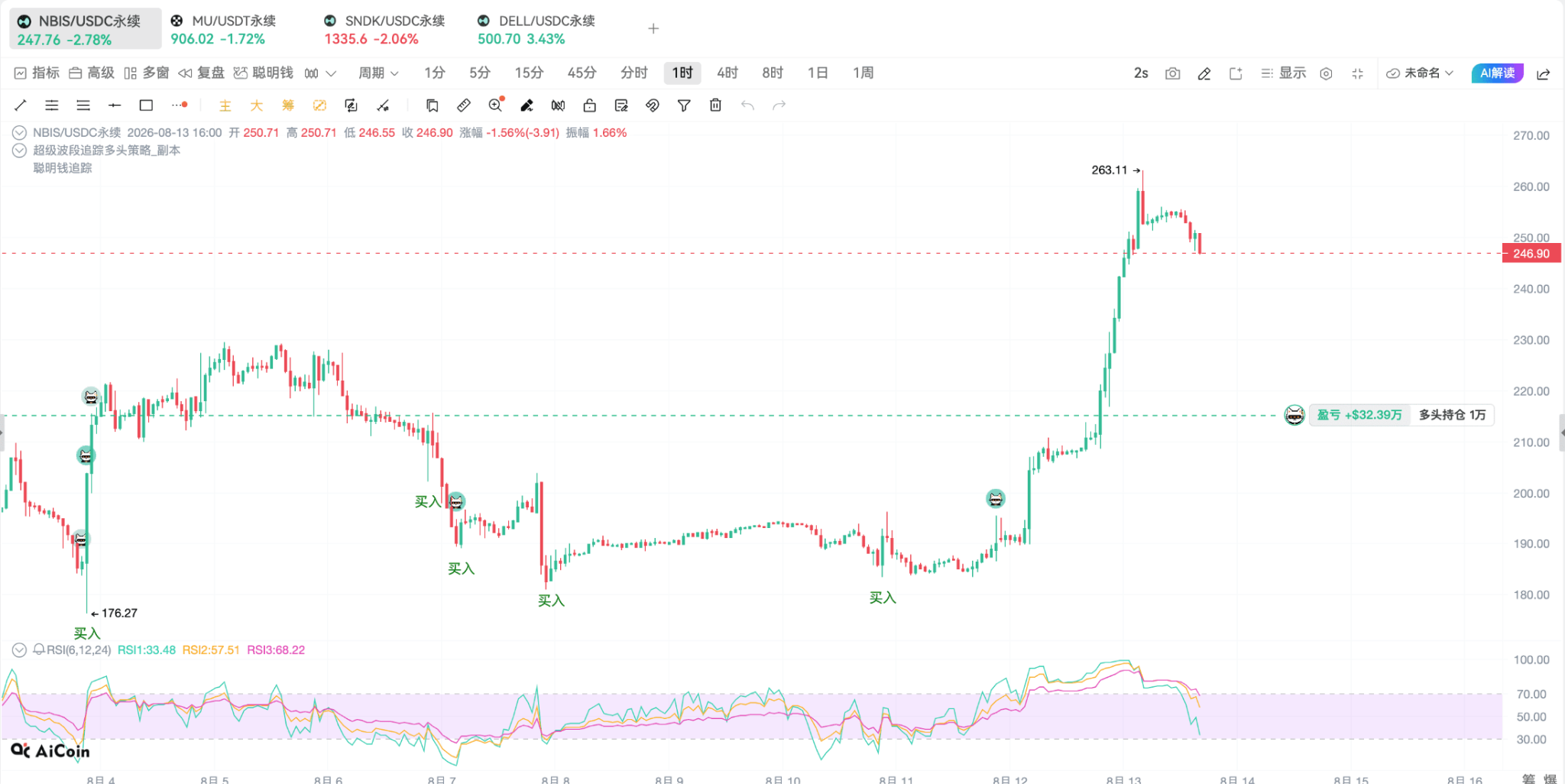
NBIS is undoubtedly the most eye-catching today. At the time of data capture, it had risen about 21.6% from the previous day's reference price, a significant increase, so it's no wonder everyone is asking what exactly happened.
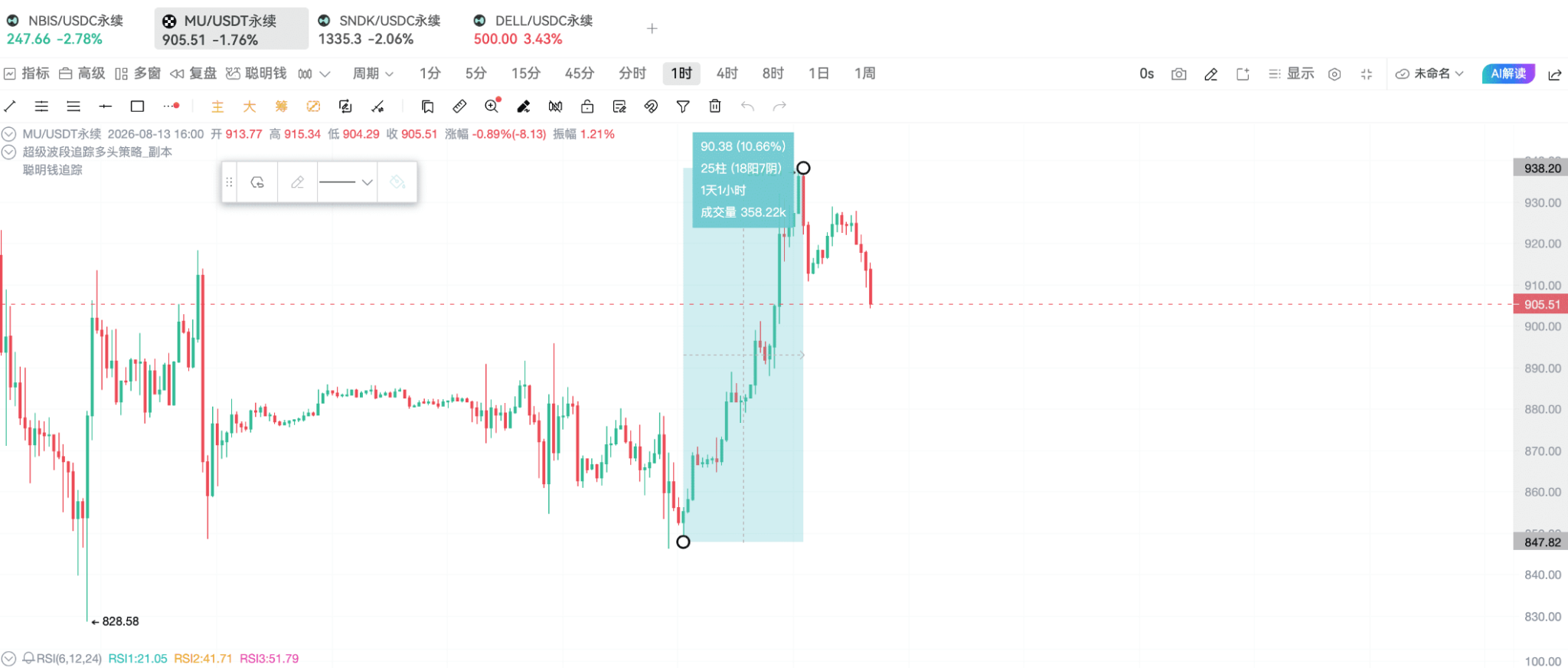
MU and SNDK both rose around 4.5%, not as wildly as NBIS, but with higher trading activity. One focuses on memory and the other on storage, and from them, one can infer whether this market surge is driven solely by NBIS's individual stock news or if there is funding moving into the entire AI hardware sector.
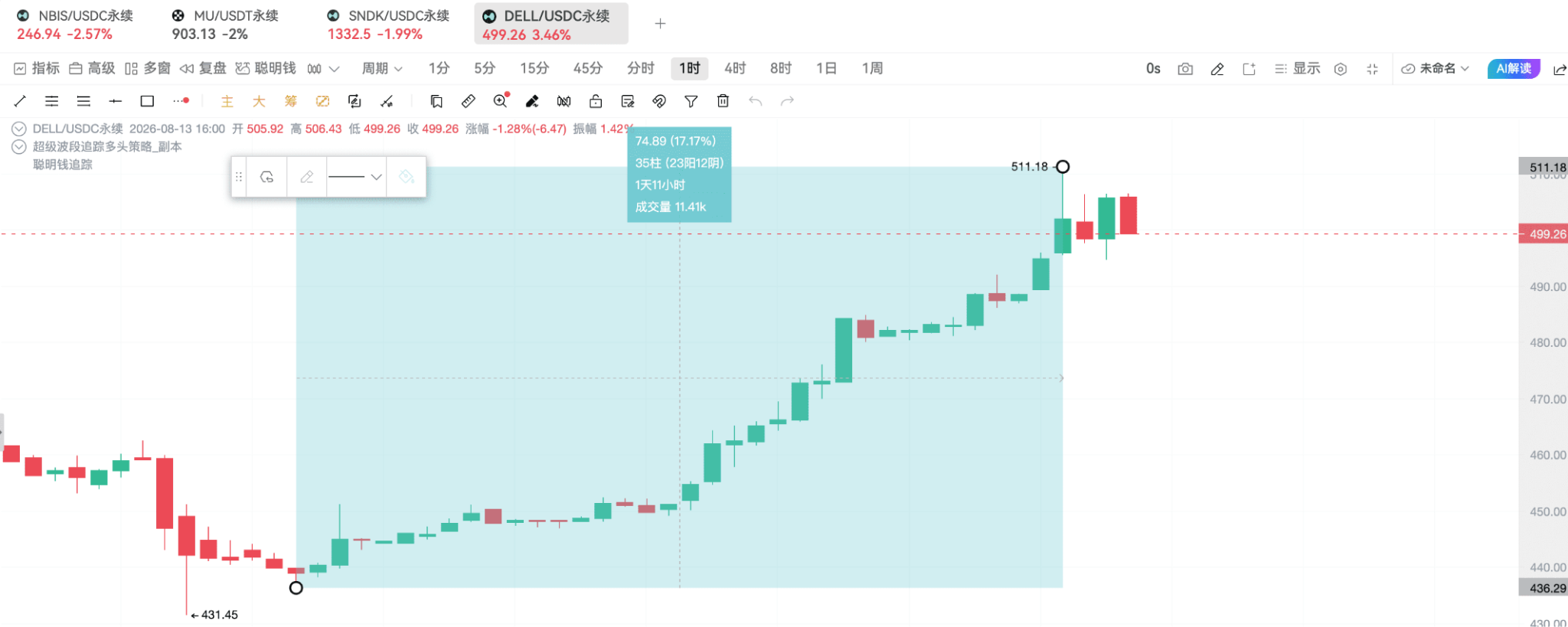
DELL also rose by 12.6%, which seems significant, but clearly many fewer people participated on-chain.
This type of product has a characteristic: it rises quickly but also falls rapidly, which is just right to discuss the risks of chasing highs. In summary: NBIS looks at hotspot heat, MU and SNDK at industry resonance, and DELL at risk signals.
Now let's talk in detail about today's protagonist, NBIS. Its corresponding company is Nebius, which focuses on AI infrastructure.
"AI infrastructure" sounds complex, but it just means building "factories" and providing "equipment" for artificial intelligence. Training AI models and running inference requires vast amounts of chips, servers, power, networks, and cooling systems; Nebius's role is to integrate these resources and provide computing services to businesses in need.
Such companies have a vast imagination space, given that more and more companies are competing for AI computing power. However, the practical issue is quite stark: building data centers is incredibly expensive. Land, power, chips, construction — every single one requires upfront heavy investment, and after completion, customers must come and use it truly for revenue to materialize.
Therefore, when analyzing Nebius, one cannot just ask "is AI hot?"; one must ask three more practical questions: has the customer signed contracts? Can the data center be completed on time? Can the money invested be converted into revenue? These three questions will run through the entire story of NBIS.
This reminds me of the movie "The Big Short", where the real-life character Michael Burry gained fame in 2008 by shorting the subprime mortgage market, and since then has liked to find short opportunities at the hottest moments in the market. Recently, he has focused on AI, believing valuations are too high, and capital expenditures are excessive which makes shorting some of these companies not difficult — and Nebius is one of the targets he aims to short.
At this time, Nebius also submitted a very solid earnings report. In the second quarter, revenues were $582 million, exceeding market expectations of $574 million; adjusted earnings per share showed a loss of $0.12, whereas the market had expected a loss of $0.70. Revenue from AI cloud business reached $575 million, a year-on-year increase of 514%, with a gross margin of 77%. The CEO also stated that the company had already secured four contracts worth billions of dollars.
Once the earnings report was released, NBIS on the US stock market surged by 34.14% in a single day. The xyz:NBIS on Hyperliquid also followed suit, rising by over 20% at one point in 24 hours, with a trading volume exceeding $100 million.
In this market surge, one address made a significant gain, which is 0xf29c6bc1147a841519b382459a6d7a373c6b9971. This is not a short-term player betting before the earnings report; they began to build up long positions on NBIS on June 12, buying 104.66 units at an average transaction price of $226.36. Later, NBIS shot up to $299.97, and they stayed in; subsequently, the stock price dropped from nearly $300 to a low of $141.48, a retracement of more than half, and they still held on.
Transaction records from the last 30 days show that on July 24, they already had 7,000 long positions; on August 3, when NBIS fell to a range of $181 to $184, they added more to their position. After flipping for two months, they now hold 10,000 units with an average cost of $215.37.
Based on Hyperliquid's price of approximately $251, this long position is worth about $2.51 million, with an unrealized gain of about $356,000. The entire account has earned approximately $947,000 in the last 30 days, with a profit of $1.089 million in the last week alone.
This address, which has laid out its position early and steadfastly held onto the right targets, is what we should truly focus on tracking as smart money.
Those who are optimistic about NBIS and AI computing power follow three core logical points.
- First, the demand for AI computing power continues to rise, as more companies are training models and running operations, which requires more data centers and servers; as long as demand does not cease, there is growth potential for computing service providers.
- Second, whether customers are willing to sign long-term contracts in advance. Just being verbally interested doesn’t count; a willingness to sign long-term contracts or even prepay demonstrates real demand and can help companies alleviate the financial pressure of building data centers.
- Third, will profitability improve once the scale is achieved? Data centers require a massive upfront investment, but once built and in use, as customer usage rates increase, additional income may not necessarily require a proportionate new investment.
Therefore, bulls are betting not on the scale that has been built today but on how much can be built and how many customers can be acquired over the next year or two, and how much revenue these customers will ultimately contribute. At least from the current earnings report, NBIS's performance is indeed strong, and even the "White-haired Stock God" is quite optimistic.
That said, where is the risk for these AI manufacturers?
The biggest risk for NBIS, ironically, lies in what makes it most attractive: rapid expansion costs money even faster.
Building AI data centers is not just about buying chips but also about land, power, networks, cooling, and construction, each requiring substantial funds. Even if a company has a lot of cash, it’s not just about "how much money is there"; it’s about how much is planned to be spent each year.
The second risk is progress risk. Signing contracts doesn’t mean revenue arrives immediately; if the data center experiences delays due to power, equipment, or construction, the customer's usage time is pushed back, and revenue would similarly be delayed.
The third risk is overly high expectations. After the stock price rises rapidly, the market has already priced in a lot of good news. Even if the company continues to grow, if it does not grow as fast as imagined, the price could also see a significant retracement.
As we dig deeper into the AI industry chain, what other segments could benefit?
When talking about AI, many immediately think of chips. However, when a complete AI system runs, it relies on an entire chain. The front end requires clients needing computing power — model companies, cloud vendors, and large enterprises; then come data centers and AI cloud platforms like NBIS that provide space, power, and computing power; further down the line are server manufacturers like DELL that put together entire systems of chips, memory, storage, networks, and cooling; at an even deeper level are memory represented by MU and storage represented by SNDK.
To put it simply, chips are like the chefs in a restaurant, but just having a chef doesn’t mean the business can operate; there also need to be kitchens, gas, refrigerators, a warehouse, and a whole service system. The concept of an AI data center follows the same reasoning; if any link does not keep up, the overall expansion will be stuck.
This is why after NBIS's earnings report ignited the market, we also need to watch MU, SNDK, and DELL. If multiple links activate together, it indicates the market is trading not just a single company's news, but the entire AI construction chain. The overall market's risk appetite is rising, making it easier to bring about significant trends.
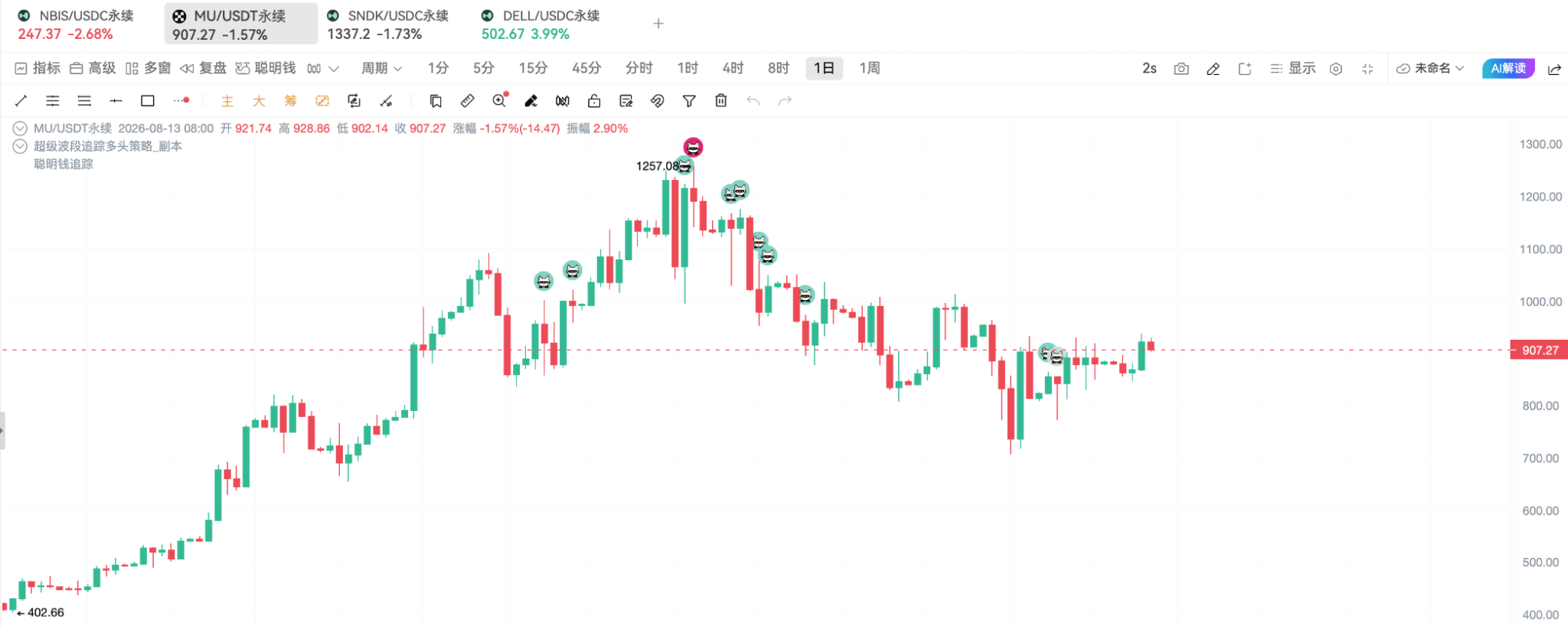
MU corresponds to Micron Technology, and AI servers not only require chips but also a large amount of high-speed memory to read and process data faster.
At the time of data capture, the on-chain price of MU rose around 4.5%, far less eye-catching than NBIS, but with higher trading activity and a less extreme movement. Such targets are particularly suitable for judging whether a theme has truly spread.
If only NBIS itself skyrockets, it might be just an earnings-driven single-stock trend; if the memory sector also becomes active alongside, it suggests the market is trading on broader demands for AI devices. Simply put, NBIS is the star under the spotlight, while MU is the adjacent confirmation light — as long as it’s lit, the entire industry’s narrative gains more credibility.
It can be seen that following the positive feedback from NBIS and the overall increase in market risk appetite, a large number of storage stocks have also begun to take off.
Let’s also talk about SanDisk SNDK.
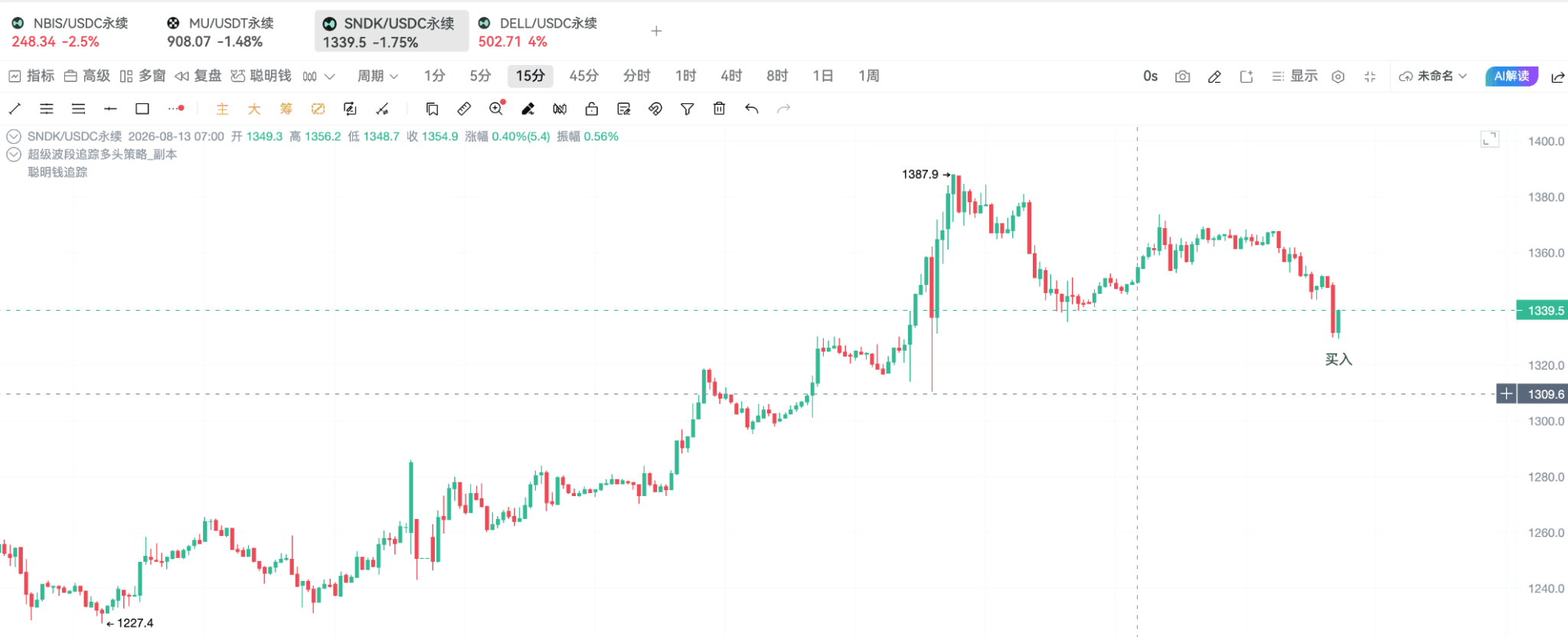
SNDK corresponds to the storage direction. AI models need to read and store vast amounts of data, and besides computation and memory, storage is also a fundamental aspect. At the time of data capture, SNDK's rise was similar to MU at around 4.5%, with trading activity nearly equivalent. However, when looking at it over three days, SNDK's fluctuations are more pronounced and more volatile than MU.
A reminder: the storage industry itself is a cyclical industry; when business is good, everyone expands, so the market valuations won’t always remain high. Don't just dive into storage stocks because they have a low PE ratio, as you may well be standing on the cusp of the cycle's peak.
MU and SNDK had similar gains and trading liveliness, but the key observation points differ. MU's trend is relatively stable and is more suitable for observing whether the heat in the entire memory direction can continue; SNDK's greater volatility is better for gauging whether the market is willing to continue pursuing high elasticity.
Should the market pull back next, if MU falls less while SNDK quickly retreats, it indicates capital is starting to withdraw from high volatility varieties and move toward stability; if both can stabilize and then rise together again, the persuasiveness of industry resonance is stronger. Storage may likely open up a second major market trend, so those who missed out last time should pay more attention to the chances of jumping in this time.
Now talking about DELL, at the time of data capture, the on-chain price rose about 12.6%, and clearly accelerated in the latter half of the recent three days. By itself, the trend looks strong, but the trading activity on-chain is significantly lower than that of MU and SNDK.
To put it plainly, on-chain, DELL is still seen as an edge player in AI. If there’s nothing else to hype in the future, if companies like DELL and Lenovo, those assemblers, get dragged out for speculation, one should be wary of short-term top risks.
Looking back at the entire path of speculation along the AI industry chain: starting from graphics cards and optical modules, to cloud vendors, then moving down to storage and assemblers, the segments that are being speculated on are increasingly further down the line, and the market is gradually starting to experience aesthetic fatigue. If everyone still wants to dig for opportunities in the AI industry chain, they can shift towards more segmented directions, like bottom-level aspects such as photoresists.
Finally, let me share several directions I personally find promising. Compared to the already over-speculated GPU, AI cloud, and servers, the following tracks are relatively less crowded.
First is power and grid transformation. The most significant shortage for AI data centers might not be chips but power. Transformers, distribution equipment, energy storage, nuclear power, and natural gas generation will all benefit indirectly. Transformers and inverters had surged the last two years; one can explore more segmented areas now.
Second is liquid cooling and heat dissipation. The power consumption of AI chips is increasing, and traditional air cooling cannot handle it anymore; liquid cooling, cold plates, pumps, and thermal exchange equipment will become necessities. This direction hasn’t surged much currently, making it a key focus area.
Lastly, industrial robots and edge AI. Not only are models trained in the cloud, but factories, automobiles, and logistics equipment will also implement AI on-site, representing a longer-term application chain. The currently popular world models are actually moving in this direction.
We have live streams every day, and you are welcome to continue following along, AiCoin friends! Reserve in advance 👇
https://www.aicoin.com/zh-Hans/live/list?tab=upcoming
Join our community to discuss together and grow stronger!
Official Telegram group: https://t.me/aicoincn
AiCoin Chinese Twitter: https://x.com/AiCoinzh
Aster rebate: https://www.asterdex.com/zh-CN/referral/9C50e2
Hype rebate: https://app.hyperliquid.xyz/join/AICOIN88
Binance rebate: https://jump.do/zh-Hans/xlink-proxy?id=3 invitation code: aicoin668
Coinbase rebate: https://jump.do/xlink?checkProxy=true&proxyId=25 invitation code: Y8L23JL
免责声明:本文章仅代表作者个人观点,不代表本平台的立场和观点。本文章仅供信息分享,不构成对任何人的任何投资建议。用户与作者之间的任何争议,与本平台无关。如网页中刊载的文章或图片涉及侵权,请提供相关的权利证明和身份证明发送邮件到support@aicoin.com,本平台相关工作人员将会进行核查。