Written by: KarenZ, Foresight News
Galaxy's second-quarter financial report shows that its two business engines are operating in different ways.
One follows the ups and downs of the cryptocurrency market, with falling coin prices continuing to drag down performance; the other extends upwards from Texas data halls, with servers installed and power delivered, and rent confirmed gradually as capacity increases.
Reduced Losses of 131 Million USD, Own Investment Portfolio Remains a Major Drag
On August 5, Galaxy Digital announced its second-quarter performance for 2026. The company's net loss for the quarter was 85 million USD, 131 million USD less than the 216 million USD loss in the first quarter; adjusted gross profit was 43 million USD, compared to a loss of 88 million USD in the first quarter. Adjusted EBITDA was a loss of 77 million USD, down from a loss of 188 million USD in the first quarter.
In simple terms, adjusted EBITDA is an operating metric obtained by excluding interest, taxes, depreciation, amortization, stock-based compensation, and some one-time items from net profit, and it is mainly used to compare business performance across different quarters.
Breaking down the business segments, the digital assets and data center operations combined contributed 86 million USD in adjusted gross profit, with an adjusted EBITDA totaling 1 million USD. Among them, the digital assets business achieved 66 million USD in adjusted gross profit, a 34% quarter-on-quarter increase, while adjusted EBITDA was a loss of 11 million USD; the data center achieved 20 million USD in adjusted gross profit and 11 million USD in adjusted EBITDA.
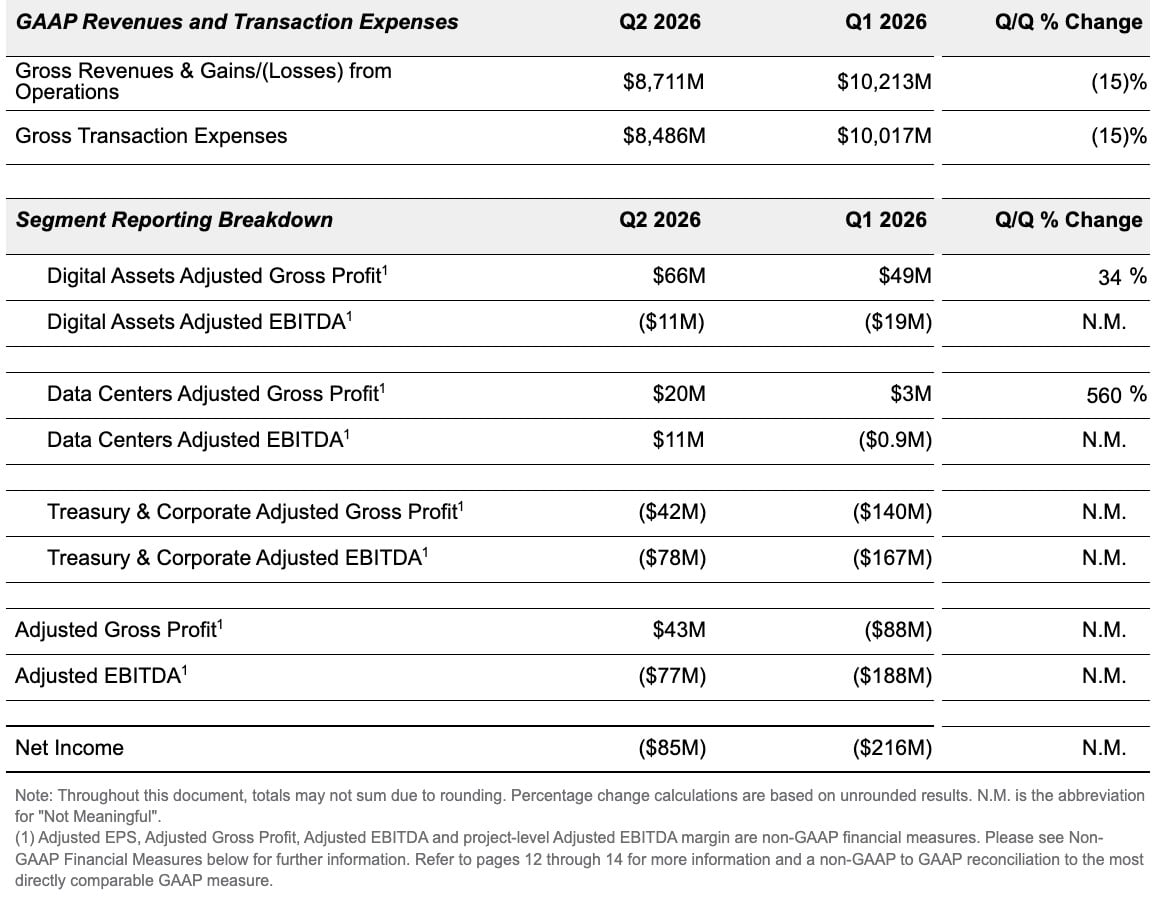
What left Galaxy's overall adjusted EBITDA in the loss range was primarily the company's own investment portfolio. The financial report categorized this portion under the "Treasury & Corporate" segment. It can be understood as a basket of assets held with Galaxy's own funds, including both digital asset spot, derivatives, and ETFs, as well as stocks of publicly listed companies, venture capital, private equity, and fund investments.
In the second quarter, this segment recorded an adjusted gross loss of 42 million USD and an adjusted EBITDA loss of 78 million USD. Galaxy stated that the main reason was the unrealized losses incurred by related digital assets and investment positions. The two operating businesses in digital assets and data centers together contributed 1 million USD in adjusted EBITDA, and after adding this segment, Galaxy's overall adjusted EBITDA turned into a loss of 77 million USD.
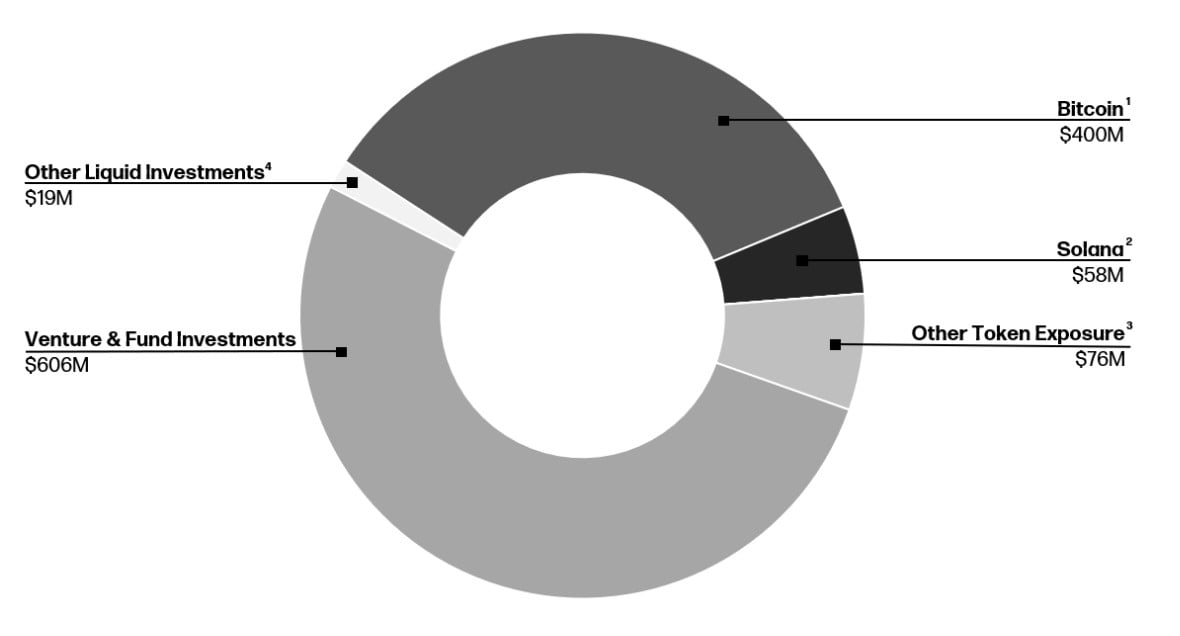
As of June 30, the net exposure of this investment portfolio was 1.16 billion USD. Among them, venture capital and fund investments amounted to 606 million USD, the largest; Bitcoin exposure was 400 million USD; other token exposure was 76 million USD; Solana exposure was 58 million USD; and other liquidity investments were 19 million USD. The financial report specifically noted that Bitcoin and Solana exposure, in addition to spot, also include derivatives, short positions, and other hedging positions, as well as wrapped tokens and related investment instruments, so the above amounts should not be directly understood as the scale of spot holdings.
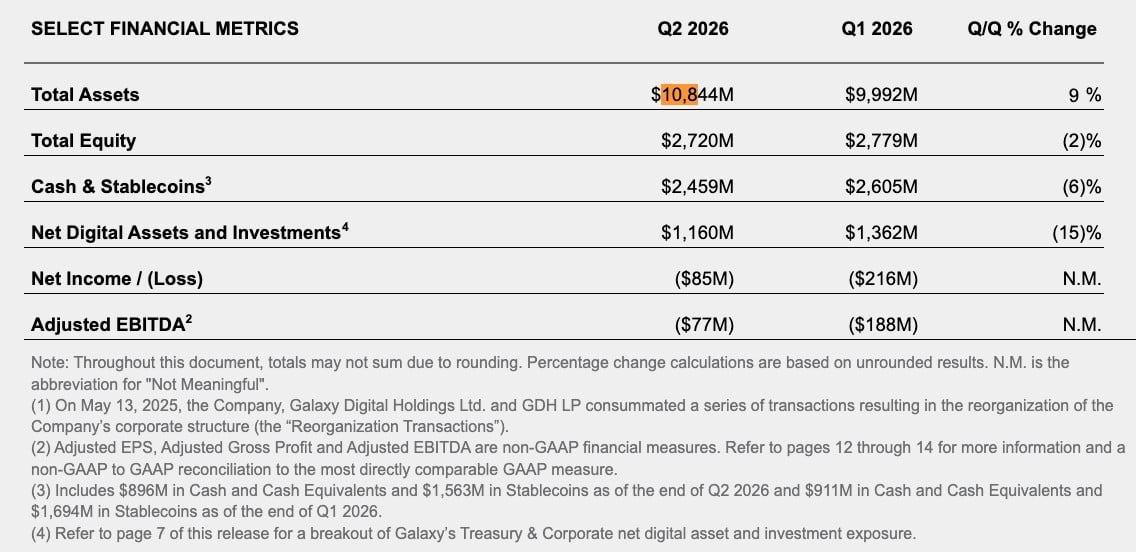
In terms of the balance sheet, as of June 30, Galaxy's total assets increased from 9.992 billion USD to 10.844 billion USD, a quarter-on-quarter growth of 9%; total equity declined from 2.779 billion USD to 2.720 billion USD; cash and stablecoins decreased from 2.605 billion USD to 2.459 billion USD. During this period, the previously mentioned net exposure of digital assets and investments decreased from 1.362 billion USD to 1.16 billion USD. These are changes in balance at the end of the period, distinct from the net loss for the quarter under different financial metrics.
Trading Volume Decreases, But Adjusted Gross Profit of Digital Assets Business is Rising
There was also an interesting contrast within the digital assets business.
The adjusted gross profit of global market operations increased from 31 million USD to 49 million USD, a quarter-on-quarter growth of 58%; the number of counterparties increased from 1,691 to 1,741, while the average loan size remained stable at around 1.4 billion USD. The company disclosed a 7% quarter-on-quarter decline in trading volume, stating that the drop in industry trading volume exceeded double digits during the same period. What can be confirmed here is that Galaxy maintained a relatively stable market share in a weak market but cannot conclude that long-term profitability has stabilized based on this.
The data for asset management and infrastructure solutions is more affected by coin prices. Galaxy disclosed that by the end of the second quarter, the total asset management scale and pledged assets amounted to approximately 7.1 billion USD, a quarter-on-quarter decrease of 12%, mainly influenced by the drop in digital asset prices. Among them, ETF-related assets were 1.805 billion USD, alternative assets were 2.553 billion USD, and pledged assets were 2.790 billion USD.
133MW Begins Collecting Rent, Helios Moves from Construction Site to Profit Statement
The most substantial change in the second quarter occurred in West Texas. Galaxy has delivered a total power of 200MW for Helios Phase 1 to CoreWeave, corresponding to 133MW of critical IT load, and completed the phase 1 delivery as planned. Rent was gradually confirmed in the second quarter with the delivered capacity, making the data center division a revenue-generating business for the first time.
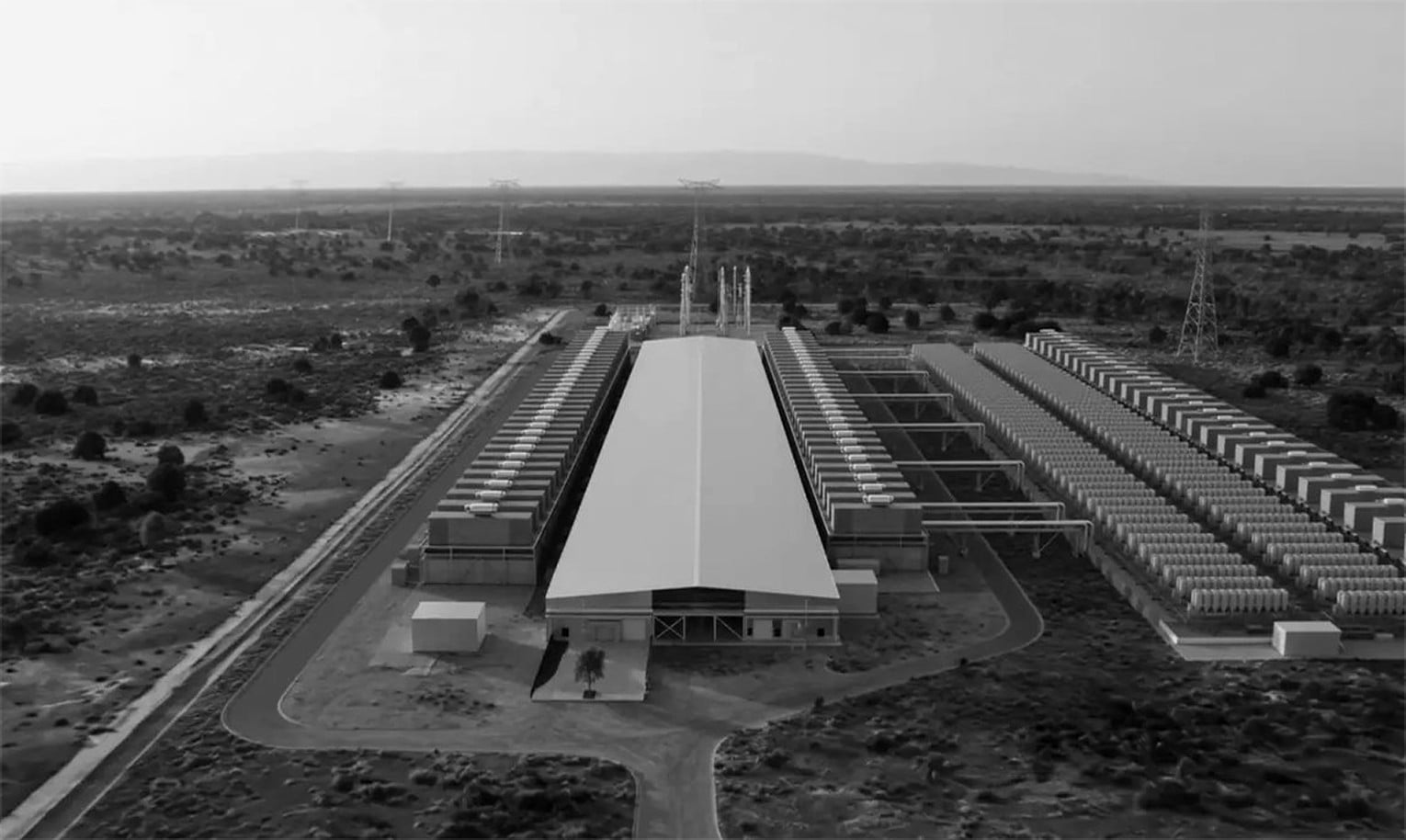
Aerial view of the Galaxy Helios data center park
After the delivery was completed, Galaxy expects Helios Phase 1 to generate approximately 80 million USD in quarterly rental income starting in the third quarter of 2026, with an adjusted EBITDA margin exceeding 90% at the project level. The core IT load contracted with CoreWeave has a basic lease term of 15 years; a total of 526MW of critical IT load has been signed across all three phases.
The company expects that the average annual income from this lease will exceed 1.2 billion USD over the entire lease period, with an expected average adjusted EBITDA margin exceeding 90% at the lease level.
This business also requires more capital. The data center capital expenditure for the second quarter was 448 million USD, up from 354 million USD in the first quarter. By the end of the quarter, the total liabilities categorized in the data center business increased from 1.33 billion USD to 1.548 billion USD.
On July 28, Galaxy's project company completed a private issuance of 3.5 billion USD in senior secured notes maturing in 2031, with the proceeds to be used for the construction of Helios Phase 2. Phase 2 plans to add 260MW of critical IT capacity, with the data hall expected to begin delivering from the second quarter of 2027.
As for the most eye-catching "over 5.7GW" in the financial report, it must come with qualifiers. It refers to the potential power pipeline laid out by Galaxy in Texas and is not capacity that has already been energized or leased. Helios currently has approved power capacity exceeding 1.6GW, with two additional applications for 1GW loads each in ERCOT interconnection processes; newly acquired Merlin, Caspian, and Selene parks have potential capacities of approximately 500MW, 700MW, and 900MW respectively, with the Merlin initial agreement supporting about 74MW.
From Institutional OTC Predictions to On-Chain Financing Rates Products, What Does Galaxy Want to Capture?
If Helios provides longer-term lease contracts, Galaxy's digital assets business is attempting to turn institutional services into reusable products.
In the second quarter and after, Galaxy launched institutional OTC prediction market trading, on-chain financing rate products (GOFR), and Galaxy Curator.
Among them, the on-chain financing rate product GOFR integrates floating rates from on-chain lending markets such as Aave, Morpho, Spark, and Kamino into a dynamically rebalancing financing rate, with clients dealing directly with Galaxy, which handles wallet, smart contract execution, and collateral monitoring. The company commits to investing up to 100 million USD of its own capital as priority loss protection, but the protection scope is subject to specific terms.
Galaxy Curator, on the other hand, is built on Morpho to develop institutional treasury strategies and distribute them through Fireblocks Earn, allowing institutions to access on-chain yield products within their existing approval, signature, and strategy control processes. They have expanded Galaxy's service boundaries but have not disclosed income separately in this quarter's financial report, so a more accurate description would be "product capability expansion" rather than "growth curve has been validated."
The compliance channel is also progressing concurrently. In May, the New York State Department of Financial Services granted GalaxyOne Prime NY a BitLicense and a money transmitter license, allowing it to provide regulated digital asset trading and custody services to institutions in New York State.
In August, Galaxy announced a multi-year partnership with Bank of New York Mellon (BNY) to provide staking support for BNY's digital asset custody platform and participate as a design partner in the platform's infrastructure construction.
Mike Novogratz, in the CEO letter of the same period, summarized Galaxy's strategy as a convergence of two forces: the migration of financial activities on-chain and the ongoing increase in demand for power, land, and data centers driven by the development of artificial intelligence. This is the management's explanation of the company's direction and not the financial results themselves. The information that truly impacts the reports in the second quarter is more straightforward: cryptocurrency asset prices still significantly affect profit and loss, the resilience of digital asset operating business has improved somewhat, and the data center has begun to contribute positive adjusted EBITDA for the first time.
Thus, the exam questions for Galaxy have become specific. On-chain products need to convert institutional partnerships into recurring revenue, and the Texas park needs to turn potential GW into billable MW at each milestone. In the financial report, on one side is the still volatile coin price curve, and on the other side are the electric meters that have started to turn. The weight of the next phase depends on whether the latter can light up on time and within budget, building by building.
免责声明:本文章仅代表作者个人观点,不代表本平台的立场和观点。本文章仅供信息分享,不构成对任何人的任何投资建议。用户与作者之间的任何争议,与本平台无关。如网页中刊载的文章或图片涉及侵权,请提供相关的权利证明和身份证明发送邮件到support@aicoin.com,本平台相关工作人员将会进行核查。


