Author: Claude, Deep Tide TechFlow
Deep Tide Introduction: On July 30, the U.S. stock market experienced a flurry of earnings reports after the bell. Apple's Q3 revenue was $109.4 billion, a 16% year-over-year increase, with iPhone sales reaching $54.2 billion, growing over 20% for three consecutive quarters. However, revenue from Greater China and services fell short of expectations; Tim Cook described the rise in storage prices as a "once-in-a-century event," leading to a drop of about 6% after hours. Amazon's Q2 revenue was $200.6 billion, exceeding expectations, with AWS revenue surging by 37% year-over-year to $42.2 billion, the fastest growth since 2021. The backlog of orders reached $496 billion, with CEO Jassy stating that AWS is set to become a trillion-dollar business, but capital expenditures were raised to $220 billion, which "is still not enough," resulting in a rise of over 10% after hours. Reddit's revenue grew by 61% year-over-year to $805 million, exceeding expectations and raising guidance, but due to unstable search referral traffic, it dropped by over 10% after hours.
Apple: Tim Cook's Last Earnings Call, Leaving a "Once-in-a-Century" Cost Warning
Apple's Q3 FY2026 (for the quarter ending June 27) revenue was $109.4 billion, up 16% year-over-year, with EPS of $2.02, a 29% increase year-over-year. Revenue and profit both exceeded analysts' expectations of $108.8 billion and $1.89, respectively.
iPhone revenue was $54.25 billion, up 22% year-over-year, surpassing the expected $53.86 billion, marking a historical high for the June quarter with growth exceeding 20% for three consecutive quarters. Mac revenue was $10.35 billion, a 29% year-over-year increase, driven by the MacBook Neo and MacBook Pro.
However, two key metrics fell short of expectations. Service revenue reached $30.74 billion, below analysts' expectations of $31.22 billion. Revenue from Greater China was $18.8 billion, lower than Bloomberg's expected $19.6 billion.
The stock price dropped about 6% after hours. CNBC pointed out that despite exceeding revenue expectations, the impact of storage costs has already manifested this quarter and will become a larger headwind in the future.
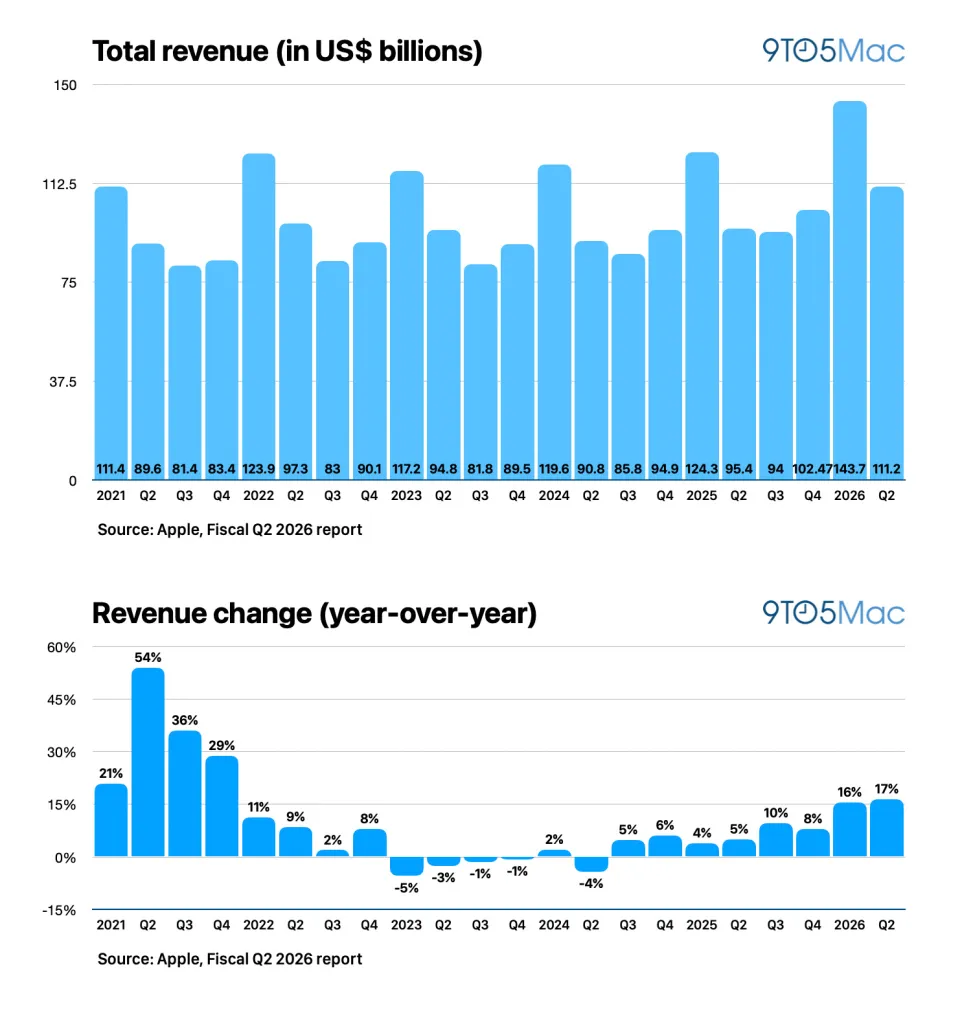
This was Tim Cook's last earnings call as CEO (effective September 1, hardware engineering head John Ternus will take over). Cook's farewell remarks included a heavy cost warning. He stated during the call, "We reluctantly raised prices. I would describe this trend in storage pricing as a 'once-in-a-century flood', with an exponential increase in storage prices."
Apple already increased prices for Mac and iPad in June, and management warned that storage costs will rise further in the September quarter. The guidance for next quarter's revenue is projected to grow 9%-11% year-over-year, with a gross margin expectation of 47%-48% (approximately 46.5% after adjusting for tariff rebates), with the slowdown in growth primarily due to about a 2.5 percentage point currency headwind and significantly intensified supply chain constraints.
Structural issues in Greater China are worth noting. Although revenue grew by 22.4% to $18.86 billion, IDC data showed Apple's market share in the Chinese smartphone market rose from 13.9% to 18.1%. However, part of the growth stemmed from consumers making early purchases—Apple had hinted at price increases in the second half of the year, leading to a wave of panic buying. This suggests that the digital figures in China for the second half could face overstatement risks.
Amazon: AWS Accelerates for Five Consecutive Quarters; Jassy Predicts Trillion-Dollar Revenue, but $220 Billion Capital Expenditure is "Still Not Enough"
Amazon's Q2 total revenue was $200.6 billion, a 20% year-over-year increase, exceeding analysts' expectations of $196.5 billion. EPS was $5.75, far exceeding the expected $1.82, but included $53.4 billion in non-operating pre-tax income primarily from investment returns in Anthropic.
AWS was the focus of this earnings report. AWS quarterly revenue reached $42.2 billion, a year-over-year increase of 36.7%, the fastest growth since 2021, significantly exceeding the analysts' expectations of $40.5 billion. AWS's annualized revenue has reached $169 billion, which, if calculated independently, would rank 24th in the Fortune 500. AWS's operating profit was $16.6 billion, a year-over-year increase of 64%, with an operating profit margin of 39.4%.
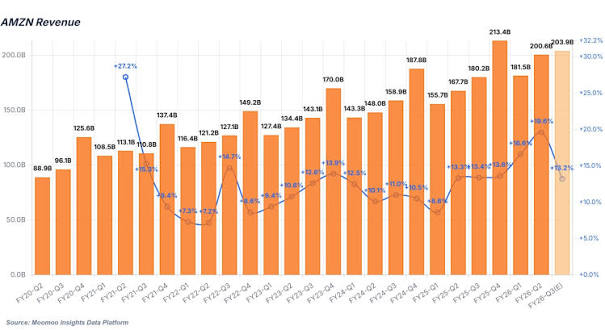
Jassy shared several significant figures during the call. AWS's backlog of orders (contracts signed but not yet launched) reached $496 billion. Jassy stated AWS is "highly likely to become a trillion-dollar annual revenue business in the future." AI and self-developed chip (Trainium, Graviton) businesses both exceeded $25 billion in annualized revenue, with three-digit year-over-year growth.
Capital expenditures continue to inflate. Jassy announced that the expected total capital expenditure for the year 2026 was adjusted from the previous $200 billion to $220 billion, primarily due to rising storage chip costs. However, he stated, "Even $220 billion is still not enough to meet all the needs for 2026. I believe 2027 will be the same."
Jassy detailed the logic of capital returns to analysts: Servers have a lifespan of at least 5-6 years, with most AI computing power signed under contracts of at least 5 years, and server and network equipment will generate substantial free cash flow within 2-3 years after breaking even. "Over time, the growth rate of revenue will exceed the growth rate of incremental capital expenditure."
For Q3 guidance, Amazon expects revenue of $197-202 billion. This is below LSEG analysts' expectations of $204.1 billion, but the company explained that this year's Prime Day was moved from July to June, causing a distortion in the year-on-year base for Q3. Adjusting for this factor, the growth rate would be approximately 400 basis points higher.
The stock price rose by over 10% after hours. The market's judgment was clear: In the AI infrastructure arms race, Amazon holds the most orders and is growing the fastest.
Reddit: Exceeds Expectations Across the Board but Concerns Over Search Traffic Trigger Selloff
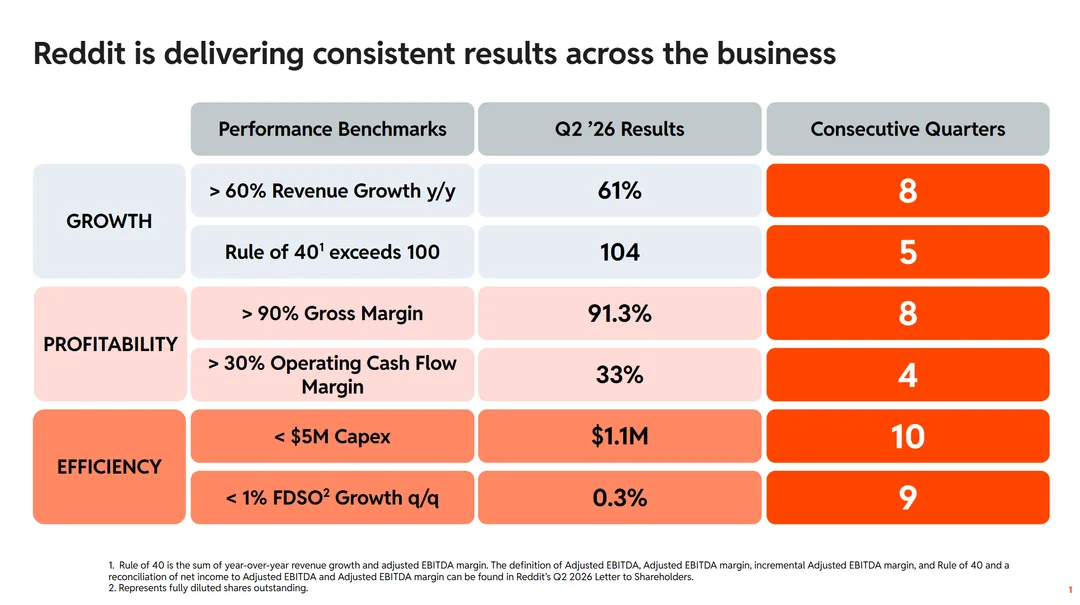
Reddit's Q2 revenue was $805 million, a 61% year-over-year increase, significantly exceeding LSEG expectations of $730 million. EPS was $1.25, well above the expected $0.95. Net profit reached $253 million, nearly double year-over-year. This marks Reddit's eighth consecutive quarter of revenue growth exceeding 60%.
Q3 guidance is also strong: Revenue is expected to be $860-870 million (median $865 million), surpassing analysts' expectations of $828 million. Adjusted EBITDA is projected to be $385-395 million, also exceeding the expected $368 million.
Advertising revenue grew by 64% year-over-year to $762 million, with international revenue up 84%. Global daily active users (DAUq) increased by 18% year-over-year to 130.3 million, while U.S. DAUq grew by 6% to 53.2 million. Free cash flow doubled to $261 million.
All core metrics exceeded expectations. However, the stock price dropped over 10% after hours.
The reason can be summarized in one sentence: Reddit stated in its letter to investors that "search referral traffic was unstable." This struck a sensitive nerve among investors. A significant proportion of new users on Reddit come from Google search result pages; if Google adjusts its search algorithms (for example, replacing traditional search results with AI summaries), Reddit's user acquisition costs and growth ceiling could both be impacted.
Another factor is valuation. Reddit's stock has seen significant gains year-to-date, and with multiple quarters of 60%+ growth, the market's tolerance threshold for "exceeding expectations" has become increasingly high. A revenue surprise of nearly 10% and guidance outperforming by 4% would have previously driven substantial increases; now it is only enough to maintain stability—any emergence of concerns turns into a reason for selloff.
Storage Costs: A Common Thread Through Three Financial Reports
When looking at these three financial reports together, the rising prices of storage chips are the core variable running through them.
Apple has directly borne the consumer impact: the "once-in-a-century flood" of storage costs has forced the company to raise prices for Mac and iPad, and the guidance for gross margin has been lowered, with pressure expected to increase in the second half. Amazon, meanwhile, feels pressure on the infrastructure side: the rise in storage costs is the main reason for the increase from $200 billion to $220 billion in capital expenditures.
The global DRAM market has only three major suppliers: Samsung, SK Hynix, and Micron. The demand for high-bandwidth memory (HBM) driven by AI has completely broken the supply-demand balance in the traditional memory market. Cook stated on the call that Apple is "evaluating all supply flexibility options." More troublesome is the demand from U.S. senators on the same day, July 30, that Apple cease procurement from Chinese memory manufacturers Yangtze Memory Technologies Co. (YMTC) and ChangXin Memory Technologies (CXMT) before August 21, further narrowing Apple's supply options.
For investors, memory chips are a crucial cost variable for the technology sector in the second half of this year. They affect both the gross margins of consumer electronics and the capital expenditure efficiency of cloud vendors, with no signs of easing on the supply side in the short term.
免责声明:本文章仅代表作者个人观点,不代表本平台的立场和观点。本文章仅供信息分享,不构成对任何人的任何投资建议。用户与作者之间的任何争议,与本平台无关。如网页中刊载的文章或图片涉及侵权,请提供相关的权利证明和身份证明发送邮件到support@aicoin.com,本平台相关工作人员将会进行核查。


