I really enjoy this kind of friendly discussion. What Teacher Mai Tian said about crude oil storage potentially changing the peak price has already been mentioned by the third friend. I am very grateful that the teachers are willing to spend time communicating with me; I am truly very happy.
Indeed, the crude oil inventory in the market has decreased significantly compared to March when compared to the government emergency reserves of IEA member countries. However, I do not believe that a mere decrease in inventory is sufficient to conclude that oil prices will definitely break through historical peaks.
There are three reasons:
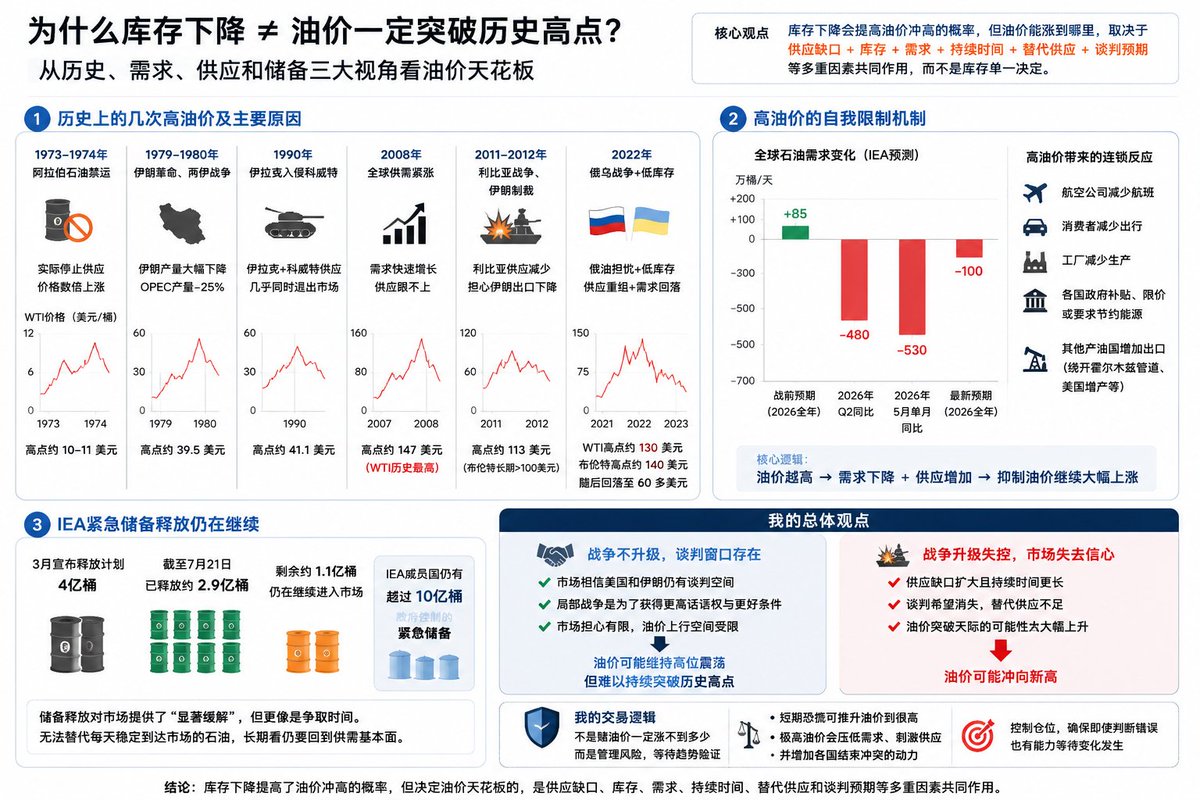
1. Historical reasons for several high oil prices
1973 to 1974: Arab countries imposed an oil embargo on the United States and other countries while actively reducing production. At that time, it was not the market's concern about a potential oil shortage in the future; it was that oil really stopped being supplied, leading to a several-fold price increase.
1979 to 1980: The Iranian Revolution coupled with the Iran-Iraq War. Iranian production significantly decreased, and then Iran and Iraq went to war, further impacting supply throughout the Middle East. By 1981, OPEC's production had dropped by about a quarter compared to 1978, and oil prices roughly doubled.
1990: Iraq invaded Kuwait. The oil supply from Iraq and Kuwait almost simultaneously exited the market, and there were also concerns that the war would expand to oil-producing countries like Saudi Arabia, leading to a rapid rise in oil prices. However, as the outcome of the war became clearer, other countries increased their supply, and oil prices quickly fell back.
2008: During this period, the global economy had been growing rapidly for several years, with countries like China and India rapidly increasing their oil consumption, but new production could not keep pace, and the amount that could be temporarily increased was very limited. The market was in a long-term state of "demand exceeds supply."
WTI pushed close to $147 (historical high). After the financial crisis broke out, global demand suddenly dropped, and oil prices plummeted.
2011 to 2012: The Libyan civil war, the Arab Spring, and Iranian sanctions occurred simultaneously. Libyan oil supply decreased, and there were concerns that Iranian exports would continue to decline, while global demand was still growing, so Brent crude remained above $100 for a long time.
2022: After the Russia-Ukraine war broke out in 2022, WTI rose to around $130, and Brent approached $140. Although the war has not ended, Russian oil continued to flow to the market through new trade routes, other oil-producing countries increased supply, and high oil prices began to suppress demand, leading WTI to ultimately return to over $60.
Therefore, the restructuring of trade routes is also an important reason.
These are several historical peaks; I won't mention the latest situation between the United States and Iran. What often pushes oil prices to extreme positions is usually a combination of supply gaps, inventory, demand, and duration. Inventory is just one aspect and not the only main reason.
2. Self-restraining mechanisms
The release of inventory is just part of it; more importantly, after oil prices become too high, the world begins to reduce oil consumption, and other oil-producing countries increase exports. According to the IEA's latest July report, global oil demand in the second quarter of this year decreased by about 4.8 million barrels per day compared to the same period last year, with a monthly decline in May reaching as much as 5.3 million barrels per day. Before the war, the IEA had predicted an increase in demand of 850,000 barrels per day this year, which has now been revised to a decrease of about 1 million barrels per day for the whole year.
This is the most important self-restraining mechanism of high oil prices. The higher the oil price, the more airlines reduce flights, consumers reduce travel, factories reduce production, and governments start to subsidize, set price limits, or call for energy conservation. Meanwhile, other oil-producing countries will find ways to increase exports; Saudi Arabia and the UAE will use pipelines that bypass the Strait of Hormuz more, and countries like the United States will also increase supply.
3. IEA's release
The release of IEA reserves has not yet ended. As of July 21, approximately 290 million barrels of the 400 million barrels release plan announced in March have been released, with about 110 million barrels still continuing to enter the market, while IEA member countries still have over 1 billion barrels of emergency reserves controlled by their governments.
My point is that if the war does not continue to escalate, the market will believe that the United States and Iran still have a window for negotiation, and local wars are just to gain higher bargaining power and better negotiation conditions; the market's concerns are limited.
If the war truly escalates, and the market loses confidence in the controllability of the war situation, then the likelihood of oil prices skyrocketing is very high, as was the case at the beginning of the Russia-Ukraine war. However, before the conflict between the US and Iran, the Russia-Ukraine war also had not ended, but oil prices dropped from $140 back to over $60.
My logic for shorting oil has never been "the historical high is only $147, so it will never exceed $147 in the future." My judgment is that although short-term prices can panic to very high levels, extremely high oil prices themselves will suppress demand, stimulate supply, and increase the motivation for various countries to end conflicts. What I need to do is control my position and ensure that even if I misjudge the short term, I have the capacity to wait for these changes to happen.
Of course, I have repeatedly stated that this is my personal view; my personal opinion may not be correct, but this is indeed my understanding after doing my homework. My understanding may be wrong; this is also very possible, so I will use my position to hold myself accountable for my understanding.
免责声明:本文章仅代表作者个人观点,不代表本平台的立场和观点。本文章仅供信息分享,不构成对任何人的任何投资建议。用户与作者之间的任何争议,与本平台无关。如网页中刊载的文章或图片涉及侵权,请提供相关的权利证明和身份证明发送邮件到support@aicoin.com,本平台相关工作人员将会进行核查。


