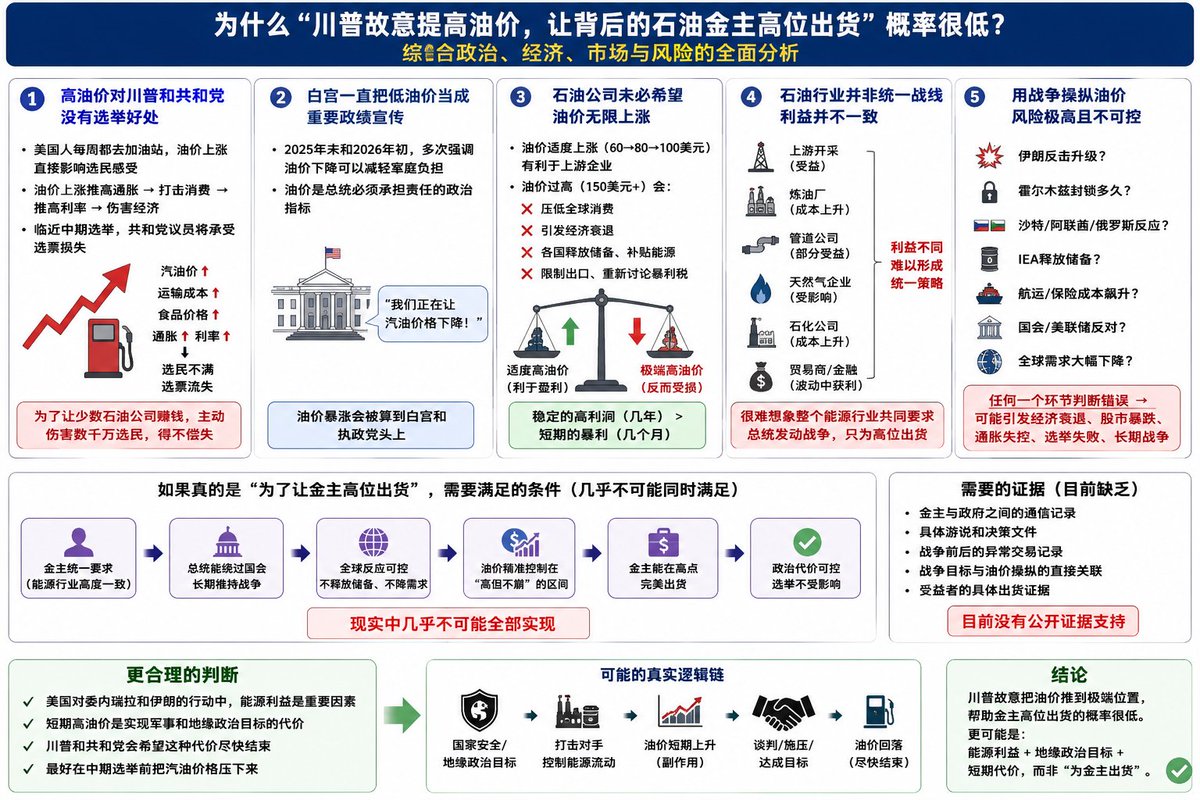
I have heard similar statements from friends many times. When there's nothing to do on the weekend, we chat about it. From my perspective, the likelihood that Trump deliberately raises oil prices to benefit his financial backers is extremely low.
Firstly, high oil prices bring no electoral benefit to Trump or the Republican Party.
The average American might not pay daily attention to Iran, Venezuela, and the Strait of Hormuz, but they do visit gas stations every week. On July 20, the average gas price in the U.S. surpassed $4 per gallon again, having risen over 30% since late February, before the escalation of the war.
After gas prices increase, the prices of transportation, aviation, agriculture, express delivery, food, and goods will all be affected, and the Fed’s ability to cut interest rates will also be constrained. Oil producers might make more money, but the impact is felt by tens of millions of American voters and nearly all industries.
With the midterm elections approaching, it does not make sense for Trump to create inflation, impact consumption, and raise interest rates just to let a few oil companies make extra profits, while the Republican lawmakers bear the loss of votes.
Before the war, the White House promoted low gas prices as an important achievement. At the end of 2025 and the beginning of 2026, the Trump administration repeatedly emphasized the decrease in gas prices, believing it could ease the burden on families.
Trump's own promotions, of course, cannot directly prove his true motives, but at the very least, they indicate that gas prices are a political indicator for which the U.S. president must take responsibility. After oil prices soar, voters will not blame the oil companies but will ultimately hold the White House and the ruling party accountable.
Secondly, oil companies may not necessarily want oil prices to rise indefinitely.
The rise of oil prices from $60 to $80 or $100 might be good for upstream producers, but if oil prices suddenly shoot up to $150, $180, or even $200, the situation would be completely different.
High oil prices can suppress consumption, lead to economic recession, force countries to release oil reserves, subsidize energy, restrict exports, and even revisit windfall taxes and price interventions.
The U.S. Energy Information Administration has pointed out that this year's high oil prices, fuel shortages, and the measures taken by various countries to reduce consumption are clearly suppressing global oil demand. The more extreme the oil prices are, the fewer quantities oil companies will be able to sell in the future. For large energy companies, being able to maintain high-profit prices for several years is usually more valuable than a few months of uncontrollable surges.
Moreover, the so-called “oil backers” are not a unified organization. The interests of oil extraction companies, refineries, pipeline companies, natural gas companies, petrochemical companies, and commodity traders are not completely aligned when faced with high oil prices. Even for integrated energy giants, different business segments may profit while incurring higher costs. It is hard to imagine the entire energy industry collectively asking the president to create an uncontrollable war just to cash out collectively on a certain day. 😂
Furthermore, the risks of manipulating oil prices through war are simply too high.
The U.S. president can launch airstrikes, expand sanctions, and deploy troops, but he cannot fully control how Iran will retaliate or how long the Strait of Hormuz will be blocked. Saudi Arabia, the UAE, Russia, the IEA, shipping companies, insurance companies, Congress, the Federal Reserve, and global consumers will all react in their own ways.
If any single link in this chain misjudges the situation, the outcome could shift from rising oil prices helping backers profit to a global economic recession, a significant drop in U.S. stocks, uncontrolled inflation in the U.S., the Republican Party losing Congress, or even the U.S. becoming embroiled in a prolonged war.
It is difficult to consider such numerous uncontrollable variables as a precise trading plan to help the backers cash out at high prices.
Lastly, regarding the significance to Trump himself.
Deliberately pushing oil prices to extreme levels to help behind-the-scenes oil backers cash out involves prohibitive political costs for Trump and the Republican Party, while the execution process is filled with uncontrollable variables.
What could these so-called backers possibly provide to Trump?? What could be more advantageous than Trump continuing to hold the presidential position? What could be more advantageous than a smooth handover to the next Republican?
A more reasonable judgment is that Trump may be willing to view short-term high oil prices as a cost to achieve military and geopolitical goals, but he and the Republican Party would certainly prefer this cost to end soon, ideally lowering gas prices again before the midterm elections.
免责声明:本文章仅代表作者个人观点,不代表本平台的立场和观点。本文章仅供信息分享,不构成对任何人的任何投资建议。用户与作者之间的任何争议,与本平台无关。如网页中刊载的文章或图片涉及侵权,请提供相关的权利证明和身份证明发送邮件到support@aicoin.com,本平台相关工作人员将会进行核查。


