South Korean retail leverage remains high — CFD balance close to historical peak
The previous discussion focused on South Korea's margin accounts and leveraged ETFs, now the CFD data can also showcase the leverage level of South Korean investors.
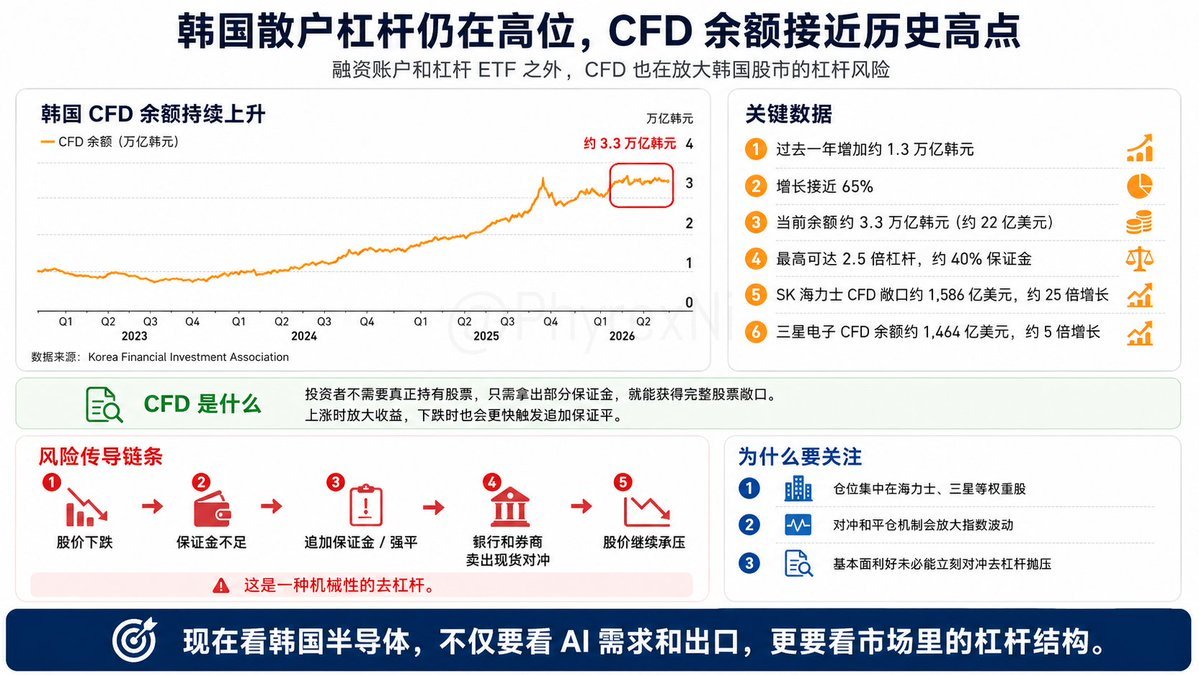
According to data from the Korea Financial Investment Association, the unfunded balance of South Korean CFDs has increased by approximately 1.3 trillion won over the past year, nearly a 65% growth, currently reaching about 3.3 trillion won, equivalent to 2.2 billion dollars, and it is near historical highs.
CFD can be understood as another type of stock leverage tool. Investors do not need to actually own the stocks; they only need to provide about 40% margin to gain full stock exposure, with leverage up to 2.5 times.
During an upward trend, CFDs can amplify profits. When stock prices fall, insufficient margin will trigger a margin call, and if investors do not continue to add funds, their positions will be directly liquidated, similar to cryptocurrency contracts.
This round of CFD funding is also concentrated on the hottest AI semiconductor stocks in South Korea. The CFD exposure of SK Hynix has increased by about 25 times to reach 158.6 million dollars, and the CFD balance for Samsung Electronics has also grown about 5 times to reach 146.4 million dollars.
With increasing demand for HBM and rising storage prices, the earnings expectations for Hynix and Samsung continue to strengthen, and the stronger the fundamentals, the more willing retail investors are to use leverage to amplify their positions.
As mentioned earlier, over 1.2 million leveraged accounts in South Korea have received margin call notices this year, with approximately 320,000 to 360,000 accounts being directly liquidated by brokers. The risks of CFDs will continue to transmit to the spot market since banks and brokers typically need to hold or trade the corresponding stocks to hedge their clients' CFD positions.
When clients are forcibly liquidated, banks also need to sell the corresponding spot positions to unwind the hedge.
As stock prices fall and investors face insufficient margin, the triggering of forced liquidation results in banks selling stocks like Hynix and Samsung, with further selling in the spot market causing stock prices to decline. Ultimately, this results in a mechanical deleveraging cycle.
South Korea has already suspended the listing of new single stock leveraged ETFs, indicating that regulators are starting to worry about the impact of retail leverage on market stability. However, suspending new products will not cause existing margin accounts, leveraged ETFs, and CFD positions to disappear automatically; there remains a significant amount of funds in the South Korean market that need to be passively adjusted amidst volatility.
These positions are primarily concentrated in index heavyweight stocks like Hynix and Samsung; as long as there are sufficient price fluctuations, the hedging and liquidation mechanisms may further amplify the ups and downs of the index.
Therefore, looking at South Korea's semiconductor sector now, AI demand, chip exports, HBM orders, and storage prices are indeed very important, but the leverage structure in the market remains the most crucial aspect, at least for now.
@Gate Crypto, US stocks, Hong Kong stocks, Korean stocks, gold, CFD, one-stop trading for futures markets
免责声明:本文章仅代表作者个人观点,不代表本平台的立场和观点。本文章仅供信息分享,不构成对任何人的任何投资建议。用户与作者之间的任何争议,与本平台无关。如网页中刊载的文章或图片涉及侵权,请提供相关的权利证明和身份证明发送邮件到support@aicoin.com,本平台相关工作人员将会进行核查。


