Organized & Compiled: Deep Tide TechFlow
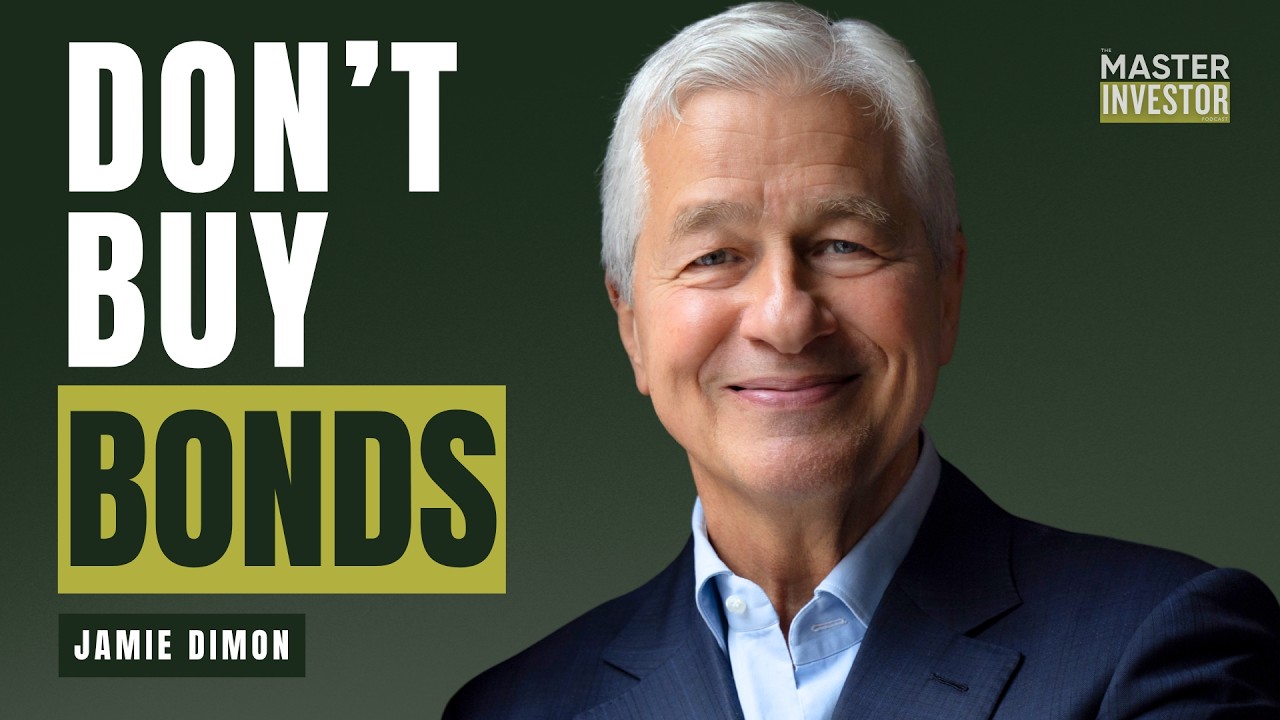
Guest: Jamie Dimon, Chairman and CEO of JPMorgan Chase
Host: Wilfred Frost, Master Investor Podcast
Podcast Source: Master Investor Podcast
Original Title: Jamie Dimon: Why I Won't Buy Bonds, AI's Future & Leadership Lessons
Broadcast Date: July 20, 2026
Disclosure of Interests: Jamie Dimon manages JPMorgan Chase, the largest bank in the world by assets (nearly $5 trillion in assets, $900B+ market cap). This episode discusses the overall market and macro judgments, without recommending any specific stocks. JPMorgan's income depends on trading volume, asset management scale, and investment banking activity; if Dimon's bearish view leads to volatility, it may actually benefit its trading business.
Note: Dimon, as the CEO of a large financial institution, discusses macro and industry judgments rather than specific stock recommendations; the conflicts of interest do not constitute a significant issue.
Key Points Summary
Jamie Dimon manages the largest bank in the world and just delivered the highest quarterly profit ever of $21.2 billion. But in this 60-minute interview, his repeated emphasis is on risk. His core judgment is straightforward: at current price levels, he will not buy the U.S. stock market or long-term government bonds. The reason is not that any particular stock is too expensive, but the real issues lie in geopolitics, fiscal deficits, and AI investment returns – which are not fully priced in by the market.
Regarding AI, he is not bearish; on the contrary, he believes AI will cure cancer and extend life. However, the pace of spending and the timeline for returns are almost impossible to meet market expectations, and early leaders could be replaced by latecomers, like Yahoo and Netscape. In the latter half of the interview, Dimon rarely reveals a personal side: the "sinking feeling" he had when he signed the acquisition of Bear Stearns in 2008, a near miss from the operating table due to aortic dissection in 2020, and family barbecues on Fridays.
Highlights of Opinions
Not Buying U.S. Stocks and Long Bonds
- "If I were a retail investor, I would consider individual really good investments, but at this price level for the overall market, I wouldn't buy."
- "Long-term government bonds? Personally, I would not buy. Even if inflation returns to 2%, the yield on the 10-year government bond should be around 4% to 4.5%, which we've pretty much reached. I don't understand where the upside is."
AI Investment Returns
- "AI is real; it will cure cancer, your children will live to 100. But the money poured in is enormous. Will there be overall returns? Probably yes, like the internet. Will the return happen in the way and time you expect? Absolutely not."
- "We've seen Yahoo and Netscape, and those companies went bankrupt. Google rose later, Facebook came later."
Geopolitical Risks Underestimated
- "I believe these risks could be much larger than others think."
- "The market may have baked in some factors, but it hasn't baked in what might happen next if these events actually occur."
Fiscal Deficit
- "Global debt is about 100% of GDP, with a deficit of about 5%. Such numbers usually only happen during major recessions or wars. My judgment is that this will ultimately become a problem."
- "It will manifest in higher interest rates. Remember the bond vigilantes, they will demand higher returns to compensate for fiscal risks."
Leadership
- "Bureaucracy, complacency, and its cousin, arrogance, are the scourges of any company."
- "Customer complaints are gifts. When a customer complains, don’t first think about whether they are right, look for the parts they might be right about."
- "Some people become insecure when they attain high positions. Insecure people tend to surround themselves with friends, modify reports to make them look good, and not tell you bad news."
Record Profits Don't Mean 'Anything Goes'
Wilfred Frost: A few days ago, you delivered the highest quarterly profit ever, $21.2 billion, a 41% increase year-on-year. I don't want to rain on your parade, but can this situation continue?
Jamie Dimon: We are a company built for the long term. Obviously, the current environment for banks is almost the best: high trading volumes, high asset prices, many people doing transactions. This state can last for a while, but it will ultimately end. That's not how we run our bank. We serve clients globally every day, investing regardless of market conditions.
I remind you, our best year was not the year we made the most money. Our best year was 2008, with a tangible equity return of only 7%, but we outperformed everyone; that was our most brilliant moment in a relative sense.
Wilfred Frost: Current economic data is good, your stock prices are good, and the economy is good. But do you think the tail risks are higher than they have been for most of the time you've been in charge for 20 years? Excluding 2008 and COVID.
Jamie Dimon: First, I don’t know what probabilities the market has baked in. If you say the market has a 10% chance of dropping 40%, that’s a 4%, a PE multiple thing, so maybe something has already been baked in. But it hasn't baked in what happens next if these things actually occur.
Do an exercise listing all those complex, long-term geopolitical constructs: the Ukraine war, Middle East terrorism, Iran, global massive deficits, global remilitarization, U.S.-China relations. These things might cause problems, or they might not. I hope they can all be properly resolved. But I do believe these risks could be much larger than others think.
Resilience of Oil Prices and the 'Straw that Broke the Camel's Back'
Wilfred Frost: You previously said the global economy unexpectedly withstood the shock of Iranian oil prices. But now the war has flared up again, and the Strait is closed. Can we be this lucky again?
Jamie Dimon: I think the resilience does not come from oil inventory. If you look back, there’s been a daily reduction of 20 million barrels, but China cut 5 million barrels, released reserves, and we also released reserves; another 5 million barrels have been transferred to the other side of the Red Sea. The adjustment process is remarkable, and no one predicted it in advance.
But oil is just one issue. The war in Ukraine is still ongoing, trade negotiations are happening, and the global deficit is there. I don’t know when or how these will cause problems, but I won’t take them off the list.
My assumption is that the global economy is more diversified now, hence more resilient, and it is far less dependent on energy than in the past. But that doesn't mean there isn’t a breaking point. The breaking point is a strange thing; if you look back at each one in history, it’s always triggered by multiple events converging simultaneously. It might take more straws to break this camel’s back, and now that this war has restarted, perhaps it isn’t enough.
Iran: It's Not an Economic Issue, It's a Survival Issue
Wilfred Frost: If the president were to ask you, can the economy support military actions against Iran for several months?
Jamie Dimon: You have to distinguish what is truly important and what is economic. On the economic side, you don’t want to see oil prices rise or unemployment rates increase, and that’s correct. But Churchill endured Hitler alone for 18 months; could the economy take it? Not very well. But you did.
Iran, whether you like this war or not, I think it is naive to pretend it isn’t a significant threat to the world. They have been killing for 47 years. They cannot have nuclear weapons. Something has to be done. Why have we allowed so many proxy wars to continue endlessly?
I think the president needs to go before the American people and say this is important; we need to resolve it. I can choose not to go to war, not to send a hundred thousand kids to the battlefield, but we need a strategy, primarily economic, to tighten their economy until they say enough. That might take a year; oil prices might rise, but it’s better than them having nuclear weapons ten years later.
Fiscal Deficits Will Ultimately Explode, Bond Vigilantes Are Waiting
Wilfred Frost: Global debt is about 100% of GDP, with a deficit of about 5-6%. How high-risk is this question? Will it be resolved calmly, or will it wait until it explodes to address?
Jamie Dimon: These are very high debt numbers and very high deficit numbers. Our economy is actually pretty good; such numbers usually only appear during major recessions or wars. My judgment is that it will ultimately become a problem. It's best if we sit down to solve it maturely. Many years ago, Paul Ryan and President Obama tried to form a group to acknowledge the problem and come up with solutions; that was better practice.
Another way is to wait until it becomes a problem, and that will manifest in higher interest rates and market turbulence. Remember the bond vigilantes; they will demand higher returns to compensate for fiscal risks.
Wilfred Frost: So, would you buy long-term government bonds now?
Jamie Dimon: Personally, I wouldn’t buy. I know yesterday's inflation data was good, but if you really dig into these numbers, I wouldn’t give them much weight. Kevin Warsh is right; we should look at how these things are calculated, which ones react to what, and how to weigh them.
Even if inflation returns to 2%, the yield on the 10-year government bond should be around 4% to 4.5%, and short-term rates should be between 3.25% to 3.5%, which we’ve pretty much reached. So even if you believe inflation will get to 2%, I don’t understand where the upside is. Moreover, inflation has been above 3% for five consecutive years.
As an economic historian, I can’t forget what happened after the recession of 1974. At that time, the deficits were lower, and the Vietnam War had already ended. Interest rates climbed from 3.5% to 5%, 7%, 9%, 11%. You can say the oil crisis was a major factor, and unions were stronger back then; there are reasons for all that, but inflation didn’t stop.
AI: It Will Truly Change the World, but Returns Will Not Come on Your Schedule
Wilfred Frost: Do you think the current corporate investments in AI can yield positive returns?
Jamie Dimon: AI is real. This technology will cure cancer, and your children will live to 100. Many of our current ailments will lessen, new medications will be invented, misdiagnoses in hospitals and car accidents will decrease. This is great for humanity. Of course, there are negatives; like when aviation and pharmaceuticals first emerged, the government has a responsibility to regulate it to ensure we get the best parts, not the worst.
Regarding jobs, I think this is a reasonable concern, but there's no need to panic excessively. Right now, there are 8 million vacant AI and cybersecurity positions, and it currently creates more jobs than it destroys. We need to retrain our systems to help people quickly regain skills. Many high-paying jobs will emerge in technical fields.
But when I look at AI itself, the amount of money being poured in is enormous. Will there be overall returns? Probably yes, like the internet. Will the returns happen in the way and time you expect? Absolutely not.
We saw Yahoo and Netscape; these companies later went bankrupt. Google and Facebook came up later. The internet created immense value, but the first movers are not necessarily the final winners. Companies will increasingly scrutinize their AI budgets, examining what $10 million can actually yield. We are already finding cheaper ways to get things done; someone writes code to route queries to the cheapest and fastest models instead of relying on the most expensive one favored by many current programmers.
S&P 500 and SpaceX
Wilfred Frost: Looking at the entire market, does the current pricing reflect a perfect outcome? Would you buy at this level of the S&P 500?
Jamie Dimon: It may not be perfect, but it could be a good outcome. Profits are indeed rising; you can digest valuations through growth. But if a downturn occurs, that’s another matter.
I invest stock by stock; I’m not someone who buys indices.
Wilfred Frost: Have you bought stocks recently?
Jamie Dimon: No. But if you came to me and said there’s a particularly good investment, I would consider it. At this price level for the overall market, I wouldn’t buy.
Wilfred Frost: You’ve participated in a lot of discussions about SpaceX’s IPO. How do you view this company and its pricing?
Jamie Dimon: The price is not what I want or don’t want. Thousands of very smart people are discussing valuations and pricing. You need a clearing price. This is an extraordinary company; I have visited. Starlink is an extraordinary product. The idea of space data centers could be feasible; very cheap energy, very cheap cooling, very stable, without the vibrations found on Earth. The technical issue is how to get the data back; they use lasers but switch to another satellite when the weather is bad. Starlink currently has 10,000 satellites in orbit, and the next generation V3 will have 100,000. If you’ve used Starlink V2, you know how good it is in places in the English countryside where there are no other connection options.
2008: JPMorgan Never Had Zero Risk
Wilfred Frost: When Lloyd Blankfein was on my show, he said Goldman had a 15-20% chance of bankruptcy in 2008. Looking back, did JPMorgan have such a probability?
Jamie Dimon: No, zero probability. Our capital and liquidity were far above most others in the market. On my first day at JPMorgan in 2004, I saw many companies' leverage ratios soaring in the previous seven years, and I thought it was too much. We have always been doing stress tests.
I agree with Lloyd; you have to be prepared to survive. I always ask: what’s the worst-case scenario? How bad is it? If it gets to that point, can each of your business units withstand it? Then look at everything combined; even if each unit hits the worst-case scenario simultaneously, can you withstand it? That scenario is extremely unlikely, but you always need to calculate.
Wilfred Frost: How lonely was it when you were signing the Bear Stearns acquisition? What were you thinking when you sat at the table to sign?
Jamie Dimon: We did a lot of due diligence; every single asset, every loan, every transaction, their systems, litigation, personnel records were all reviewed. The price had a huge margin of safety; their book value was $12 billion, and we ended up buying it for $1 billion, writing it all off. Their management team was in place the next day.
But at the end, when the board voted and handed the documents to you, at the moment you signed, you knew you just committed the company, not just yourself, but the 150,000 employees at that time, to 12 months of hard and terrifying work. The shareholders would be under pressure, and there would be political repercussions. You walked into a storm that could have been avoided. You felt a sinking feeling in your stomach. That moment was lonely.
Bureaucracy, Character, and Insecure CEOs
Wilfred Frost: You now manage 320,000 employees. How do you prevent bureaucracy?
Jamie Dimon: Bureaucracy, complacency, and its cousin arrogance are the scourges of any company. This is not a problem unique to big companies. If you run a good restaurant, you’ve got to prepare good food and good service every night.
The way to combat it is to always honestly assess yourself. Look at products and services, read customer complaints, go to call centers, and speak to frontline people. We organize bus trips and ride-alongs not just for show; I want to listen. We put tellers and branch managers on buses, give them beer, give them exemptions, and let them speak freely. Sometimes they tell me, Jamie, do you really want it that way? That's when I know some products have issues.
Customer complaints are gifts. When a customer complains, don’t first think about whether they are right; look for the parts they might be right about. Usually, there’s a little bit of truth worth acting on.
I’ve seen people in my management team restless, not wanting the lower levels to report how bad things are. That tells me something about that manager; they might not be suited for that job.
Wilfred Frost: You’ve said character is the most important. Is this something learned from founder J.P. Morgan or coincidental?
Jamie Dimon: Coincidental, but many people would say the same thing. The key is to honestly understand what it means. Would you promote someone your own child wouldn’t want to report to? Would you want to report to them? These tell you how you make decisions.
I reinstated that J.P. Morgan maxim: "Character is above all." We take it as a core principle. This is especially important in banking because, in a sense, we are financial partners, not just selling a piece of steel. We need to know how you operate in difficult times, what kind of person you are, how you treat employees. These are not things you write on a credit form, but they are forms of credit.
Wilfred Frost: You’ve said insecure CEOs tend to inflate. Why?
Jamie Dimon: John Weinberger at Goldman once said: some people grow when they attain high positions, and some people inflate. The higher you go, the less you really understand the position. When you were in mortgage, you were the world’s most knowledgeable person about mortgages. When you move up to manage trading, now you have to manage stocks, commodities, fixed income, Asia. You move up another level, you have 36 functions pointing at you, and you only understand one; you’ve probably learned five, and the rest are unfamiliar.
This creates insecurity. Secure people trust others, are not afraid of what they don’t know, are curious, and say, "Tell me again, let me see if I can help you." Insecure people surround themselves with friends, have people make PPTs to make themselves look good, and don’t tell you bad news. Reports start to be modified to look good. The true state of your company, customer satisfaction, complaint rates, starts to disappear.
New York, London, and Bank Taxes
Wilfred Frost: Is your commitment to New York absolute? What would make you say, "That's enough"?
Jamie Dimon: I wouldn’t frame it as a binary choice. But I want to point out that our number of people in New York has dropped from 35,000 twenty years ago to 26,000, while in Texas it's grown from 11,000 to 35,000. Where it's suitable to do business, where people want to live, all of these are comprehensive considerations of taxes, healthcare, commuting, and housing. Mayors need to think about these things because there is competition between cities.
Wilfred Frost: The bank tax in the UK has dropped from 8% to 3%. What if it goes back up? Would you still build your new building at Canary Wharf?
Jamie Dimon: I have always thought that bank taxes are wrong. JPMorgan has not harmed the UK; we are good citizens, employing locals, training locals, hiring veterans, providing healthcare for all employees. Punishing a company that has nothing to do with the crisis, still collecting after 17 years. That’s $5 billion out of my shareholders' pockets. You think "taxing banks" sounds good, but it will have negative consequences.
If the government decides to do it, there’s nothing I can do, but in the long run, it will lead to decisions they might not like. Rachel Reeves is doing well; I hope London remains our home for the long term. But I would advise the government: a competitive, consistent, and capital-forming tax regime is the right way to drive growth. Look at how many companies have delisted from London; if I were a policymaker, I wouldn’t want to see those.
Succeeding, Life and Death, and Final Words
Wilfred Frost: Is your successor definitely Troy or Doug? Is Jen still a possibility?
Jamie Dimon: Troy and Doug are obviously in positions where they could potentially succeed. There could also be others. Jen has clearly stated that it’s not her preference. The interesting thing about this job is that the closer people are to it, the less they want it.
Wilfred Frost: On March 5, 2020, you almost didn’t make it off the operating table. Aortic dissection. Did your life flash before your eyes?
Jamie Dimon: Prior to that, the more painful experience was throat cancer; radiation and chemotherapy drained you completely. I knew what aortic dissection was; many people don’t make it to the hospital, and even if they do, they don’t come out of the emergency room. I knew at that moment it might be goodbye. But the good news is, I have no regrets. I will leave behind good kids, a good wife, a good company. I did my best. Of course, I made mistakes, but not like the movie "Defending Your Life" where they show all your dumb mistakes on a big screen. Luckily, I pulled through.
Wilfred Frost: One last question. Give the audience the most important career advice.
Jamie Dimon: Learn. There are only two ways to learn. Read, read a lot. Read conservative ones and read liberal ones; read George Will and also read Tom Friedman; don’t lock yourself in an information silo. Read more history; history teaches you how people make mistakes when times are good and how they cope during bad times.
Then learn from people. Learn from different people, from smarter people, from people with different ways of thinking. You will be shocked by the stories others carry within. Ask others about their past on the bus; if they trust you, they will open up.
Develop your emotional intelligence. Do you have empathy? Can you tell if someone else is having a bad day? Some bosses see a trader lose money in a day and say, "Get out of here"; some bosses will pat a shoulder and say, "It’s okay, go home and have a drink; everyone faces this sometimes."
Also, take care of your mind, body, soul, friends, and family. When you are young, with high pressure, just married, or just having a baby, you tend to neglect certain parts. Some people complain they don’t have time for their kids but spend weekends playing two rounds of golf or watching three games. Stop playing golf; take your kids to play tennis; find something that belongs just to the two of you.
免责声明:本文章仅代表作者个人观点,不代表本平台的立场和观点。本文章仅供信息分享,不构成对任何人的任何投资建议。用户与作者之间的任何争议,与本平台无关。如网页中刊载的文章或图片涉及侵权,请提供相关的权利证明和身份证明发送邮件到support@aicoin.com,本平台相关工作人员将会进行核查。


