
Kimi K2.6 is still ranked 18th on the Frontend Code Arena coding evaluation list. After just one version iteration, Kimi K3 has topped the list with a score of 1679, securing first place in 6 out of 7 covered frontend sub-fields, pushing Claude Fable 5 and GPT-5.6 Sol behind. Such a leap from 17th to 1st place is rare in the history of AI coding model competition.
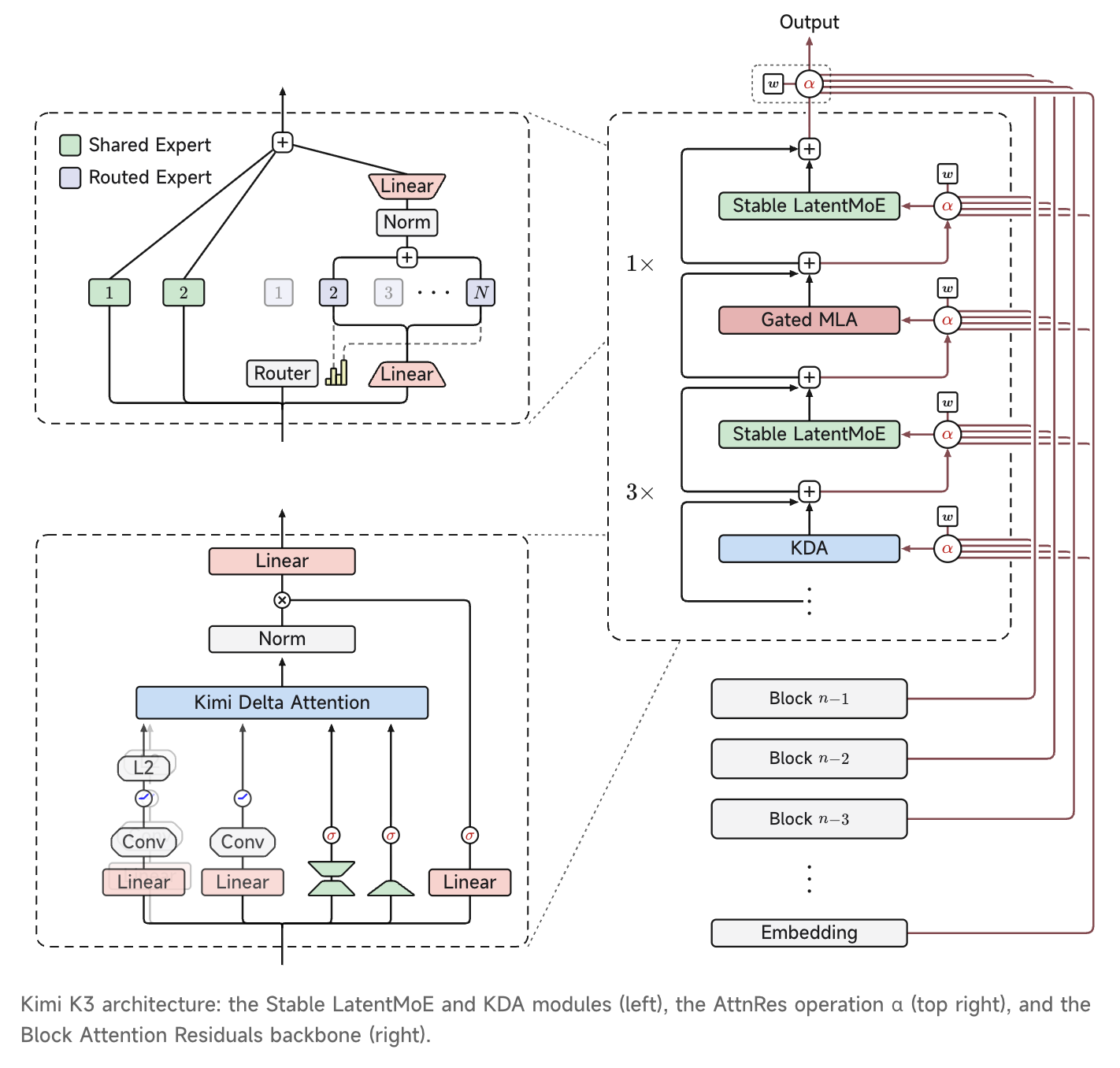
Kimi K3 technical architecture diagram, including Kimi Delta Attention, Attention Residuals, and MoE expert routing mechanism
In stark contrast to its soaring performance is its pricing strategy. The API pricing for Kimi K3 is $3 for every million tokens input and $15 for every million tokens output, with a cache hit price reduced to $0.3. Compared to the previous generation K2.6's prices of $0.95 and $4, K3's standard input price has increased about 3 times, and the output price has almost quadrupled. At a time when domestic large models are generally seizing the API call market with extremely low unit prices, the Dark Side of the Moon has clearly abandoned a low-price competition strategy.
How is Kimi K3 able to make a leap to the top in long-context intelligent coding scenarios? What does this seemingly expensive pricing strategy mean for developers and enterprise procurement costs?
The leap from 17th place: How 2.8 trillion parameters MoE supports frontend coding domination
Frontend coding is a scenario that requires high comprehensive capabilities from large models. It not only requires the model to understand complex UI design intentions and generate compliant HTML/CSS/JavaScript code, but also to handle dependencies and state management between multiple files. The evaluation of the Frontend Code Arena covers multiple sub-fields such as brand marketing, reference design, data analysis, consumer products, and simulation, comprehensively examining the model's performance in real development tasks. To achieve high scores across these dimensions, the model must possess powerful code generation capabilities, a keen understanding of design language, and the stability to handle long sequence codes.
Kimi K3 is able to lead in these fields due to its core support from a 2.8 trillion parameter hybrid expert architecture. According to data disclosed in the official technical blog, Kimi K3 has 896 expert networks, but only 16 are activated during each forward propagation. This design allows the model to maintain a large knowledge capacity while controlling the actual computational load to be at a level comparable to smaller dense models. In frontend coding scenarios, this means the model can invoke expert networks dedicated to handling styles, interaction logic, or data binding, thus achieving refined improvements in generation quality without incurring unacceptable inference delays due to oversized parameters.
However, simply stacking parameters does not directly translate into an elevation in frontend coding capability. K3's key technological breakthroughs lie in two architectural innovations: Kimi Delta Attention (KDA) and Attention Residuals (AttnRes).
In long-context coding scenarios, the computational complexity of the attention mechanism increases quadratically with the sequence length, which is a core bottleneck restricting the model's ability to handle large codebases. When the context expands from tens of thousands of tokens to millions, traditional full attention mechanisms result in a surge in memory usage and a sharp decline in decoding speed. KDA adopts a hybrid linear attention mechanism that significantly reduces the computational overhead of long sequences by converting part of the attention calculations into linear operations. Official data shows that it can achieve a 6.3 times acceleration in decoding with a million tokens of context. This means that when developers provide a large frontend project containing dozens of files to the model, K3 can complete code understanding and generation with lower latency, without significant performance degradation during long context processing phases. For common scenarios in frontend development, such as cross-file component calls and global state tracking, this low-latency long-context processing capability directly determines the usability of the generated code.
AttnRes, on the other hand, improves training efficiency by approximately 25% through a cross-layer selective retrieval mechanism. In traditional Transformer architectures, each layer must independently compute attention, leading to redundant processing of information between different layers. AttnRes allows the model to reuse and retrieve critical attention information across layers, reducing computational waste during the training process. This makes the model more efficient in learning complex frontend code patterns and UI design rules, directly reflecting in the quality and accuracy of the generated code. For common scenarios in frontend development involving complex layout nesting and component reuse, this improvement in training efficiency translates into a deeper understanding of code structure, enabling the generation of code that aligns better with engineering standards rather than simple functional accumulation.
The native support for a context window of 1 million tokens is another foundational support. In traditional coding workflows, handling large projects often requires complex context truncation and retrieval strategies, which can lead to the model losing key global information. For instance, when the model only sees part of the component code and cannot access global state management configurations, the generated code often suffers from interface mismatch or state conflict issues. The 1M context window allows K3 to accommodate the entire source code, design description, and interface documentation of a medium-sized frontend project at once, enabling code generation and refactoring from a global perspective. This global view is particularly important for frontend development, as the correctness of frontend projects heavily relies on the collaboration between components and consistency of styles. When the model can see routing configurations, component trees, and stylesheets all at once, the generated code can not only run but also seamlessly integrate into existing project structures, which is an important prerequisite for its top ranking in frontend coding evaluations.
Input $3, Output $15: The pricing logic of K3 and the real task costs
When developers first see the pricing of $3 for input and $15 for output, it's easy to categorize it as an "expensive" model. If only looking at the per-token price, K3 is indeed one of the most expensive models released by Chinese AI labs. But when positioned within the competitive landscape of mainstream coding models, the conclusion changes.
In comparison, Anthropic's Claude Fable 5 has an input price of $10 and an output price of $50; OpenAI's GPT-5.6 Sol is $5 for input and $30 for output. K3's standard pricing is about one-third of Fable 5's and one-half of GPT-5.6 Sol. This is comparable to the standard pricing of Claude Sonnet 5. This indicates that K3 is not priced at an artificially high position out of touch with the market, but rather fits within the mid-range pricing band of international frontier models.
More importantly, in intelligent coding scenarios, what determines the cost for enterprises is not the per-token price but the total cost of completing a real development task. Data from Artificial Analysis provides a crucial reference: on the same coding task set, Kimi K3's single-task cost is $0.94, while GPT-5.6 Sol is $1.04, and Claude Fable 5 is as high as $2.75. K3's single-task cost is not only lower than Fable 5's but also lower than GPT-5.6 Sol.
K3's advantage in single-task cost lies primarily in its caching mechanism. In the smart coding workflow, the model needs to repeatedly read system prompts, codebase context, and historical interaction records. These contents often remain unchanged during multi-round dialogues, forming the basis for cache hits. K3's cache hit price is only $0.3 per million tokens. The official technical blog shows that its cache hit rate can exceed 90% in coding scenarios.
This means that in ongoing coding interactions, the actual billing standard for most input tokens is $0.3 rather than $3. If calculated based on a 90% cache hit rate, its effective input cost drops to about $0.57 per million tokens. This shift from "per-token price" to "task cost" pricing logic is the confidence behind K3's decision to abandon a low-price strategy. For enterprise teams that have already established stable intelligent coding workflows, K3's actual usage cost may be far lower than its apparent pricing.
However, this strategy also faces challenges. For low-frequency calls or scenarios with drastic context changes, maintaining a high cache hit rate becomes difficult, at which point K3's actual calling costs will be significantly higher than those of domestic low-price models. For independent developers or small startup teams just starting, if they have not formed a stable intelligent coding workflow, K3's initial usage threshold remains relatively high. Additionally, K3's output pricing of $15 means that in scenarios involving the generation of large amounts of code and inference tokens, the output cost cannot be ignored. Developers need to assess their own workflow's cache hit potential to determine whether K3 truly offers better cost-effectiveness than low-price models.
Long context and intelligent coding: Changing the context management strategy of the toolchain
Kimi K3 clearly focuses on long-context intelligent coding scenarios, which is not just a functional positioning but a judgment on the current evolutionary direction of the AI coding tools ecosystem.
In existing intelligent coding workflows, developers generally need to rely on external tools to manage codebase context. For example, using tools like Codebase memory mcp to handle memory and retrieval issues for the codebase requires extracting relevant code snippets to feed to the model. This is because traditional models have limited context windows and cannot accommodate the entire project at once. Developers have to construct complex retrieval-augmented generation (RAG) processes, screening relevant code snippets through vector databases and semantic searches, which both increases system complexity and introduces the risk of retrieval omissions.
K3's 1 million tokens native context window is changing this paradigm. When the model itself can accommodate the entire codebase of a medium-sized project, developers can reduce dependence on external codebase retrieval tools and directly input project structure, core files, and interface definitions as context. This lowers the complexity of context management and reduces generation errors caused by retrieval omissions. For frontend projects, the inheritance of styles and event passing relationships between components are often difficult to capture completely through snippet retrieval. The long context window allows the model to see the complete component tree and stylesheet at once, generating more consistent code.
For intelligent orchestration frameworks like Agently, long-context models provide greater orchestration space. The framework can leverage K3's capabilities to handle more complex coding task flows, such as simultaneously analyzing frontend design drafts, backend interface definitions, and database structures, generating full-stack integration code. In traditional orchestration modes, frameworks need to split tasks into multiple sub-tasks, call the model to handle each, and then stitch results together manually or through scripts. Long context enables frameworks to process more complete task chains in a single call, reducing information loss in intermediate stitching stages. With the open weights of K3, such orchestration tools will gain more autonomy in model selection, allowing flexible switching between API calls and self-hosted deployment based on task complexity.
However, long contexts also bring new challenges. Simon Willison observed in practical tests that K3 consumed 16,658 output tokens when generating an SVG pelican image, of which 13,241 were inference tokens. K3 always operates in max-level inference mode and does not support disabling thinking. This high consumption of inference tokens may become even more pronounced in complex coding tasks, ensuring generation quality but also increasing the cost of the output phase. Developers need to seek a balance between generation quality and token consumption, and K3 currently does not provide options to adjust the depth of thinking. For scenarios requiring rapid iteration and frequent calls, this unadjustable inference depth may become an efficiency bottleneck.
Open weights on July 27: Expectations for self-hosting and hardware barriers
The official announcement states that the model weights of Kimi K3 will be opened on July 27, 2026. This is the most influential move for the model beyond commercial APIs.
Open weights provide companies with computational resources a self-hosting option with data privacy guarantees. In sensitive industries like finance and healthcare, enterprises are concerned about compliance when uploading their codebase to third-party APIs. Open weights enable these companies to deploy K3 locally, utilizing its long-context coding capabilities to build internal intelligent agent development platforms. For large tech companies, self-hosting can also avoid the rate limits of API calls, ensuring the stability of coding assistants during peak periods.
However, the scale of 2.8 trillion parameters sets a very high deployment threshold. According to community discussions and experiences deploying models of similar scale, running K3 requires a significant number of high-end AI accelerators. Some analyses point out that smoothly running this model may require over 64 accelerators. This means that for most small and medium developers and startup teams, self-hosting is not realistic, and the open weights are more about releasing technical influence to the community rather than directly changing the API-call-centric business model. Even for enterprises willing to self-host, careful assessment of the long-term balance between hardware procurement costs and API call costs is necessary.
Additionally, the official has yet to clarify the specific agreement for open weights. Different open-source licenses have different restrictions on commercial use, which will directly impact whether downstream coding tools are willing to use K3 as the default underlying model. If a loose agreement is adopted, K3 is expected to quickly spread in the open-source coding tool ecosystem; if there are commercial restrictions, its ecological influence will largely be confined to research and non-commercial fields. The developer community's expectations for open weights are not only about whether they can be used for free but also about whether they can be fine-tuned and customized based on the weights to meet the coding needs of specific programming languages or frameworks.
The technical origin of the Dark Side of the Moon: From long contexts to intelligent coding strategic choices
The product positioning of Kimi K3 did not emerge out of nowhere, but rather is a natural extension of the technical route established by the Dark Side of the Moon since its inception.
The Dark Side of the Moon was founded in March 2023, with founder Yang Zhilin having a profound background in natural language processing and being the first author of heavyweight papers such as Transformer-XL and XLNet. One of the core directions of this research is how to allow models to handle longer sequences. Since its founding, the Dark Side of the Moon has bet on a long-context technology route, which was a non-mainstream choice in the AI market dominated by short text dialogues at that time.
From the early Kimi Chat focusing on long-text processing, to the K2 series expanding the context window, and now to K3 integrating long contexts with intelligent coding, the technical route of the Dark Side of the Moon has remained consistent. This strategic determination has been rewarded in the capital market. According to public reports, after funding in May 2026, the Dark Side of the Moon's valuation has reached about $20 billion, with cumulative financing exceeding 37.6 billion yuan.
Ample capital support enables the Dark Side of the Moon to afford training and optimizing large-scale MoE architectures, and also provides financial cushioning for its "not racing to lower prices" strategy. K3's pricing strategy reflects the Dark Side of the Moon's attempt to establish brand positioning through capability premiums rather than low-price volume sales. In the coding model market, developers are much more sensitive to code quality and task completion rates than to token prices. K3 proves its capabilities by topping the Frontend Code Arena and then using single-task cost advantages to persuade corporate procurement, representing a commercial path distinctly different from domestic low-price models.
However, this path is also fraught with risks. The capability iteration of AI coding models is rapid, and the top position of the Frontend Code Arena may be seized at any moment by the next generation of Claude or GPT. Once K3 loses its leading edge in absolute performance, its high pricing will lose its rationale. Moreover, the official acknowledges that K3 still lags behind Fable 5 and GPT-5.6 Sol in overall user experience, with the model potentially being overly proactive in making decisions for users in ambiguous scenarios and being highly sensitive to the history of thoughts. These limitations need to be cautiously managed in actual development workflows.
Kimi K3's ascent proves the potential of combining the 2.8 trillion parameter MoE and long contexts in coding scenarios, and its pricing logic based on real task costs provides a new reference for the commercialization of large models. However, to hold its ground against the attacks from Claude and GPT, the Dark Side of the Moon still needs to address more shortcomings in user experience and ecosystem development.
免责声明:本文章仅代表作者个人观点,不代表本平台的立场和观点。本文章仅供信息分享,不构成对任何人的任何投资建议。用户与作者之间的任何争议,与本平台无关。如网页中刊载的文章或图片涉及侵权,请提供相关的权利证明和身份证明发送邮件到support@aicoin.com,本平台相关工作人员将会进行核查。


