Author: Wall Street Insights
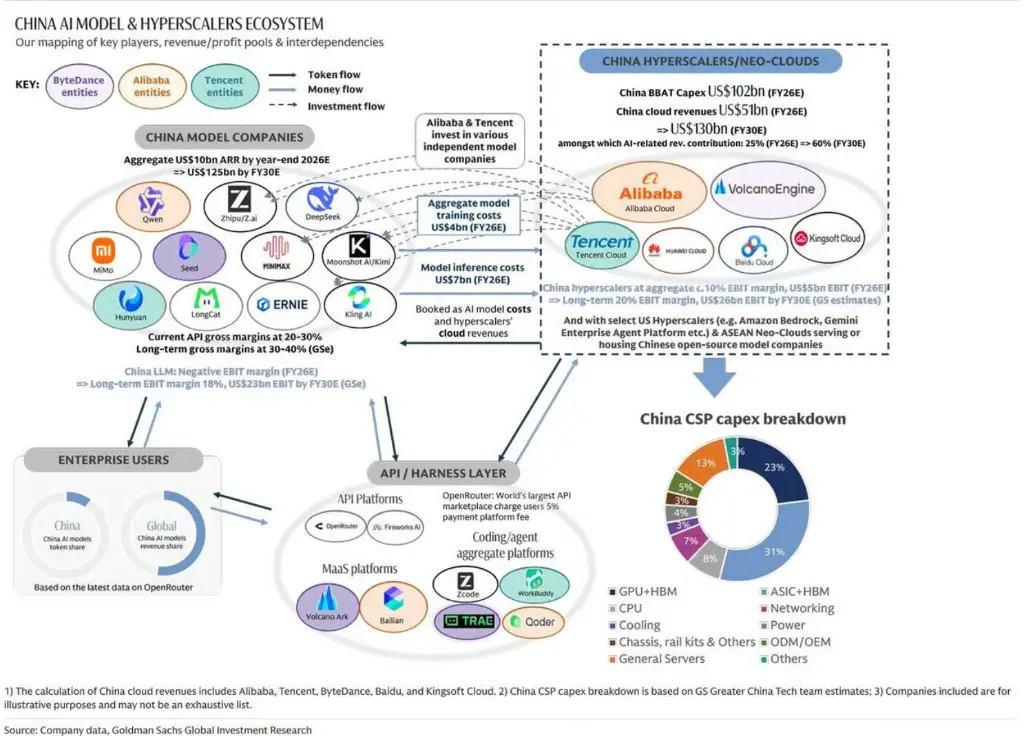
Chinese AI large models are at a historic turning point. Goldman Sachs believes that the intelligent performance of China's open-source/weight-sharing large models is approaching the level of the world's top proprietary models, and the adoption scale by domestic companies and global SMEs is rapidly expanding, creating a data flywheel effect that will further promote model iteration and upgrading.
According to the Wind Trading Desk, Goldman Sachs' latest report points out that this evolutionary trajectory can be summarized as "from Last Year's Cost Efficiency Moment of DeepSeek to This Year's Model Intelligence Moment of Zhizhu GLM." The team led by Goldman Sachs analyst Ronald Keung conducts a systematic assessment in this 50-page report around four core questions: how China’s AI models achieve high performance at low cost, why they choose the open-source path and how to monetize it, where the core addressable market lies, and who will become the long-term winner.
In terms of competitive landscape judgment, Goldman Sachs has launched a "competitive positioning framework" based on pricing power, cost advantages, and financial strength. Based on this, they established that in the field of foundational text models, Zhizhu (first covered) and DeepSeek (unlisted) are the most strongly positioned; in the multimodal field, ByteDance (unlisted) is leading. Goldman Sachs also maintains a buy rating on MiniMax and Kuaishou.
Small Investment, Big Returns, Winning with Efficiency
China's large models can achieve comparable performance at a cost far below similar products from the United States, mainly due to breakthroughs in architectural innovation and parameter efficiency.
Goldman Sachs' report points out that the parameter scale of China's open-source models generally ranges from 200 billion to 1.6 trillion, only 2% to 10% of the world’s top models, mainly due to limited access to high-end computing power. At the same time, innovations such as mixed expert architecture (MoE) and sparse attention mechanisms mean that the actual proportion of activated parameters to total parameters is only 3% to 5%, significantly lowering training and inference costs.
On the specific model level, DeepSeek V4 Pro has a parameter count of 1.6 trillion, Zhizhu GLM5.2 has 0.7 trillion, and MiniMax M3 has 0.4 trillion.
Goldman Sachs attributes the recent leap in programming capability of Chinese models to the synergistic effect of data filtering, reinforcement learning post-training, and other factors. On June 27, DeepSeek launched the speculative decoding framework DSpark, which has been deployed in the online services of V4-Flash and V4 Pro, improving the user generation speed by 60% to 85% (V4-Flash) and 57% to 78% (V4 Pro) without altering model weights or output quality.
Meituan’s LongCat 2.0, released on June 30, is seen by Goldman Sachs as an important milestone for the autonomy of Chinese AI infrastructure—this is China's first completely domestically trained and deployed 1.6 trillion parameters open-source MoE model, based on 50,000 domestic computing power cards. Goldman Sachs believes this demonstrates the feasibility of a localized hardware stack in the computation-intensive pre-training phase, which has far-reaching significance for Chinese AI models to break free from reliance on foreign high-end chips.
Market Polarization, the Stronger Get Stronger
Goldman Sachs describes the Chinese AI model market as forming a "dual-layer structure" and identifies two quadrants for maximized ARR.
In the high-end market, top models represented by Zhizhu GLM5.2 and Alibaba Qwen3.7 Max are priced at about 1 dollar per million tokens, five times that of low-end models, with a gross margin of about 10% to 20% (according to Goldman Sachs). In contrast, top models in the United States are priced at 4 to 8 dollars per million tokens, while Chinese high-end models are only 10% to 25% of that, yet are still able to maintain a positive gross margin thanks to lower parameter activation ratios.
In the low-end market, models aimed at intelligent tasks are priced as low as 0.06 to 0.2 dollars per million tokens, targeting price-sensitive global SMEs and individual users. MiniMax generates 60% to 70% of its revenue from overseas. Notably, DeepSeek has announced a peak and off-peak pricing mechanism for the V4 series starting mid-July, with peak rates being twice those of off-peak, and mixed pricing of about 0.35 dollars per million tokens (V4 Pro) and 0.12 dollars (V4 Flash).
Goldman Sachs predicts that the API and subscription revenue of Chinese AI models will grow from an estimated 35 billion RMB in 2026 to 879 billion RMB in 2030, corresponding to a daily token consumption increase from 350 trillion to 4600 trillion, a growth of about 25 times.
Open Source Strategy: Broad Penetration, Monetization Path Upgrading Needed
Goldman Sachs' report details the strategic logic of adopting an open-source/weight-sharing route for Chinese AI models and their monetization limitations.
The core advantage of the open-source strategy lies in flexible deployment and community ecology. Alibaba's Qwen series, DeepSeek, Zhizhu GLM, and MiniMax M3 all adopt an open-source or weight-sharing approach, while ByteDance's Seed model is a major exception, using a completely closed-source proprietary route. The open-source model allows for flexible deployment of models both inside and outside mainland China and accelerates iteration through community feedback.
However, Goldman Sachs points out that the ARR figures disclosed by open-source model companies likely severely underestimate the actual deployment scale and revenue potential. For example, Zhizhu aims for an ARR target of 1 billion dollars by the end of 2026, but the actual global deployment of GLM5.2 will far exceed the token volume and revenue from Zhizhu's own API channels — Alibaba Cloud's Bailian MaaS platform can directly host the GLM5.2 open-source model without any fees to Zhizhu.
Goldman Sachs expects the industry to gradually shift from pure open-source (MIT license, completely free) to an "open weight + community license" model — that is, commercial use requires signing a revenue-sharing agreement with the model company. The MiniMax M series has taken the lead in adopting this model. Goldman Sachs believes this shift will significantly improve the unit economics of AI model companies because model companies can benefit from revenue-sharing agreements with platforms like AWS Bedrock and Alibaba Cloud Bailian, without bearing the inference computing costs themselves.
From "Token Maximization" to ROI Priority
Goldman Sachs characterizes international market expansion as the most important upward space for Chinese AI models, especially in non-U.S. markets.
Goldman Sachs' American research team estimates that by 2030, intelligent agent AI will drive global token consumption to grow 24 times, reaching 120 quintillion tokens per month, with enterprise intelligent agents contributing a 55-fold growth and consumer intelligent agents contributing a 12-fold growth. In the global market (outside China), Chinese AI models have achieved significant token share growth due to performance improvements and price advantages.
Goldman Sachs reports that the AI usage paradigm of global enterprises is undergoing a fundamental shift from "token maximization" to "ROI priority." The former will prevail by the end of 2025 to early 2026, where enterprises equate high token consumption with organizational productivity; the latter focuses more on clear task boundaries, daily active intelligent agent counts, backend process automation, and actual output. A Jellyfish AI engineering trend study shows that heavy AI users in enterprises consume 10 times the tokens, but the output only improves 2 times.
On the channel side, Alphabet's Gemini Enterprise Agent Platform and Amazon's AWS Bedrock have both provided hosting services for Chinese AI models like DeepSeek, MiniMax, Moonshot, GLM, and Qwen. According to the Wall Street Journal, Microsoft’s CEO recently stated that Microsoft is considering hosting a version of DeepSeek on Copilot as an optional low-cost model, emphasizing that if DeepSeek is hosted, it will operate within the Microsoft cloud ecosystem, ensuring client data remains in Azure.
Who Will Be the Long-Term Winner?
Goldman Sachs has constructed a three-dimensional competitive positioning framework to quantitatively assess the long-term winning probabilities of various players, with the core formula being: ARR scale × gross margin advantage + financial strength.
Pricing power dimension examines listing speed (compared to previous models and peers), LMArena arena scores (based on large-scale blind user evaluations), and mixed pricing levels per million tokens.
Cost advantage dimension assesses throughput (number of tokens per second), cache hit rates, parameter activation ratios, and gross margins on inference. Financial strength dimension looks at cash on hand, net cash as a proportion of total assets, and valuation multiples.
In the foundational text model space, Goldman Sachs determines that Zhizhu (first covered, neutral rating, target valuation of 110 billion dollars) and DeepSeek (unlisted) are the strongest positioned, both excelling in pricing power and cost advantages. The overall implicit valuation of independent AI model companies exceeds 200 billion dollars.
In the multimodal/video generation space, ByteDance leads with Seedance, with reports from LatePost and 36Kr indicating that Seedance has a gross margin of up to 70%, with ARR exceeding 2 billion dollars. Kuaishou's Keling and MiniMax Hailuo/upcoming H3 model are also viewed positively by Goldman Sachs, expected to benefit from breakthroughs in the integration of video generation and LLMs in the second half of 2026, along with healthy pricing due to supply constraints.
Goldman Sachs maintains a buy rating on MiniMax, with a target price of 860 HKD, reasoning that its M3 model is in the ARR maximization quadrant of high token volume and attractive pricing, and the current valuation is only 13 times the ARR at the end of 2026, showing a significant discount compared to the valuation multiples of similar companies in China and globally, with a risk-reward profile biased towards the upside.
免责声明:本文章仅代表作者个人观点,不代表本平台的立场和观点。本文章仅供信息分享,不构成对任何人的任何投资建议。用户与作者之间的任何争议,与本平台无关。如网页中刊载的文章或图片涉及侵权,请提供相关的权利证明和身份证明发送邮件到support@aicoin.com,本平台相关工作人员将会进行核查。


